


November 18, 2026 court of first instance - Judgments
Claim No: CFI 095/2024
THE DUBAI INTERNATIONAL FINANCIAL CENTRE COURTS
In the name of His Highness Sheikh Mohammad Bin Rashid Al Maktoum, Ruler of Dubai
IN THE COURT OF FIRST INSTANCE
BETWEEN
(1) ROMAN ABRAMENKO
(2) VADIM MISEVICH
Claimants
and
IGOR CHUPRIN
Defendant
| Hearing : | 2 March 2026 to 17 March 2026, and 23 July 2026 to 24 July 2026 |
|---|---|
| Counsel : | Mr Ruper Reed KC and Mr Michael Walsh KC instructed by Trowers & Hamlins LLP for the Claimant Mr Alexander Cook KC and Mr Hossein Sharafi instructed by Bracewell UK LLP for the Defendant |
| Judgment : | 18 November 2026 |
JUDGMENT OF H.E. JUSTICE ANDREW MORAN
A: Introduction and Background
1. This case concerns a bitterly fought dispute about the legal effect and validity or invalidity of a Trust Declaration named as the “IC Trust”, which was executed by the Defendant, Igor Chuprin, on 10 November 2016, in respect of a Trust Fund defined in paragraph 2 of Schedule 2 to the Trust Declaration. In short, the Claimants’ case is that it is a valid and effective trust under DIFC Trust Laws and the Defendant’s case is that it is not a valid trust at all, but a sham document; or, if not a sham in law, it is a trust that should be held to be invalid or voidable on the grounds of misrepresentation or mistake. More fundamentally, it concerns an underlying dispute about who is, or are, the true beneficial owners of the whole or parts of a corporate group or structure involving various entities, performing the various different functions of what is, and has been referred to throughout in these proceedings, as the KamaGames Business or the KG Business, operating in various countries and via the internet. It will be referred to as such hereafter. The determination of that underlying dispute is key to the determination of the dispositive questions in this trial. Those questions are whether the IC Trust is an effective and valid trust under the DIFC Law of Trusts, by which law (pursuant to Clause 5) it is governed and whether this Court has jurisdiction to decide? Or is the document entitled ‘IC Trust’ an ineffective sham; or a trust that is liable to be set aside on the grounds of misrepresentation or mistake in its creation?
2. The KG Business is now, by common acclaim of the Parties, a “billion-dollar business”, which has developed and monetised a collection of social games and gaming applications (“apps” hereafter) played by customers through the apps on their mobile phones or devices, on the Apple and Google Play platforms, through which streams of income generated by various means within the apps are paid pursuant to licensing agreements, to the entity in the KG Business presently holding the intellectual property rights (“IPR” hereafter) in the games, KamaGames Entertainment Group Limited (“KGEGL”), an Isle of Man registered company. The Court will explain and illustrate the important corporate components of the business further below in this judgment.
3. The names of the games and apps developed by the business make their type or genre clear and obvious, including as they do, "Texas Poker", "Pokerist", "Blackjackist", "Slottist", "Video Poker", "Roulettist", "Baccarist", "Set Poker", "Omaha Poker" and "Durak" and others (the "games" hereafter). The games and apps are not presently set up on any internet platform for real money gambling between customers but have the potential for development and exploitation in that manner in the future.
4. It is a business which has enjoyed spectacular growth in the popularity and profitability of its games and the apps to play them published across the world, since its humble beginnings in or about the year 2008 in Vladivostok, Russia. It all began after the launch of the Apple iPhone in about 2007, when one or more of the protagonists in this litigation (and the court hereafter decides the fundamental question of who it was) set about developing software for use on the iPhone; and then came up with the brilliant idea of developing games and apps to be played on mobile devices on the internet. From this germ of an idea, the intellectual property at the heart of this dispute came into existence and was first developed in a project described back then in Vladivostok, as the “iPhone project”. It has since been technically developed and augmented massively and exclusively by KG Business entities now based in Moscow. That hugely valuable IP is not however now legally held or vested in those Russian entities involved in the creation, development and maintenance of the games and apps, but has instead become legally vested (by the labyrinthine processes described hereafter) in what the Defendant claims to be the separated (since about 2014-2015) marketing and publishing arm of the KG Business, of which he claims to be the Ultimate Beneficial Owner (“UBO”). This is through his claimed beneficial ownership of the shares in Zotobi Management Limited (“Zotobi”), KamaGames International Group Limited (“KGIL”) and Wise Wave Limited (“WWL”).
5. It is the Claimants’ case that Igor Chuprin has never been anything other than, at first a mere nominee legal holder of corporate or other assets of the KG Business held by him on a bare trust for the “Founders” of the KG Business (as they claim to be in their different roles), namely, Mr Evgeny Olomskiy, Mr Viacheslav Sarapulov and the Second Claimant, Mr Vadim Misevich. Thereafter, upon its execution and as trustee under the IC Trust, Mr Chuprin was nothing more than the trustee of the Trust Fund assets and the additions thereto and never a beneficial owner of them. It is claimed by the Claimants that he held all of these assets as trustee for the Beneficiary, Mr Misevich, until his lawful replacement by the Protector of the Trust, Mr Sarapulov, on 4 November 2024, with Mr Roman Abramenko (First Claimant and General Counsel of the KG Business since February 2012).
6. For reasons of business expediency explained later in this judgment, Mr Chuprin was, from the time of his move to Cyprus and employment by the KG Business, a general manager, in the company named KG Cyprus Limited (“KG Cyprus”), deceptively presented to the world at large by the Founders, the First Claimant and others employed in the KG Business, as the UBO of KG Business entities; in particular, and until he was replaced as Trustee of the IC Trust, as the UBO of Zotobi. It is alleged that as part of this pretence, Mr Chuprin was used by the KG Business as an acceptable (to banks, professional service providers and regulators in jurisdictions where the business operated) expatriate English-speaking Russian, and wealthy founder of a business not owned and controlled from Russia, so that the companies within the KG Business group could be serviced and authorised to operate, in their various locations. He was assisted to pass KYC requirements and the like, with a false storyline and credentials designed principally by Mr Sarapulov and Mr Abramenko, that enabled the opening of multiple bank accounts in different jurisdictions in his own name. These accounts are particularised in Schedule B to the Amended Particulars of Claim (the “Schedule B Accounts” hereafter) and it is claimed they are in fact Trust Accounts, holding Trust Fund assets and not the personal funds and assets of Mr Chuprin (save to the extent he has been responsible for co-mingling in them any small unquantified amount of his personal funds).
7. It is the Claimants’ case that upon Mr Chuprin becoming dissatisfied with his role and situation in the KG Business and encountering personal difficulties in his marriage and with alcohol abuse; and upon deciding that he was entitled to a substantial share of the business or its assets for himself, which he wished to take upon leaving it and not being granted any such share; and upon realising that he would no longer be needed as trustee or account holder for trust assets, he dishonestly, secretly and in egregious breach of trust, resolved to take (and has taken) for himself, millions of dollars-worth of funds from the Schedule B trust accounts under his control. These assets he has attempted to put out of reach of the Claimants by transfers of huge amounts to purchase expensive properties and payments to accounts of friends and family, and by refusing to provide full information as to the whereabouts of missing trust funds. The Claimants’ case is that Mr Chuprin is a fraudster and thief who has exploited the trust reposed in him, by exploiting the position he was placed in and secured, by many false representations he made or was knowingly party to, that he was the UBO of Zotobi and other Trust Fund assets. It is claimed that in his defence and counterclaims in these proceedings, he is engaged in an attempt before this Court, to effectively steal the IPR asset-holding, revenue-receiving and massively profitable part of the KG Business, which he holds as trustee, by his refusal to hand over trust assets to the new trustee, and by his false denial of the validity of the IC Trust.
8. Mr Chuprin’s case to the contrary is that it is he who is the victim of a corporate raid by the Claimants on assets beneficially owned by him, from the time of his personal acquisition of Zotobi, which was, he claims, purchased with his own funds and of which he became the registered shareholder on 15 December 2011. It is his case that upon his wife-to-be, Maria Eleni Vastou, becoming pregnant and him intending to marry her, he was advised by Mr Abramenko, acting as his personal attorney, that in order to protect his assets in the event of a divorce, he should create a document entitled the IC Trust, which was a sham. It was intended to be put in a box and relied on, if necessary, against his wife in the event of a divorce. He never intended it to be a valid declaration of trust and was intending to deceive his wife and/or any court as to its validity. This intention to deceive seemingly involved deception of his wife both at the time she witnessed his execution of the IC Trust document and when and if he might seek to rely on it, in response to claims by her for a share of his assets, in the event of a divorce. He advances the alternative cases that if it was not a sham but an effective trust, it should be set aside for misrepresentation by Mr Abramenko as to its purpose and effect or Mr Chuprin’s mistake as to its effect.
9. It is Mr Chuprin’s case that he was honestly and truthfully presented (and presented himself) as the UBO of Zotobi and other assets now claimed to be Trust Fund assets, on the multiple occasions from 12 January 2012 to 20 December 2024, collected in the Schedule to his Closing Submissions at {AAA/2/165} – {AAA/2/179}, until the Claimants embarked upon their fraudulent scheme to expropriate him. They are doing this by relying on the IC Trust document Mr Abramenko and Mr Sarapulov had procured him to execute as a sham, on 10 November 2016, by purporting to remove him as Trustee and thereby taking control of his assets, eight years later, on 4 November 2024. It is implicit on Mr Chuprin’s case, that the Claimants had this sham instrument in store for all this time before deciding to use it to expropriate his assets, in late 2024.
10. It will be clear even from the limited details given in this introductory explanation of the dispute, that this case turns principally on the Court’s factual findings, based on its assessment of the witnesses called before it and the evidence they gave, together with the documentary evidence produced, which goes to support or undermine that evidence. The Court has also had to grapple with a panoply of alleged wrongdoing by interference in the trial processes of discovery and the calling of witnesses, that are unfortunately often encountered in disputes of this kind, where assets of such massive value (current and prospective) are at stake and cross allegations of serious criminal misconduct, dishonesty and contempt abound.
11. This alleged “interference with the trial process” (as the Court collectively names these issues for convenience) is dealt with in Section D of this judgment below. It includes the following matters in summary. Allegations of intimidation of witnesses, who it is claimed would, but for intimidation by or on behalf of the Claimants, have given oral evidence favourable to the Defendant but later refused to do so having provided statements; and of one witness, Ms Kurulenko, the former Financial Director of the KG Business, who eventually did give evidence, after refusing to do so. These allegations are vigorously disputed by the Claimants. There are allegations of missing witnesses who, it was submitted, could and should have been called on both sides – the so-called “empty chair” complaints. There are allegations of deliberate failure to retain or refusal by the Defendant to produce, for disclosure or imaging purposes, computers and/or devices on which it is alleged evidence unfavourable to his case would likely have been found. There are allegations of suppression or selective deletion of documents and/or non-disclosure of relevant documents from each side. It is alleged there was inadequate control and supervision of the disclosure process by the Defendant’s solicitors, who left the Defendant to conduct his own searches of his documents using key words without legal supervision or oversight of the search or its product. It is alleged by the Defendant that there has been manipulation and thus forgery of messages exchanged on the KG Business internal chat or messaging facility known as “AnyTalk”, which the Claimants claim to be genuine and have had recovered from devices under their control. These are relied on to show, by reference to the manner of his treatment and instruction by other participants in the chats, that the Defendant was nothing more than a subordinate employee – a signer and dater of documents only - with no executive power or input that would be expected, if it were true that he was the real beneficial owner of the most valuable part of the KG Business. One of the chats, the so-called Trust Igor Chat, was allegedly used by its participants to co-ordinate trust matters and manage the funds in the claimed Schedule B Trust Accounts. It is relied on by the Claimants as containing genuine instructions from Mr Sarapulov for the Founders, Ms Kurulenko and her colleague in the Finance Department, Mr Butyrskikh, to Mr Chuprin as a trustee holding trust assets, regarding trust matters and the use and disposition of trust funds in those trust accounts. There was either a mass data loss of messages from the AnyTalk platform, or a deliberate wiping of the accounts of Mr Chuprin and Ms Kurulenko from it by the KG Moscow development team on 10 November 2023, which the Defendant claims prevents him from deploying exchanges that would support his case and/or demonstrating that the exchanges relied on by the Claimants have been manipulated.
12. The Parties on each side invite the Court to find the facts alleged in relation to these matters in their favour, and to draw adverse inferences against any party or witness it finds responsible for such misconduct or failures. The Court has had a mammoth and difficult task to pick its way through conflicting evidence spanning more than twenty years, concerning the origin, beneficial ownership of IPR and the development of the KG Business, involving the myriad of factors that it has considered and weighed in reaching its findings which follow. The Court will explain its approach to its assessment of the evidence and making its findings in a devoted section of this judgment below. It will highlight as it traverses the issues and evidence relating to them, particular factors to which it has given weight, but it cannot possibly refer to all influencing factors it has considered in reaching its findings. These are contained in all the evidence produced and referred to before the Court, and in arguments about that evidence. The competing arguments are contained in literally hundreds of pages of written opening and closing submissions and transcribed oral opening and closing submissions, which have all been listened to, read, re-read and weighed, in reaching the findings which follow. In referencing submissions, witness evidence and documents, the Court will refer to the Parties' principal written submissions using the acronym CWCS/§ for the Claimants' Written Closing Submissions and paragraph number. Likewise for the DWCS/§. For references to documents and transcripts, I will adopt the same form of referencing as used on the OPUS platform, on which the Trial Bundle is located, employing upper case square brackets containing the reference {ref} inserted in the text of this judgment, rather than in footnotes. This enables easier reading and faster referral than looking up and down at footnotes. It has been done in this manner, in the expectation that the judgment will be uploaded to the OPUS platform so where I have provided a reference, it may be hyperlinked to the document referred to.
13. The structure of this judgment is as follows.
14. In Section B, the Court will explain its approach to finding the facts, the assessment of the evidence of the witnesses who gave evidence before it and the documentary evidence produced to support or undermine it or not produced - where production of documents might have been expected - and any reasons for non-production advanced. It will also deal with the burden of proof and where it lies; and whether any enhanced or more onerous standard than proof on the balance of probabilities is required, in relation to any of the contested issues in this case.
15. In Section C and its sub-sections, following the approach explained, the Court will consider the issues and the evidence relating to them, under headings informed and focussed by the Parties Written Closing Submissions, the Agreed List of Core Issues {H/12} and the respective “Key and Principal Findings Sought” by the Parties {AAA/1.3} and {AAA/2.1} in a chronological sequence from the origins of the KG Business recording its findings on the core issues and their sub-issues as it proceeds. The Court will set out the Agreed List of Core Issues at the outset of this section and provide its determination of them after making its factual findings and legal holdings, in Section G.
16. The Sub-Sections of Section C will deal with and contain the Court’s findings of fact on the matters and issues listed in the sub-paragraphs immediately below. In making those findings, the Court will inevitably express its findings on the credibility and reliability of the witnesses on the specific issues being dealt with. These findings on credibility and reliability on specific issues are both informed by and inform the Court’s overall assessment of the witnesses in Section E of this Judgment.
(a) The founding of the KG Business and its early development, who were its founders, whether Mr Chuprin played any part in its foundation or development, including during his role at DRK until leaving that business in about February 2009; or after he moved to Dubai, in the period to March 2011?
(b) The development and operations of the KG Business up to and from March 2011 and Mr Chuprin’s role in Cyprus. This includes development of the business, adversity it faced, acquisitions it made and Mr Chuprin’s engagement in its operations after the “First Cyprus (re-location) Agreement” of 21 April 2011 and the “Second Cyprus (employment) Agreement” of 1 June 2011.
(c) The operations of the KG Business from the time of Mr Chuprin’s move to Dubai circa July 2014 and his engagement in its operations after his contract of employment with Zotobi of 1 August 2014, including whether there was a splitting of the KG Business into two parts of Publishing (owned by Mr Chuprin) and Development (owned by Mr Olomskiy).
(d) Alleged contra-indications of Mr Chuprin’s beneficial ownership of the Publishing arm of the KG Business. These include:
i. The request to Mr Olomskiy on 3 June 2020 for a loan to assist in the purchase of a property;
ii. The request to Mr Sarapulov on 24 August 2023 for a salary increase; and
iii. Mr Chuprin’s role within Zotobi and the manner of his treatment in performing it.
This sub-section will include consideration of the expert evidence and the Court’s overall consideration of whether, notwithstanding the experts' agreement there is no technical evidence of forgery in the materials they examined, the Defendant has proved forgery or manipulation of the pleaded messages and/or of any parts of the records of AnyTalk chats, relied on by the Claimants, as genuine messages passing between those to whom they are attributed.
(e) Whether the narrative of Mr Chuprin’s ultimate beneficial ownership of Zotobi and other alleged trust assets presented to third parties, was true or false.
(f) The competing cases on the background to, and execution of the IC Trust document, and the subsequent administration of the alleged trust or Mr Chuprin’s property. This includes the use, application and acquisition of assets, alleged confirmation of the trust by the further 2017 declaration and alleged additions to trust assets, the role of Mr Misevich and dealings with property by Mr Sarapulov, which it is alleged by the Defendant are inconsistent with the existence of the IC Trust and would have been in breach of it, if it existed.
(g) Events leading up to the breakdown of the Parties’ relationship and the alleged removal of Mr Chuprin as trustee of the IC Trust on 4 November 2024.
(h) The events following Mr Chuprin’s alleged removal as trustee - what they amount to and what they demonstrate.
17. Section D will deal with issues arising from allegations of interference with the trial process.
18. As already indicated, Section E will contain an overall assessment of the credibility and reliability of the witnesses.
19. Section F will deal with the relevant legal principles and issues arising on the facts as found, in relation to whether the Defendant has proved that the IC Trust document is a sham or a valid and effective declaration of Trust; or is liable to be set aside on the grounds of misrepresentation or mistake.
20. Section G will contain the Court's final determination of the list of issues and will deal with the relief sought and granted in light of the Court’s determination of the factual and legal issues in the case.
B: The Court’s approach to finding the facts, the assessment of witnesses and their evidence, and the burden and standard of proof
21. The Defendant has drawn the Court’s attention to relevant recent authorities from England and Wales, with which it is not only familiar, but which are often the subject of discussion in judicial and arbitral circles about how those who are fact finders by appointment and role, should go about finding them. Those authorities contain salutary warnings and guidance helpfully extracted and referred to by counsel for Mr Chuprin in their written closing submissions, which the Court has heeded and followed. Whilst it has considered and weighed all references and submissions, it extracts the following dicta and submissions which it has found most relevant and helpful in guiding its approach, in the extraordinary circumstances of this case.
22. I have read and considered yet again paragraphs 15-21 of the judgment of Leggatt J (as he then was) in Gestmin v Credit Suisse [2020] 1 CLC 428 {AAA/4.8/1} leading to his view in paragraph 22 of the judgment that:
“….the best approach for a judge to adopt in the trial of a commercial case is, in my view, to place little if any reliance at all on witnesses’ recollections of what was said in meetings and conversations, and to base factual findings on inferences drawn from the documentary evidence and known or probable facts. This does not mean that oral testimony serves no useful purpose – though its utility is often disproportionate to its length. But its value lies largely, as I see it, in the opportunity which cross-examination affords to subject the documentary record to critical scrutiny and to gauge the personality, motivations and working practices of a witness, rather than in testimony of what the witness recalls of particular conversations and events. Above all, it is important to avoid the fallacy of supposing that, because a witness has confidence in his or her recollection and is honest, evidence based on that recollection provides any reliable guide to the truth.”
23. Counsel for the Defendant is correct to describe this as “oft-repeated” guidance; and as H.E. Justice Roger Stewart observed in Alawwal Capital JSC v Rasmala Investment Bank Limited [2023] DIFC CFI 038 (12 June 2025) at ¶10 {AAA/4.2/6}, this decision and dicta are commonly referred to in common law courts (and I would add in international arbitrations in common law seats), to illustrate the proper approach to the evidence of witnesses of fact and the fallibility of memory which can be demonstrated to occur in respect of even the most honest of witnesses.
24. I accept the views and approach of Leggatt J in Gestmin, referred to and quoted above, subject to two qualifications. First, I do not agree that a judge should always place little reliance on witness recollection of what was said in meetings and conversations, if that is what the learned judge was suggesting. That is because, in my view, the weight to be given to such recollections, in the iterative process of ascertainment of the truth, depends on all the circumstances and what is, or is not available in the whole corpus of evidence to support such recollections. Secondly, confidence and honesty in a witness are important human qualities that a judge is capable of recognising and, whilst it is a fallacy to suppose that a witness who is confident and honest must be telling the truth, they are important characteristics to be weighed in the assessment of the witness and of the truth or falsity, reliability or unreliability of the evidence he or she is giving, in performing the whole iterative process of fact finding that the English Court of Appeal has advocated (see further below). They are characteristics that may have to be given weight in circumstances where, for example, as in this case, the documentary record is scant at critical times in the sequence of relevant events; and/or the documentary record forming a part of the relevant events which does exist, may have been designed and created to mislead for a commercial purpose or simply fabricated.
25. In this case, I find myself in the more difficult territory of fact finding that the English Court of Appeal was dealing with when it observed (referring to Gestmin and another decision) as follows in Natwest Markets Plc v Bilta (UK) Ltd [2021] EWCA Civ 680 at §§49-51 {AAA/4.15/12}:
“49. In a case such as the present, where the events in question took place over 9 years before the trial and occurred in a narrow period of around 3 weeks, the salutary warnings about the recollections of witnesses in Gestmin SGPS SA v Credit Suisse UK Ltd [2015] EWHC 3560 at [22] and Blue v Ashley [2017] EWHC 1928 at [68] are pertinent. It was therefore of paramount importance for the Judge to test that evidence against the contemporaneous documents and known or probable facts if and to the extent that it was possible to do so.
50. We say, “if and to the extent that it was possible to do so”, because it is important to bear in mind that there may be situations in which the approach advocated in Gestmin will not be open to a judge, or, even if it is, will be of limited assistance. There may simply be no, or no relevant, contemporaneous documents, and, even if there are, the documents themselves may be ambivalent or otherwise insufficiently helpful. The case could be one about an oral promise which turns entirely on the word of one person against another’s, and the uncontested facts may well not point towards A’s version of events being any more plausible than B’s. Even in a case which is fairly document-heavy (as this one was) there may be critical events or conversations which are completely undocumented. The CarbonDesk dinner is a good example. Whilst there are documents from which inferences might be drawn about what was or was not said at that dinner, there are no notes of the discussions and no memoranda or emails sent afterwards which appear on their face to record or report what was said on that occasion.
51. Faced with documentary lacunae of this nature, the judge has little choice but to fall back on considerations such as the overall plausibility of the evidence; the consistency or inconsistency of the behaviour of the witness and other individuals with the witness’s version of events; supporting or adverse inferences to be drawn from other documents; and the judge’s assessment of the witness’s credibility, including his or her impression of how they performed in the witness box, especially when their version of events was challenged in cross-examination. Provided that the judge is alive to the dangers of honest but mistaken reconstruction of events, and factors in the passage of time when making his or her assessment of a witness by reference to those matters, in a case of that nature it will rarely be appropriate for an appellate court to second-guess that assessment.”
(emphasis added)
26. I have also found the thoughtful and perceptive analysis of H.E. Justice Roger Stewart in Alawwal Capital JSC v Rasmala (supra) at §§10-12 {AAA/4.2/6}, to be of assistance in dealing with the multiple allegations before me concerning document (and device) production, non-production or suppression, when, after reviewing the panoply of difficulties in modern litigation concerning production and/or non-production of documents, he concluded as follows:
“(h) It follows that, before simply proceeding on the basis of whatever documents happen to have been produced for a trial, a further assessment is likely to be required after a trial in order to consider such matters as:
(i) Whether the Court is likely to have access to all or only a sub-class of records in relation to particular issues;
(ii) What documents were ordered to be produced in relation to what issues;
(iii) Who has control over relevant records; and
(iv) What positive assertions are being made by each party and what records could be expected to be produced by a party in order to support such assertions;
(i) It is only after considering such matters that a court is likely to be able to consider the documents that have been produced in their proper context and consider the proper factual findings which follow.”
Consideration of all of these matters has been required and carried out by me, in reaching my determinations of the facts in issue, which follow.
27. In the unusual circumstances of this case, explained in §7 and §9.3 of the DWCS, in which both sides allege that many of the key documents produced are dishonest or misleading and cannot be relied upon, I accept the Defendant’s submissions in §8 thereof, that:
“In assessing the veracity of the documents, it is necessary to have regard to the oral evidence, the credibility of the parties, and the inherent plausibility of the parties’ respective cases.”
I also accept that in assessing where the truth lies in this case, the inherent probability that people generally behave honestly carries little if any weight, in the assessment of which documents tell the truth of what they purport to show. I have weighed all of the usual considerations mentioned in §§10.1, 10.2 and 10.3 of the DWCS in my assessment of who is telling the truth in their evidence before me in this case. They are considerations which are not of much assistance in this extraordinary case. They all cut both ways to the advantage and disadvantage of the Parties and their witnesses on each side of the case, with similar weight and effect.
28. In proceeding in the manner described, I have been careful to follow important principles and warnings (including from an eminent authority in his extra-judicial writing) now widely accepted, concerning the assessment of witnesses and their credibility from the evidence they gave. I have taken account of the illustration of how not to go about finding facts referred to in Khan v General Medical Council [2021] EWHC 374 (Admin) at §§71-72 {AAA/4.22/18} and §§108-109 {AAA/4.22/29}, by Knowles J, referring to the judgment of Warby J in R(Dutta) v GMC [2020] EWHC 1974 (Admin). In the latter case, before his summary of a series of English and Australian cases including Gestmin, illustrating the correct approach to judicial determination of facts, the judge had found three fundamental errors of approach in a tribunal to the resolution of the central factual dispute in the case before him as follows:
“First, the Tribunal approached the resolution of the central factual dispute by starting with an assessment of the credibility of a witness's uncorroborated evidence about events ten years earlier, only then going on to consider the significance of unchallenged contemporary documents. Secondly, the Tribunal's assessment of the witness's credibility was based largely if not exclusively on her demeanour when giving evidence. Thirdly, the way the Tribunal tested the witness evidence against the documents involved a mistaken approach to the burden of proof and the standard of proof.”
I have avoided those errors in my determination of the facts in this case.
29. The DIFC Court has previously warned (per H.E. Justice Lord Angus Glennie) in Mheiri v Araj [2021] DIFC CFI 057 (16 June 2025) at ¶6 {AAA/4.13/4} that the “demeanour of a witness in the witness box can be an uncertain guide to that witness’s honesty”. I would respectfully go further and hold that a witness’s perceived demeanour is of virtually no assistance, particularly in a case of this type. As noted by the English Court of Appeal in R (SS) v Secretary of State for the Home Department [2018] EWCA Civ 1391, there are particular risks in judging the demeanour of a witness who is giving evidence in their second language, or through an interpreter (see §§36-37 {AAA/4.18/11}). The Court cited with approval an article by OG Wellborn, “Demeanor” (1991) 76 Cornell LR 1075 and the Law Commission Report No 245 (1997) “Evidence in Criminal Proceedings”, paragraphs 3.9–3.12 and concluded that:
“While the studies mentioned involved ordinary people, there is no reason to suppose that judges have any extraordinary power of perception which other people lack in this respect.”
I would therefore accept that the consensus in psychological research is that demeanour is not an effective tool in determining whether, and when, a person is lying. As the passage from the article “Demeanor” concluded:
“According to the empirical evidence, ordinary people cannot make effective use of demeanor in deciding whether to believe a witness. On the contrary, there is some evidence that the observation of demeanor diminishes rather than enhances the accuracy of credibility judgments.”
30. The warning that there are particular risks in judging the demeanour of a witness who is giving evidence in their second language, or through an interpreter (and more so of relying on it) was best explained for the purposes of this case more than 40 years ago by Lord Bingham (and which was relied on by the English Court of Appeal in R (SS) v Secretary of State for the Home Department at §37 of the judgment) in his seminal essay on “The Judge as Juror” where he memorably observed:
“If a Turk shows signs of anger when accused of lying, is that to be interpreted as the bluster of a man caught out in deceit or the reaction of an honest man to an insult? If a Greek, similarly challenged, becomes rhetorical and voluble and offers to swear the truth of what he has said on the lives of his children, what (if any) significance should be attached to that? If a Japanese witness, accused of forging a document, becomes sullen, resentful and hostile, does this suggest that he has done so or that he has not? I can only ask these questions. I cannot answer them. And if the answer is given that it all depends on the impression made by the particular witness in the particular case that is in my view no answer. The enigma usually remains. To rely on demeanour is in most cases to attach importance to deviations from a norm when there is in truth no norm.”
(emphasis added by the Court in R (SS) v Secretary of State for the Home Department and by this Court)
See Bingham, “The Judge as Juror: The Judicial Determination of Factual Issues” (1985) 38 Current Legal Problems 1 (reprinted in Bingham, The Business of Judging at p11).
31. In R (SS) v Secretary of State for the Home Department, the court concluded its comprehensive review of relevant authority with the following observations at §§40-41:
“40. This is not to say that judges (or jurors) lack the ability to tell whether witnesses are lying. Still less does it follow that there is no value in oral evidence. But research confirms that people do not in fact generally rely on demeanour to detect deception but on the fact that liars are more likely to tell stories that are illogical, implausible, internally inconsistent and contain fewer details than persons telling the truth: see Minzner, “Detecting Lies Using Demeanor, Bias and Context” (2008) 29 Cardozo LR 2557. One of the main potential benefits of cross-examination is that skilful questioning can expose inconsistencies in false stories.
41. No doubt it is impossible, and perhaps undesirable, to ignore altogether the impression created by the demeanour of a witness giving evidence. But to attach any significant weight to such impressions in assessing credibility risks making judgments which at best have no rational basis and at worst reflect conscious or unconscious biases and prejudices. One of the most important qualities expected of a judge is that they will strive to avoid being influenced by personal biases and prejudices in their decision- making. That requires eschewing judgments based on the appearance of a witness or on their tone, manner or other aspects of their behaviour in answering questions. Rather than attempting to assess whether testimony is truthful from the manner in which it is given, the only objective and reliable approach is to focus on the content of the testimony and to consider whether it is consistent with other evidence (including evidence of what the witness has said on other occasions) and with known or probable facts.
(emphasis added)
32. In the course of the trial and in exchanges with counsel for the Defendant during oral closing submissions, counsel having relied on the smiling reaction of a witness to a question put to her; and I having remarked upon a similar smiling reaction of another witness to a suggestion put to him, I made observations during the course of the exchanges with counsel which could have conveyed the impression that I might attach significant weight to such reactions. I make it absolutely clear now, especially after full reading, reminder and consideration of all of the authorities placed before me, that whilst (as the court recognised in the passage just cited) it is impossible and perhaps undesirable to ignore those and similar reactions of other witnesses to questions put to them altogether, I have attached no significant weight to them in my determination of where the truth lies in this case. I have been careful to follow the guidance and warnings I have extracted in this important part of this judgment, in reaching all my determinations of fact which follow.
33. In doing that, I have followed what the English Court of Appeal has most recently prescribed in the recent decision of Singh v Bains [2026] EWCA Civ 408 at §136, {AAA/4.20/23}, for a fact-finding exercise of the type in which I have engaged as follows:
“Any fact-finding exercise requires the court to marshal all of the evidence, including the witness testimony, the documents and the uncontested events, and to test each strand of evidence against the others, and against the inherent probabilities and motives of the actors. It is an iterative or reflexive process. In this case, where events over a number of years were in play, a chronological approach would have been preferable. That approach, which is usefully taken in judging many business or property disputes, creates a handy framework for the court to assess and weigh each strand of evidence about the contended factual issues.”
34. The Court stresses that its findings, although approached on a chronological basis, will not be findings on issues determined in isolation (though they are more efficiently and coherently addressed separately in chronological order) but findings reached through that iterative or reflexive process advocated in Singh v Bains, of cross-checking and taking account of all influencing factors across the whole range of issues, in the search for the truth pertaining to them all, before making the findings set out separately, at the point of dealing with them. This iterative process has been followed in dealing with the matters dealt with separately in Sections C, D and E below, including those relating to allegations of witness intimidation; allegations of suppression of evidence and documents and breach of disclosure obligations; and the experts’ evidence concerning their agreed finding that there was no technical evidence of forgery of the AnyTalk messages relied on by the Claimants.
35. The iterative process the Court has adopted, of taking account of all relevant evidence on the issues and cross checking findings across and against them all, is well-illustrated by determination of the issue of whether the AnyTalk messages relied on by the Claimants are genuine and authentic; or have been manipulated in some way and thus forged, to convey a false impression of the Defendant being nothing more than a frontman, a signer of documents and a subordinate employee following instructions from his superiors. Determination of that issue is informed by and depends on much more than the experts’ agreement that there is no technical evidence of forgery in the materials they examined. It depends on all of the following: (i) a complete appraisal of the witnesses who claim they participated in the chats and of those who claim they did not participate and of all their evidence in the case – not confined to their evidence on the content of the chats; (ii) on the unchallenged content of the chats; (iii) on the magnitude and sophistication of the manipulation and forgery that would have been required (including slotting in or leaving in place exchanges favourable to the Defendant) and the inherent risk of discovery of forgery by technical experts bound to be engaged; (iv) on the consistency or inconsistency of what is in the chats with other contemporaneous documentary or witness evidence relating to their content; (v) on the lack of particularity in the allegations of manipulation in Mr Chuprin’s evidence and when put to witnesses; and, (vi) on the fact of the experts’ agreement that there is no technical evidence of forgery by manipulation in any of those messages relied on by the Claimants in their pleadings, or in samples selected by the Defendant, in the material they examined.
36. Turning to the burden and standard of proof, it is not now in dispute that the burden of proving that the IC Trust is a sham or that it was induced by misrepresentation on behalf of the Claimants or is the consequence of a mistake on his part, rests on Mr Chuprin. It has likewise been decided by me in an earlier judgment in this case, that the burden of proving that the AnyTalk messages relied on by the Claimants have been manipulated and are forgeries, also rests on Mr Chuprin. Similarly, it is for Mr Chuprin to prove his allegation that witnesses have in fact been intimidated, that it is to be inferred that was done knowingly by or on behalf of the Claimants to deter witnesses from giving truthful evidence supporting Mr Chuprin’s case; and, that based on those findings if made, the Court should go on to infer that the Defendant’s case is a true one and that the Claimants’ case is false.
37. Issues have arisen as to whether, first, an allegation that a document is a sham must as a matter of law always include an element of dishonesty; and, specifically, that the allegation in this case, that the IC Trust instrument is a sham, requires proof of a dishonest shamming intent in its creation by those involved – or at least Mr Chuprin and Mr Sarapulov as protector. Based on this alleged requirement of proof of dishonesty, the Claimants have advanced submissions before me concerning my approach to, and the required standard of proof in my determination of whether the Defendant has proved that the IC Trust is a sham document. There is an issue of law as to whether the Defendant is entitled to rely on his own shamming intent, but that issue will be dealt with only if necessary, in Section F of this judgment, in light of the Court’s relevant finding on the issue of whether Mr Chuprin had such an intent in executing the IC Trust. The Claimants’ submissions on the standard of proof are to the following effect at §§15-18 CWCS:
(a) In the case of sham which involves implicit findings of dishonesty, “[t]here is a requirement of very clear evidence given the seriousness of the allegation”. See Lewin on Trusts 20th ed. at ¶5-021 {AA/16/13}.
(b) The principles governing the correct approach to considering and determining allegations of fraud and dishonesty were summarised by Calver J in ED&F Man Capital Markets Ltd v Come Harvest Holdings Ltd [2022] EWHC 229 §§69-71, upon the basis of his review of the English authorities he referred to, the Claimants submit (§17 CWCS) that:
“This Court ought to adopt Calver J’s summary as an authoritative statement of the relevant principles in DIFC law. In particular, when determining allegations of fraud or dishonesty, the inherent probability or improbability of an event is a matter to be taken into account in deciding whether, on balance, the event occurred: the more improbable the event, the stronger must be the evidence that it did occur before, on the balance of probability, its occurrence will be established. A finding of fraud or dishonesty can only be made having considered all the relevant evidence as a whole.”
(c) Reference was made by the Claimants in a footnote to the speech of Lord Nicholls in the English House of Lords decision in Re H (Minors) 1996 A.C 563 at page 586, which dictum was applied and followed in this Court by Justice Roger Giles in GFH Capital Limited v Haigh [2014] DIFC CFI 020 (10 November 2016) at §12 {AA/25/3}. (See CWCS at {AAA/1/10}).
(d) My attention was also drawn in footnote 29, to another case before this Court, a decision of H.E. Justice Lord Angus Glennie in SBM Bank (Mauritius) Ltd v (1) Renish Petrochem FZE (2) Hiteshkumar Mehta [2018] DIFC CFI 054 (29 December 2021) at §29 {AA/29/7} (see CWCS {AAA/1/10}); but the dictum referred to makes no reference to Re H (Minors) and does not suggest that there is any enhanced standard of proof in civil cases of fraud or dishonesty, nor provide support for the whole submission at sub-paragraph b. above.
(e) Counsel have not referred me to any Court of Appeal authority in this jurisdiction, which has considered the decisions in Re H Minors (and whether the dictum of Lord Nicholls referred to by the Claimants should still be followed in these Courts), the decision of Justice Roger Giles in GFH Capital or the later decision of the English House of Lords (particularly the leading speech of Dame Brenda Hale) in Re B (Children) [2009] 1 AC 11, at §§64 and 70. These dicta were referred to by the Defendant’s counsel in his oral closing submissions, when relying on the decision of the English High Court in Broxfield v Sheffield City Council [2019] EWHC 1946 (infra) on this issue. It does not appear from the judgment in GFH Capital that the seminal decision of the House of Lords in Re B (Children) was drawn to the attention of Justice Giles.
38. In response to these submissions, counsel for the Defendant relied at DWCS §9.2 and orally, on the decision of Mostyn J in Broxfield on this issue. That case concerned an appeal to the High Court of England and Wales from findings by a District Judge on summonses issued by a local council for liability orders for business rates, against the appellant rateable occupier. It had denied liability on the ground that it was not the rateable occupier during the relevant period, having leased the premises to a company named Busy Bodies. The District Judge had eventually held (after remittal of the case to her by the High Court for a finding) that it was a sham lease agreement and liability orders made against the Appellant were upheld and the appeal dismissed. In response to an almost identical submission made on behalf of the Claimants in this case, Mostyn J held as follows:
“25. Mr Royle argues that the ratio of the decision in National Westminster
Bank plc v Jones is that because a finding of sham obviously will involve dishonesty, and because dishonesty is a serious finding, the court should be slow to make it and should require “very cogent evidence” before reaching such a finding. I am surprised that after the seminal decision of the House of Lords in Re B (Children) [2009] 1 AC 11, such a submission should still be made. At [64] Baroness Hale stated:
“Lord Nicholls' nuanced explanation [in Re H (Minors)(Sexual Abuse: Standard of Proof) [1996] AC 563, 586D-H] left room for the nostrum, "the more serious the allegation, the more cogent the evidence needed to prove it", to take hold and be repeated time and time again in fact-finding hearings in care proceedings (see, for example, the argument of counsel for the local authority in Re U (A Child) (Department for Education and Skills intervening) [2004] EWCA Civ 567, [2005] Fam 134, at p 137. It is time for us to loosen its grip and give it its quietus.”
And at [70]:
“My Lords, for that reason I would go further and announce loud and clear that the standard of proof in finding the facts necessary to establish the threshold under section 31(2) or the welfare considerations in section 1 of the 1989 Act is the simple balance of probabilities, neither more nor less. Neither the seriousness of the allegation nor the seriousness of the consequences should make any difference to the standard of proof to be applied in determining the facts. The inherent probabilities are simply something to be taken into account, where relevant in deciding where the truth lies.
See also Lord Hoffmann at [15] to the same effect. The fact that an allegation is serious, or that its consequences, if proved, will be serious, is not a reason for subversively elevating the standard of proof from the simple balance of probability, nor for suggesting that the quality of the evidence, should such an allegation be made, needs to be better than if the seriousness of the allegation were less grave. The court has to consider on the admissible evidence whether the charge is more likely than not made out, no more no less.”
39. I would add to Mostyn J’s references to Re B (Children), what Lord Hoffmann actually said which was as follows:
“14. Finally, I should say something about the notion of inherent probabilities. Lord Nicholls said, in the passage I have already quoted, that —
“the court will have in mind as a factor, to whatever extent is appropriate in the particular case, that the more serious the allegation the less likely it is that the event occurred and, hence, the stronger should be the evidence before the court concludes that the allegation is established on the balance of probability.”
15. I wish to lay some stress upon the words I have italicised. Lord Nicholls was not laying down any rule of law. There is only one rule of law, namely that the occurrence of the fact in issue must be proved to have been more probable than not. Common sense, not law, requires that in deciding this question, regard should be had, to whatever extent appropriate, to inherent probabilities.”
(this Court’s emboldened emphasis added)
40. It should also be recorded that before delivering the paragraphs of her seminal judgment giving the troublesome (as it had become in child welfare cases) dictum of Lord Nicholls its quietus, Dame Brenda Hale had also referred to the speech of Lord Lloyd in Re H (Minors) in which he had disapproved of the idea that it should be said that the more serious the allegation, the more cogent the evidence needed to prove it. She relied on his holding as follows:
“There remains the question whether anything should be said about the cogency of the evidence needed to ‘tip the balance'. For my part I do not find those words helpful, since they are little more than a statement of the obvious; and there is a danger that the repeated use of the words will harden into a formula which, like other formulas (especially those based on a metaphor) may lead to misunderstanding.”
41. At §9.3 DWCS, on the basis of the Mostyn dictum highlighted above from Broxfield (but more pertinently having regard to the background of the highest authority in England and Wales concerning the standard of proof in civil cases), counsel for the Defendant submitted as follows:
“This is not a case where one party alleges that the other has behaved dishonestly, and the other has simply denied this. Rather, both sides positively rely on their own alleged dishonesty in relation to the core issue in these proceedings. Mr Chuprin’s case is that he, in the past, signed documents that falsely stated that he did not beneficially own Zotobi’s shares, to deceive his wife. The Claimants’ case is that they and their associates have, in the past, produced documents that falsely stated that Mr Chuprin did beneficially own Zotobi’s shares, to deceive banks and state authorities. Even if the Court usually applies a stricter evidential scrutiny to allegations of sham because, as a matter of inherent probability, people generally behave honestly, this is not a factor that applies in the present case.”
42. It is thus apparent that it is the Defendant’s case that in creating what he claims to be a sham to deceive at least his wife (and possibly a court) in the event of a divorce, he was acting dishonestly. It is on that basis that the Claimants make their submission based principally on the collection of authorities in the decision of Calver J in ED&F Man Capital Markets Ltd, set out in paragraph 37 b. above.
43. Having considered all of the submissions and authorities before me on this issue, I do not accept that the Defendant is required to discharge his burden of proving that the IC Trust is a sham to some elevated standard above the ordinary civil standard of proof on the balance of probabilities (if and to the extent that is implied in the Claimants’ submission), or that he is required to adduce more cogent or stronger evidence to discharge his burden to that ordinary standard. Free, so far as I am aware, from Court of Appeal authority in this jurisdiction, binding me to hold otherwise, I respectfully decline to follow Justice Giles’s highlighted acceptance of that part of the speech of Lord Nicholls at page 586 of the report in Re H (Minors) in his holding that “The more improbable the event, the stronger must be the evidence that it did occur before, on the balance of probability, its occurrence will be established”. Instead, I would accept and apply the later dicta from the speech of Dame Brenda Hale quoted by Mostyn J above, in his rejection of the submission made to him, that the Court should require “very cogent evidence” before making a finding of dishonesty in the creation of a sham document. It should be noted that in GFH Capital, Justice Giles was dealing with an application for summary judgment. It was not a case that required an exegesis and decision about conflicting high authority on the civil standard of proof or the cogency of evidence required to prove fraud; and, most importantly, it does not appear he was referred to the later decision of the House of Lords rejecting the requirement of stronger or more cogent evidence to prove serious allegations of wrongdoing made in civil cases.
44. Although both of the House of Lords’ decisions referred to, involved serious allegations concerning harm done to children and not fraud or dishonesty, it has never been suggested that the precise nature of the allegations requiring proof to the civil standard should affect the requirements of proof in civil cases of allegations of serious wrongdoing. It is beyond contemplation that there should be a different civil standard of proof or evidential requirement as between cases of child abuse on the one hand and fraud or dishonesty on the other. The dicta in the House of Lords decisions under consideration in this case, have been applied across the board in civil cases involving different types of serious wrongdoing since being handed down. This is illustrated by the earlier one of them being followed by Justice Giles in the GFH Capital case, which concerned the dishonest misappropriation of USD 5 million by a defendant in this jurisdiction; and the later one being followed by Mostyn J, in a sham case. The highest authority in England and Wales defining the civil standard of proof and the approach to determining if it has been satisfied in any civil case, is now the decision of the House of Lords in Re B (Children). Absent apex court authority in this jurisdiction or any DIFC law to different effect binding me, I am satisfied that it is appropriate for me to require proof to the ordinary civil standard and to follow the approach to determining if that requirement has been satisfied on the evidence, prescribed by Dame Brenda Hale in that case, as quoted above.
45. Dealing then with the Claimants’ submission which I quote again separated into three parts or propositions, to highlight where it is right and wrong. I am satisfied that it is correct in its first numbered part below, with my additional words highlighted and underlined, taken in part from the dictum of Dame Brenda Hale at paragraph 70 of her speech in Re B (Children) and in part from the emphasis on those qualifying words of Lord Nicholls “to whatever extent is appropriate in the particular case”, emphasised by Lord Hoffmann in paragraph 15 of his speech in Re B (Children). The submission is wrong and contradicted in its second numbered part by the laying to rest by the House of Lords of the “nostrum” it contains, taken from the speech of Lord Nicholls in Re H (Minors). It is correct in its third numbered part because it is so obviously trite and correct that any finding should only be made after considering all the relevant evidence as a whole.
“(i) when determining allegations of fraud or dishonesty, the inherent probability or improbability of an event is a matter to be taken into account where relevant and to whatever extent is appropriate in the particular case in deciding whether, on balance, the event occurred: (ii) the more improbable the event, the stronger must be the evidence that it did occur before, on the balance of probability, its occurrence will be established.
(iii) A finding of fraud or dishonesty can only be made having considered all the relevant evidence as a whole.”
46. As for the Claimants' reliance on Calver J’s summary gathering of dicta from cases involving fraud and dishonesty, in ED&F Man Capital Markets Ltd v Come Harvest Holdings, the passages quoted by the Claimants from the Judgment are found under the heading “Preliminary Considerations” under the sub-heading “(i) The burden of proof concerning allegations of fraud” at pages 15-16 of the judgment. It does not appear that the learned judge was referred to Re B (Children) and the dicta from the authorities referred to by him are largely a collection of conventional utterances from judges in fraud cases about inherent probabilities and improbabilities, and that inferences of dishonesty may not be drawn when facts found are equally consistent with honesty or negligence. Whilst there is reference to cogent evidence being required to prove fraud in the citations selected, it is in the context of acceptance that the standard of proof is the same in every civil case and that inherent probabilities and improbabilities are to be taken into account – as Dame Brenda Hale made clear they are where relevant, without more, in her dictum quoted above. There is nothing in the judgment of Calver J, in his selection of quotations from the authorities referred to, that harks back to the discarded nostrum of Lord Nicholls or that supports the Claimants' submission that stronger or more cogent evidence is required as a rule in the assessment of the probabilities, for a civil court to find that fraud or dishonesty or other serious misconduct has been proved.
47. I would therefore reject and correct the Claimants’ submission in §17 of the CWCS as I have set it out in paragraph 45 above. I find that Calver J’s selection of quotations about how to approach assessment of the probabilities in fraud cases, does not conflict with or go beyond the guiding principles and approach now settled in English Law by the decision of the House of Lords in Re B (Children). I hold that in the absence of authority binding upon me to the contrary or different effect in this jurisdiction, that decision should be followed in this jurisdiction as it was by Mostyn J, when dealing with the same issues of standard of proof and evidential requirements, where dishonesty was alleged in creating a sham document. I therefore hold in line with Mostyn J, that the fact that an allegation is serious, or that its consequences, if proved, will be serious, is not a reason for subversively elevating the standard of proof from the simple balance of probability, nor for suggesting that the quality of the evidence, should such an allegation be made, needs to be better than if the seriousness of the allegation were less grave. The Court has to consider on the admissible evidence whether the charge is more likely than not made out, no more no less. When determining allegations of fraud or dishonesty, the inherent probability or improbability of an event is a matter to be taken into account, where relevant and to whatever extent is appropriate in the particular case, in deciding whether, on balance, the event occurred.
48. I deal finally in this section with the Defendant’s submission quoted at paragraph 41 above. Essentially, it is a submission that having regard to the extraordinary circumstances of this case, in which the Parties on each side aver that they have engaged in deceptive conduct that right thinking persons would regard as dishonest and improper, it would be inappropriate to give weight to any inherent probabilities or improbabilities in determining how, and with what state of mind the Parties probably acted in this case. Is it relevant and/or appropriate to any extent, to take the improbability of dishonest acting into account, in this particular case? The problem with this submission is that the opposing parties do not admit the truth of the others’ averment. The Claimants' case is that there was no dishonesty or deception being practised on anyone by Mr Chuprin in his execution of the IC Trust. It reflected the truth and reality of the fact he had always been a nominee holder of the Trust assets and the IC Trust was a formalising of that truth and reality. On the other side of the case, Mr Chuprin says there was no deception of the banks and local authorities and no dishonesty in representing that he was the UBO of all of the trust assets. That, he says, was the truth. In my judgment, the Court has to determine where the truth lies in these conflicting cases, and the inherent probabilities remain relevant to that determination. I am required by the high authority I have determined to follow, to have regard to them if I consider them to be relevant. The extent to which it is appropriate to have regard to them, essentially the weight they are to be given, is a function of considering “all the relevant evidence as a whole” as the Claimants have correctly submitted. The Defendant’s submission that the inherent probabilities do not apply or are not to be considered in this case, is accordingly rejected.
C: The Agreed List of Core Issues and chronological findings of fact
49. The List {H/12/9} follows on from undisputed matters of common ground {H/12/1}, which will be inserted into the chronological sub-sections of this section of the judgment. They serve as useful, agreed anchor points around which the evidence swings. The Agreed List of Core Issues is as follows, with original paragraph numbering retained to avoid confusion:
“54. Did Mr Abramenko act as Mr Chuprin's personal attorney?
55. Did Mr Chuprin, Mr Olomskiy, and/or Ms Kurulenko, operate a business importing iPhones into Russia in around 2008?
56. Was Mr Chuprin involved with the KamaGames business before March 2011 and was his role as a founder of the business or as a subordinate and nominee?
57. Were any of Mr Olomskiy, Mr Misevich, or Mr Sarapulov founders of the business? Is Mr Misevich's role within the business limited to acting as a nominee?
58. What was Ms Kurulenko's role within the KamaGames business? Why did she leave the business?
59. Is KamaGames one single business, or divided into two businesses (being KG Development and KG Publishing) under separate control and ownership?
60. Was Mr Sarapulov the beneficial owner of KG BVI? Or did he own KG BVI as a nominee for Mr Chuprin?
61. Who was the beneficial owner of KG Cyprus?
62. Did Mr Chuprin move to Cyprus in 2011 as an employee and to act as a nominee for Mr Olomskiy, Mr Sarapulov and/or Mr Misevich, or on his own volition as the ultimate beneficial owner of KG Cyprus? In particular:
62.1. Was the nominee agreement dated 21 April 2011 effective in accordance with the terms set out in the document, or was it intended to be a document of no legal effect created only in order to be presented to the Cypriot authorities?
62.2. Was the nominee director declaration signed by Mr Chuprin on 13 August 2013 intended to be effective in accordance with its stated terms, or was it intended to be of no legal effect?
63. Did Mr Chuprin acquire Zotobi for himself, or was he acting as a nominee acting on instructions from Mr Sarapulov, Mr Misevich and Mr Olomskiy?
64. Has Mr Abramenko assisted Mr Chuprin in producing audited accounts and KYC reports, describing Mr Chuprin as Zotobi's ultimate beneficial owner?
65. Did Mr Chuprin send the following messages:
65 .1. To Mr Sarapulov on 24 August 2023 that he wanted an increase in his salary.
65.2. To Mr Olomskiy on 1 November 2020 in relation to the IC Loan.
65.3. To Mr Sarapulov on 19 November and 6 December 2023 to exit the KamaGames business.
66. Is the IC Trust a sham and/or has no legal effect under the DIFC common law of trusts and equity and/or under DIFC law generally? In particular:
66.1. Did Mr Chuprin, Mr Misevich, and Mr Sarapulov have the common understanding that the only effect of the IC Trust Instrument would be to shield Mr Chuprin's assets from claims in the event of divorce?
66.2. If so, is such an understanding sufficient for the IC Trust to be a sham?
66.3. If the IC Trust was a sham at inception, was the IC Trust rendered valid by the appointment of Mr Abramenko as trustee or by Ms Inna Olomskaya's reliance on the IC Trust?
66.4. Is Mr Chuprin barred from relying on his own shamming intent?
67. Alternatively, is the IC Trust liable to be set aside for misrepresentation. In particular:
67 .1. Did Mr Abramenko represent that the sole effect of executing the IC Trust would be to protect Mr Chuprin's assets in the case of a divorce?
67.2. If so, was Mr Chuprin induced by such representation to execute the IC Trust?
68. Alternatively, is the IC Trust liable to be set aside for mistake? In particular:
68.1. Did Mr Chuprin execute the IC Trust as a result of a mistake as to the effect and consequences of declaring a trust?
68.2. If so, does the DIFC court have the power to avoid or revoke the IC Trust?
68.3. If so, is or ought Mr Chuprin be entitled to avoiding or rescinding
(sic) the IC Trust?
69. If the IC Trust is valid:
69.1. What are the current assets of the IC Trust and do they include, shares in Zotobi, cash dividends and assets deriving therefrom, intellectual property rights, shares [in] KG Cyprus, and/or shares in KG International?
69.2. Is Mr Chuprin liable to account for the assets and what orders ought the Court make in that regard?
69.3. Are the Claimants entitled to trace into assets received by Mr Chuprin prior to January 2021, or have the rights to such assets been waived by Mr Misevich?
69.4. What orders are necessary to transfer the current assets of the IC Trust to Mr Abramenko as trustee?
70. If the IC Trust is invalid, what orders ought the Court [to] make?”
C.a. The founding of the KG Business and its early development
50. The story of the founding of the KG Business (which will often be referred to below simply as the “business”) begins in early 2006. The evidence before me establishes and I find as follows: that at that time, Mr Olomskiy had established several business ventures held together under his main holding company OOO “Dalnevostochnaya Regionalnaya Kompaniya” (“DRK”) which name can be translated as the ‘Far Eastern Regional Company’. It was based in Vladivostok. Various functions within that business were assigned to dedicated companies. For example, one of its companies, Status DV, was specifically incorporated as an in-house marketing agency, as described by the witness, Vasili Kliukin, in his first witness statement at §5. From this early time, 20 years ago, I am satisfied that Mr Olomskiy was the owner of and presided over a conglomeration of diverse business enterprises under the DRK banner. These were described by Mr Kliukin when he first met Mr Olomskiy in around 2006 at §2.4 of his first statement as follows:
“At that time, Evgeny Vladimirovich ran a company called DRK (Dalnevostochnaya Regionalnaya Kompaniya) and was involved in various lines of business, was a serious entrepreneur-visioner. I was aware that he operated the Phone Club Café, the Strike bar, the Gorilla billiards club with gaming machines, a chain of car washes and a network of car service centres specialising in DRK alarm installation, a construction business and a network of “24 chasa” (“24 hours”) supermarkets which he wanted to rebrand into a “RedMart” chain of shops. As part of that project, there was a plan to establish a ready-made and frozen meals production factory called “Pischegrad” (“Meals City”), in-store finishing lines within the supermarkets and an “active cooking” brand, “Am! Ready”.
51. This evidence is of course confirmed and expanded by Mr Olomskiy and Mr Sarapulov but, I refer to Mr Kliukin’s evidence specifically as it is important evidence, from a witness I find to be knowledgeable, obviously more independent than the Founders (who are fighting for what they claim as their business), and accurate and truthful in the material parts of his evidence before me - having regard to the totality of his evidence and other evidence in the case supporting it. This finding is despite the Defendant’s criticisms of him and his evidence, which are exaggerated and rejected for reasons explained later in this judgment. His evidence serves to demonstrate and satisfy me that from the outset of the relevant chronology of events, Mr Olomskiy was a well-established entrepreneur who had obviously had and was developing, a diverse range of different business ideas, several of which he had brought into operation successfully, before they were seriously and adversely affected by economic conditions in Russia. That is a finding which carries some weight in assessing the probabilities of who it was had the germ of the ideas for the “iSoft” and “iPhone” projects (described below), and the capacity to take them forward and develop them into the KG Business. The contrast with Mr Chuprin’s claimed business and entrepreneurial achievements and capacity, and his actual role shown by documentary and other evidence, is stark, as I find and relate below.
52. Mr Sarapulov was Mr Olomskiy’s ‘second-in-command’ at DRK since early 2006. He is a close friend of Mr Olomskiy since their school days, and they refer to each other familiarly as “Slava” (Mr Sarapulov) (e.g. four times by Mr Olomskiy in an allegedly manipulated AnyTalk chat with Mr Chuprin at {G/1364/1}) and “Zhenya” (Mr Olomskiy). It was plain and obvious to me that Mr Sarapulov was, from the start of his engagement with his old friend in DRK, as even Ms Kurulenko described him to be, an excellent business administrator, with the capabilities required to develop and promote any business in which he might have become involved. I accept his account (supported as it is by Mr Kliukin) of how diverse the DRK business was at that time, of Mr Olomskiy’s ideas and plans for its development, particularly its supermarkets, and of how he, Mr Sarapulov, set about re-branding, marketing and re-construction of the trading halls, before being appointed deputy director of DRK in January 2007, and taking charge of managing the entire business. Mr Olomskiy was fortunate to have Mr Sarapulov at this time; and even more fortunate to regain his services having lost them in January 2009 (as explained below), when he returned to work with him in June 2010, and became increasingly involved in the nascent KG Business.
53. It is useful to record at the outset that I found Mr Sarapulov, by the content of his evidence and the documentary and other evidential support for it, to be an excellent witness overall. He was criticised by counsel for the Defendant for prolixity and evasion in his answers, but in large part, the length of his answers and failure to answer them on occasion, was due to his complete mastery and recollection of significant events in the development of the KG Business (which I am satisfied derived from him being a Founder and someone who had overseen and orchestrated most of it); and his understandable desire to explain it all to the Court in giving his evidence. It was also due to the bare putting of the Defendant’s case to him by counsel on various issues, without forensic direction and focus, sometimes merely inviting him to read passages from witness statements followed by an open-ended invitation to respond or comment. Unsurprisingly, in responding, Mr Sarapulov was doing just that – commenting as he saw fit and sometimes expansively on aspects of the development of the KG Business that he was recounting, truthfully in my judgment, as a Founder of the business and the person who had managed and overseen its international development (as I find and explain below). The contrast between his rational, coherent, knowledgeable, and unhesitatingly detailed recounting of how the business was developed and the hesitant, vague, jargon-laden, pretentious and, on occasion, simply waffling account and responses of Mr Chuprin, could not have been starker, when Mr Chuprin was tested on the contents of his witness statements, in his evidence before the Court.
54. Returning to the narrative, Mr Kliukin was at this time a marketing specialist and held a position as Executive Director with a company known as Pacific Media. He had come to know Mr Sarapulov as the representative of a client of his employers. In about mid 2006, Mr Sarapulov and Mr Olomskiy had decided to create a dedicated marketing department in DRK and by December had decided to incorporate Status DV to deal with all marketing matters relating to the DRK Business. Knowing of Mr Kliukin and regarding him as a highly professional marketing specialist, Mr Sarapulov invited him to work for DRK as the Head of Marketing Communications. By early 2007, Mr Kliukin had become the director of Status DV and eventually assembled a team of about five or six people in his marketing team – one of which was Mr Chuprin as next explained. Mr Sarapulov meanwhile continued with his development and re-branding of the DRK business, which involved opening a large office for the business on Svetlanskaya Street, where he met Ms Kurulenko. She had been working as an accountant for Mr Olomskiy’s business before he joined and eventually became the chief accountant (as he describes her) for the whole group.
55. Mr Kliukin was a radio presenter and programme director at a radio station, New Wave, and between 2000 and 2001, having become acquainted with Mr Chuprin, he invited him to join the radio station as a presenter as he had a window to fill. He describes in his first statement (§3.1) assisting Mr Chuprin to overcome a form of panic known as “Hot mic syndrome” and how Mr Chuprin became a successful radio presenter in Vladivostok. According to Mr Kliukin, they kept in touch, even after leaving the radio station, Mr Kliukin was occasionally put back on air by Mr Chuprin at New Wave. When Mr Chuprin left Russia and worked in Dubai as a radio presenter, he expressed his gratitude for the opportunity and assistance Mr Kliukin had given him in radio, which had enabled him to support himself in his new country. Mr Kliukin was also aware that after working at New Wave, Mr Chuprin worked as a PR manager for a company called A11, which sold digital equipment. All of this is important to explain what it appears Mr Chuprin was doing before June 2007, how it came about that he was offered a job by his erstwhile radio presenter friend for some years, Mr Kliukin, and how as a result, he was employed as a Brand Manager by Status DV/DRK.
The employment of Mr Chuprin by DRK
56. Mr Chuprin, as part of his case that he was, prior to the founding of the KG Business, a businessman and entrepreneur, operating his own business as a marketing consultant, and a person who “had substantial experience as a tech entrepreneur” (see DWCS §2.1), does not accept that he became a mere employee. He describes in his eighth witness statement at paragraphs 7-11 how, between 1998 and 2005, he “worked in several companies and primarily developed consumer-oriented business skills. I was most interested in learning how to build business relationships and market products to create successful businesses rather than in the development of the products themselves”. He described how his first moment of significant financial success came when he sold (for USD 100,000 – which was used to purchase his first property in Vladivostok) his share in a payments processing company he had established in Vladivostok with two named friends, Alexey Bokov, and Maxim Vologdin, named Biscorp. His exit was because of their wish to partner with a certain individual named Pavel Vrublevsky to provide payment services for pornographic websites. He claims he did not wish to involve himself with that type of business due to the reputational impact it could have on him. He has produced a collection of materials (see DWCS §§121-124 and referenced website documents) to substantiate his case that Vrublevsky was a pornographer and criminal he would want nothing to do with.
57. He then claimed that following his exit from Biscorp “in around 2006”, he established a marketing consultancy business and that he/his business, without a name or documentary trace of its existence, was engaged by the DRK Group as a marketing consultant and by other companies (but naming only one, A11 - which Mr Kliukin said he worked for as a PR manager). He claims he expanded his entrepreneurial activity to business development and negotiating media wholesale supply arrangements, benefitting from an extensive network of advertising contacts he had made while a radio presenter. He claims that during this time, while running his consultancy business, he became friends with both Ms Kurulenko (then Chief Financial Officer of Far Eastern – the name in English for DRK) and with Mr Olomskiy - as they were working in the same office building. He claims that he and Mr Olomskiy “moved in the same social circles” and went to the same bars and nightclubs, naming some of them.
58. The Claimants dispute all of this as a fictional foundation for the dishonest and fraudulent attempt the Defendant is engaged in before this Court, to expropriate the Founders, by denying their true beneficial ownership of the KG Business in all of its parts and the validity of the IC Trust, by falsely claiming he is the true owner of its most lucrative parts. The Claimants’ case is that Mr Chuprin was never anything more than an employed brand manager at DRK, from about June 2007, and that this foundational feature of their case, is supported by the substantial documentary materials that exist in relation to his employment.
59. On this issue, I find the facts to be as follows for the reasons now given.
60. It is common ground that it was Mr Kliukin who brought Mr Chuprin into DRK and the timing of him doing so is supported by an email of 4 July 2007 attaching his CV {F/203T/1} which runs up to January 2007. Mr Chuprin’s evidence about his pre-existing consultancy business is wholly unsupported by any documentary evidence or particularity of what he/his business was doing or which companies he/his business was working for; and its existence is contradicted by documents that do exist. It is contradicted by the CV he did produce to Mr Kliukin in July 2007, by what is recounted as his work history for the whole period it covers and the absence of any reference to his consultancy business or its clients in it. His work with A11, which is detailed on the CV, is framed in terms of personal employment for a single employer to January 2007, with no reference to his services being provided through a company or business of his own. There is no list of the other companies to which his business was providing consultancy services. There is a reference in the CV to “Simultaneous private entrepreneurial activity” whilst working at the radio station between 2001 and the end of 2003, which may be an unenlightening reference to his involvement with Biscorp (he was not asked about this entry when giving evidence) but there is nothing in this document to substantiate the grandiose claims he made about his consultancy business in his witness statement and before me. He had made no mention of ever being made an employee for documentary record purposes in his first statement, which story was clearly late invention when confronted with the compelling witness and documentary evidence of his employment. His evidence in his ninth witness statement (§7) that, “Any records that show me listed as an employee reflect Russian employment law at the time which I understand took a broad approach to identifying employees, rather than the reality of the situation which is that I worked as a consultant” is an unsubstantiated, unqualified, illogical contention that would mean he was an employee of all the companies he claims his business was engaged by. I am satisfied that his evidence in cross examination, both about his claimed consultancy business and being employed only on paper for record keeping purposes, was invented, incoherent, contrary to the documentary evidence and abundant witness evidence (which I accept), of his ordinary employment at DRK, and accordingly untrue.
61. That evidence in cross-examination {Day9/138} - {Day9/149} from Mr Chuprin, began with questions about another CV of his, produced in 2013 {F/44/1}, when he was based in Cyprus. That CV also contains no reference to his claimed consultancy business and entrepreneurial activities before and when he was engaged by DRK in 2007, until he left that business (nor, I note in passing, of his claimed involvement in the iPhone project - as to which, see further below). His attempts to explain what was and was not in that later CV were incoherent, evasive and made no sense at all - especially his claim to have been the Managing Director of the whole DRK business and him saying when confronted with the nonsense of that claim, that this was “about the marketing direction of the business”. Also, his contrived and unreasoned explanation at {Day 9/142} in answer to the following question:
“Q. And there's no reference in this section of the CV dealing with DRK to your being -- or your acting on a contractual basis, is there? There's no suggestion that you're self-employed?
A. Because I was employed in DRK and ... I do not remember actually the position I was employed there formally because I need to have connection at that time to the company. I was employed on the paper. What was mentioned there, if you see that documents, the other side, provides the evidence, it's kind of an extremely low level of the salary which is cannot be possible. So it was a formal.”
62. When asked about the claims made in his eighth witness statement summarised above, he produced what I find to be another extravagant claim and asked to see his witness statement, as follows:
“Q. Your witness statement, your eighth witness statement, states in clear terms that you established a market consultancy business that provided services to DRK. Which is it? Were you an employee or were you an independent consultant?
A. I was providing the complex services for the group of the company and I also were employed in one of the companies connected to DRK to have it formal. It was necessary at that time.
Q. So you were both an employee of one part of the business and consulting independently to some other part of the business. Is that your evidence now?
A. Can I see my evidence you're relying on?”
63. After a long pause reading or re-reading his statement produced for him, he came up with what I find to be a bizarre and incredible story of him moving to Shanghai for a year and carrying out an unspecified “large marketing project” – without details of what it was, or who it was for – a project not taking place in Shanghai, but back in Vladivostok, Russia.
“Q. Now, you've just confirmed the truth of that statement, including that paragraph [§9], haven't you?
A. Yes, well, I can add some point to this, it may be important. Because when I left A11, I moved to China, Shanghai, for about a year I spent there, and I was involved in a large marketing project on the -- you can say that freelance basis because I was obviously away from Vladivostok and Moscow. I was dealing with – and I still providing the services with some of my partners in the media companies, in advertising, production companies and so on, so when I back to Vladivostok, when I returned again to Russia, as I mentioned here in paragraph 9, so I also provided marketing consultancy services to the group of these companies in that marketing field where I felt like I have a strong expertise and connections and possibilities, actually.
H.E. JUSTICE ANDREW MORAN: So which company in your CV that we've been looking at was the work in China for?
A. No, in China I did not work in any company. I was living there in Shanghai and I was being involved in marketing activities with Russia.
HE JUSTICE ANDREW MORAN: I just want to be clear about this. You moved to China, Shanghai, "for about a year I spent there".
A. Yes.
H.E. JUSTICE ANDREW MORAN: "I was involved in a large marketing project", and you can say that's on a freelance basis because you were away from Vladivostok.
A. Yes.
H.E. JUSTICE ANDREW MORAN: So where was the marketing project taking place? In China or in Russia?
A. In Russia, in Russia, yes. It was in Russia, in Vladivostok.
H.E. JUSTICE ANDREW MORAN: And you were doing it from Shanghai, were you?
A. Correct.”
64. It may be true Mr Chuprin moved to Shanghai for a year, but the story of him working from there on an undescribed large marketing project, for an unnamed client of his business back in Vladivostok, had all the hallmarks of invention under cross examination to bolster this false starting point of his story, that he was already a tech entrepreneur with substantial experience and a marketing consultancy business, at the time when, as he claims, he and his business were engaged by DRK in 2006. The evidence of Mr Chuprin about being away in Shanghai for a year, by reference to paragraph 9 of his witness statement, in which he recounts establishing his marketing consultancy following his exit from Biscorp in around 2006, gives the lie to his false story of being engaged by DRK and working in the offices in Vladivostok from 2006. He would not have been back in Vladivostok on his own account, until sometime in 2007, which is also consistent with Mr Kliukin’s evidence of when he was hired and employed as a brand manager, in about June 2007.
65. The reality of what he was, and what he was doing at DRK, is in my judgment clear from the abundant witness evidence on the Claimants’ side and documentary exhibits that are referred to in their CWCS at §§189-195.
66. The effect of the evidence and exhibits relied on may be illustrated and summarised as follows:
(a) {F/202T/1} is an email dated 4 June 2007, sent by Mr Chuprin on his Gmail account (an active and personal email account all that time ago from which he might have retrieved documents to support the existence and activities of his busy consultancy) attaching his resume.doc or CV. It is usual that such a document would be supplied around the time of the start of an employment, and I find it probably was so provided in this case.
(b) {F/203T/1} is the attached CV. It was suggested to the Claimants’ witnesses that it demonstrates he had an overlapping role in 2007 working for various businesses and thus proved he was an independent contractor. In my judgment, it does not begin to demonstrate that claim. It does not refer to his involvement with Biscorp but I am satisfied he probably did have something to do with Biscorp and online payment systems at some stage in his working life, and that his explanation for not mentioning it here or in any other CV is credible. It is however a grain of truth in his story (like others referred to hereafter) that has been exaggerated in its significance and falsely relied on to erect this story of him being an established tech entrepreneur with a marketing consultancy business, having a multi-corporate-client base, who had previously sold out his interest in an online payments business for USD 100,000, when he joined DRK.
(c) Mr Chuprin says he bought property with that money (or some of it) but he does not identify that property or produce any records of ownership or transfer or disposal of it. Even making full allowance for the distance in time since those events, that would have been a very significant event and transaction for a man then in his mid-twenties; it was a very substantial amount of money he received in anyone’s books, but there is no trace of it happening beyond his bald assertion that it did. All ordinary folk (save perhaps wealthy property investors) can no doubt remember their first significant property purchase from years ago and give some account of it, Mr Chuprin has given none. Whilst I am not satisfied that Mr Chuprin left Biscorp, with a pay-off of such an amount (see further below in the section dealing with early funding of the iPhone Project) or bought property with it or any part of it, it does not affect my determination about Mr Chuprin’s role with DRK from when he started to work for it.
(d) {F/201T} is a spreadsheet memo with two dates on its face listing advances to employees including Mr Chuprin. In one column in the top row, there is an entry “Annex No1 to the Order” and in the row below the words “dated December 26, 2006 No. 14” Under the heading memo, there is a date 2007 above the list of employees in the Department of Marketing and Communication (DMC) to be paid advances – 9000 (Roubles) in Mr Chuprin’s case. Having considered the Defendant’s argument that this demonstrates Mr Chuprin was working at DRK in 2006, I am not so satisfied at all. Firstly, the preponderance of witness and documentary evidence, including from Mr Chuprin himself as just illustrated, is to the effect that he could not have started work at DRK until 2007 (because he was in Shanghai) and it is likely it was in June of that year. I found the evidence of both Mr Sarapulov and Mr Kliukin convincing, when the claimed effect of this document was put to them and rejected by them. I accept that the Claimants’ explanation for the inconsistent dates on the document, namely, that it is an earlier template to which the Memo part has been added later, is credible and likely, having regard to the totality of the evidence that Mr Chuprin was not an employee of DRK in December 2006. I accept the evidence that Mr Chuprin did not start working at DRK until June/July 2007 and find accordingly. As Mr Kliukin observed, Mr Chuprin’s personal labour record brochure would contain the exact date of Mr Chuprin’s appointment, but he has not produced that record.
(e) {F/218T} is an email with a photomontage of signage for part of the DRK business and appears to show Mr Chuprin using a DRK email address, and signing himself off in his employed role as a brand manager, Far Eastern Regional Company LLC.
(f) The effect of the many documents produced by the Claimants from this time demonstrating that Mr Chuprin was employed in a subordinate role doing and supervising menial tasks, is well summarised and substantiated with reference to multiple documents, by Mr Sarapulov in his first witness statement at paragraph 2.7 {C/8/274} thus (I do not include the references to the documents but all assertions are supported by references to real documents from the time, which I have carefully read and considered and judge to be genuine):
“Hierarchically, Igor directly reported to his manager, Vasili. For instance, he would tell him about the condition of furniture at PhoneClub, request permission to remove it, or ask about awarding bonus payments to the café's head chef. He prepared reports on his activities for Vasili as well. However, he would address memoranda on certain issues to me directly and seek approval for expenditure and budgets from Alena or me and Evgeny, as appropriate. Igor was involved during the company's participation in exhibitions and festivals, where he prepared and distributed promotional leaflets, set up the company's booth etc. Igor's responsibilities also included taking photographs of finished products.”
(g) Mr Chuprin’s futile attempts to explain away and avoid the clear effect of these many documents demonstrating his role in doing or supervising menial promotional tasks, when asked about them in cross examination, is well illustrated by the Claimants’ submission at CWCS §192, in relation to one of them and the passages of transcript referred to at {Day10MT1/7} - {Day10MT1/8}, which I accept as correct, as follows:
“For example, he reported to Mr Kliukin on the condition of furniture (‘good’, ‘dirty’, ‘very dirty’) in a spreadsheet sent by him to Mr Kliukin in an email. When these documents were put to him in cross-examination, he suggested that Mr Kliukin may, all the way back in 2008, have sent this email from Mr Chuprin’s corporate account to “make things formal”. This explanation is manifestly implausible and plainly false. There is no reason why it would have been necessary for Mr Kliukin to obtain access to Mr Chuprin’s corporate account to send a document for formality purposes or why he would have asked Mr Chuprin to send it to create some sort of a digital trail involving a recently employed brand manager.”
I also therefore reject Mr Chuprin’s evidence in paragraph 8 of his ninth witness statement, that he did not send these documents and was not involved in the activities they describe.
(h) I have considered the Defendant’s submissions at DWCS §§126-130 attempting to undermine the effect of all of this documentary and witness evidence of his role but I find them to be wholly ineffective arguments. It is a nonsense to submit that the Claimants’ case that Mr Chuprin did menial work with no decision-making power of his own, “did not survive contact with trial”. The many documents demonstrating that he did such work and/or at best supervised his subordinates to do such work are in my judgment genuine, accurately reflect the nature of his employment and cannot be air-brushed out of existence. It is true that Mr Sarapulov and Mr Kliukin were somewhat more appreciative of the value and importance of Mr Chuprin’s work in giving oral evidence than they had been in their written statements, but in my view, this was to their credit. Even if they had deliberately downplayed its value in their statements, it did not change the fundamental character of the work that Mr Chuprin was doing as an employed brand manager reporting upwards to Mr Kliukin and Mr Sarapulov. I am satisfied and find that Mr Chuprin was acting at all times in that role and capacity from his employment at DRK in about June/July 2007, until he left DRK in early February 2009.
(i) This leaving date and end of his employment in DRK, is established by a handover report (entitled “Progress Report” on its face) {F/242T} from Mr Chuprin to Mr Kliukin sent on 29 January 2009. This report clearly demonstrates by its content what menial matters Mr Chuprin was dealing with in his employment, with the handing over of information about such things as from whom to purchase glow sticks, to the identity of a saxophonist for parties, to contacts at sponsors and regular contractors used for advertising and marketing. The email exchange between them {F/236T} on 2 February 2009 (Mr Chuprin using his Gmail account) is illuminating of both Mr Chuprin’s role and status as a subordinate employee and Mr Kliukin’s dissatisfaction with his final performance in that role:
“On 3 February 2009, at 9:20 a.m., user Vasiliy Klyukin <prezent@bk.ru> wrote:
>
> Fuck-up of a handover...
>
> Contacts in Oblomov [sic], debt amount?
> You think I’m going to go to jazz to pick up that junk you took over there in the summer???
> how many respect club cards were issued and who to, etc. etc.
>
> This isn’t a handover, it’s just taking the piss out of my fucking old age…
>
>
> -----Original Message-----
> From: Igor Chuprin <igorchuprin@gmail.com>
> To: prezent@bk.ru
> Date: Mon, 2 Feb 2009 19:46:04 +1000
> Subject: Fwd: here you go. Think that’s everything”
(j) Mr Chuprin was plainly not acting as an established tech entrepreneur and owner of a consultancy business providing strategic marketing services to DRK, (nor being dealt with as one) and I am satisfied and find he has lied to the Court in claiming that he was.
The “iSoft” / “iPhone” project
67. As the Claimants explain in footnote 608 to their CWCS, the project is variously referred to as the iPhone or the iSoft project in the evidence. ‘iSoft’ was the early brand name before ‘KamaGames’ (Olomskiy 1, §4.1 {C/6/183}). There is no material difference between these names, and the name ‘iPhone Project’ will be used to describe it in this judgment.
68. The very important and agreed (on each side’s case) inception date of the idea and project was June 2007 when Apple launched its first iPhone. The relevant background in addition to that momentous event to the project that the Claimants rely on, and substantiate by the evidence there referred to in footnotes, is set out at CWCS §§187-188.
69. It is not in dispute that the financial crisis of 2008 seriously affected Mr Olomskiy’s businesses insofar as they were substantially in debt to Sberbank, one of the largest Russian banks, and ultimately led to their insolvency. I accept and find as a fact that at this time, Mr Olomskiy was exploring new opportunities that the iPhone presented. By way of introductory summary of my findings under this heading, explained in more detail below, I accept Mr Olomskiy’s evidence that in 2007 or 2008, an acquaintance had brought back an iPhone from a foreign trip and that Mr Olomskiy bought a device for himself. I also accept that he was fortunate to know a professor who put him in touch with a very good software engineer Vladimir Eroshchuk and that Mr Eroshchuk helped him at the start to create an application called iModem that allowed an iPhone to be used as a modem for a PC and an SMS messaging application for use on the iPhone, which was called MySMS. I accept Mr Olomskiy’s evidence that by January 2008, he had decided to launch a new project in relation to the iPhone and that he had told Mr Sarapulov and Mr Kliukin about this, which they both confirmed in their evidence (which I accept as true and correct), explaining convincingly and by reference to a raft of documentary materials, how the project developed and that Mr Chuprin had nothing whatsoever to do with that development, before he left DRK in early February 2009.
70. In cross-examination it was put to Mr Sarapulov that the timeline for the development of the first apps does not make sense because the Apple App Store was not launched until 10 July 2008. Accordingly, it was said, it was not possible for Mr Olomskiy to embark on an app development project for iPhones as early as January 2008. This was obviously put on instructions from Mr Chuprin, but as the detailed answer and explanation given in response by the witness demonstrated, the instructions were wrong and obviously given in ignorance of how and on what platforms the initial apps created in the iPhone project were launched {Day1/102} – {Day1/105}. As Mr Sarapulov explained in response to this suggestion, the first products (which he was able to list) were launched on Cydia (not the Apple App Store) using a platform called Big Boss. I accept that iPhones could be “jail-broken” (i.e. their systems preventing uploading of other developers’ apps neutralised) and that the Apple App Store was merely one store from which apps could and can be downloaded. Others exist now (e.g. the Google Play Store) and I accept they also existed back in early 2008. Listening to Mr Sarapulov’s knowledgeable and comprehensive evidence, and reading the transcript of it, was and is illuminating both of how the project developed; and of Mr Chuprin’s non-involvement in that development and his ignorance of it. This is not at all surprising, he having only just been employed at DRK as a brand manager, to do and or supervise the mundane marketing and promotional activities for a part or parts of the business, that the many documents referred to from the time show he was concerned with, and which had nothing to do with the iPhone Project.
Mr Chuprin’s claimed friendship with Mr Olomskiy
71. It is at this time after starting work at DRK that Mr Chuprin claims he became friends with Mr Olomskiy. He claims this happened because:
“…. we were working in the same office building in Vladivostok. We moved in the same social circles and went to the same bars and nightclubs such as Outhall, Fabula and Cuckoo.”
Eighth Witness Statement of Igor Chuprin, 19/12/2025 §11
72. Even on the basis of the facts thus far established, it seems highly improbable that the significantly younger man, Mr Chuprin, former DJ, radio presenter and frequenter of the nightclub scene in Vladivostok, who has just secured a job at DRK as a brand manager and become one of 250 employees {Day4MT1/93:5-6} in the same office building, would be moving in the same social circles as the top boss of the whole DRK conglomerate, and almost immediately become such good friends with him, that they would embark together on the iPhone project. When one examines the evidence of Mr Olomskiy on this issue and considers the complete lack of any supportive evidence from Mr Chuprin from this period of time; and all evidence to the contrary, it becomes clear that this is another fabricated part of Mr Chuprin’s story, that it is necessary for him to invent to mount his incredible case, that he was engaged in the iPhone project from the start and thus in the foundation of the KG Business.
73. It is clear from the evidence of all of Mr Olomskiy, Mr Misevich and Mr Sarapulov, (and supported by Mr Kliukin – infra) that Mr Olomskiy had his own tight knit circle of friends, men closer in age and common background, like Mr Misevich and Mr Sarapulov, who had been Mr Olomskiy’s friends for a considerable period of time, who were also real businessmen; and with whom he would socialise, such as in his “Banya” (sauna) and no doubt elsewhere from time to time over single malt whisky, as spoken of by Mr Misevich §3.1 {C/2/45}, for which he and Mr Olomskiy were enthusiasts. There is a picture of Mr Olomskiy on what I find to be his Azimut Yacht with a bottle of The Famous Macallan behind his right shoulder {F/31/1} and the passenger manifest for 23 September 2023 showing Mr Sarapulov, members of his family, Mr Misevich and Mr Butryskikh aboard his yacht. These are small feathers in the wind, tending to confirm the truth of the Founders’ relationship and the ultimate beneficial ownership of the yachts dealt with later in this judgment. This was in the way of real friendship, long association and mutual trust that in my judgment, explains their joint founding, through their different roles and contributions at different times to (and them taking different and variable returns from) the KG Business as it ultimately became.
74. I am not satisfied, and reject Mr Chuprin’s evidence quoted above, and all of it to similar effect and purpose, that in the years 2007-2008, Mr Chuprin became a friend of Mr Olomskiy in any true sense or meaningful way the word “friend” would be used – certainly not in such a way that he would be joined as a friend into the new business project based on the iPhone, that had occurred to the real entrepreneur in this story, Mr Evgeny Olomskiy. I am satisfied that what Mr Chuprin is doing in making up this story of friendship with Mr Olomskiy from the start, is trying to falsely intrude himself into Mr Olomskiy’s circle of friendship and confidence, in order to make it appear credible that he was also embraced into the latest business plan that Mr Olomskiy had conceived.
75. I am satisfied that Mr Kliukin, an independent witness of the lack of any such friendship, gave a truthful account when he said at paragraph 3.7 of his first witness statement that:
“However, Igor never had a social relationship at all with Evgeny Vladimirovich. When I started at DRK, Viacheslav explained to me that Evgeny Vladimirovich’s social circle was very close and tightly kept; his friends were all in top management positions at his various businesses. These were the people that would come into Evgeny Vladimirovich’s office and talk to him on a regular basis. Igor was just not on the same level – he might have crossed paths with Evgeny Vladimirovich in the office corridors, but that was it.”
First Witness Statement of Vasili Kliukin, 16/12/2025 {C/7/224}
This evidence was not undermined in the slightest when he was cross-examined {Day7MT1/27:21} when in response to the suggestion that because Mr Olomskiy had bought iPhones from Mr Chuprin in 2008, that meant he was in Mr Olomskiy’s circle of friends. This was met with the answer, which I accept as the truthful reality, “This is highly unlikely”.
76. I have considered Mr Cook KC’s futile (for the reasons now explained) attempts in cross-examination of Mr Olomskiy to erect the existence of a friendship between the two men based on exchanges in AnyTalk, which exchanges are in friendly terms. The exchanges relied on, inconsistently to the point of incoherence in the suggestions being put by Mr Cook, form part of a wider log of messages that Mr Chuprin suggests have been manipulated (i.e. forged) {Day4MT1/13} - {Day4MT1/20} but which specific messages he nonetheless claims to be genuine.
77. The first and obviously relevant feature of the messages relied on, is that the first took place in 2016 – eight or nine years on from the claimed inception of the friendship in 2007-8 and with a lot of water having flown under the bridge of a relationship between an ultimate employer and his subordinate as set out below. These later events include helping with the purchase of a boat in Dubai, Mr Chuprin becoming an employee of the KG Business in Cyprus and a nominee holder of its important assets and him being sent to Dubai to work for the KG Business in what was seen as a more secure and favourable business environment.
78. At the time of these messages in 2016-2020, Mr Chuprin had become the face or frontman of the KG Business in Cyprus and then Dubai. He was dealing with organisation of business matters and was the knowledgeable man on the ground. Mr Olomskiy was obviously traveling and being sociable and friendly to a man who by this time in 2016, was playing an important role in the KG Business. Nothing greatly turns on precisely what was happening between them at the time, but it appears from the earlier parts (and previous days) of the first AnyTalk chat put to Mr Olomskiy {G/1364/8} lines 208-214, that they had both gone to Cyprus – Mr Chuprin on a $100 flight from Dubai with his wife’s discount as an Emirates employee, but with Mr Olomskiy’s tickets (presumably from Russia) being expensive (see rows 158 and 159 – all details evidencing the normality and genuine sequence of the chat). They were clearly engaging in some property transaction with a man called Dimitris, and discussing a budget and his fees. This was on 31 October 2016. The next day, Mr Olomskiy is obviously in a restaurant that Mr Chuprin knows (he writes that he likes all the food in that restaurant), waiting for him to join him for lunch, whilst Mr Chuprin is elsewhere with Dimitris, receiving an explanation of what needs to be handed in (to someone for the transaction in prospect – so it appears) and he writes that he’ll be back in 20 minutes. So, Mr Olomskiy responds, “OK then I’ll order meat and potatoes already”.
79. Mr Cook then went on to put two further exchanges. First {G/1364/32} rows 887-892 in November 2017 which is another undisputed chat in the middle of an allegedly manipulated/ forged document – with Mr Chuprin, in a friendly manner with smiley faces, proposing a board meeting in Dubai commenting that the weather is whispering “borrow but drink” and all that followed by a humorous response from Mr Olomskiy. This is occurring ten years after the relevant time when it is said they became friends. Mr Cook suggested that Mr Chuprin was suggesting a board meeting in Dubai so they could go drinking together – it was obviously a jocular suggestion to his boss. Secondly, at {G/1364/88} line 2393 in January 2020, they have a discussion about Russian movies initiated by Mr Chuprin in which it is suggested Mr Chuprin is asking for recommendations.
80. After all of that effort to demonstrate the two men were friends occupying five pages of the transcript – with the purpose of showing they were friends as long as 12 years before the last exchange about Russian movies – the question was asked:
“And my question -- I'm sorry this has taken so long. My question is that these messages show that you and Mr Chuprin were, indeed, friends, don't they?
A. (Interpreted). No, this is not true. Look at the time here. It's 8.30 pm. We are somewhere outside of Russia, somewhere abroad. There is a limited number of people there. There's absolutely nothing odd or weird about me reaching out to some people or people reaching out to me when there is a limited bunch of people in a foreign country sitting together or rather being present together in a foreign country.
Q. Mr Olomskiy, that doesn't remotely explain why, for example, Mr Chuprin would be asking you for movie recommendations or why you would be going drinking with him.
A. (Interpreted). I disagree with that.”
(Day 4MT1, 05/03/2026, 97:22-98:11, Mar.05, 2026)
81. What was put in this cross-examination seems to be the best that Mr Chuprin could provide for his counsel to use, to try and demonstrate that he had become friends with Mr Olomskiy up to twelve years or so before the latest exchange of messages put. It was in my judgment, a manifestly futile attempt to advance a false case of friendship as a true one, that served only to highlight the lack of any persuasive evidence that Mr Chuprin was ever a friend in any true sense, of Mr Olomskiy. It is clear from the totality of evidence from and about him in this case, that Mr Olomskiy was a sociable man who would engage with, become familiar with and reward people who worked for him – especially if sitting in a foreign country with a man on hand to arrange things for him. It is perfectly natural for Mr Olomskiy to offer to put food on the table for such a man shortly to join him in a restaurant; it is unsurprising that they should have taken drinks together; or that they shared a common interest in Russian cinema. That evidence, arising many years after the event of the inception of the iPhone project, which is perfectly understandable and unremarkable in the circumstances of Mr Chuprin’s later employment and role, including as a general factotum for the Founders, is woefully lacking for the purpose of showing that Mr Chuprin and Mr Olomskiy became such good friends almost immediately in 2007-8, that they became partner/founders in what was to become the KG Business. It is yet another piece of the narrative fabricated by Mr Chuprin to advance his false claims of ownership of the most lucrative part of the KG Business, brought before this Court.
82. I have carefully considered the ingeniously crafted arguments of Mr Cook at DWCS §§131-134, founded on the basis of the scanty materials he refers to in the evidence, deployed in an attempt to prove there was the early friendship with Mr Olomskiy, on which Mr Chuprin’s case depends to at least some extent. I find his referenced submissions to be lacking in cogency and am wholly unpersuaded by them that Mr Chuprin and Mr Olomskiy became friends in 2007-8, for reasons already given; or ever became real friends in the true sense of that word.
83. Mr Olomskiy’s admission of purchase of iPhones from him when giving evidence and failure to mention it in his statement, are insignificant matters in the balancing of the weight of evidence that shows Mr Olomskiy had little if anything to do with Mr Chuprin until 2011, beyond his purchase of the iPhones he told me about.
84. Ms Kurulenko’s evidence that around 2008, she would often see Mr Chuprin in Mr Olomskiy’s office “discussing technical innovations” is devoid of any revealed capacity in her to understand or explain what these technical innovations allegedly under discussion were, how it came about she was in Mr Olomskiy’s office to hear or be party to these discussions or even, if any discussions took place, that they related to the iPhone Project. As will become apparent in relation to other parts of her evidence, I am satisfied that this is casual fabrication designed to support Mr Chuprin’s false case of involvement in the iPhone Project from the start, borne of hostility towards Mr Olomskiy and his partners in the KG Business, for the wrongs she perceives he has done to her.
85. Mr Cook’s reliance on the reference by Mr Olomskiy to Mr Chuprin as “Igorek” – the diminutive friendly familiar term – years later; and the kindly words of liking the way he conducted himself socially, having a drink with him on the beach in Dubai, putting food on the table for him etc., is all part and parcel of the much later knowledge and appreciation of him as a person who worked for him and looked up to him. It serves to undermine Mr Chuprin’s case rather than support it, that this was the developed view of Mr Olomskiy long after he had first encountered Mr Chuprin back in 2008, when he had just started working for him, and was selling iPhones to him and perhaps a few others on the side. If they had started the KG Business together years earlier, in which Mr Chuprin was by this time performing the role that is evident to me, as a frontman and factotum, as I find to be the case, then Mr Chuprin would not have been addressing Mr Olomskiy in the respectful terms he did using his patronymic name; and Mr Olomskiy would not have been treating him and addressing him as if still a young subordinate in his business.
86. Mr Chuprin’s appointment as a director of NTS Prim was insignificant for reasons explained by Mr Kliukin – he was a handy “straw man” or as colourfully put and explained by the interpreter an “empty jacket” needed and recommended as a replacement nominee director by Mr Kliukin, in the difficult circumstances explained by him {Day7MT1/29} - {Day7MT1/31}. I found Mr Kliukin’s evidence in this respect to be honest, supported by his own observations and experience; and self-deprecating in explaining that a monkey could have done the job of acting as a nominee for Mr Olomskiy in the way that not only Mr Chuprin acted, but also as he acted himself. He volunteered to me in an obviously truthful manner the following:
“A. Mind you, the same goes for me. I was also a jacket, an empty jacket kind of person in Pamistia(?).I only played the role of nominee and signed the documents that were brought to me.
H.E. JUSTICE ANDREW MORAN: Could a monkey have done your job, Mr Kliukin, in that company?
A. Definitely.
H.E. JUSTICE ANDREW MORAN: Thank you.
MR COOK: Mr Kliukin, whatever you say about your own role, I suggest to you that Mr Chuprin's role in this business was not as a straw man but as a genuine director. Do you agree?
A. I cannot agree with your statement because I did not see him play any role consistent with what you've just said. By "role" I mean the role of an active actor, active participant in business.”
(Day 7MT1, 10/03/2026, 31:7-31:22, Mar. 10, 2026)
87. I am satisfied by and accept Mr Olomskiy’s evidence supported by Mr Kliukin’s evidence, that he only became properly acquainted with Mr Chuprin when he assisted him with the purchasing of the yacht in Bahrain. He was engaged for this task because he happened to be relatively nearby in the Middle East, had previously worked for his company DRK (where he had even been an “empty jacket” for him) and was known to his trusted employee, Mr Kliukin. I find this engagement was not by way of any deal to share profits on any onward sale, for reasons more fully explained below, I reject Mr Cook’s submission that Mr Olomskiy’s evidence about his becoming acquainted with Mr Chuprin concerning his purchase of the first Azimut yacht and its successor “is simply not credible” - insofar as the submission refers to anything beyond a prior passing acquaintance between employer and employee and the purchase of iPhones. I accept Mr Olomskiy’s evidence in relation to his acquisition and use of both Azimut yachts he has owned through different companies, as true and correct. Contrary to Mr Cook’s submission, what is simply not credible, is Mr Chuprin’s tale of near immediate friendship formed with Mr Olomskiy and their joint conception and advancement of the iPhone Project. Likewise, Mr Chuprin’s evidence in his ninth witness statement at §§80-83 {C/23/633} about the acquisition of both of Mr Olomskiy’s Azimut Yachts that he (Mr Olomskiy) has used for his personal and family pleasure; and for the use and enjoyment by his friends and co-founders and for rewarding valued employees. This largesse never once included Mr Chuprin - as Mr Olomskiy has explained and substantiated by documents he has produced. Although Mr Chuprin has never once been aboard the yacht, he claims to have bought the latest Azimut yacht, the “Sophie” (named after Mr Olomskiy’s daughter), “for corporate entertainment in Europe” {C/23/633} §83 and that it has been owned by him through Zotobi since 2017. Those incredible claims are dealt with in more detail later in this judgment.
Mr Chuprin’s claim that his importation of iPhones was related to the iPhone Project
88. Returning to the chronological narrative, Mr Chuprin claims at paragraph 12 of his eighth witness statement {C/13/365} that “When Apple launched the iPhone in June 2007, I was very excited about the technology because of the new markets and opportunities it created. My enthusiasm was shared by Ms Kurulenko and Mr Olomskiy.” This was precisely when he had just started working in the subordinate role and capacity as I have found and described above. As already mentioned, I find it to be incredible, for the reasons given, that at and from the point of being taken on in the conglomerate that was DRK, he immediately became a friend and joint collaborator with its boss Mr Olomskiy and Ms Kurulenko, its Financial Director (whom he had not known previously), in having and developing the idea with them, of producing software apps for use on the newly released iPhone, that led to the iPhone project, which then led to the creation of the KG Business. That it is incredible, is confirmed by the facts, proved by convincing witnesses and documentary evidence, that Mr Chuprin had nothing to do with the idea, inception or development of the iPhone Project or its early software products, as next explained in the chronology of events.
89. Beyond a “side hustle” as Mr Reed KC aptly dubbed it, of importing a few iPhones to make some profit for himself by on-selling them, which Mr Chuprin has some minimal documentary evidence about, and has sought to link to the iPhone Project, there is no reliable evidence beyond his bald extravagant assertions that he played any part in the iPhone Project. Even his evidence about this personal business of importing and selling iPhones on the side, when tested in cross-examination {Day10MT1/16} - {Day10MT1/17} was, in my judgment, and making full allowance for the distance in time from these events, shown to be unsubstantiated (beyond one email exchange with “mobilniq” on his Gmail account {F/223/1} showing one purchase of ten of phones and nothing more), exaggerated, inconsistent and improbable. The following extract of his cross-examination by Mr Reed, is telling of its dubiousness and lack of any connection with the iPhone Project or its development.
“Q. And there's no evidence, is there, other than this being a purchase by you personally. This is a side hustle, isn't it?
A. No, it was my main business at the very beginning when iPhones became available It was a very high margin, high profitable business at the time, and one iPhone could be re-sell ten times more than it costs at the very beginning of the sales. It was not a hustle and -- (overspeaking) --
Q. So you're saying you would buy an iPhone in Hong Kong for roughly $1,000 and you're saying you would be selling it for $10,000? A. Yes, exactly. If it was the very first days, right after the iPhones were out for sale in Apple stores, yes.
H.E. JUSTICE ANDREW MORAN: What was the volume of the business? How many of these iPhones did you import at this level of profit, 9,000 on top of what you paid for it?
A. No, it's not a lot of them. As I already said, it was the very first days it was possible to put that amount on top of the actual price for the people who really wanted them, and it was possible only like the first couple of years of the iPhone's existence. I remember that with the iPhone4, when I already moved to Dubai, it was not even close.”
(Day 10MT1, 13/03/2026, 16:19-17:19, Mar. 13, 2026)
90. The probability is that Mr Chuprin did have an interest in iPhones when they came out (along with millions of others). He probably did buy and sell some of them at inflated prices in Russia where they were not readily available, including to Mr Olomskiy. He has misrepresented this interest and sideline to erect a false connection of it with the iPhone Project. Insofar as iPhones were needed to test software being developed in connection with the iPhone Project, I accept Mr Kliukin’s evidence in his first witness statement at {C/7/225} §4.4 and the evidence of Mr Olomskiy to like effect, and find that Mr Chuprin was not running any iPhone import business for the benefit of the iPhone Project; and if he did buy any devices for that project, they were probably bought on instruction with company funds and sourced locally in Vladivostok from a company, the iTech Store, whose owners are known to Mr Kliukin. I reject Mr Chuprin’s evidence to the contrary and found his answers in cross examination {Day10MT1/18} - {Day10MT1/19} on this issue to be evasive and unconvincing. I have considered the Defendant’s submissions at DWCS §136 on this issue of the importation and sale of iPhones by Mr Chuprin, but am wholly unpersuaded that this had anything to do with the iPhone Project. It is a desperate submission to argue that because Mr Chuprin could find the money to buy his phones to sell, that is consistent with Mr Chuprin being an entrepreneur from an early stage, especially when Mr Chuprin gave no evidence about where or how he got the money to buy them. As is plainly obvious, this could have been from any source of borrowing or advance payment by customers or prior profits.
91. I have considered the Claimants’ submissions on this issue at CWCS §§207-211 and find them compelling to the conclusion that there was no business of importing and selling jailbroken iPhones in Russia between Mr Olomskiy, Ms Kurulenko and Mr Chuprin, from which it was a natural step to develop applications. There was no such joint business and the development of applications for the iPhone was Mr Olomskiy’s sole idea and conception in the way he and other witnesses for the Claimants who give evidence on this topic, describe. The answer to issue 55 in the agreed list is indeed that Mr Olomskiy, Ms Kurulenko and Mr Chuprin did not operate a business importing iPhones into Russia in around 2008.
92. In reaching these findings thus far, I have considered but reject the Defendant’s submissions (DWCS §§135-139) for the reasons just set out, and find further as follows in rejecting them:
(a) The submission at §135 takes the denial that the business had its origins as a “tech start-up of a few enthusiasts” seriously out of its context in paragraph 118 of the Claimants’ skeleton argument. The denial is used for contrast purposes with the stories that are legend, of tech start-ups in a bedroom by techies with nothing beyond a laptop and an idea, who have just left school and go on to make millions. The denial is followed with a full explanation of how the project was a specific investment in an already existing business empire, with a sophisticated administration and many employees, and explains how it developed within DRK and how those involved in that business took prominent roles in the KG Business, when DRK was wound up. It is misleading to suggest that what is said in §118 of the Claimants’ skeleton, is contradicted by Mr Olomskiy’s evidence, which confirms the whole sense and meaning of the paragraph properly read and understood. His reference to original software being worked upon for his personal needs in the passage of transcript referred to, is entirely consistent with the whole account in evidence before me from the Claimants’ witnesses, of the early development of iModem and MySMS in the iPhone Project’s development, and Mr Olomskiy’s personal need for “a well-encrypted secure messenger to send private messages”, which he explained in his first statement at §3.1 {C/6/182}. Mr Olomskiy’s evidence was therefore entirely consistent with his and the Claimants’ case when he told me:
“A. (Interpreted). IPhone a priori was not a business project. Specifically and exclusively for my personal needs I developed encrypted messenger. This wasn't a goal to make money out of this. Only three persons were involved in this: myself, Mr Eroshchuk and Mr Tumakov. It was very limited.”
(Day 4MT1, 05/03/2026, 106:13-106:18, Mar. 05, 2026)
It takes the Defendant’s case nowhere to point out, that both Mr Olomskiy and Mr Chuprin had to engage in “jailbreaking” of iPhones to install their apps upon them in Russia back in 2008 – as no doubt many other Russians also had to do. These submissions in DWCS §135, are not only without merit, but dealing with them also confirms the merits and truth of Mr Olomskiy’s case and evidence, that the iPhone Project was his sole idea and conception, developed by him starting in the small way he has described. I record in passing here, that I found Mr Olomskiy’s evidence to be truthful by reference to its logical content and consistency with other witness and documentary evidence to the same effect. He is plainly a man afflicted by serious illness associated with his consumption of alcohol, and there may be gaps in his memory and failures of recall; but I am satisfied that he came before me intending and doing his best to tell me the truth of how he had this idea, and how he took it forward and developed it in the iPhone Project. He occasionally showed flashes of incredulity in responding to what was being put to him, of anger at Mr Chuprin, aided by Ms Kurulenko attempting to steal his business from him, and of irony and humour in the content of his evidence going beyond mere demeanour (which I would ignore) that were testament to its truthfulness, on the critical issues I have to decide.
(b) Regarding the submission in DWCS §137, suggesting that the Claimants' case appears to contain five points which are recited. I find these five points of the Claimants’ case entirely plausible and correct in fact, having regard to all else I have found and referred to above and below. I am satisfied of the truth of the fifth of them, viz. that Mr Chuprin had no role whatsoever in the iPhone Project.
(c) As to the submissions in DWCS § 138, I find that the troubles and demise of DRK would have been part of the driving force behind Mr Olomskiy’s vigorous pursuit of the iPhone Project; and far from the collapse of DRK impairing the development of the iPhone Project, it motivated it. It is plain that Mr Olomskiy’s financial difficulties were by various means overcome. Entrepreneurs usually find a way to fund their ventures; and I am satisfied that Mr Olomskiy did find a way to fund the iPhone Project initially, and as it developed. This issue of funding is dealt with in detail under a separate heading below.
The recruitment of the team of technicians for the iPhone Project
93. The next important part and foundation of Mr Chuprin’s case that he is a co-founder and owner of parts of the KG Business, is his claim that he was responsible for the recruitment of the development team for the iPhone Project, in the manner and to an extent first advanced in his eighth witness statement at {C/13/365} §§13-18. These claims are now as put in the DWCS at §§140-143, which I have carefully considered in reaching my findings which follow on this sub-issue.
94. The evidence refuting these claims and submissions of Mr Chuprin is cogent and overwhelming. It is very well-summarised in the CWCS at §§199-206 with references to the evidence of several witnesses contradicting Mr Chuprin’s case. For efficiency’s sake, I will refer only to particularly compelling parts of the evidence, but record my acceptance of the Claimants’ evidence and submissions just referred to, and my rejection of the Defendant’s evidence and submissions, which lead to my findings, which follow:
(a) I found Mr Eroshchuk to be an impressive witness by the content and detail of the evidence he was able to give, of how he was recruited by Mr Olomskiy, through the Dean of his University (who was known to Mr Olomskiy), and how the iPhone Project team was assembled thereafter. When he was cross examined, he was consistent and precise in the answers he gave. He never sought to argue a case for his employers, making obviously truthful concessions about what he knew and did not know; and could and could not speak to, about Mr Chuprin’s non-involvement in the iPhone Project from the start of the business, and who its inventor and director was. Examples may be given thus:
“Mr Cook: Mr Eroshchuk, I suggest to you that the ideas for developing the apps emerged collaboratively from discussions between Mr Olomskiy, Mr Chuprin and Ms Kurulenko. What do you say to that?
A. To be honest, I have never heard about anyone apart from Mr Olomskiy coming up with ideas, and I had never been a witness to Mr Chuprin or Ms Kurulenko being involved in discussing of application-related matters.” (Day 9, 12/03/2026, 38:4-38:11, Mar. 12, 2026)
“Q. I suggest to you that Mr Olomskiy could not make unilateral decisions that would affect the wider business, which had to be made in conjunction with Mr Chuprin. Do you accept that?
A. From my experience over the past 17 years, all the matters that arose from my side were dealt with and resolved by Mr Olomskiy at the time of those matters being discussed. When they were discussed, they were resolved by Olomskiy.”
(Day 9, 12/03/2026, 44:2-44:10, Mar. 12, 2026)
“Q. Can we have a look at paragraph 7.3 of your statement. It's at {C/9/330} of the English and {C/9/322} for the Russian. 7.3, please. Now, at the final two lines you say: "... I do not know what his [that's Mr Chuprin's] relationship to [Mr Olomskiy] or other important members of our organisation, like ... [Mr] Sarapulov, is." So, I suggest you simply can't say that Mr Chuprin is not the owner of companies in the KamaGames business, can you?
A. From a legal perspective, there's no way I can say that. However, speaking from my perspective personally, all matters were always dealt with and decided upon by Mr Olomskiy, considering that especially at the start of the operations I was in charge of a very broad spectrum of matters and decisions. I would even say I was in charge of all the decisions in this area. Of course I'm referring to the technical and marketing areas of work. I could -- whatever signs I could perceive, whatever signs I could detect went to prove that he was the owner of the business.”
(Day 9, 12/03/2026, 44:11-45:7, Mar. 12, 2026)
(b) Mr Olomskiy’s evidence about his ideas and his recruitment of persons with the business software developers after Mr Eroshchuk, including Pavel Egorkin, Denis Dranitsyn, and Ivan Tumakov, all of whom, save for Mr Egorkin, remain key individuals in the business today, was clear and specific and is to be contrasted with the evidence of Mr Chuprin which is characterised below in my findings about it. Mr Eroshchuk is the person who originally coded the Texas Poker app, which became the prototype for the success of the business, while Mr Dranitsyn designed the KamaGames logo that is still used today and is now the General Director of KG Moscow. Mr Olomskiy’s evidence about how developers were subsequently recruited from Rhonda, a Russian software development company, when it was making staff layoffs, was coherent and consistent with the facts deposed to about Rhonda by Mr Kislov. Again, this evidence is to be contrasted with the dubious evidence of Mr Chuprin about Mr Tsvetnikov, his friend (and for whom he claims to have been best man at his wedding at {Day10MT1/22:1-2} and his claimed involvement in the recruitment process Chuprin 8 §14-15 {C/13/365} notably the claim that “Mr Tsvetnikov helped Mr Egorkin build a team of specialists having been introduced to each other by me”. I reject that evidence from Mr Chuprin, as unsupported and improbable; and also inconsistent with Mr Tsvetnikov’s allegiance and admitted (by Mr Chuprin) involvement with Rhonda for years afterwards. It is inconsistent with his answers in cross-examination as follows:
“Q. Mr Tsvetnikov remained at Rhonda, didn't he, indeed until 2020? A. Yes, I think so. But I cannot tell you the year exactly. The last information I had, he became a Fujitsu represent -- like, kind of representative in Russia.
Q. Okay. I put to you he remained in Rhonda. He did not to any extent join the iPhone project or indeed provide programming support or programmers to the iPhone project, did he?
A. You mean Mr Tsvetnikov himself?
Q. I do.
A. No, I don't think so, as much as I aware, he's not.”
(emphasis added)
(Day 10MT1, 13/03/2026, 22:3-22:15, Mar. 13, 2026)
(c) I accept and find that Mr Chuprin’s claims in his witness statement, about the involvement of Mr Tsvetnikov in recruitment of the iPhone Project team, and his unsupported (by any of them) and enigmatic claims in oral evidence that through him he transformed enthusiasts into an effective business unit and “unlocked the door nobody else could unlock, and they just opened it”, “do not withstand scrutiny”, as the Claimants contend. I find that Mr Chuprin’s claims about Mr Tsvetnikov’s involvement in the recruitment process for the iPhone Project team, are fundamentally undermined for the reasons and evidence referred to by the Claimants at CWCS §204.
(d) As for the evidence of Mr Kislov, one of the team recruited, who might have been aware of this valuable assistance and input from Mr Tsvetnikov (if it had been given), that supposedly enabled Mr Chuprin to transform enthusiasts into an effective business and to unlock doors that nobody else could unlock, he (who knew Mr Tsvetnikov and had been contacted by him to rejoin Rhonda in 2010) saw nothing of it. His evidence, which I accept as true, was that:
“I am aware that Vadim Tsvetnikov worked as a business development manager and at some point, as a software developer at Rhonda. Vadim Tsvetnikov already worked at Rhonda before I or Sergei joined. I briefly interacted with Vadim Tsvetnikov in the office and on work trips but we were not closely acquainted. As far as I am aware, Vadim Tsvetnikov continued to work at Rhonda after the layoffs and even after I left Rhonda. I distinctly recall Vadim Tsvetnikov reaching out to me in 2010, after I had left Rhonda, and asking me to return to Rhonda as they had received new contracts. I also know that Vadim Tsvetnikov reached out to other employees who had worked at Rhonda and left or had been laid off in his efforts to grow Rhonda's business. I refused his offer as I was content at Status-DV. Vadim Tsvetnikov was never mentioned by name or otherwise within our team, and had no part in any hiring or recruitment processes for our team.”
First Witness Statement of Sergei Kislov, 15/01/2026 {C/20/532}
(e) I also accept Mr Kislov’s evidence (Kislov 1, {C/20/531}, §§5-6) about how he and his colleague Mr Sergei Stepansov came to be recruited by Status DV – in his case on 12 May 2009 (as confirmed in his workbook {F/2420T/3}), when and after Rhonda made layoffs due to its business with Motorola declining. I found his evidence to be coherent and rational, with a logical basis and explanation of how he came to be employed at Status DV though his colleague Sergei, who had applied through a job advert. This is despite Mr Cook’s trenchant criticism of him as a witness, by reference to his recall of that detail, which he suggested was invented. I do not find it all surprising, that at a worrying time in anyone’s working life with his employer having made people redundant and learning of a prospect of betterment and more interesting work elsewhere, from a former subordinate colleague he met in the street, he is able to recall the details told to him of how his colleague found the job. It would be natural to inquire about that, when being asked to consider joining him – “how did you find out about and get the job?” – seems a perfectly natural question to ask. There is no reason why he would not remember the answer or how it all came about, especially when one considers what he then describes about the team from Rhonda that joined him, in what has since been his working life. His answers in cross examination to Mr Cook only served to re-enforce the reliability of the evidence he gave to the Court.
(f) It is entirely consistent with the rest of Mr Kislov’s evidence, and all of the other evidence referred to about how the iPhone Project team was assembled and the software projects it was engaged in at this early stage, that neither Mr Chuprin nor Mr Tsvetnikov had anything to do with any of those activities. I therefore accept as true, Mr Kislov’s evidence that:
“In all of my interactions with Vadim Tsvetnikov he never mentioned Igor Chuprin. Igor was not involved with any of the projects I describe above, nor to the best of my knowledge did he have anything to do with hiring any previous Rhonda employees for KamaGames. I did not see him in Status-DV when I joined and only heard his name for the first time around 2015 or 2016……”
First Witness Statement of Sergei Kislov, 15/01/2026 {C/20/532 §13}
.
(g) Mr Chuprin’s evidence about how he was able to transform enthusiastic coders/programmers into an effective business and to unlock doors that nobody else could unlock; and his claimed contribution to the iPhone Project, depend to a large extent on his claimed IT experience and having, as he put it “lived in the internet” since his college days. I found his evidence in cross-examination {Day10MT1/11} - {Day10MT1/12} when he made that claim, and other exaggerated claims in similar vein, to be a burst of hyperbole and name-dropping to create a false impression of association with internet pioneers and involvement even with pre-internet systems. His unverifiable claims that:
“…and I know very well a lot of Russian famous entrepreneurs who were at the very early stage the core of the technical intelligence people, like kind of early internet elite. I literally lived in internet from the time of FidoNet, bulletin board systems, BBS how we call it. And in internet itself, since George Soros' foundation brought it to Vladivostok in 1998, …
(Day 10MT1, 13/03/2026, 11:18-11:24, Mar. 13, 2026)
were designed to mislead me and fabricate the basis for his false claim (as I find it to be) that it was he who had the expertise and experience to advance the iPhone Project rather than Mr Olomskiy and Mr Sarapulov, who did not. I am satisfied that whilst Mr Olomskiy did not have the technical experience or IT expertise to advance his idea and project by himself, he knew or found out where to find it - and did so. I am satisfied and find that with the assistance of Mr Kliukin, Mr Eroschuk and others, he assembled a formidable and highly skilled team without Mr Chuprin’s assistance or input. I am satisfied after a careful examination of Mr Chuprin’s claims of experience and expertise, that they are all part and parcel of an invented and/or exaggerated narrative of his association with IT businesses and expertise, to further his false case of involvement in the iPhone Project and of the value he brought to it. He was not involved in it and thus he brought no value to it. I have previously found above that Mr Chuprin’s skills and experience were as limited as his role and employment as a brand manager required; and the Claimants have further demonstrated by their submissions and references at CWCS §202, (which I accept) that Mr Chuprin’s claim that he had any expertise in, or connections to, the IT industry are hardly substantiated by his own witness evidence and not supported by any documentary record.
95. I am therefore satisfied that the whole of Mr Chuprin’s evidence from paragraph 12-18 of his eighth witness statement and subsequent written and oral evidence to like effect, is a fabrication perpetrated by hijacking the proven ideas and actions of others, and by falsely claiming them as his own. This includes by inventing the assistance of Mr Tsvetnikov in his recruitment of the team of software developers that advanced the iPhone Project under the claimed supervision of Mr Egorkin, and that he put them in contact with each other. That is a claim that cannot be tested or verified because neither of those persons were called to give evidence by Mr Chuprin, despite claiming that the former is “a real good friend” and “like family” and that he was his best man. The latter was a “classic IT person” interviewed and recruited as one of the team by Mr Kliukin (who described him as such), who assisted Mr Olomskiy, and whose job it became to promote software with Tatyana Medvedeva. He was simply not in a position to be Mr Chuprin’s amanuensis (as he claims in effect) in recruiting, co-ordinating or supervising the iPhone Project team and I find he did no such thing.
96. In my judgment, Mr Chuprin’s case and evidence on this important aspect of the inception of the iPhone Project and thus the KG Business, is a collection of unsubstantiated and undocumented claims, rendered with self-aggrandisement and exaggeration of his modest experience, limited abilities, claimed connections and unremarkable achievements (as shown in his own CVs), that is remarkable in its extent. Mr Chuprin’s evidence in cross-examination on this issue starting at {Day10MT1/19:10} revealed, (by his evasion of answering questions, jargon-laden claims without specific details, and grandiose but vague claims of how he transformed enthusiasts into a business unit), that his claimed involvement in establishing the iPhone Project team, is pure invention. This was even more apparent when compared with the detailed, specific and coherent evidence provided by the Claimants’ witnesses on how the iPhone Project was staffed and developed. Mr Chuprin’s invented story and evidence that he was involved in the recruitment of the team proceeded thus:
“Q. Now, you claim that during this period you set the direction for the search for talented programmers. That's not true, is it?
A. This is true. I remember that conversation in the office of Mr Olomskiy. …..
A. Yes, we discussed it all together with Mr Eroshchuk, you met yesterday, and Mr Egorkin, who left the company soon after that. And with Mr Egorkin, because he was a co-ordinator of the whole project, we actually personally discussed the issues they have, and he informed me that we now -- it's not a problem to find the coder, it's a problem to make a team. So I -- (overspeaking) --
Q. Mr Egorkin and Mr Eroshchuk had their own IT connections, didn't they? They were part of the panel with Mr Kliukin who interviewed the programmers that they recruited?
A. This is correct, but this was exactly the case. If I may explain here what was the problem, what was the issue I tried to solve, but it might take a little bit longer than a couple of sentences. I promise I can be -- I try to be brief.
H.E. JUSTICE ANDREW MORAN: You can tell us as briefly as you can how you were involved in solving whatever problem it was.
A. Yes. The -- why this Rhonda Ltd I mention was so unique at the time, because that year only two companies in Russia had a programming maturity level 4. In total there are five programming maturity levels, and programming maturity level 4 simply means that this company is not a bunch of enthusiasts, with all my great respect to our team. I want to attract your attention on Mr Egorkin was a student, was a young man full of energy with good ideas, and Mr Eroshchuk was a typical, in a good way, coder, programmer, how we know them, very talented, almost genius, I would say, guy. But the business process necessary to be implemented, to get the good product and to have this product updated, have this product like actually become a business, not a hobby, this is -- hardly was other companies around except Rhonda. They could offer already train, because was unique situation when Rhonda Ltd got a lot of trainings from Motorola directly, they were working in Motorola --
H.E. JUSTICE ANDREW MORAN: Mr Chuprin, so what you're saying is you were responsible for transforming these enthusiasts into a business unit; is that right?
A. I would say, your Honour, I unlocked the door nobody else could unlock, and they just opened it. And this is what I wanted us to do, because Mr Vadim Tsvetnikov is one of the founders of the Rhonda Ltd, one of the five guys who started this company”
(Day 10MT1, 13/03/2026, 19:10-21:14, Mar. 13, 2026)
The early funding of the iPhone Project
97. In short, it is Mr Chuprin’s case and evidence in his ninth witness statement that:
“…. in this earlier period, Ms Kurulenko and I were investing in the business by covering discrete costs on an as-needed basis, taking payment from the revenue generated by the apps when it was available, and then reinvesting any surplus into the growth of the business. Mr Olomskiy could not invest in the business in the same way because of the issues he was having with creditors. There was no investment agreement or understanding by which anyone contributed a specific amount in respect of a share of ownership: this is simply not how it worked.” Ninth Witness Statement of Igor Chuprin, 19/01/2026 {C/23/632}
98. Ms Kurulenko has asserted somewhat differently, without confirming Mr Chuprin’s claims and stating that it was she who financed the business in the following manner:
“At this early stage, I financed the project because the DRK group of companies had virtually no money and had to prioritize paying salaries to its employees. The developers were not officially employed by DRK. When we released the first applications in 2010, I financed all the advertising on the platforms. I did this using my own bank card.”
Certified translation of witness statement of Alena Kurulenko, 17/03/2026 {C/38/4} §14
99. Mr Olomskiy states that the project was originally funded using money from his earlier businesses and that Mr Misevich also contributed some money and that they took out some loans from banks and the private sector Olomskiy 1 {C/6/183} §4.1. Understandably, there is a lack of precision as to dates and where money was coming from on all sides, because of the complete lack of, or limited documentation produced.
100. Having considered all of the evidence and the Parties’ submissions on this issue, I find as follows.
101. The iPhone Project was Mr Olomskiy’s idea and conception from June 2007 when the iPhone appeared (for reasons given in the next sub-section of this judgment), and I am satisfied it was being launched by him in early 2008. At that time, DRK was still operating (probably the effects of the 2008 financial crisis had not yet had their worst impact on the business or its creditors support of it) and as confirmed by Mr Eroshchuk in his evidence before me:
“I can say that during the first years of my work we definitely were not a standalone business, because we did not have our own legal department or financial department, and we actually used the same chefs, the same cooks, to prepare lunches for us as for the rest of the people. We simply occupied one of the rooms in a larger office space. And those people who had already been employed by the company were giving us a hand. They were helping us out with the various matters. Especially on those matters where we did not have our own employees who would deal with those matters. And it was only when we moved to Moscow we started using our own specialised departments.”
(Day 9, 12/03/2026, 40:11-41:1, Mar. 12, 2026)
Mr Misevich gave evidence to like effect in his first witness statement at §4.1 {C/2/47}
102. I therefore accept the Claimants’ submission that:
“Accordingly, at the very beginning, when there was not yet a revenue stream from any apps, the project was funded by DRK. The Claimants accept, of course, that as the project began to generate revenue, that revenue was reinvested, so that some of the salary payments (later on) would have been covered from these sums. In addition, some external funding was obtained from banks and the private sector.”
Written Closing Submissions of the Claimants {AAA/1/110} §213
103. Apart from bank card statements for the payment of some advertising produced by Ms Kurulenko (see further below) on 25 and 26 December 2013, which obviously, from the dates of the payments, do not substantiate her evidence that she was paying for advertising in 2010, neither she nor Mr Chuprin have produced any documents to substantiate their claims of investment into a separate business from DRK, that was the iPhone Project in its nascent stage. She was the accountant and financial controller of the business, who might be expected to have preserved or be able to obtain and produce documentary records of investment payments in 2010 if they were made – as she has done for payments in 2013, not long afterwards. She has also not corroborated Mr Chuprin’s account that he invested in any way in a separate business (from DRK) at this early stage, which was the iPhone Project. Likewise, the Claimants have not produced documentary evidence of the funding Mr Olomskiy claims to have received from various sources, so the Court must do the best it can to ascertain where the truth lies as to early funding, from the evidence that is before it.
104. It is a factor that bears some weight, that having regard to her role and occupation, Ms Kurulenko has not even produced any sort of a detailed account or even an estimated amount of how much she provided by way of investments and payments into the iPhone Project in its early days. It can be more easily understood that Mr Olomskiy and Mr Misevich who were friends who trusted each other implicitly; and were not accountants or, as it seemed to me from their evidence, details men; are not in a position to detail and document investments made and received precisely, and where funds came from to sustain this project in its early days.
105. The Claimants have at least produced some documentation, unchallengeable in its effect, that in the early days of its existence, the iPhone Project was being operated as a part of and being supported financially by DRK, even as the financial crisis of 2008 must have been having a serious adverse effect on that business. In March 2009, not long after Mr Chuprin had left his employment at DRK a Ms Sherbakova at DRK with a DRK email address sent the following message to Mr Kliukin, amongst others, all with DRK corporate email addresses, (but not to Mr Chuprin or Ms Kurulenko, who claim to have been investing in the project and sustaining it). Mr Kliukin was at this time overseeing the iPhone Project within DRK:
“Dear colleagues, good afternoon!
I’m sending a draft of the salary schedule for the iPhone project. Your comments have been taken into account in the project. The issue with the job descriptions has still not been resolved. Gennadiy Viktorovich, to make them, we need a list of duties for each position. Could you please respond and send me the duties.
Thank you for your cooperation.
Sincerely, A Sherbakova”
Claimants00008384 - Exhibit VK1 - Email from Anna Petrovna Shcherbakova to Vasili Kliukin, Gennady Surzenko and Tatiana Samylenko Leonidovna - English Translation, 23/03/2009{F/373T/1}
106. The attached spreadsheet {F/369T} is telling in that it lists, as at 18 March 2009, positions and salaries (minimum and maximum) for eight programmers, three content managers and one designer with six of those positions being shown as vacancies and the rest filled by the programmers (with dates of start of employment or transfer following). These are Mr Kukharets (23/2/2008), Mr Pavel [Y]egorkin (30/9/2008), Mr Vladimir [Y]eroshchuk (3/7/2008), Mr Sergei Stepansov (13/2/2009), a content manager, Ms Tatiana Medvedeva (15/1/2009) and the designer, Mr Ivan Tumakov (6/11/2008). It is plain from this spreadsheet, as was confirmed by Mr Misevich in his evidence {Day6MT1/4} - {Day6MT1/5} that in the early days, DRK was sustaining the iPhone Project financially by paying the salaries of the technical team recruited for it (and planning to do so with more employees to be taken on, as the spreadsheet shows, by the vacancies provided for in the accounts). I found Mr Misevich’s evidence below in this respect of DRK’s early funding of the iPhone Project, and his own role in running DRK, and within it, the iPhone Project, to be compelling and true.
“Q. Yes. What I'm inviting you to agree, Mr Misevich, is that, prior to the publication of Texas Poker in May 2010, you had no involvement whatsoever in the KamaGames business. Do you agree?
A. I would disagree with this statement. The first reason for disagreeing with you, sir, is that at that time the programmers, including Eroshchuk, the designers, such as Mr Tumakov, the managers, such as Mr Egorkin, they were not part of a KG business. Their small department or small section was just part of a much, much larger company called DRK. And they got their salaries paid. And when I say "they", once again I mean the very, very small department -- not even the department, like a section. They got their salaries paid by DRK, which was entirely my purview and entirely my area of business. I was running DRK.
Q. Mr Misevich, it was an entirely separate project. The salaries were paid from revenue from the apps.
A. This is a major misconception on your part, if I may, sir. All the money that we were making within KG, up until 2014, maybe even 2015, was ploughed back into the promotion of the business.”
(Day 6MT1, 09/03/2026, 4:4-5:1, Mar. 09, 2026)
107. His evidence is confirmed by the unchallenged evidence of Mr Kliukin (Kliukin 1, §4.1 {C/7/224}) who worked for DRK at this time but did much for the iPhone Project. In summary, he arranged workstations, organised rental accommodation when new staff members relocated from elsewhere, conducted interviews of prospective employees, acquired source code, registered domains, worked on integrating payment systems into the products, and administered staffing schedules and various reports. His evidence is corroborated by both Mr Eroshchuk (Eroshchuk 1, §§3.2-3.3 {C/9/326}) and Mr Sarapulov (Sarapulov 1, §2.9 {C/8/274}). The evidence that the iPhone Project was a section or venture operating within DRK; and that DRK was sustaining it financially and administratively in its early days, is substantial and credible. I am satisfied and find there was no hard line between the DRK business and the project. I reject Mr Chuprin’s case and suggestion that the iPhone Project was a separate business involving Mr Chuprin, Ms Kurulenko, and Mr Olomskiy, which was put to each of Mr Kliukin, Mr Eroshchuk, Mr Misevich, Mr Olomskiy, and Mr Sarapulov in cross-examination. All five denied it convincingly with details of their evidence showing how and why it was not operating as a separate business. I accept the truth of their denials.
108. Mr Chuprin has relied on Mr Olomskiy’s financial difficulties with his creditors to support his case that he and Ms Kurulenko funded the iPhone Project in its early days, by claiming as follows:
“In fact, in this earlier period, Ms Kurulenko and I were investing in the business by covering discrete costs on an as-needed basis, taking payment from the revenue generated by the apps when it was available, and then reinvesting any surplus into the growth of the business. Mr Olomskiy could not invest in the business in the same way because of the issues he was having with creditors.”
Ninth Witness Statement of Igor Chuprin, 19/01/2026 {C/23/632}
109. I do not accept that either of them funded the iPhone Project in its early days, in the manner claimed or at all. My findings above relating to DRK’s financial support of the project in the first quarter of 2009 demonstrate that substantial employment and other administrative costs were being borne by DRK directly; and I am satisfied that until and after March 2009, funding for the project would have been provided for the project from Mr Olomskiy’s sources – whether it was from DRK until it was wound up, or from other businesses of Mr Olomskiy, or from other sources of his. This would include increasing revenue from the apps and games that were being developed, being ploughed back into the project as its growth continued, in the way Mr Misevich described (supra).
110. It is a naïve feature of his evidence, and the submissions made on behalf of the Defendant, that much reliance is placed on Mr Olomskiy’s financial difficulties, when as a matter of indisputable fact, the development of the business was obviously funded by various means for it to grow and develop as it did. I accept the Claimants' submissions, at CWCS §§219-220 and the evidence there referred to, and find it is probably the case that by the various means there described, Mr Olomskiy secured the funds he needed to continue operating and developing his iPhone Project to grow it into the KG Business it is today. I am satisfied that such funding did not come from the Defendant or Ms Kurulenko in the early days of this project (or at any time); and if and whenever it did come from the latter, it was not by way of permanent investment. Even the evidence of Mr Chuprin, as quoted above, suggests that if costs were covered by her pro-tem, they were recovered by taking payment from the revenue generated by the apps when it was available.
111. Whilst the evidence before me now shows that Ms Kurulenko paid for some AdMob promotional expenses at the end of 2013 using her bank card, this was five years on from the early stages of the business when the games were generating revenue. The Parties have not totalled the amounts paid (nor have I) but they are substantial USD amounts in total. It is inconceivable that if these substantial amounts were paid as an investment not to be repaid, Ms Kurulenko would not have documented it or claimed repayment of it long before these proceedings began, in the nearly 13 years since the amounts were paid. I am satisfied that she did not make these payments shown in the bank statements at {F/2836T/1} from her own account, without either receiving prior payment or reimbursement of them at some stage from Mr Olomskiy or his business. She has not demonstrated any other permanent contribution or investment in the business to my satisfaction.
112. In reaching these findings, I have obviously considered and weighed the fact that it was obviously put on instructions to her, that she did not make such payments; and then when she belatedly produced in a trice, whilst giving evidence, documents to show that she did so pay, Mr Olomskiy was forced to concede that fact. He then asserted when he gave evidence for the second time, that he gave her the money to pay them. Ms Kurulenko was also asked to produce banking documents to demonstrate the source of the funds with which she paid for these expenses on her bank card. She did not produce anything – though she clearly had the means and capacity to obtain and produce such documents swiftly if they existed.
113. Whilst it is troubling that it was put on behalf of Mr Olomskiy that she had not paid these expenses, having considered all of the evidence on this issue, I am satisfied on balance that his instructions were probably given in error due to failure of recollection and mistaken reliance on his knowledge of the truth that Ms Kurulenko had never invested in the business. Further, I am satisfied she was paid in advance or reimbursed for these payments she made; and that Mr Olomskiy is telling the truth about him securing funds by various means to sustain the business that was the iPhone Project. I am satisfied that although Ms Kurulenko was, no doubt, a very able financial administrator and that she performed important roles of holding internet accounts and, for a short period, IPR in the games, she was never anything more than an employee and nominee; and was not an investor in the iPhone Project or Mr Olomskiy’s business. It is notable that although the Defendant advances strident argument about Mr Olomskiy’s financial difficulties, the many judgments against him and his bankruptcy, allegedly making it incredible that he obtained funding for the business, Mr Chuprin does not appear to be aware of, or advance any alternative means for how the business was funded in its nascent stage (which it indisputably must have been), other than by the means advanced by the Claimants.
114. It is also relevant to weigh in determining this issue of early funding of the iPhone Project, in circumstances where Mr Chuprin has failed to produce any documents to substantiate his claim that he had money to invest, that Mr Chuprin’s employment and earnings background as I have traced and found it to be above, does not demonstrate how he could have assembled any funds to invest in this nascent business. Whilst I have accepted that it is probable he had something to do with what was to become the “dirty” payment systems at Biscorp, I do not accept Mr Chuprin’s evidence that he received the pay-out he claims he received of USD 100,000, or that he invested any part of that money if he did receive it, into the iPhone Project. I find the Claimants’ submissions at CWCS §216 {AAA/1/111} to be compelling of the finding that this story of his receipt of a pay-off from Biscorp and investment in the iPhone Project, which I have already found he had nothing to do with, at its inception, is another lie, concocted as part of his false narrative to sustain his claim that he is the true beneficial owner of part of the business it has become. I therefore find as a fact that neither Mr Chuprin nor Ms Kurulenko provided any early funding, permanent or temporary (save in Ms Kurulenko’s case, the AdMob expenses, for which she was probably reimbursed), towards the development of the iPhone Project.
The idea for the games and the IPR in them
115. I have already indicated my findings on this issue in the introductory paragraphs of this section of the judgment, and reiterate here that I am entirely satisfied that it was Mr Olomskiy alone, who had the ideas, first to develop apps on the iPhone (iModem and MySMS), when it was released, for use in Russia; and then the idea to create apps for games to be played on the devices and monetise them. The first of these was “Texas Poker” which is now “Pokerist” (still the most successful of all the Kama Games offerings) followed by others. I am also satisfied that Mr Olomskiy was, and that subsequently by his (and his co-Founders’) direction and arrangement, companies within the KG Business became, the owners of the IPR in all of the Kama Games produced by the KG Business. The result is that the ultimate beneficial owners of the KG Business and its asset holding entities from time to time, were and now are the ultimate beneficial owners of the extremely valuable IPR at stake in these proceedings. I am so satisfied, for the host of compelling reasons advanced by the Claimants at CWCS §§221-231 and the evidence and documents there relied on, which I accept as true and correct. I summarise them as follows:
(a) I found the evidence of Mr Olomskiy, the poker player with the gambling problem, that he conceived the idea of playing the game on the iPhone, true and convincing, following on from his idea to create the early apps he conceived and developed with Mr Eroshchuk from the start.
(b) I found Mr Chuprin’s evidence that the idea to create the first apps emerged collaboratively between him, Mr Olomskiy and Ms Kurulenko to be a fabrication. Ms Kurulenko denied any participation in such a collaboration and told me she was not involved. There was no immediate friendship as I have found, and no collaboration between the older entrepreneur and boss of the whole enterprise and its recently employed subordinate brand manager (who was only performing and supervising mundane marketing tasks), about the former’s bright ideas about development of apps for the iPhone. The idea and suggestions that there would be such collaboration, is illogical and incomprehensible.
(c) Mr Chuprin had nothing to do with the programmers' work in contrast to the close involvement of Mr Olomskiy, nursing his baby that was the iPhone Project through its growth stages. I found the following submission reflected truth and reality in its first part; and presented an incredible notion in its second part.
“Thus, Mr Olomskiy’s conduct at that time showed all the typical features of the founder of a start-up. He had the ideas for the products and was interested in their creation. By contrast, Mr Chuprin’s own account of his role portrays him as an aloof mastermind who dreamt up the ideas but neither communicated them directly to those who implemented them, nor checked with them on their progress.”
Written Closing Submissions of the Claimants {AAA/1/114} §223
Mr Chuprin was no mastermind, and I find he dreamt up nothing to do with the iPhone Project – else he would surely have behaved and engaged in its development, as Mr Olomskiy did, rather than decamping to Dubai.
(d) All of the events in the table below, taken from the chronology provided by the Claimants in their skeleton argument {AA/1/84} – {AA/1/85}, which I accept as accurate with all relevant references to documents that support it, happened without any involvement of Mr Chuprin after he left DRK and Russia, and had moved to Dubai to be a Disc Jockey on a Russian radio station. It demonstrates conveniently and briefly, by the vesting of IPR recorded in it, who the ideas for the games came from, who was the true owner of the developed IPR in them. This is demonstrated by the formal documentation of ownership, and how, with the assistance of Mr Sarapulov who had returned to the business, Mr Olomskiy began to “internationalise” the exploitation of his IPR in the games, through the KG Business and the corporate entities that were assembled under its umbrella.
| Date | Event | Witness Statement | Evidence | Pleading |
|---|---|---|---|---|
| c.2009 - 2010 | Mr Chuprin moves to Dubai. | Chuprin 8 §19 {C/13/363} Kliukin 1 §6.4 {C/7/228} | {A/10/12} §62 {A/11/15} §77 | |
| 31 January 2009 | Mr Sarapulov leaves DRK and Mr Misevich replaces him as the Operational Director of DRK. | Sarapulov 1 §2.12-2.13 {C/8/275} Misevich 1 §3.4 {C/2/46} Chuprin 9 §11-12 {C/23/631} | ||
| 6 February 2009 | Mr Olomskiy acquires IP rights to graphic designs for Pokerist from Mr Tumakov. | Olomskiy 1 §3.3{C/6/182} | {F/243/1} {F/243T/1} | {A/10/7} §41 {A/11/11 §56 |
| 25 February 2009 | Mr Eroschuk transfers IP rights for Texas Poker to Mr Olomskiy. | Olomskiy 1 §3.3 C/6/182} Eroschuk 1 §5.1 {C/9/328} | {F/273/1} {F/273T/1} | {A/10/7} §42 {A/11/11} §57 |
| mid - late 2009 | Winding up of DRK amid financial crisis. | Misevich 1 §4.4 {C/2/48} | ||
| c. March – June 2010 | Mr Sarapulov returns to and starts to have increasing involvement in the nascent Kama Games (“KG”) Business. | Sarapulov 1 §3.1-3.2 {C/8/276} Misevich 1 §4.6 {C/2/48} Chuprin 9 §16 {C/23/614} | {A/10/8} §44 {A/11/11} §59 | |
| 17 March 2010 | Mr Olomskiy acquires further IP rights to graphic designs for Pokerist from Mr Tumakov. | Olomskiy 1 §3.3 {C/6/182} | {F/455/1} {F/455T/1} | |
| May 2010 | Texas Poker becomes publicly available on the Apple Store. | Sarapulov 1 §3.2 {C/8/275} | {A/10/8} §45 {A/11/12}§ 60 | |
| 5 May 2010 | Mr Olomskiy transfers IP rights used in the KG Business to Alena Kurulenko (“Ms Kurulenko”). | Olomskiy 1 §3.4 {C/6/182} Sarapulov 1 §4.6 {C/8/278} | {F/463/1} {F/463T/1} | {A/10/9} §51 {A/11/13}§ 66 |
| 20 July 2010 | Denis Dranitsyn (“Mr Dranitsyn”) transfers IP rights for the graphics of the KG logo and brand to Mr Olomskiy. | Olomskiy 1 §3.3 {C/6/182} | {F/466/1} {F/466T/1} | {A/10/8} §46 {A/11/12} §61 |
| c. mid 2010 | The KG Business obtains advice on international corporate structure. | Sarapulov 1 §4.1-4.2 {C/8/277} | {F/471T/1-10} {F/476T/1-22} | |
| late 2010 | The KG team moves from former DRK offices at Svetlanskaya street to Dalpress building in Vladivostok | Sarapulov 1 §3.5 {C/8/277} Olomskiy 1 §5.2 {C/6/183} | ||
| 16 December 2010 | Incorporation of KamaGames Ltd (“KG BVI”) | Sarapulov 1 §4.4 {C/8/278} | {A/10/2} §10 {A/11/8} §36 | |
| 31 December 2010 | Incorporation of KamaGames Ltd (“KG Cyprus”) | Sarapulov 1 §4.5 {C/8/278} | {A/10/3} §14 {A/11/8} §38 | |
| 25 January 2011 | Incorporation of Kama OOO (“KG Vladivostok”). | Sarapulov 1 §3.6 {C/8/277} | {A/10/4} §22 {A/11/9} §44 | |
| 4 February 2011 | Ms Kurulenko transfers IPR in apps developed by the KG Business to Mild Right Limited (“Mild Right”). | Sarapulov 1 §4.6 {C/8/278} Chuprin 9 §22 {C/23/619} | {F/496/1} | {A/10/9} §51 {A/11/13} §66 |
| 7 February 2011 | Application License Agreement between KG Cyprus and Mild Right. | Sarapulov 1 §4.6 {C/8/278} | {F/498/1} | |
| March 2011 | Mr Olomskiy contacts Mr Chuprin regarding purchase of Azimut 75. | Olomskiy 1 §8.2 {C/6/186} Sarapulov 1 §5.3 {C/8/280} Chuprin 9 §81 {C/23/633} | {A/10/12} §63 {A/11/15} §78 |
(e) I am satisfied and find for all the reasons given by the Claimants at CWCS §§225-230, that Ms Kurulenko was never a beneficial owner of any of the IPR in the games, and that for the short time she held them, it was in the capacity of a nominee. The Defendant’s case to the contrary, that she became the beneficial owner of IPR in the apps because of her prominent role in the business and the steps she took to register them, is wholly inconsistent with the creation of the intellectual property by Mr Olomskiy and it being the foundation and prime asset of his latest business. It is inconsistent with the documentary evidence referenced in the table above recording the measures taken to formally vest the IPR as they were developed, in him. It is inconsistent with Ms Kurulenko’s own evidence that she acquired these foundational and valuable rights from “the onset”. It is inexplicable, and even was by her, when asked by me what she did to acquire the IPR (she told me only that they were published under her name because she financed advertising of the apps), and why and how she should acquire such rights outright from the man who created and thus acquired them. Mr Chuprin’s patent inability to recall and explain clearly and precisely why the IPR he now claims to own beneficially through Zotobi, was transferred to the company Mild Right in Hong Kong, and the inconsistency of his guesses (cheap and acceptable corporate entity in Hong Kong) with reasons advanced by Ms Kurulenko (to enable Mr Chuprin to internationalise the business), make it plain that neither of them beneficially owned or were in control of the IPR in the games, and that she was just doing as she was bidden, by the real beneficial owner of those rights who was her boss, Mr Olomskiy. I therefore find Mr Chuprin’s and Ms Kurulenko’s claims that she was or ever became the beneficial owner of any IPR in the games at any time, by any means, to be incoherent with the weighty evidence before me to the contrary, unfounded and false.
Mr Misevich’s replacement of Mr Sarapulov in DRK
116. This occurred at the end of January 2009 with Mr Sarapulov leaving to pursue his own ventures and Mr Misevich being brought in to fulfil a managerial role in the business at the start of February.
117. I have considered the competing accounts of how and in what circumstances, Mr Sarapulov left DRK and how and for what role Mr Misevich was engaged. I am satisfied that there was at that time a difference of view between Mr Sarapulov and Mr Olomskiy about how the business might be preserved and taken forward, which was aired at a board meeting towards the end of 2008. I find that as a result, there was a parting of the ways. I cannot and do not believe it was in the way Mr Chuprin and Ms Kurulenko describe, of an abrupt walking out by Mr Sarapulov, leaving his office empty, taking only his papers and laptop and saying “it is not my war”, in reference to the financial difficulty in which DRK and Mr Olomskiy found themselves. That is inconsistent with the long-standing trusting relationship between the two men, the evidence (which I accept), of the proper handover to Mr Misevich of his management role and Mr Misevich taking it on, and Mr Sarapulov’s return to run the nascent KG Business just over a year later around March 2010. I accept Mr Sarapulov’s evidence that:
“Q. Mr Sarapulov, I'm suggesting that you decided to leave DRK with immediate effect because of Mr Olomskiy's financial difficulties, which you considered was not your war.
A. (Interpreted). ….. First of all, I left the company due to the reasons that I recently set out. And there are witnesses who can attest to this fact, people -- like Vasili Kliukin, for example -- who attended the Board meeting. I also would disagree with your statement that I left with immediate effect. At the Board meeting Evgeny made a decision to invite -- to invite Vadim Misevich to replace me in the role that I had accomplished and it took me about two months to hand the business over. I spent two further months in the office handing over to Mr Misevich, explaining to him every single piece of paper on my desk, all the documents and the rest of it.
So I would respectfully disagree with your statement that I left with immediate effect, sir.”
(Day 1, 02/03/2026, 110:23-111:20, Mar. 02, 2026)
118. I am satisfied that his departure was in the manner and for the reasons advanced by the Claimants at CWCS §§232-235, and clear in my judgment that Mr Misevich took over the important role in management of DRK in very difficult circumstances where Mr Olomskiy needed him; and which enabled Mr Olomskiy to advance his iPhone Project then beginning. Mr Misevich was not a “fall guy” for Mr Olomskiy, he was as Ms Kurulenko agreed, experienced in dealing with companies going through insolvency and was for the reasons advanced by the Claimants, the right man for the job at that time. I accept Mr Misevich’s evidence in his first witness statement at {C/2/48} §§4.1-4.11, where he explains, truthfully and coherently, his initial and developing role in DRK until its dissolution, and in what was to become the KG Business, up until encountering Mr Chuprin, who was by then employed by the business in Cyprus. What occurred from that time is dealt with in the following sub-section of this judgment.
119. Mr Chuprin’s case, which is to denigrate Mr Misevich as a mere nominee from the start of his involvement, is, in my judgment, entirely lacking in foundation from this starting point. I am satisfied, Mr Misevich took on a vital and needed role, which included real management responsibilities, as illustrated by the abundant documentary evidence referred to in CWCS §236, including for the section of the business which was the iPhone Project; and, vitally, that he held the fort, as it were, until Mr Sarapulov’s return a year later.
120. It appears he ruffled Ms Kurulenko’s feathers (as did Mr Kochubeev some years later) and had to smooth them with a bunch of flowers and an apology; and that she did not think much of his management skills, laughing when his role was put to her. I am satisfied that her view and reaction did not reflect: the reality of the reasons for his engagement; Mr Olomskiy’s need for and reliance upon him; his performance of his management role including his early involvement in the iPhone Project; and his role therefore, as a Founder of the KG Business. I prefer and accept the evidence of Mr Kliukin, an independent observer of his role and performance when he told me:
“Vadim was a strongman, he was a strong hand: he was cutting costs, he was getting rid of deadweight, quite an assertive management style.”
(Day 7MT1, 10/03/2026, 33:9-33:11, Mar. 10, 2026)
121. I have considered Mr Chuprin’s submissions at DWCS §§144-150 in relation to this aspect of the start of the KG Business. I find them to be lacking any substantial foundation and reliant on insignificant differences in recollection and evidence about matters that cannot be precisely measured or dated. For example, the Claimants’ case is attacked because Mr Misevich expressed the view that DRK was not in financial difficulty (in response to an imprecise question in which the extent of financial difficulty was not made clear) when he joined in February 2009. It is plain by his subsequent evidence, that he had in mind when answering, the serious financial difficulty that came later in the year when Sberbank started to call in existing loans and stopped making new loans, which was the precursor to the winding up of DRK as the financial crisis was having its full effect, in late 2009. The claims that the fact of a disagreement in the face of difficulties exaggerated as at January 2009 by counsel as being “financial collapse and political onslaught”, (DWCS §145) are inaccurate hyperbole beyond the limits of an advocate’s licence. In January 2009, DRK was still trading (although probably with some financial difficulty), and it was not only operating its own business but as demonstrated above, it was funding the nascent iPhone Project. The claim that it is also “plainly incredible” that there was a one-month handover (Mr Sarapulov said two months, which fits from his decision to leave recorded at the board meeting at the end of 2008 and Mr Misevich taking over in February 2009) because no documents to substantiate it have been produced, is nonsense. This submission disregards the nature of the evidence that was given about it by Mr Sarapulov (quoted above) and Mr Misevich, from which it is to be inferred this was done in the office between the two men over all the bits of paper on Mr Sarapulov’s desk. The reliance on Ms Kurulenko’s jaundiced view of Mr Misevich and what he was brought in to do and manifestly did, in my judgment, is a very weak basis for rejection of all of the evidence to the contrary.
122. The pleading point taken in DWCS §149, is a bad one; and a reliable indication of the lack of any cogent basis for rejecting the evidence of all of Mr Sarapulov, Mr Misevich and Mr Kliukin, regarding the important role taken on by Mr Misevich when he did join DRK, at which time, the “project” (which word was amended to “DRK” in the Amended POC), was then being developed within and as part of DRK. The claim that Mr Misevich “changed his mind during cross-examination and inexplicably claimed that this was correct” is simply not borne out upon examination of the whole answer and explanation he gave at {Day6MT1/6} - {Day6MT1/7} in dealing with two different pleadings and two confusing allegations of falsehood. He was not changing his mind, he was doing his best to explain that the project was something happening within DRK and then giving his best recollection of what happened in relation to his discussions in late 2008, that led to him joining DRK and “beginning to take over from Mr Sarapulov in January [2009]”. I found his evidence and explanation coherent with the rest of the Claimants’ evidence before me on this issue; and even if not precisely accurate as to dates, it is clear this was something happening towards the end of 2008, when the disagreement on the way forward for DRK, between Mr Olomskiy and Mr Sarapulov arose. This submission is dancing on the pinhead of a distinction between joining DRK and joining the project, at a time when the former included the latter. Having to rely on a lawyer’s correction of a pleading to identify precisely which legal entity he was employed by, when he joined Mr Olomskiy’s business, to try and undermine Mr Misevich’s credibility and the Claimants’ case, illustrates the vacuity of the Defendant’s case and submissions on this issue.
123. The Defendant’s submissions, concerning the “vague and contradictory” evidence relating to the financial support given by Mr Misevich to Mr Olomskiy (which are part of the reasons and contributions for why Mr Misevich claims to be, and is accepted by Mr Olomskiy and Mr Sarapulov to be, a Founder of the KG Business) are, in contrast to the other submissions just dealt with, of some weight and have a substantial basis. There is all of a lack of detail of amounts contributed, documentation and contradiction as to how and when financial contributions were made, across the evidence of Mr Olomskiy and Mr Misevich.
124. Having reflected carefully on this feature throughout the case and hearing the evidence, I have come to the conclusion and finding, that it is a significant feature of the relationship between the three men, who I find to be the Founders of the KG Business, in different ways, and with different forms and levels of contribution to their joint venture at different times, that they have a profound trust in and reliance upon each other in relation to it. It is plain that Mr Olomskiy is what I would term as the “Boss Founder” and entrepreneur who had the bright ideas for what started the KG Business and which have powered its development. He could not have achieved that development without his co-Founders. In Mr Misevich, he had a good friend who had helped him with earlier financial assistance and stepped into the breach, when his even longer-term friend of his youth, stepped back from the business (but not for long). Thereafter he was fortunate to have them both. Mr Misevich, there when needed and stepping into the breach; and Mr Sarapulov, the obviously excellent administrator and business manager, a first-rate COO, whose management skills and scheme devised (with expert advice - vide infra), for internationalising this business, has taken it very far.
125. It is a relationship between the Founders that has never demanded precise, fixed and documented agreements inter se, and I am satisfied it has proceeded on the basis of undocumented financial assistance and practical managerial input, on an as and when needed basis, as the venture has developed. Similarly, in relation to their rewards for their mutual endeavour and contributions, these have not been set in stone and have been agreed and I have no doubt will be agreed going forward, based on their mutual recognition of the value of each other’s contributions, and their bond of mutual trust and confidence in each other.
126. It is therefore not at all surprising, where there is no precise agreement or documentation of precise shares of beneficial entitlement in the KG Business between the Founders; nor of funding provided, loans made and repaid or not as the case may be; that recollections may differ as to when funding was provided, by what means and in what amounts (especially now from so long ago). This is not a commercial enterprise as might be encountered in the City of London, conducted in accordance with the rules and regulations, and the customs and practices of doing business in that place. This is a dispute concerning a business conceived and operated from its core in Russia with foreign outposts, between Russian parties, being determined in an international commercial court, in which recognition and understanding is given to the evidence before it of different ways of doing business in accordance with the modes, customs, practices and cultural influences operating in other jurisdictions. The Court does not have some pre-conceived idea of a norm for how things ought to have been done and recorded in business and has decided this issue on the evidence. There is plainly a difference between the practice in this case regarding documentation of agreements between principals doing business together based on mutual trust, reliance and friendship; and their requirements for the creation and maintenance of documentation for the operation of their business by them and their employees. There is much documentation of that latter type in this case – down to requiring submission of receipts for expenses incurred in buying paper clips and such like, by Mr Chuprin. To borrow the words of Lord Bingham quoted above in an entirely different context, to rely on business norms is in most cases to attach importance to deviations from a norm when there is in truth no norm.
127. I am satisfied that Mr Misevich did make financial contributions to support Mr Olomskiy at times when he needed it, and that he was a trusted and reliable friend of Mr Olomskiy who was well-able to step into Mr Sarapulov’s shoes when the need arose. I reject Ms Kurulenko’s evidence about Mr Misevich’s lack of means and ability to assist financially, in circumstances where it has not been demonstrated that she was privy to such information at any time it was provided; and where her evidence has obviously been contrived to assist Mr Chuprin, in his false case of denial and denigration of Mr Misevich, in his various roles from time to time as a Founder of the KG Business.
128. For all of these reasons, I reject Mr Chuprin’s characterisation of the reasons for Mr Misevich’s taking on his role advanced at Chuprin 9, §§100-102 {C/23/638} – {C/23/639} and find that his denigration of Misevich’s role and performance of it (supported by Ms Kurulenko), is a transparently obvious, lying attempt to undermine Mr Misevich’s important role in the early days of what became the KG Business, leading to him becoming one of its real Founders. I accept the Claimants’ submission that:
“For all these reasons, the Court should find that Mr Sarapulov left, without any rancour, because of differences in views on strategy. He was replaced by Mr Misevich who took on the very real role of managing DRK.”
Written Closing Submissions of the Claimants {AAA/1/119} §237
and I so find accordingly.
Mr Chuprin’s first move to Dubai in 2009
129. This brings me to paragraph 19 of Mr Chuprin’s eighth witness statement, in which Mr Chuprin claims:
“As the revenue increased, I began thinking about how to take the business to the next level, and to increase our user base in the international market. This was particularly the case in 2010 after the business started generating advertising revenue through contracts with AdMob, which Ms Kurulenko sourced for the business. Gathering this information was at the forefront of my mind when I moved to the UAE in 2010. In Dubai, I was also working for a Russian radio station. My work at the radio station greatly expanded my professional network in Dubai which would later prove very useful when I returned from Cyprus in 2014. It also did not take all of my time, which allowed me to continue to work on developing the business.”
Eighth Witness Statement of Igor Chuprin, 19/12/2025 {C/13/366}
130. For the following reasons, I find this evidence (and all elaboration of it in paragraphs 15-20 of his ninth statement {C/23/614-615} and in his oral evidence) to be transparently false and contrived to get over the fact that Mr Chuprin left DRK in February 2009, having had nothing to do with the iPhone Project and nothing more to do with Mr Olomskiy, Mr Sarapulov or Mr Kliukin (apart from brief messages exchanged with the latter on 11 and 18 March 2011 at {F/509T/1}, which only go to prove his disengagement from the business of those involved in the iPhone Project). Thus, he has to invent some continuing link with, and activities in which he was engaged to promote the development of the KG Business, until and when he was fortunate to be in the right place at the right time, to assist Mr Olomskiy with his purchase of a motor yacht from Bahrain.
131. It is interesting first, that in his ninth witness statement, (and in his DWCS §151) it is Mr Chuprin’s case now that his first sojourn in Dubai was only brief – claiming he moved there in 2010 (without giving a date in that year). It is however part of the common ground, agreed at paragraph 31 thereof, that Mr Chuprin moved to Dubai in February 2009. There is also evidence from Mr Kliukin in his first witness statement {C/7/228} §6.4 that although Mr Chuprin did not move abroad immediately after leaving his employment with DRK, but stayed for some time after resigning; and that the last he saw of him in Vladivostok was in early 2009, when he bumped into him there. Whatever the correct date of him moving to Dubai was, it makes no difference to the fact as I find it to be, that there was a complete severance from and cessation of Mr Chuprin doing any work for any business of the Founders, including the nascent KG Business, until as I find below, he was employed by KG Cyprus pursuant to agreements concluded in May and June 2011.
132. I have considered the written and oral evidence of Mr Chuprin and Ms Kurulenko about this claimed continuance of work by Mr Chuprin investigating the internationalisation of the KG Business after he left DRK and when he was living in Dubai before moving to Cyprus in May 2011. I find it to be another part of the false narrative to which this Court has been treated by Mr Chuprin with Ms Kurulenko’s false supporting evidence. Mr Chuprin’s first claim {Day10MT1/26:14-18} is of his main intention being “to establish international business based on my previous knowledge with some offshore jurisdictions I am talking now to Biscorp – about Biscorp. I’m referring to Biscorp”. When asked what he actually did in Dubai to promote the KG business, his response was utterly vague and unsubstantiated ending with his claim of setting up a company in one of the Emirates, the name of which he could not even remember. Making all due allowances for the passage of time, the unavailability of documents for possible good reasons of none coming into existence or not being preserved, Mr Chuprin’s and Ms Kurulenko’s evidence in relation to this claimed activity and engagement (without any claim or evidence of either of them sharing it with the Founders or any staff actually building the KG Business in Russia) is, in my judgment, incredible and false. Mr Chuprin has had his Gmail account from before this time until the present; and his reason for not producing documents was not that they did not exist but that he did not save them in his filing when he moved to Cyprus in haste. If Mr Chuprin had been engaged in the activities and engagements with Ms Kurulenko to advance the KG Business it is likely there would be accessible documentation to prove it. The following exchanges in oral evidence below, provide a flavour of the vacuity of Mr Chuprin’s answers. Nothing sufficient was provided to enable checking or verification or refutation of his claims – such as the inability to remember the name of the company he claims to have set up, and giving three possible variations for it. No names of the management in the Free Zones he claims to have met with or even their status or location of meetings. No names for any of the consulting companies, law firms, banks or other entities he claims it was necessary “to choose right to run the business without failures” {Day10MT1/30:7-17}. His answer below, that his company was not a business, followed by the incredible suggestion from a recently employed brand manager and present disc jockey, that he was investigating and in discussion with the highest management possible in the Free Zones, about “…how the other countries, jurisdictions, see actually the partnership, possible partnership with such a company”, was simply incredible. It was waffling fabrication in my judgment, that was easy to recognise for what it was.
“Mr Chuprin. What did you actually do?
A. Actually, the first I think three to four months I spent personally driving around the emirates and meeting their management, as much higher management as possible, of the Free Zones, trying to choose jurisdiction. A Free Zone would be more suitable for the establishing of the company. Q. There's no evidence of any of this activity, is there?
A. I established my own company as the -- in Ras Al Khaimah Free Zone, FZE, named eCom, like e-commerce, and I --
Q. That was your business, that was one of your side hustles, wasn't it? A. It was not a business, it was a company established to understand how it is possible to work with the publishing, how it is possible to register the company with a -- to establish the Apple account for publishing, some other accounts, other platforms, and how the other countries, jurisdictions, see actually the partnership, possible partnership with such a company. So Ras Al Khaimah was the most cheap at the moment.
Q. Thank you. What was the name of the company you say you set up in that Free Zone?
A. ECon or eCom. It was two options. I do not remember which one I chose.”
(Day 10MT1, 13/03/2026, 26:22-27:20, Mar. 13, 2026)
133. When she was cross examined {Day14MT1/77} - {Day14MT1/78} about the lack of any documentary trace of these claimed activities and engagements, Ms Kurulenko reacted with what was effectively a refusal to engage and respond further as to why there were no documents in existence, simply saying “I have nothing to say I have nothing to add” and presuming to determine that it would not be in the interests of the Court for her to “prolong the discussion”.
134. I am therefore satisfied that the Claimants’ submissions at CWCS §§238-242 are correct and I accept them based on the evidence or lack of it before me. I reject the Defendant’s brief and unsupported submissions to the contrary at DWCS §§151-152 and accept the Claimants’ concluding summary of how the Court should regard this part of Mr Chuprin’s case as follows (and find accordingly):
“……it is unclear how his work as a radio host, apparently working from a building housing other radio stations, would have contributed in any more meaningful sense to the success of the KG Business. The Court should find that Mr Chuprin’s narrative is implausible and false. He was not a part-time radio DJ, part-time entrepreneur driving around the Emirates for months having all sorts of meetings with unidentified individuals, seeking out, but not documenting, the best jurisdiction in which to incorporate entities to serve the interests of the KG Business. There is no documentary or other record of any such exploratory activities because they did not occur.”
Written Closing Submissions of the Claimants {AAA/1/121} §242
Mr Chuprin’s first engagement with the KG Business
135. I am satisfied this came about in the manner and for the reasons described in the evidence of Mr Olomskiy, Mr Sarapulov and Mr Kliukin, with the first engagement being in connection with Mr Olomskiy’s purchase of an Azimut 75 motor yacht from Bahrain in about March 2011 for his personal use. On any view of the matter of the acquisition of this first yacht by Mr Olomskiy, it was an important event to demonstrate the nature of the relationship between Mr Olomskiy and Mr Chuprin. On Mr Chuprin’s case, they were partners and joint collaborators in the iPhone project at the time, with him busily engaged in exploring the internationalisation of their business in the free zones of the Emirates of the UAE. One would have expected Mr Chuprin to deploy what he claims to have been another ad hoc partnership on the side between them, to buy and sell a very expensive motor yacht from Bahrain and to share the profits of an on-sale, from the outset of his case,. It was specifically put to Mr Olomskiy {Day5MT1/15:1-3} that he asked Mr Chuprin to assist was because he had “a close personal and working relationship with him” (which was rejected convincingly – it was because – “he was very near to the place where he needed to be”). It is surprising therefore to say the least, that Mr Chuprin did not mention this partnership in his first (eighth) witness statement for the trial; whereas Mr Olomskiy described in his first statement how, when he had been told how it was nearly impossible to buy yachts from Bahrain, and Mr Kliukin had mentioned that Mr Chuprin was living nearby in Dubai, it was decided to reach out to him to ask if he could help with this. Mr Kliukin provided Mr Chuprin’s contact details to Mr Sarapulov who got in touch and as a result, Mr Chuprin helped with the acquisition of the yacht as described briefly by Mr Olomskiy at Olomskiy 1, §§8.2-8.3 {C/6/186-7} free of charge or for some comparatively small reward as he later struggled to recall when cross-examined, of $10-15,000. I am satisfied that is the truth of what happened in relation to the purchase of the first yacht.
136. It was only in his ninth witness statement that Mr Chuprin produced the story of the purchase of this yacht being a joint business venture between him and Mr Olomskiy at {C/23/633} §§80-82 and gave the account of him inspecting the yacht, negotiating the price and arranging for it to be shipped from Dubai to South Korea and then on to Vladivostok. He then claims that in the end, they decided not to sell the yacht but does not explain when or why; or if any other agreement was reached in relation to it. He does not explain what happened to it or if it was ever sold. He does not explain what happened to his promised profit share when he says it was subsequently transferred to a company called Pepino Universal Ltd for tax purposes.
137. Mr Chuprin then goes on to describe in §83 of his ninth statement, his purchase of another superior Azimut 77, without the slightest detail of where and how he purchased it or for how much, “to be used for corporate entertainment in Europe …in around 2017” and states:
“The Azimut 77 yacht is a different yacht which is currently in Montenegro (built in 2016, registration no. 747404, called the “Sophie”). I bought this yacht to be used for corporate entertainment in Europe. As far as I can remember, this happened in around 2017. This yacht’s name has no relation to Mr Olomskiy’s daughter. This is an absurd idea in circumstances where, as stated in paragraph 68 above, Mr Olomskiy went personally bankrupt in 2017.It goes without saying that Mr Olomskiy would not have told the court that he had no assets while supposedly owning a 77-foot yacht named after his daughter. I have recently discovered that this yacht is being marketed for sale for an asking price of €2,400,000 (see pages 188 - 189 of IC9). The yacht is owned by Zotobi and I have not been consulted about this or approved the sale.”
Ninth Witness Statement of Igor Chuprin, 19/01/2026 {C/23/634} §83
138. I deal with Mr Chuprin’s stories about the acquisition of the two motor yachts together because they are related and both bizarre stories, incoherent internally and with the evidence that both of these multi-million-dollar craft – the quintessential ultimate reward by which many successful entrepreneurs mark and enjoy the profits of their ventures - were acquired by and delivered into the exclusive possession and use of Mr Olomskiy under his personal control in Vladivostok and later Montenegro. There was compelling evidence before me from Mr Olomskiy, supported by documents and photographs of his personal use of the yachts, which I accept as true and which demonstrate in a logical and coherent manner, that for all practical purposes he was the Founder who was the owner of and entitled to these trophy-like assets of the KG Business as if his personal property (and was regarded by his fellow Founders as such, when they were invited aboard). His oral evidence at {Day5MT1/14} - {Day5MT1/18} rang true in every detail of refutation of the bizarre and highly unlikely case being put to him. This putting of the case on behalf of Mr Chuprin, included in relation to the Azimut 77 that it was not named after Mr Olomsky’s daughter Sofya and could have been used by Mr Chuprin if he had wanted to use it, which was refuted convincingly as follows:
“Q. Yes. This was purchased by Mr Chuprin for Zotobi.
A. (Interpreted). No, he had nothing to do with this at all. I was the purchaser. He didn't -- had nothing to do with this.
Q. You also say in your evidence that Mr Chuprin was never invited to use The Sofie. I suggest that's completely wrong. He could have used it if he wanted to.
A. (Interpreted). Well, let him try -- give it a try now. It has not been sold yet; and let's wait and see how he will be able to use it.”
(Day 5MT1, 06/03/2026, 16:16-16:25, Mar. 06, 2026)
And in answer to my question for clarification:
“HIS EXCELLENCY JUSTICE ANDREW MORAN: If he had asked to use The Sofie, would you have allowed him to use it?
A. (Interpreted). No one -- no one, apart from me -- no one among my friends or acquaintances have ever used The Sofie alone. Whenever it was being used, it was used either by myself or by myself and that particular person. And if he had asked me -- and if it -- if he had ever asked me to have use of The Sofie, I would have said "no". No one ever has even used the sleeping premises, the bedroom, on The Sofie until most recently. It had always been used by myself alone.”
(Day 5MT1, 06/03/2026, 18:11-18:22, Mar. 06, 2026)
139. I am satisfied that Mr Chuprin did no more than to assist Mr Olomskiy in his purchase of his Azimut 75 in March 2011, probably for some modest financial reward. I am satisfied there was no joint business venture in relation to the purchase of that yacht. I am satisfied that Mr Chuprin has invented this story of a joint venture for a share of the profits on a re-sale, as another part of the false narrative he has created, as the foundation for his false claims before this Court. Mr Chuprin probably did do the job he had been asked to do well; and proved himself useful as Mr Olomskiy’s de facto agent. I accept that in consultation with Mr Olomskiy, Mr Sarapulov was also at this time, working towards replacing expensive corporate service provider directors in foreign countries, with employed and appointed nominee directors they felt they could trust to act in accordance with their directions and under their control. As I have already remarked, Mr Chuprin was fortunate to be in the right place at the right time, and he fitted the bill for the needs of the Founders guided by Mr Sarapulov. It must have seemed a very promising opportunity for Mr Chuprin to move from being a radio DJ in Dubai, to becoming (later) a director (even if only a nominee) and general manager of an exciting, growing, worldwide internet business based in Cyprus. It took very little time for him to agree, on 21 April 2011, to re-locate to Cyprus, doing so on 20 May 2011.
C. b. The development and operations of the KG Business up to and from March 2011 - Mr Chuprin’s role in Cyprus
The Corporate Structure of the KG Business and how it came about
140. It is important to set the scene of the corporate structure that had been put in place for the KG Business by the time of Mr Chuprin being engaged by it, between April and June 2011 to work in Cyprus. It is illustrated shortly by the events in the chronology inserted above and my more detailed findings in relation to those events are set out below.
141. I am satisfied that it was Mr Sarapulov who devised and drove the whole development of the KG Business corporate structure from the time of his return to the business after March 2010 until the present day. Neither Mr Chuprin nor Ms Kurulenko had anything to do with devising the corporate structures beyond the latter dealing with financial matters within her remit. Insofar as she participated and was consulted and or acted in connection with that activity and development, she did so in discharge of her employment duties as the Financial Director of the developing business. Mr Sarapulov rented separate office premises and the iPhone Project became a distinct business venture as the entire team moved into them. Mr Sarapulov then embarked on the task of developing the corporate structure which in Russia, included him incorporating KG Vladivostok on 25 January 2011 and KG Moscow on 21 December 2011.
142. Having less experience setting up a business internationally, I am satisfied Mr Sarapulov engaged the services of external consultants, Paragon Advice Group (“Paragon”) and GSL, in late 2010. The advice from GSL set out a structure, pursuant to which support and development would be conducted in Russia by Russian companies, the IPR would be held in a BVI company, and a Cyprus company would distribute the applications to Apple. The advice at {F/12T/1} is an extremely detailed report, compiled after performance of a ten-point assignment to analyse (in summary) the activities of the foreign companies for their appropriateness in terms of tax implications and other risks, including contractual relations in listed major countries of operation, regulation of intellectual property, licensing agreements with Apple Inc and the implementation of double taxation agreements. The report provides a clear demonstration of the complexities involved in the internationalisation of the KG Business that were being identified and dealt with by Mr Sarapulov (and which he was manifestly capable of dealing with, as his competent and detailed evidence before me revealed) with the benefit of Paragon and GSL’s advice. I am satisfied and find, from the vague and waffling evidence he gave (which I did not believe) of merely thinking about the international development of the KG Business, Mr Chuprin would have had no clue about, or competence to deal with, such complex matters or to devise or put any scheme to deal with them into effect. The GSL report contained a structure chart which illustrated the corporate structure being planned which informed actions that were taken by Mr Sarapulov to develop the international structure of the KG Business, while Mr Chuprin was working as a DJ in Dubai and was not, as I have found, working in any capacity for Mr Olomskiy or the iPhone Project. The structure chart is reproduced below as it explains at a glance the corporate structure and business model Mr Sarapulov was putting in place.
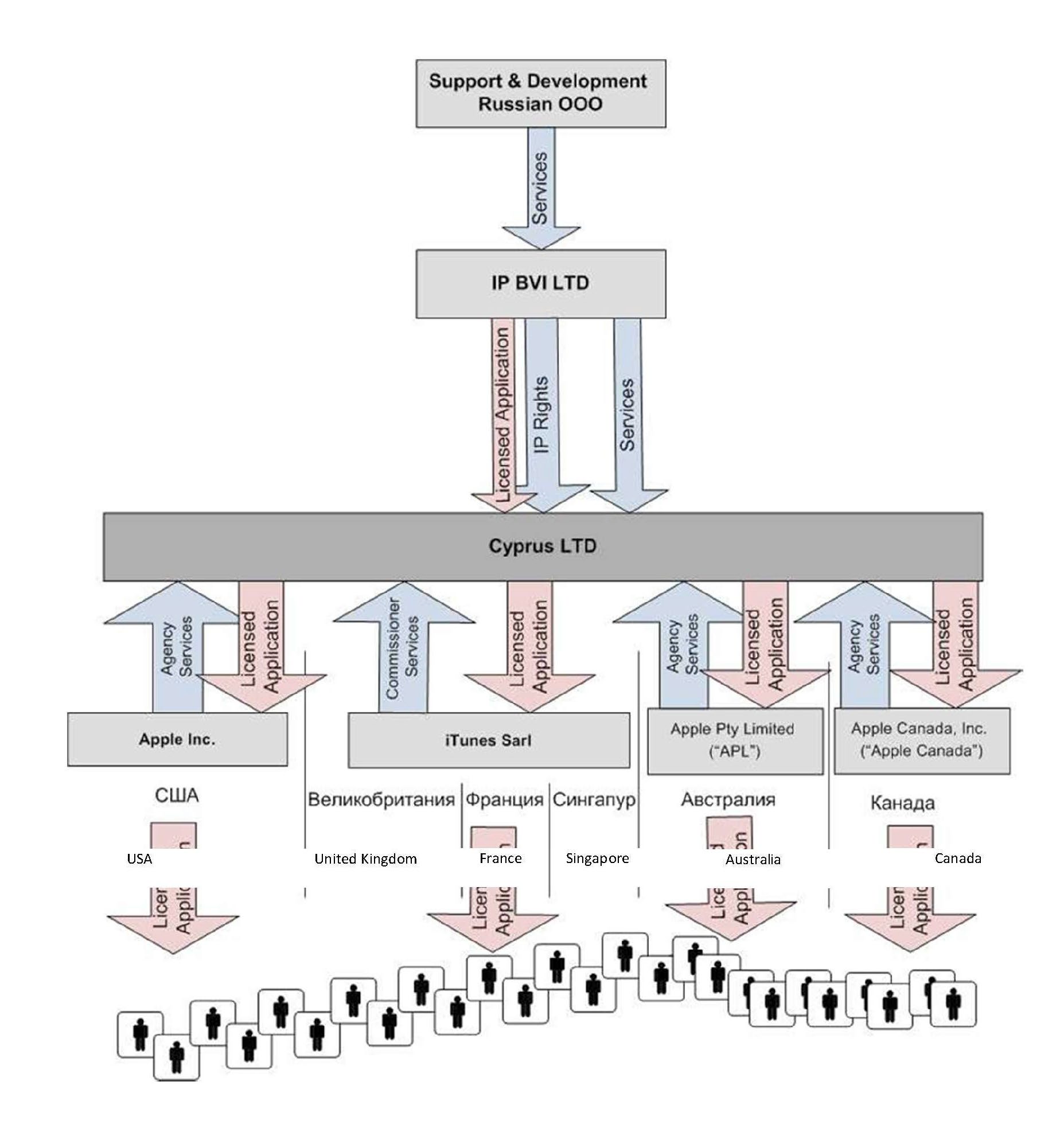
143. Having advised in a first report of 18 November 2010, {F/471T}, in its final report of 9 December 2010 {F/476/1}, Paragon advised holding the IPR in an offshore company in a low-tax jurisdiction. Cyprus was identified as the ideal location and it was advised that another BVI company should be set up for the purpose of receiving dividends tax free. I note that at {F/476/14} Paragon advised as follows:
“Having examined the Convention on the Avoidance of Double Taxation between the United States and Cyprus and its Technical Explanation, we have concluded that, in order to be able to benefit from the provisions of the Convention, 75% of the shares of the Cypriot company (IP Rights Holder) should be owned by an individual who is a resident of Cyprus. Therefore, the best solution to this problem is to use an individual as a nominee shareholder of the Cypriot company who will own 75% of the company’s shares. With regard to the safety of transferring shares to a nominee, it should be noted that the shares would be transferred under a trust deed which can specify in detail the terms of the transfer and in whose favour the shares are held and dividends distributed. In addition to nominee shareholders, nominee directors who are residents of Cyprus may be used.”
Claimants00004030 - Exhibit VS1 - Paragon Report– English Translation, 09/12/2010{F/476T/14}”
It is thus obvious that from well before the start of Mr Chuprin’s move to and employment in Cyprus by the KG Business, it had been advised to use a Cypriot company as the IPR holder, which was at least 75% owned by a resident of Cyprus as a nominee shareholder and/or trustee. There was also very early mention of the use of a trust deed in the advice that was given. This explains the role and capacity for which Mr Chuprin was to be re-located to Cyprus and employed, to advance the international corporate and tax planning arrangements for the KG Business that Mr Sarapulov had embarked upon investigating, taking advice on and putting in place.
144. I accept that Mr Sarapulov consulted with Mr Olomskiy on these matters, even though he took the lead in relation to these tasks, and shared Paragon’s report with Mr Olomskiy on 9 December 2010. Shortly thereafter, Mr Sarapulov followed Paragon’s advice. He duly caused KG BVI to be incorporated on 16 December 2010 {F/481/1} and KG Cyprus on 31 December 2010 {F484/1}.
145. In respect of KG BVI, I find that Mr Sarapulov signed an agreement with Joahna Alcindor, a professional nominee, for nominee services {F/479/1}. Ms Alcindor also signed a declaration of trust over KG BVI in favour of Mr Sarapulov {F/480/1}. Similarly, the first shareholder of KG Cyprus, Mr George Georgiou, signed a declaration of trust over KG Cyprus in favour of Mr Sarapulov {F/482/1}. Both KG BVI and KG Cyprus were therefore held on trust for Mr Sarapulov. I am satisfied that Mr Sarapulov was the beneficial owner of KG BVI (which was never transferred to anyone else) and that he was also the ultimate beneficial owner of KG Cyprus. The idea that Mr Sarapulov was a nominee holder of KG Cyprus for Mr Chuprin and that the latter was the true beneficial owner at any time is, I find, fanciful for the reasons so far given and given below in rejecting Mr Chuprin’s case and evidence that he was.
146. It is also important to deal here with the acquisition of Wise Wave by Mr Misevich for the purposes of the KG Business at around this time. I accept the Claimants’ evidence from Mr Sarapulov and Mr Misevich that in the first half of 2011, Mr Sarapulov also had the idea of moving part of the business to Hong Kong. I accept therefore, the Claimants’ evidence and submissions (CWCS, §257), that in the execution of this plan, on 7 June 2011, Mr Misevich acquired Wise Wave from Starworld Consultancy Ltd, a company owned by Mr Ilya Zaytsev, whom the Founders already knew to be someone from whom off-the-shelf companies could be acquired. Originally, the purpose of Wise Wave was to expand into the Asian market, but it now fulfils a much broader role as the distributor of the games on both the Google Play Store and the Apple App Store.
147. Mr Misevich’s evidence in cross-examination was clear and compelling about this {Day6MT1/15} - {Day6MT1/18} in particular, the way in which he dealt, knowledgeably and convincingly, with the unsubstantiated suggestions being put to him on instructions from Mr Chuprin – who claims to be the beneficial owner of Wise Wave (see {A/5/68} Response 7). His evidence clearly demonstrated that he was a competent businessman taking part in a decision with his co-Founders on an idea from Mr Sarapulov, who was leading the internationalisation of the KG Business, that part of the business should be based in Hong Kong. Further, that he, having experience of business in Asia, would take the lead in that part of the venture and acquire the corporate vehicle through which it would be developed. I found his rejection of the suggestions that Wise Wave acted as a “development sandpit” for development of games outside the KG Brand without risk to its reputation, and that he was a mere nominee owner particularly compelling. Obviously, these were suggestions put on instructions, and the suggestions put and responses, made it plain that Mr Chuprin has no first-hand understanding of the reasons for the acquisition of Wise Wave, of the operations in which it engaged, or its management, or how it was integrated into the KG Business, or how the dividends it declared were disbursed. I found the Claimants’ submissions in relation to these matters at CWCS §§258-263 to be powerful and compelling of these findings and accept the Claimants’ concluding submission that:
“Mr Chuprin’s case on Wise Wave is inconsistent insofar as stated, implausible, lacking in any documentary evidence and should be rejected in its entirety as another lie. Wise Wave is, and always was, Mr Misevich’s company, but it clearly plays an integral part in the KG Business, as the long-term distributor of the games in the Google Play Store and more recently the Apple App Store.”
Written Closing Submissions of the Claimants {AAA/1/130} §163
148. I have considered Mr Sarapulov’s evidence about all of these matters in his first witness statement at {C/8/277} §§4.1-4.8 and orally in response to how it was ineffectually challenged in cross examination of him. He gave a clear and compelling account of how the international corporate structure of the KG Business was developed by him, including the holding of the IPR as explained and documented in §4.6 {C/8/278}, leading to them being held by Mild Right Limited (“Mild Right”). I find his account to be true and correct. As already stated above, I am satisfied that Ms Kurulenko’s claim that she was ever (for some unarticulated reason) the real beneficial owner of the IPR in the games to be incomprehensible, unfounded and false. I find, as already mentioned, that for the short period she held them, from 5 May 2010 to 4 February 2011 (see {F463T} and {F/496}), she did so as a nominee for Mr Olomskiy and did as she was instructed to do, in transferring them to Mild Right.
The True Founders, their agreements and rewards
149. I also found Mr Sarapulov’s explanation of how the Founders came to be founders of the KG Business by their contributions to it; and how they discussed and agreed at this stage, how they would be rewarded for their different contributions to the development of the KG Business, in paragraph 4.8 of his statement {C/8/279}, to be logical and comprehensible having regard to the extent and importance of those contributions. I find that Mr Sarapulov described them accurately and truthfully. It is clear these were agreements that occurred in a dynamic situation as the business was developing and its structure and corporate assets were being acquired up to the end of 2011, and cannot be precisely dated. In their CWCS at §§272-277, the Claimants have provided a more detailed assembly of the different contributions each of the Founders have made in the early stages of development of the KG Business, which I accept and find justifies their respective claims to be its Founders. These submissions are all well-supported by the witness evidence before me, which is referred to in them (all of which I accept as true and correct). It is also obvious and verifiable by the very existence of the KG Business and its embryonic international corporate structure put in place by mid 2011, that it can only have come from these described contributions of the Founders. It did not come into existence from the thin air of Mr Chuprin's claimed “thinking” or from any unparticularised, untraceable and unverifiable investigative actions allegedly undertaken by him, during his sojourn in Dubai.
150. The Defendant’s submissions at DWCS §§161-164 contrary to these findings, were wholly unpersuasive and are rejected. They depended on what was plainly Mr Misevich’s best recollection of the time at which he considered he acquired an ownership stake in the KG Business as a whole, based on his entire contributions of funding and labour; and on a chronology based on that date when distribution rights for Pokerist were conferred in July 2011. This does not begin to demonstrate that Mr Misevich’s personal acquisition of Wise Wave and him bringing it, and investing its earnings into the KG Business structure, was as a nominee rather than as the beneficial owner of that part of it. The incorporation and acquisition of KG Cyprus and KG BVI by Mr Sarapulov and use of Zotobi and later its acquisition by Mr Chuprin, as trustee for the Founders in December 2011 was all part of the Founders’ plan. The Founders were at that time engaged together in the assembly of the corporate assets of the developing KG Business, without the need for documenting and timing their understanding and agreements inter se. Mr Sarapulov and Mr Misevich held certain assets personally and beneficially; and Mr Chuprin acquired and held Zotobi as nominee and trustee for all three Founders, in accordance with the terms of the First and Second Cyprus Agreements (as to which, see further below). All of these submissions on behalf of the Defendant (referenced above in this paragraph) are based on artificial and unrealistic expectations of things set in stone and as if timed and documented precisely. That was not the way in which these Founders created and developed the KG Business by their combined efforts and agreements from mid 2011 onwards.
151. As for Ms Kurulenko’s role in the KG Business, I have no doubt whatsoever that she played a most important role as its Chief Financial Officer, Chief Accountant or Financial Director (the title at any particular time does not matter) and controlled the purse strings of the KG Business with an iron fist, but ultimately subject to the direction of Mr Olomskiy advised by Mr Sarapulov. It is obvious to me that she was a vital cog in the wheels of its operations until it all ended badly in early 2024, when she came to leave the business with a strong, and as she believed, justifiable grievance for her treatment upon her departure, against Mr Olomskiy. I am satisfied that she also acted as a nominee holder of IPR for a short period of time to assist in the structuring of the business and optimal holding of those rights. I accept that she acted as a conduit for payments for services rendered to Mr Olomskiy’s business but am satisfied she was always reimbursed and find she was never a short or long-term investor in the business beyond performing that role. I did not believe her unsubstantiated (which ought to have been capable of documentary substantiation by her, of all people, if it had been true) evidence that she bought expensive cars for her own use or apartments in Moscow from her own resources; and find that she acted as a nominee, arranger and conduit of funds derived from the KG Business to acquire those assets, ultimately, for Mr Olomskiy’s benefit; and that she presently retains them against his wishes. Whether she is entitled to do so under Russian Law, is not a matter this Court has to decide and is not within its jurisdiction.
152. I accept the Claimants’ submission (CWCS §264) that Mr Chuprin's case is unclear as to whether he claims Ms Kurulenko was a founder of the KG Business. Ms Kurulenko’s evidence was ultimately clear that she was not a beneficial owner of the business. I have considered the Claimants’ submissions at CWCS §§264-271 and find that they fairly represent the reality of Ms Kurulenko’s role in the KG Business and that she was not a co-founder of it or beneficial owner of any part of it.
153. In contrast to the Claimants’ well-supported case and evidence on these issues as to who were the Founders of the KG Business which I have accepted, I found Mr Chuprin’s case and evidence, supported to such extent as it was by Mr Kurulenko, to the effect that he was a founder of the KG Business, to be nothing more than bald assertion, which was unsubstantiated, undocumented, vague, evasive and laden with excuses for not being able to demonstrate that Mr Chuprin actually did anything, to create or promote the corporate structure of the KG Business, that was needed to “internationalise” its development. I found the notion and suggestion that Mr Sarapulov was acting as Mr Chuprin’s nominee and taking instructions from him on the international corporate development of the KG Business, to be absurd. This was particularly clear considering the stark contrast in the content of their evidence, and the evident competence and knowledge of Mr Sarapulov in giving it, compared with the transparent ignorance of Mr Chuprin in relation to the internationalisation of the KG Business and the formation of the structure to achieve that. I find the Claimants' submissions about the content of Mr Chuprin’s evidence at CWCS §§ 246 (including the quoted passage of his evidence in that paragraph – which illustrates his vagueness and evasion), also at §§247, 249, and 250-253 (demonstrating the falsity of both the evidence of Mr Rubets, concerning the incorporation of KG Cyprus and KG BVI; and likewise of Mr Chuprin in relation to his claim that he was the beneficial owner of KG Cyprus) to be compelling towards the finding I make. That finding is that all of Mr Chuprin’s evidence and any supporting evidence of Ms Kurulenko, on these matters concerning his participation and role in the creation of a corporate structure for internationalisation of the KG Business and the beneficial ownership of KG Cyprus, is false and untrue.
154. Before reaching these conclusions and findings, I had carefully considered the Defendant’s submissions at DWCS §§151-156 to the contrary but found them to be wholly unconvincing and unpersuasive of Mr Chuprin’s case to the contrary, for the following reasons.
(a) The argument about anything of value for the KG Business being done in Dubai does not go anywhere beyond the bald assertion that “he spent his time there looking at the prospect of expanding the KamaGames Business internationally”, without any particularity of what he did, followed by excuses for there being no trace of it.
(b) The reliance on Mr Rubets, a discredited witness who sought to mislead the Court in parts of his evidence, and on the coincidence of him being engaged on a recommendation from an unnamed person before he was also recommended by Mr Chuprin in April 2011, to assist with the formalities of his immigration and move to Cyprus, is overblown in its significance. Likewise the dealings between Ms Kurulenko and Mr Rubets, carry very little force or weight. Being driven to such reliance reflects the lack of any cogent evidence in support of the Defendant’s case. I do not find it to be a remarkable coincidence or unlikely, that someone known to Mr Sarapulov in Vladivostok knew and recommended the émigré, Mr Rubets, from that city, “who had specific experience of helping business men like us to set up Companies in Cyprus and the BVI” {C/8/281} §5.8, should also be known to Mr Chuprin and recommended by him. It is in my view an explicable coincidence having regard to whence Mr Rubets came or had been in 2001 (Vladivostok), and his role and activities assisting Russian businessmen in Cyprus. It is a very weak argument when the coincidence relied on was specifically flagged up by Mr Sarapulov in his first witness statement. It does not begin to undermine the important facts that Mr Sarapulov, without any input from Mr Chuprin or Mr Rubets, had already embarked upon implementing the necessary corporate structure to internationalise the KG Business himself, by the incorporation of KG Cyprus and KG BVI, in accordance with the advice he had obtained from Paragon and GSL.
(c) The correspondence relied upon between Mr Rubets and Ms Kurulenko {F/2790T/1} plainly shows Ms Kurulenko intervening with an accounting matter (which was her role). This was in an email exchange between Mr Sarapulov and Mr Rubets in July 2011, concerning the substantial matters of immigration and work permits Mr Sarapulov was dealing with, for Mrs Irina Olomskya (Mr Olomskiy’s mother who was moving to Cyprus for health reasons and to keep an eye on Mr Chuprin but had to be presented as an employee for her to live there) and Mr Chuprin. The other piece of correspondence involving Ms Kurulenko which is relied on, from Mr Zakharov of Paragon to Mr Sarapulov, in which she is copied unsurprisingly as CFO, is the covering email for the Kama Games tax structure document, with prices for the services being offered. These pieces of correspondence do not advance the Defendant’s case one jot. None of this provides any support for Mr Chuprin’s case and Ms Kurulenko’s evidence supporting it, that they participated beyond their employment roles in the foundation of the KG Business.
(d) As for the submissions at §§154-155 DWCS, again this is bald assertion in §154, and what is asserted in §155 completely ignores the massive contribution that Mr Sarapulov was making in devising (with professional advice) and implementing by his own actions, the internationalisation of the KG Business. It also ignores the trusting relationship between the Founders which I have found to exist and the sharing of rewards of their endeavours by agreement.
(e) I find the reliance on the email {F/502T/1} to be an ineffectual reliance on a literal misinterpretation of words that were obviously intended to refer to someone who was going to be presented as if he were the real director/beneficial owner of the KG Cyprus in accordance with the advice received from Paragon. I reject the interpretation and understanding placed on this document by Mr Cook; and I reject his submission it is to be inferred that the real director/beneficial owner being referred to in the email was Mr Chuprin (who was still a radio DJ in Dubai when this was written). The email certainly does not evidence that Mr Chuprin was involved in the KG Business prior to March 2011 (still less that he was the beneficial owner of KG Cyprus) – indeed, by the fact that there is no mention of Mr Chuprin or anyone else by name, evidences that so far as Mr Sarapulov and Mr Olomskiy were concerned, when corresponding privately between themselves, there was no private recognition or identification by them of Mr Chuprin as a real director/beneficial owner; and no naming of him or anyone else who might be presented in that role.
(f) The email {F/502T/1} just referred to, and the words relied on as the basis of the Defendant’s submission that the real director/beneficial owner being referred to was Mr Chuprin, are also taken out of context. That context was that the Founders were being advised to put in place their “person” as a nominee beneficial owner rather than the real beneficial owner of the Cypriot company. In that email, sent at 11:17 on Saturday 26 February 2011, Mr Sarapulov was reporting to Mr Olomskiy on negotiations about the nominee arrangements they were seeking to put in place whereby the nominee would sign “that they are the real owners” of the business and he reports on that aspect of the negotiations as follows:
“It’s not customary there for nominees to sign that they’re the real owners. But with references to laws and normal practice, they were finally convinced that there’s nothing improper about that.”
(g) Just seven minutes later, on the same day, Mr Sarapulov sent another email to Mr Olomskiy forwarding Mr Rubets' answers to questions that had been asked of him and his answer to the second question was as follows:
“On the second question.
The main purpose of a nominee service is to create an effective place of management in a country that has a friendly tax regime. But clearly, if you channel income through Cyprus to an owner who lives in another country, then as far as the US is concerned, the Cypriot company will be viewed as resident in that beneficial owner’s country. With regards to the time factor, your person will only be considered a tax resident of Cyprus when all the documents have been completed (which takes 3-4 months in practice) and the person has been resident in the country for over six months. So if you start work now, your person will fully meet the US criteria by the end of the year. Things may end badly if a nominee confirms that a beneficiary in the Russian Federation has Cypriot residency, because collaboration between the US and Cyprus on economic violations functions really well, which is why providers refuse. So in your case, you need to temporarily change the beneficial owner and then put yours in once everything is set up. That’s my opinion. You can ask other companies for advice, I’m sure they’ll say the same thing.”
(emphasis added)
(h) When this answer was put to Mr Rubets {Day9/110} - {Day9/111} and that he was advising Mr Sarapulov to put in a temporary nominee beneficial owner (as Mr Chuprin was later chosen to be), and very well knew that the real beneficial owners were in Russia and he was advising against them becoming beneficial owners, he responded as follows:
“A. Can I give a bit detailed answer, your Honour? Because I cannot say this is correct or not because definitely this is correct, however there were two people we were discussing -- there were two people on the table, Mr Igor Chuprin and Irina Olomskaya, and I should stress out that this -- in this particular moment, there was no direct certainty who was final and real beneficial owner, and that is why we discussed it just theoretically before they asked me, you know, to provide a consultancy advice. This is my question -- this is my answer, excuse me.
Q. Mr Rubets, you cannot seriously be giving evidence that you didn't know who the -- there was no clarity of who the beneficial owner was and it was an option between two people and you had to choose one. I mean, obviously what you are talking about here is a nominee.
So what you didn't know was whether Igor Chuprin was going to be chosen as a nominee or Irina Olomskaya, Mr Evgeny Olomskiy's mother, would be chosen as a nominee, but you knew very well that they would be nominees and the real owner was in Russia; that is the truth, isn't it, Mr Rubets?
A. I cannot comment on this, I do not remember.”
(emphasis added)
(Day 9, 12/03/2026, 110:12-111:10, Mar. 12, 2026)
(i) It is clear from this exchange in cross-examination, and the emails I have referred to containing his advice, that Mr Rubets knew very well that the real beneficial owners of the Cyprus company being used for the KG Business were in Russia and that of the two “people on the table” for the role, Mr Chuprin became their nominee; and that his attempts to suggest by his evidence that Mr Chuprin was the real beneficial owner of KG Cyprus (and later Zotobi) had been exposed by his own answers as false. Thus, when these obviously true facts were put to him, he resorted to blatant evasion by claimed inability to comment and feigned loss of memory. I am satisfied that Mr Rubets came before the Court to give false evidence on behalf of Mr Chuprin in support of his false case that he was the real beneficial owner of KG Cyprus and later Zotobi. I reject all of Mr Rubets’ evidence to that effect.
155. The reality is, and I find as a fact, that Mr Chuprin was not and was never intended to be the beneficial owner of KG Cyprus; neither had he been identified in February 2011, as the person who might be presented in that role down the track.
156. Against that factual background as I have found it to be, it is easy to understand and recognise the role in which, Mr Chuprin was employed by the KG Business from the start of his employment in the KG Business in mid 2011, until his removal as a trustee of the IC Trust on 4 November 2024. It was solely as a nominee and trustee holder of corporate and other assets of the KG Business, for the purposes of international growth of the business. The scheme or business model, in which this role was of central importance, had been investigated, and, with the benefit of substantial expert consultancy advice, devised, implemented and developed by Mr Sarapulov. Mr Chuprin took on this role and employment in the business model Mr Sarapulov devised, which from the start, required him to be presented as, and to act and present himself, as if he was the real beneficial owner of the entities, by and through which the KG Business was going to be doing its business internationally. It was thereby able to expand exponentially in and from the various jurisdictions where those entities were seated, across the world and by the World Wide Web of the internet, on the Apple and Google platforms. Mr Chuprin willingly and knowingly participated in this false presentation of himself throughout all of the instances of it occurring. Whenever he acted on the instructions of the Founders or his superiors, including Ms Kurulenko and Mr Abramenko and others authorised to instruct him by the Founders, and it was necessary or desirable for him to represent himself as a UBO, he did so. Many, if not all of these instances, are collected (and evidenced by the referenced documents) in the “SCHEDULE-UBO REPRESENTATIONS” to the DWCS. It is crystal clear that without the business model and scheme thus devised, the creation of non-Russian corporate entities and Mr Chuprin’s performance of the employment and role he undertook within it, the KG Business owned and run by three Russian Founders, controlled from Vladivostok and later Moscow, would never have succeeded. It would not have got past first base with the foreign regulators, bankers and other professional service providers from which the business required approval, acceptance or services, in order to succeed as it has done.
Mr Chuprin’s engagement, role and actions in Cyprus for the KG Business
157. So it was that Mr Chuprin re-located to Cyprus, by economy class with Aeroflot, pursuant to what has been termed the “First Cyprus Agreement” {F/528T}. I am satisfied that it is an agreement that: (i) represents the truth and reality of the terms of Mr Chuprin’s relocation; (ii) that it contains a summary of the nominee and managerial role that he was re-locating to fulfil; (iii) that it provides broadly for the remuneration and benefits he would receive: and, (iv) that it accords with the advice Mr Sarapulov had received from Paragon, that the nominee/trustee to be used to hold corporate assets acquired by the KG Business, should be or become a tax resident in Cyprus that year. It is not a public facing document or agreement to serve the pretence that Mr Chuprin was the UBO of anything. It was created only in Russian so would be of no use or purpose for immigration purposes. It is far from perfect or complete in its drafting by Mr Sarapulov and does not even name party 1. I am satisfied however, it was intended to be in the nature of and to reflect a gentlemen's agreement, binding nonetheless, between the Founders of the KG Business and Mr Chuprin, to be followed as it was, by an employment contract with KG Cyprus. I accept Mr Sarapulov’s account in his first witness statement {C/8/280} §5.6 of its purpose and form; and that it governed how the Founders and Mr Chuprin understood their relationship with each other until the IC Trust was settled on 10 November 2016. It reflects in my judgment an overarching agreement pursuant to which subsequent employment contracts were concluded between corporate entities forming part of the KG Business and Mr Chuprin; and pursuant to which Mr Chuprin would hold corporate assets as nominee and bare trustee for the Founders.
158. Mr Chuprin’s evidence was that it was created for immigration purposes (Chuprin 9 {C/23/617} §26) and despite pleading that he did not know if Mr Rubets used it for that purpose, his evidence when it came, plainly implied it was to be used for that purpose. He elaborated about advice given to him by Mr Rubets concerning this document and claimed that the modest salary it provided for, was the minimum amount required to obtain a visa for someone coming to Cyprus – adding the transparently casual lie, as I find it to be, that, “Through the various business ventures described above, I had my own money and ability to support myself and the agreement was only for the purpose of obtaining a visa”. I am satisfied that it was not created or entered into for the purposes of obtaining a visa or work permit to enter Cyprus. That process was being dealt with by Mr Rubets, and when the First Cyprus Agreement was shown to him under cross-examination, he did not even recognise it; and told me it was “definitely not” a document he would have used to obtain Mr Chuprin’s work permit in Cyprus {Day9/83:6-22}. I am satisfied and find that Mr Chuprin has lied to me in an attempt to deceive me into believing that the First Cyprus Agreement was created for immigration purposes and does not accurately and truthfully describe the role Mr Chuprin was undertaking and his status in the KG Business as a nominee and employee he was to become in the Second Cyprus Agreement, just over a month after the First Cyprus Agreement was signed.
159. It also demonstrates the falsity of Mr Chuprin’s evidence that:
“As described above, I had been working on the development of the international structure for the business while I was in Dubai principally with Ms Kurulenko but also with Mr Olomskiy. Once we had identified that Cyprus was an attractive place to establish part of the structure, I started making arrangements to move to Cyprus, using my own funds, as described in paragraphs 20 and 21 of my Eighth Witness
Statement.”
and that he
“worked with Mr Rubets to make the arrangements”
Ninth Witness Statement of Igor Chuprin, 19/01/2026 {C/23/616} §§25-26
when in truth, it was Mr Sarapulov who was working with Mr Rubets to make the arrangements (including at the same time, for getting Mr Olomskiy’s mother into Cyprus as an employee) and that Mr Rubets was reporting to Mr Sarapulov on the matter, as shown by his message at {F/2790T/1}.
160. I have considered the Defendant’s submissions concerning this First Cyprus Agreement, (DWCS §§159-160) and the evidence there referred to, which do nothing to undermine its effectiveness and its statement of the relationship between the Founders and Mr Chuprin. The document plainly contains an agreement which is prospective in nature, of Mr Chuprin holding corporate assets as nominee and trustee for the Founders. I am satisfied that pursuant to it, Mr Chuprin came to acquire and hold Zotobi in that capacity for the Founders, in December 2011 (including for the further reasons given below). The fact that the agreement contains clauses beyond (not inconsistent with as alleged) the role of a mere nominee, including as mentioned above managerial duties, does not detract from the fact that it provides for Mr Chuprin to act as a nominee shareholder and director of the Founders’ companies. The fact that Mr Sarapulov was contracting to get more than mere nominee services from Mr Chuprin is unremarkable and entirely to be expected from a sharp businessman and owner, getting his money’s worth from an employee re-located to Cyprus to be the front man for the KG Business entity or entities, located or to be located there in future.
161. A futile attempt was made (at DWCS §160.4) on Mr Chuprin’s behalf, to dismiss the damning effect of Mr Rubets’ evidence on his case, that he did not recognise the First Cyprus Agreement and that it was “definitely not” a document he would have used to obtain Mr Chuprin’s work permit in Cyprus. This attempt was made on the grounds that it was pleaded by Mr Chuprin that he did not know if Mr Rubets had used it; and there was a flurry of documents being created at the time, not all of which were used. The vacuity of these grounds and attempt to dismiss the effect of this evidence, only serves to confirm the falsity of Mr Chuprin’s denial that the First Cyprus Agreement was created for the reasons explained by Mr Sarapulov and truthfully records Mr Chuprin’s status and role upon joining the KG Business in mid-2011 for the first time, as its employee and nominee/trustee.
162. Thereafter, it came about that on 1 June 2011, Mr Chuprin signed the Second Cyprus Agreement {F/573/1}, which was an employment agreement with KG Cyprus as a General Manager. It set out Mr Chuprin’s monthly salary to be EUR 3,700 (clause 4.1), accordingly within the contractual limit already set in the First Cyprus Agreement. Mr Chuprin then began to submit receipts for various expenses, including car rental services and even purchasing stationery for EUR 7.40. I reject the suggestion that the purpose of claiming expenses was to demonstrate the effective conduct of business locally for regulatory and tax purposes (though it may have had that benefit) and find that it was in the ordinary way of a modestly paid employee claiming reimbursement of personal money spent by him for his employer’s benefit. I am satisfied also, that it demonstrates that whenever Mr Chuprin was required to incur expense to further the scheme of internationalisation of the KG Business, he would have been pre-reimbursed or reimbursed for any expense incurred.
163. For all of these reasons, I am satisfied and find as a fact, that Mr Chuprin moved to Cyprus in May 2011 as an employee and to act as a nominee for the Founders in all he did there, as confirmed by my further findings which follow.
164. It is not necessary for me to deal with each and every manifestation of Mr Chuprin acting in his role with the KG Business and the contested complexions placed on those actions during his time in Cyprus. I will deal in more detail with the Parties competing cases on the more important actions involving Mr Chuprin, such as the acquisition of Zotobi and its acquisition of the IPR in the games from Mild Right (and the timing of that acquisition) separately below.
165. I have considered the Claimants’ submissions (and the evidence and documents referred to in them) at CWCS §§292-298, and the Defendant’s submissions and evidence to contrary effect. I deal with these competing cases in summary, without the need to refer to all the documents relied upon, and find as follows in relation to the role and actions of Mr Chuprin:
(a) I accept the Claimants’ submission that his role was to sign, scan, and send various documents on the instructions of others in the business – but not his only role. (I am satisfied he would also have undertaken mundane managerial activities in accordance with the First and Second Cyprus Agreements). There is ample documentary evidence to that effect. I find he received such instructions in brusque and demanding terms (inconsistent with him being a Founder/owner of the KG Business or any part of it) including from comparatively low-ranking employees in other parts of the KG Business, including Mr Butyrskikh, Clodagh Conlon (an employee at KG Ireland) and Olesya Stewart (an employee in the legal department). I find there is no documentary evidence to show that he had any involvement in the substance of the agreements that he signed. By contrast, there is evidence that documents which he was asked to sign had been pre-approved by others, such as Mr Sarapulov and Mr Olomskiy.
(b) Mr Chuprin’s production of documents that he signed off on at (Chuprin 8, §22 {C/13/367}) as “a few examples” only, in support of his case and evidence that the scope of activity he undertook at KG Cyprus shows that he was not a mere nominee, because “he carried out the full range of activities typical of one of the founders of a mobile gaming company” presents a false and misleading picture, when the totality of the evidence relating to what occurred, and who actually carried out the substance of the activities relied on, is examined. This is clear from a consideration of the evidence and documents referred to by the Claimants at CWCS §§293-294.
(c) Mr Chuprin’s subordination to Mr Sarapulov as the Founder, principally directing the operations of the KG Business, and the nature of his own status and role, is well illustrated by the tone and content of Mr Sarapulov’s messages directing him to act (and what limited inputs were required from him). This is well-illustrated in relation to the 1Mobile insertion order {F/743}, put forward by Mr Chuprin (Chuprin 8, §22(d) {C/13/367}) to claim he was “contracting with advertisers to bring new users to the apps”. The Claimants’ submission at CWCS §295 is substantiated and correct in demonstrating that Mr Chuprin was merely signing the order under instructions, without having any input in the decision to contract or its terms.
(d) The evidence of Mr Adrianov relating to the signing of a lease for office premises was a matter of his impression that Mr Chuprin was the owner of the business he was contracting for because, inter alia, he acted confidently. This is precisely what Mr Chuprin was employed to do – convey that impression to contractual counterparties, bankers, regulators and the like, that he was the owner of the business – and plainly, he was good at conveying what I find to be a false impression.
(e) Mr Chuprin did not employ Mr Kuznetsov, in the sense of identifying him and selecting him for employment on account of his qualifications and abilities.
(f) Mr Chuprin’s CV {F/44/1} and the extravagant and false description in it of his experience and background, is all part and parcel of the false presentation of him and by him, as a man of substantial experience and ability, prepared by the KG Business legal department for the purposes of passing KYC checks. The reality of his role and responsibilities is properly reflected in his modest salary of EUR 3,700 and his meticulous claims for reimbursement of even the tiniest of his expenses (including by way of example reclaiming 36 cents for staples and 38 cents for paper clips spent at Carrefour Express on 4 July 2011 {F/564/1}). I reject Mr Chuprin’s late-coming claim under cross-examination that he had income from any other source or took an additional salary as unsubstantiated invention - for all the reasons advanced by the Claimants at CWCS §§301-303.
(g) The Defendant’s repeated reliance (though his counsel in cross examination of the Claimants’ witnesses) on a single email dated 13 November 2011, {F/639T} to suggest he was in partnership with Mr Olomskiy and played a substantial role, shows no such thing. In fact, in my judgment it demonstrates precisely the opposite, by the respectful mode of address using the patronymic name, Evgeny Vladimirovich, (in the Russian way of addressing a senior and superior person) and by its offering as follows:
“Now I am in a position to open my own billing service in the interesting
area of gambling. I already told you that we had our own billing system in the early 2000s. I still have high-quality software that has been tested in real- world conditions and a very skilled programmer who wrote it (I supervise him, and I can guarantee full control in terms of the confidentiality of the project as a whole and protection of commercial information). It’s now possible to open a good gambling merchant in several different jurisdictions. Since I have experience in this area and it’s a path I’ve already been down, I immediately had the idea of suggesting using my own resources to create a bespoke billing system for you for processing your online casino payments.
I don’t have any specifics so far on figures from the merchants and therefore on the terms of service I can offer, but I’m almost certain that it’ll be market prices for similar services from competitors and bespoke processing for your project (in other words, no one else will be processed via this merchant). Also resistance to abuse and attempts to block payments, various attacks from competitors and other interference (I have already experienced all that) AND complete confidentiality in terms of safeguarding your customer base. If you’re interested in discussing this further, I will need some details so that we can continue with a meaningful conversation regarding the proposed merchant account options in various jurisdictions.”
Claimants00004079 - Exhibit EO1 - Email from Igor Chuprin to Evgeny Olomskiy - English Translation, 13/11/2011
(h) I have considered the Defendant’s case as to what this email shows. I do not accept that case. Neither do I accept the Claimants’ submissions (CWCS §299) that this was “another potential side hustle” by Mr Chuprin. I have to interpret the document as best I can in the face of those conflicting submissions. My interpretation of this email against all the background evidence and facts I have found, having considered it carefully, is that it is a respectful email from a recently engaged employee, then in Cyprus, a few months after taking up employment. It is the kind of email an employee might send to an entrepreneur boss who is developing a business in the hope of showing his initiative and that he has something to offer that might be useful in the development of his employer's business. No doubt he would be looking for some recognition and/or reward if it was taken up; but it is plain it was never responded to, nor taken up and advanced. Mr Chuprin is trying to promote his idea by vaunting his capacity to assist in a development of the addressee's business - not his own business - by offering a billing service to his employer and his business, which he claims to be in a position to provide. It is probably harking back to his experience (whatever it was) with Biscorp, but it suggests there was no partnership between these two men. Mr Chuprin was offering to his employer (in effect) "full control" and protection of commercial information. Writing as he does, “I immediately had the idea of suggesting using my own resources to create a bespoke billing system for you for processing your online casino payments”, suggests this is only Mr Olomskiy’s project and business not, as he claims, a business jointly owned by him. He refers to your project and your customer base. It is in my judgment, a proposal to supply a service that might be useful to his employer who is the owner of a growing business. It is not the sharing of an idea between equal partners in a business they are developing together, demonstrating his active and real participation in that business.
(i) I am satisfied that when Mr Chuprin signed the Nominee Director Declaration {F852/1} in relation to Zotobi, on 13 August 2013, in terms:
“I, Igor Chuprin of "Rigainas Residence” Building, Rigainas street 19, flat 202, Ayia Triada, 3035 Limassol, Cyprus having agreed the appointment a Director of
ZOTOBI MANAGEMENT LIMITED
(a company incorporated under the laws of the British Virgin Islands, company number: 1515102),
Hereby acknowledge that this appointment is in the capacity of nominee director and I acknowledge that I have no claim whatsoever against any assets of this company and/or its beneficial owner/s. I declare and say that during my tenure as nominee director, I shall only act upon instruction from the beneficial owner/s or his/their agents in such a manner as will promote and further the objects of the said company at all time and I acknowledge that I shall have no claims against the company for compensation for loss office upon my removal or dismissal.”
Claimants00005442 - Exhibit VS1 - Nominee Director Declaration13/08/2013
He well understood the plain language of what he was declaring and signing; and that this was a true statement of his role and capacity, not only specifically in relation to Zotobi, but he also knew that it was in accordance with the contracts by which he was engaged to serve the KG Business and its Founders. The fact that Mr Chuprin signed other “nonsense” per Mr Rubets {Day9/103:6} documents, produced by Totalserve the corporate service provider (“CSP”), in relation to Zotobi, does not, in the light of all the other weighty evidence that this one declares his true role in relation to it, detract from that finding. I also make the finding that this declaration states the truth, for the reasons relied on by the Claimants at CWCS §300. I found the evidence of Mr Chuprin that he did not remember signing the document and that he discussed it with Mr Rubets, in Chuprin 3 §15 {E/25/4}, and was told it was signed for “administrative reasons” (which discussion was denied - “definitely not” - said Mr Rubets, until confronted with Mr Chuprin’s statement when he hedged his denial) to be false. I am satisfied that the stark conflict in their stories, was a slip-up in their joint effort to mislead me. Mr Rubet’s evasive answers in cross examination {Day9/97} - {Day9/102} with his transparently false efforts to support Mr Chuprin’s case, made it clear that he was not a truthful witness seeking to assist the Court. I am satisfied Mr Chuprin, supported by Mr Rubets, has now expanded these false “administrative reasons” to claiming his declaration was nothing more than a standard form document required by Totalserve, in his evidence and submissions, in order to mislead me. Finally, my findings in relation to the acquisition of Zotobi by the Founders, which follow, also confirm the truth and validity of Mr Chuprin’s declaration above.
The use and acquisition of Zotobi
166. I have considered Mr Sarapulov’s evidence at section 6 of his first witness statement {C/8/282}, as supported by the documents he refers to and find it to be accurate and true for the reasons now given. He there explains the reasons for why and how Zotobi was brought into use in the KG Corporate Structure in mid-2011; and how the IPR for the games was transferred from Mild Right to Zotobi along with rights under an Application Licence Agreement dated 7 February 2011 {F/497} for the games, pursuant to which KG Cyprus had been licensed to distribute the games on the internet, in return for payment of royalties (explained further below) to Mild Right. The use and acquisition of Zotobi and the vesting of the IPR for the games in it; and its licensing of the software for the games to KG Cyprus, in return for payment of royalties by KG Cyprus (which were 35% of the monthly revenue derived by it from the marketing, distribution or commercialization of the games), involves a complex series of agreements, made even more complex and difficult to explain because of an erroneous (as I find it to be) or, as the Defendant claims happened (which I reject), a false, backdating of one of the agreements by which the arrangement was achieved.
167. Zotobi was a BVI company under the control of Mr Rubets through his company Sovan. The tax regime in the BVI was more favourable for a company receiving revenue from exploitation of IPR than in either Hong Kong or Cyprus – and there was a tax risk of retaining the IPR in Mild Right in Hong Kong. Zotobi had an operational history and existence and an active bank account, which had been emptied by those previously using the company. This was an important requirement for the entity being acquired as the ultimate receiver of revenue from the use of the games, under the business structure that Mr Sarapulov had, on advice, devised and was setting up. I accept that the Founders could not use KG BVI for this purpose, as it did not have a business history and an active operational bank account at this time. Mr Sarapulov credits Mr Chuprin (whom he had just engaged under the First Cyprus Agreement) with suggesting he contact Mr Rubets, who was already known to the Founders, and who, as just explained, controlled Zotobi.
168. The Claimants' case, which I accept, is that they had acquired the use of Zotobi (although not at this stage the company itself) by mid-May 2011, through Mr Rubets and his company Sovan, because the KG Business needed to get the IPR for the games (and the revenue received for licensing its use from KG Cyprus) out of Mild Right, since they had become aware of the risk that Mild Right was going to be treated as an onshore company in Hong Kong where it was domiciled, with adverse tax consequences for the KG Business. The Founders therefore swiftly arranged for the transfer of the IPR rights to Zotobi by an agreement {F/536/1} entitled “Agreement for transfer of exclusive rights to game applications”, (the “16 May Agreement” hereafter), said on its face to have been signed on that date, for what Mr Sarapulov describes as a “nominal” price of USD 635,000.00. Mr Chuprin contends as explained below that the date of the agreement and transfer of the IPR to Zotobi is false; and that the document was subsequently created and backdated to that date.
169. Mr Sarapulov produces in the section of his evidence just referred to, three Royalty Payment Notices, numbers 1, 2 and 3, dated respectively 20/10/11 for $35,000 {F/620}, 10/12/11 for $250,000 {F/665} and 20/12/11 for $350,000 {F/685} and three corresponding KG Cyprus Bank Outward Payment slips {F/623}, {F/678} and {F/687} which show the payments of those sums from it to Mild Right. Those slips bear a reference for the payments to the Application License Agreement of 7 February 2011. It is the Claimants’ case that these three payments totalling USD 635,000 were payments to Mild Right by KG Cyprus on behalf of Zotobi, of the price for the IPR in the games, which were transferred to Zotobi by the 16 May Agreement. It is claimed by the Claimants (CWCS §305) that KG Cyprus paid the price for the IPR to Mild Right, on behalf of Zotobi, by way of discharge of its liabilities to Zotobi under the Application Licence Agreement, which was transferred to Zotobi by Mild Right, pursuant to the “Transfer of Contract” agreement, as next explained.
170. The Royalty Payment Notices from Zotobi addressed to KG Cyprus referenced in the paragraph above, ask it to remit Royalty Payments in the amounts stated in the notices, to Mild Right, “due to the Transfer of contract dated May 10 2011”. This is a reference to the tri-partite agreement recorded in the letter at {F/533/2} headed “Transfer of Contract”, whereby Mild Right, KG Cyprus and Zotobi agreed to the transfer of the Application Licence Agreement of February 7, 2011, from Mild Right as Licensor of the IPR, to Zotobi as Licensor in its place, on the “Effective Date”, which was defined as the date of the Agreement. Thus, in line with Zotobi’s acquisition of the IPR, it also became the Licensor in place of Mild Right of the IPR to KG Cyprus as licensee, under the Application Licence Agreement of February 7 2011; and KG Cyprus was thereafter liable to pay royalties to Zotobi, for the use of the IPR in the software of the games.
171. The type written date that appears at the head of the letter recording the tri-partite agreement, is 10 May 2011, but the Claimants claim that is obviously a mis-dating, because the letter (which is addressed by Mild Right to KG Cyprus) states in the second paragraph, “on 16 May 2011 we transferred [i.e. in the past] rights on certain software our (sic) to Zotobi… ” referring to the 16 May Agreement for the transfer of the IPR in the games from Mild Right to Zotobi {F/536/1}. Further, the Claimants claim it is also demonstrated that the type-written date of 10 May 2011 at the head of the Transfer of Contract letter, is a mistaken remnant of an earlier draft, which had not been corrected, by the date of its signature {F/532/2} by two of the parties to it, inserted in manuscript as “17/05/2011” and “May, 17, 2011”, thus differently in two places under the signatures. This was obviously the day after the 16 May Agreement, transferring the IPR to Zotobi, and makes sense of the statement in the second paragraph of the Transfer of Contract letter, recording that the transfer of the IPR had occurred in the past. The Defendant disclosed a version of this Transfer of Contract Letter {F/533/3} on which the two manuscript dates of 17 May did not appear but did not advance evidence or submission that the manuscript dates were not added at the same time the document was signed; and so provides no explanation for this discrepancy. The Claimants' case is that this misdating and error at the head of the letter is of no significance and arose at a time when a number of drafts of the documents were circulating to put these transfers of IPR and the Application Licence Agreement into effect, and there was simply a failure to update the date the Transfer of Contract letter whereby, as a result of that failure and error, it appeared to pre-date the transfer of the IPR. That mis-dating at the heading of the Transfer of Contract as 10 May 2011, was then carried forward and repeated in the Royalty Payment Notices, when reference back was made in each of them to the Transfer of Contract tri-partite agreement by the words, “due to the Transfer of contract dated May 10 2011”. The Claimants thus claim that the most valuable assets of the KG Business, its IPR, were vested in Zotobi, by the 16 May Agreement before the shares in that company were subsequently acquired (they say) on their behalf and for their benefit, by and in the name of Mr Chuprin, as their nominee on 15 December 2011.
172. In his eighth witness statement {C/13/370} §32, Mr Chuprin did not say exactly when the transfer of IPR to Zotobi took place or under what agreement or that any price was paid. In order to date it, he referred to a board resolution {F/799/2} dated April 1 2013, to pay Mrs Olomskaya (Mr Olomskiy’s mother) a dividend of USD 4 million, which was actually used to pay developers of the games in Russia. I record in passing first, that Mr Chuprin says he made Mrs Olomskaya the shareholder of KG Cyprus, as a personal favour to Mr Olomskiy to help her to move to Cyprus for health reasons. Secondly, the Claimants deny that a dividend of USD 4 million was paid and that it was used to pay developers. Mr Chuprin says this in his statement:
“Shortly after this [the resolution of 1 April 2013 and payment of the dividend], the intellectual property, and ultimate earnings of the business, was transferred to my company, Zotobi. I decided to re-route the business’ revenue through Zotobi and away from KG Cyprus primarily because of the economic restrictions imposed on Cypriot companies by the Cypriot government following the economic crisis in 2013.”
Eighth Witness Statement of Igor Chuprin, 19/12/2025 {C/13/370} §32
173. Assuming Mr Chuprin was then suggesting the transfer of IPR took place in say April or May 2013, entirely of his own volition, there is thus a dispute between the Parties concerning the actual date of the transfer of the IPR, it being Mr Chuprin’s case that the IPR transfer agreement has been backdated to the date on its face.
174. Mr Chuprin’s case in response to Mr Sarapulov’s evidence and the Claimants’ case as I have outlined it above, was first advanced in his reply ninth witness statement at Chuprin 9, §34 {C/23/618} where he asserted:
“The payments by KamaGames Limited (Cyprus) referred to in Mr Sarapulov’s statement were not for the transfer of the IP rights but for the ongoing royalties owed by KamaGames Limited as the publisher of the apps to Mild Right as the owner of the IP rights and were made under the Application License Agreement dated 7 February 2011. Mr Sarapulov refers to Royalty Payment Notices No. 1 to 3 which, by coincidence, total $635,000. There is also a Royalty Payment Notice No. 4 for $500,000 dated 1 March 2012 (see page 3 of IC9) and a Royalty Payment Notice No. 6 for $650,000 dated 25 June 2012 (see page 4 of IC9). I have not been able to find Royalty Payment Notice No. 5. The fact that the transfer agreement between Mild Right and Zotobi (see pages 5 - 14 of IC9) was backdated is further demonstrated by a letter from Mild Right to Zotobi purportedly dated 10 May 2011 but which refers to the transfer agreement in the past despite it being dated 16 May 2011 (see pages 15 - 16 of IC9).”
175. Before dealing with the competing submissions of the Parties, and determining this issue, it is necessary to explain one further matter to understand Mr Chuiprin’s evidence in Chuprin 9 §34 above, and the Claimants’ submissions in response to it, dealt with below. There is another agreement which is relevant to this issue of when and how the IPR in the games was transferred to Zotobi, namely a “Facility Agreement” {F/697.1} or loan from Zotobi as Lender to Mild Right as Borrower, dated 1 March 2012, which has the following relevant terms for understanding what was going on with these various agreements I have referred to:
“2. THE FACILITY
The Lender grants to the Borrower an unsecured Sterling term loan of a total principal amount not exceeding USD 1,500,000 on the terms, and subject to the conditions of this agreement.
3. PURPOSE
3.1 The Borrower shall use all money borrowed under this agreement for advertisement and promotion of Egg Punch game.
3.2 The Lender is not obliged to monitor or verify how any amount advanced under this agreement is used.
4. TRANSFER
4.1 Subject to clause 5, the Borrower shall receive the Loan amount from KAMAGAMES LTD, Cyprus, which will transfer the monies on behalf of the Lender. The amount of the Loan shall not exceed the Total Amount. 4.2 Any amount of the not drawn down the Availability Period will automatically be cancelled.”
Claimants00077394 - Facility Agreement between Mild Right Limited and Zotobi Management Limited, 01/03/2012 {F/697.1/6}
176. It is the Claimants' case that the amount due under this loan agreement was paid in three tranches, also pursuant to “Royalty Payment Notices” numbers 4 (dated 1 March 2012 for USD 500,000), 5 (dated 7 June 2012 for USD 350,000), and 6 (dated 25 June, 2012, for USD 650,000 (total USD 1.5 million – the amount of the facility or loan). These notices, 4, 5 and 6 are found at respectively {F/696}, {F/724} and {F/727}. These notices are in the same terms as notices 1,2 and 3 as described above, referencing the Transfer Contract mistakenly dated (on the Claimants’ case) as 10 May 2011 at its heading but correctly dated 17 May 2011 under its signatures. Once again, it is the Claimants' case that these documents evidence KG Cyprus discharging Zotobi’s obligations to Mild Right under the Facility Agreement, by its payment over to Mild Right of royalties otherwise payable to Zotobi, under the transferred Application Licence Agreement of 7 February 2011.
177. Mr Chuprin's submissions on this aspect of the transfer of IPR to Zotobi and payment for it to Mild Right are contained at DWCS §§166-167 and (as a result of my request to the Parties to explain their cases on this issue better in advance of oral closings) in Mr Cook’s oral submissions {Day20MT1/140:7} - {Day20MT1/148:25}. I have considered these submissions carefully but do not accept them for the following reasons.
178. I am satisfied for the extensive reasons already given, that Mr Chuprin had nothing to do with the early development of the iPhone Project and its development into the KG Business, and was not a party to the idea of creating the applications to play games on the internet, starting most successfully with the KG Business’s Pokerist app, followed by all of the other gaming apps that were developed under the guidance of Mr Olomskiy, and in which development, Mr Chuprin played no part. The IPR thus generated were always beneficially owned (and at times legally owned) by Mr Olomskiy, and represented his major contribution to the KG Business. They were legally vested in different KG entities from time to time, and the revenue from their publication, exploitation and transfer (in this instance from Mild Right to Zotobi), was channelled to different KG entities or associated companies, as the Founders (guided by Mr Sarapulov based on expert advice he had received) saw fit, to develop the KG Business in the most efficient manner. This included for tax saving purposes, by movement of money to fund development of the games in Russia and by way of enabling payment for advertising and user acquisition.
179. Next, I am satisfied that it was Mr Sarapulov’s (and thus the Founders’) settled intention in mid-2011, as part of their business plan and scheme, which Mr Sarapulov was putting into effect, based on the advice of Paragon and GSL that I have described above, to obtain a BVI company to hold the IPR and ultimately receive the revenue and profit from the publication of the games that might become taxable. I am further satisfied that additional pressure to do this arose at that time in May 2011, because of the risk that Mild Right might be treated as an onshore company in Hong Kong and be taxed there on its profits. So, it became necessary for the KG Business to swiftly acquire use and control (and shortly thereafter ownership) of an active BVI company with an operational history and live bank account. It would obviously be necessary to demonstrate that the BVI company to be acquired, was entitled to the profits from the publication and exploitation of the games by transferring ownership of the IPR in them to it, and payment by it for those rights. This was the intention and purpose behind the 16 May Agreement transferring the IPR in the games from Mild Right to Zotobi. I am satisfied and find that whilst Mr Chuprin would have known that the Founders wished to acquire Zotobi and had identified Zotobi with or through Mr Rubets, he would not have known about or understood the intricate details of (or purposes of) the transactions put in place to transfer the IPR to Zotobi, to transfer the Application Licensing Agreement and to pay for them. Neither would he have known about the Facility Agreement under which Zotobi loaned funds to Mild Right to enable it to develop the Egg Punch Game, which loan funds were paid by KG Cyprus making payment of royalties by then due to Zotobi, to Mild Right on its behalf. Not understanding or being able to explain these transactions, Mr Chuprin was not able to recount them or explain them in his eighth witness statement (his first for the trial) and resorted to his own invented, vague and unsubstantiated account of when and how Zotobi came to own the IPR in 2013, at around the time of the Cyprus Government’s haircut of assets held by Cypriot companies, as a result of which KG Cyprus suffered substantial losses.
180. In conjunction with this claim, he also claims that the documents evidencing the transfer of IPR and payment for it from 2011 and 2012, (though not the Facility Agreement of 1 March 2012) have been backdated in association with an admittedly backdated declaration of trust in respect of his holding of the Zotobi shares for Mr Chuprin, falsely dated 1 February 2011 and signed by Mr Rubets {F/492}. This was created in draft (see {F/491} and {F/500}), according to Mr Abramenko, as recorded in discussions in emails and Any Talk messages between Messrs Sarapulov, Abramenko and Chuprin, in around October 2022, with a view to furthering the pretence to Barclays Bank, that Mr Chuprin was the true UBO of Zotobi for KYC purposes of the KG Business {see Abramenko 7 §§4.3- 4.6 and the exhibits he refers to}. There is no doubt the Claimants have demonstrated extensively, in what is their case, their capacity for creating false documents to advance the KG Business, for reasons of necessity for Russian controlled businesses trying to do business in western jurisdictions with western institutions. It is not within this Court’s jurisdiction to condemn or condone these practices but only to decide if documents creating a false impression that Mr Chuprin was the UBO of Zotobi and its assets were created. It is also relevant to the decision I have to make on this issue, that they profess to have created false documents repeatedly to deceive; and I have weighed this very carefully in making my determination of this issue.
181. Mr Chuprin’s evidence in reply {Chuprin 9 §34 {C/23/618}) to Mr Sarapulov’s evidence on this issue, still does not provide any more detailed narrative about when and how the transfer of the IPR in the games from Mild Right to “his” company Zotobi (as he claims it to be) occurred, beyond it being some time in 2013. Of all of the events that are in dispute in this case, this acquisition is perhaps the most significant of all. This IPR is the ultimate source and origin of all the wealth and value in the part of the KG Business, which Mr Chuprin claims as his own, and it is remarkable that he is not able to provide a better (if not a perfect and fully documented) explanation and account, of how it came into the ownership of Zotobi, which he claims to have been his own company beneficially, from the moment of its acquisition.
182. In the course of oral closing submissions, after Mr Cook had advanced argument (dealt with below) as to why I should reject Mr Sarapulov’s evidence and the Claimants’ case about when and how the IPR in the games was transferred to Zotobi, I asked him this question:
“MR JUSTICE MORAN: So your case, ultimately, is that the software came to be -- the IPR -- came to be vested in Zotobi, not before it was acquired by Mr Chuprin, but afterwards.
MR COOK: Yes.
MR JUSTICE MORAN: And just clarify for me, by what means, then, and what payment, under what transaction, did Zotobi acquire the IPR after Mr Chuprin had become the owner of it? What is your case on that?
MR COOK: Well, I think it happened later. I don't have the references to my fingertips. I'll perhaps address that after the break in terms of the documentary evidence on that. I think what happened was these documents were created at some point around the -- potentially around the time of the Cyprus haircut, is the best guess, because it looks like at that stage things might have been -- or there might have been an attempt to regularise things, but I don't want to give you something that isn't right, so I'll -- after the break I'll find you the references as to what happened there.
MR JUSTICE MORAN: Thank you very much.”
(Day 20MT, 24/07/2026, 140:7-148:25, Jul. 24, 2026 – the whole argument about back-dating is contained in these pages of the transcript and this question and answer was at its conclusion.)
183. Mr Cook did not revert with any convincing alternative case and narrative, still less reference to any documents, for when and how the transfer of the IPR to Zotobi occurred (otherwise than as contended for by the Claimants), beyond his arguments attacking the Claimants’ case; that the documents produced by them, had been backdated; and Mr Chuprin’s vague account of his decision (alone he claimed), to re-route the revenue from the games away from KG Cyprus to Zotobi in 2013. This inability adds weight to the Claimants’ case that Mr Chuprin had nothing to do with creation or ownership of the IPR, no entitlement to it and no knowledge of how, when and why it was dealt with by the Claimants as it was, from time to time, during the course of the development of the KG Business – including how and when it was transferred from Mild Right to Zotobi.
184. Mr Cook’s oral submissions before me were very well-crafted but depended substantially on the backdating of the trust declaration in 2022 {F/492}, and the misdating of the Transfer of Contract letter agreement. I am satisfied that the former was done for the reasons explained by Mr Abramenko and other witnesses whose evidence I accept as true, and which (for reasons explained further below) were absolutely necessary for the KG Business to do its business in non-Russian jurisdictions with western banks and other counterparties. As for the latter, I am satisfied the misdating probably occurred for the reasons advanced by the Claimants, that it is an uncorrected remnant that remained after the drafting of the suite of documents needed to put the Founders' intention to vest the IPR in a BVI company, into effect. I am satisfied it was signed as dated in manuscript on 17 May 2011. It is understandable that the Transfer of Contract document would then be referred to in subsequent documents using that mistaken date at its heading, rather than the manuscript date it was signed at the bottom of it.
185. I am not satisfied that these documents were created ex post facto to explain why KG Cyprus continued to pay large sums of money to Mild Right and find that it is probably the case that they record and reflect the Founders' intention to vest the IPR in Zotobi as soon as they possibly could, and were the means by which Zotobi (which had no funds) could make and show payment for the IPR and pay its loan to Mild Right. These were financial arrangements devised entirely by the Founders (Mr Sarapulov plainly leading the way) between associated companies under their control, for the implementation of their business plan, then being put into effect. The arrangements were also designed to transfer funds being received from the exploitation and publication of the games at that stage, to enable Mild Right to receive funds documented by way of a loan, for the development of the Egg Punch game by some means somewhere - whether in Hong Kong or Russia is not revealed in the evidence before me.
186. I do not accept that the referencing on the Outward Payment Slips to the Application Licencing Agreement of 7 February 2011 demonstrates, by something that cannot be altered (as Mr Cook submitted), that these were simply royalty payments under that agreement that KG Cyprus continued to be liable to pay to Mild Right rather than to Zotobi by virtue of the transfer of the IPR to it. I so find, in view of my acceptance that the Founders had determined, consistently with their business plan to vest the IPR in Zotobi as soon as they were able; and put in place the necessary agreements to do so. The payments were being made pursuant to correctly dated Royalty Payment Notices under the transferred Application Licence Agreement at Zotobi’s direction, which was controlled by the Founders.
187. Mr Cook’s oral argument also depends on his claim that the further payments under Royalty Payment Notices 4, 5 and 6, also evidence KG Cyprus paying royalties to Mild Right above and beyond the USD 635,000 as the price for the IPR. Quite apart from the improbability that the Claimants would produce false documents that undermine their case (if that was what they were about), Mr Cook did not address the Claimants’ case that these payments of royalties due to Zotobi after the transfer of the IPR were paid to Mild Right on Zotobi’s behalf, under the Facility Agreement. At Chuprin 9 §35, Mr Chuprin asserts and confirms that this loan agreement was dated 1 March 2012, but does not explain how the loan amount was paid by Zotobi (in the precise amount of the Royalty Payment Notices 4, 5 and 6) to Mild Right. Nor does he explain how the debt Mild Right owed to Zotobi, which was the subject of the Debt Settlement Agreement of 16 October 2012, which he also refers to {F/766}, arose.
188. I also found Mr Cook’s submission dismissing the possibility that Mr Rubets was holding Zotobi on behalf of someone in the KG Business before Mr Chuprin acquired its shares legally, to be somewhat naïve. There is in my judgment and experience, nothing inherently unlikely in such an arrangement with a CSP, for the prospect of fees; and as occurred, a subsequent sale of the company, at whatever profit might have been achieved.
189. I am therefore satisfied by the Claimants' evidence and submissions at {CWCS §§304-310} which I accept on this issue, and find that the IPR in the games was transferred to Zotobi by the 16 May Agreement as a matter of fact. I find that the Transfer of Contract letter agreement was made on 17 May 2011. Mr Chuprin has failed to persuade me to the contrary that Zotobi only acquired the IPR at some later date in 2013, which he has not been able to identify precisely, by some means, that likewise, he is unable to explain and particularise. The reason for that inability is plain – it is another part of his false narrative to sustain his false claims that he is the beneficial owner of Zotobi and its assets; and that the IC Trust is a sham.
190. However, even if I was wrong in making the finding that the 16 May Agreement transferring the IPR to Zotobi was made on that date; but made sometime later and backdated, it makes no difference to the fact and my findings that, whenever the IPR was vested in Zotobi, it was always beneficially owned by Mr Olomskiy and used for the benefit of the KG Business. It was never beneficially owned by Mr Chuprin, who had nothing to do with creating it or developing it. There is no reason whatsoever in my judgment, that the Founders would have transferred their business’s most valuable asset beneficially to Mr Chuprin, or to a company that was beneficially owned by him. Such an idea is illogical and incomprehensible on the evidence before me. I reject all of the evidence of Mr Chuprin and Ms Kurulenko to that effect, as lies and invention, for all of the reasons so far given and to follow.
191. On 15 December, 2011 Mr Chuprin became sole registered shareholder of Zotobi. The circumstances in which this occurred and the capacity in which he acted, are described by Mr Sarapulov in Sarapulov 2 at §§4.1-4.11 {C/22/587-8}. Mr Sarapulov there provides a convincing account and explanation of how and why this acquisition came about which I accept as true and correct. He also provides a refutation (including by exhibition of relevant documents disproving aspects of it) of Mr Chuprin’s case that he acquired the shares of his own volition and beneficially for the purposes of Zotobi taking over revenue streams from KG Cyprus in the wake of the Cyprus haircut of deposits held by Cypriot companies in Cypriot banks. This had led to the freezing of approximately USD 4 million held by KG Cyprus, which was never recovered. In particular, he exposes Mr Chuprin’s lies about the USD 4 million dividend allegedly paid to Mrs Olomskaya and reinvested in development, with documents signed by Mr Chuprin showing such a dividend was never paid (and could not have been paid and invested in games development). He demonstrates what did in fact occur, with a dividend that was declared in her favour of USD 100,000, when she was, for a time, made the shareholder of KG Cyprus, in an attempt to recover a small portion of the frozen funds. Mr Sarapulov explains the true reaction of the KG Business to the Cyprus haircut in Sarapulov 2 §4.4 and §7.5 of Sarapulov 1, which was its re-routing of income from the App Store to bank accounts of KG Ireland, ultimately leading to the transfer of the KG Cyprus distribution activities on the App Store to KG Ireland, by way of a tri-partite assignment agreement between those two KG entities with Apple of 6 May 2015 {F/1318}. I reject Mr Chuprin’s evidence in Chuprin 8 §§ 36-41 about his acquisition of Zotobi and that he had any reasons of his own for acquiring it. He was directed to acquire it and provided with cash to do so, by and on behalf of the Founders for the business purposes of their KG Business.
192. In more detail, the finding that the IPR was transferred to Zotobi on 16 May 2011, also makes it obvious by that fact alone, that when the shares in that company were acquired a few months later by Mr Chuprin from Mr Rubets and Sovan, they were acquired and held by him as nominee and thus bare trustee for the Founders, as he later declared when made its director, on 13 August 2013 at {F/854}. The Claimants’ submissions at CWCS §§311-315 and evidence there referred to, which I accept, lend powerful support to my finding that Mr Chuprin purchased Zotobi not beneficially for himself, but using the Founders' funds from KG Cyprus, and as a nominee for the Founders. I reject Mr Chuprin’s evidence (again falsely supported by Ms Kurulenko’s and Mr Rubets’s evidence to the same effect) that he used his own funds to buy the company. Those two witnesses could have had no direct knowledge of the source of funds used. I do not believe Mr Chuprin had the means to pay; or that if he did have the means from some source he has not demonstrated, (and contrary to the evidence of his limited income and means), he would have used them to acquire Zotobi. It was clearly acquired for the Founders’ purposes and benefit. I am unimpressed by the argument that if Mr Chuprin had bought Zotobi using funds from KG Cyprus there would be some record of it – as there is for his spending on stationery etc. The whole purpose of acquiring Zotobi in the Founders’ business plan, was to make it appear that it was beneficially owned by a resident of Cyprus, which Mr Chuprin had become for that purpose. It is not at all surprising that the Founders (Mr Sarapulov in effect) would have considered it wise to acquire Zotobi (and later other corporate entities acquired for KG Business purposes) using cash drawn by Mr Chuprin on their instructions, without keeping records of what it was spent on.
193. I have considered the Defendant’s submissions to the contrary against these findings at DWCS §§168-172 but they are all far outweighed by the facts that Zotobi was first vested with the principal assets of the Founders' business, its IPR, by the Founders; and then bought and paid for by them. If, contrary to my findings to that effect, Zotobi had been bought by Mr Chuprin beneficially for himself, the Founders would never have subsequently vested the IPR in the games in it, and thus beneficially in Mr Chuprin, as he claims occurred. It is absurd to contemplate that they might have done so at any time; or that they would ever have gifted the corporate holder of their most valuable and profit generating asset the IPR in the games, i.e. Zotobi, to Mr Chuprin beneficially.
194. I found the Defendant’s reliance on documents produced by CSPs describing Mr Chuprin as the beneficial owner of Zotobi in any jurisdiction, to be of no avail in support of his case, when it was intended by all that he should be outwardly presented as such. It is not to the point whether they were standard form and required as a matter of course by CSPs, even where they knew the person was in fact a nominee. In this case, the Founders and Mr Chuprin were engaged in falsely presenting Mr Chuprin from this early stage and throughout thereafter, as if he was the UBO of Zotobi so that documents having this effect, and the “nonsense” and meaningless other CSP documents relied upon, carry no weight in the face of the facts of the true ownership of the IPR and the KG Business, as I have found to be the case, from its inception and development. Amidst all of these documents prepared by CSPs, the only one that reflects the truth of the arrangement and role of Mr Chuprin, is the Nominee Director Declaration of 13 August 2013, signed by Mr Chuprin knowing and understanding that it represented the truth of his appointment and capacity as a nominee.
195. I reject Mr Cook’s arguments at DWCS §171 that the Claimants’ witnesses did not come up to proof on their pleaded case that Mr Chuprin held the shares in Zotobi on trust for the Founders and find to the contrary, that their evidence was compelling of the existence of such a bare trust. I find Mr Cook’s arguments that such a holding in trust could not have arisen in circumstances where the Founders might not have precisely agreed or determined inter se, their respective ownership shares in the KG Business going forward, to be unconvincing and wrong. I am satisfied that the Founders were three people engaged as joint venturers in developing the KG Business, which was comprised of various corporate assets exploiting the IPR in the games, into which business they had contributed and pooled their assets and endeavours. I see no reason why, upon his acquisition of Zotobi by Mr Chuprin as nominee for the Founders, a bare trust would not arise under which, Mr Chuprin held those shares for the Founders.
196. I was unimpressed by the Defendant’s reliance (DWCS §172) on the records of investigations and trial drafts for foundations and trusts never put into effect, particularly a draft containing reference to Mr Chuprin and his children as beneficiaries. It is easily understandable that he and his issue might figure as beneficiaries in a draft, when he was being presented as the UBO of trust assets to the draftsman of the trust company being asked to provide a draft trust deed. I accept it as likely that such drafts would be prepared, so that the Russian Founders could understand how such instruments and structures were created and worked, so as to enable them to make the necessary decisions on how best to hold or have their assets held. I found the Claimants’ submissions and explanations that these were all part and parcel of the investigation of foundation and trust structures, and Mr Abramenko’s evidence in this respect, to be logical and coherent - even if the suggestion that the draftsman “guessed” who the beneficiaries might be in one draft, was a misuse of language. A person whose first language was English, might well have used the word “inferred” instead of “guessed”. The documents and drafts relied on do not come close to outweighing the compelling evidence that Mr Chuprin was never anything other than a nominee holder of Zotobi, which ultimately came to be included in the Trust Fund defined in Schedule 2 to the IC Trust.
C c. The operations of the KG Business from the time of Mr Chuprin’s move to Dubai circa July 2014
Preliminary outline
197. It is useful to insert here another section of the chronology of events provided by the Claimants with their opening skeleton argument for an at-a-glance, referenced account of events following the acquisition of the shares in Zotobi until the execution of the IC Trust on 10 November 2016. I should mention in relation to this and the earlier extract of the Claimants’ chronology in this judgment, that the references to witness evidence do not include references to the evidence of Ms Kurulenko (who had not provided a witness statement when it was compiled), but I have considered her evidence at every stage of the events it describes in relation to them. This (together with the more detailed findings that follow), shows important developmental events in the KG Business, which I am satisfied occurred by action of the Founders or under their sole direction and control, with Mr Chuprin acting on their instructions and/or under their supervision (including of their delegates who were his superiors), in all significant activities he undertook. This was pursuant to the terms of his employment and in his role as their nominee – but which he now falsely claims to have been actions of his own volition, to develop a business he claims to own beneficially.
| Date | Event | Witness Statement | Evidence | Pleadings |
|---|---|---|---|---|
| 21 December 2011 | Incorporation of KamaGames OOO (“KG Moscow”). | Sarapulov 1 §3.6 {C/8/277} | {A/10/4} §24 {A/11/9} §46 | |
| February 2012 | Mr Abramenko joins the KamaGames business | Abramenko 1 §3.1 {C/1/3} | ||
| May 2012 | Andrey Kuznetsov joins the KamaGames business | Chuprin 8 §26 {C/13/368} Sarapulov 2 §2.9 C/22/582} Abramenko 8 §2.13 {C/14/408} | {F/712T/1} | |
| 29 May 2012 | KamaGames International Group Ltd (“KG International”) is incorporated in Cyprus. | Sarapulov 1 §7.2 {C/8/287} | {A/10/5} §30 {A/11/10}§51 | |
| 2013 | Evgeny Kochubeev joins the KamaGames business | Kochubeev 1 §3.1 {C/5/115} | ||
| 27 March 2013 | Incorporation of KamaGames Limited (“KG Ireland”). | Sarapulov 1 §7.1-7.2 {C/8/284} Chuprin 8 §47 {C/13/399} | {A/10/6} §34 {A/11/10} §53 | |
| May 2014 | Zotobi registers a branch office in the Dubai Internet City freezone. | Chuprin 8 §48 {C/13/399} Sarapulov 2 §5.3 {C/22/589} | {A/10/13} §72 {A/11/17} §87 | |
| c. July 2014 | Mr Chuprin relocates to Dubai. | {A/10/13} §73 {A/11/17} §88 | ||
| 1 August 2014 | Mr Chuprin enters into an employment contract with Zotobi to be the general manager of Zotobi’s Dubai branch. | {F/1052/1} | {A/10/13} §74 {A/11/18} §89 | |
| 13 November 2014 | Heads of Terms agreed between Daniel Hammett and Mr Olomskiy. | Olomskiy 1 §7.4 {C/6/185} Sarapulov 1 §7.8 {C/8/286} | {F/1165/1} {F/1166/1} | |
| early – mid 2015 | Contact with Trident Trust regarding the establishment of a foundation. | Sarapulov 1 §8.1 {C/8/287} Abramenko 7 §6.4 {C/1/5} Chuprin 9 §141 {C/23/648} | {F/13/1} | {A/10/14} §78 {A/11/18} §92 |
| 12 May 2015 | Redomiciliation of Zotobi to Isle of Man. | Sarapulov 1 §7.12 C/8/286} | {A/10/4} §26 {A/11/9} §47 | |
| 10/11 May 2016 | Mr Chuprin informs Mr Sarapulov about his girlfriend’s pregnancy and their plans to marry. | Sarapulov 1 §8.3 {C/8/288} Chuprin 8 §60 {C/13/375} Misevich 1 §7.2 {C/2/54} | {A/10/14} §79 {A/11/18} §93 | |
| 13/14 May 2016 | VM Trust documents signed. | Misevich 1 §7.2 {C/2/54} Chuprin 8 §63 {C/13/380} | {F/1501/1} {F/1505/3} {F/1509/1} | |
| 10 November 2016 | Execution of IC Trust Instrument. | Sarapulov 1 §8.5 {C/8/289} Abramenko 7 §6.10 {C/1/13} Chuprin 8 §71 {C/13/383} | {F/1788/1} | {A/10/14} §81 {A/11/19} §95 |
198. I consider it would be useful as a prelude to the specific findings that follow in relation to the more important events in this part of the chronology, to set out some overarching findings I have made, after consideration of all the evidence and argument before me. I do so to facilitate understanding of the impact of these specific findings, and for efficiency’s sake in rendering my reasons.
199. I am satisfied and find, that what Mr Chuprin claims to have done in his evidence before the Court during this period, is a false construction, erected by his recounting of a collection of significant events and activities, that he either observed and has partially recalled and partially understood, and/or has gleaned from documents disclosed and relied on by the Claimants (and/or retained by him), with his interwoven fabrication and/or false self-attribution of the decision-making, which led to those significant events and activities occurring, in the growth of the KG Business.
200. I accept that in the long course of his employment, Mr Chuprin would have engaged in valuable managerial activity below the strategic decision-making level, that he did his best to perform his allotted roles well and did so (else he would not have been retained for so long) and, at times, that he has shown initiative and made suggestions (as he did from the earliest days in relation to offering the on-line payment system software to Mr Olomskiy based on his claimed encounter with it at Biscorp). These actions were intended to assist in the development of the KG Business (for example the ideas he had and shared with the Founders, concerning a possible UAE buyer for the AnyTalk messaging system owned by them, which appears in the AnyTalk chats before me). He must have been loyal and trustworthy in what he was employed to do, until troubles in his personal life and his dissatisfaction with his situation, led to the breakdown of his relationship with the Founders and what I find has followed.
201. I find that in the face of the false case of ownership of part of the KG Business that has been launched by Mr Chuprin to expropriate them, the Claimants and some of their witnesses (notably not Mr Kashti – whose evidence I refer to below) have unfairly and inaccurately denigrated the very important role and contribution Mr Chuprin has made to the development of the business, by dismissing him as just a signatory and handler of documents. It is understandable that they should do so but is not condoned in any way by me; and I have weighed these false impressions conveyed to me, against the Claimants and their witnesses, in assessing their credibility. Despite that, I accept the overall effect of their evidence that Mr Chuprin was not a Founder or owner of any part of the KG Business directing its activities, by reason of the overwhelming weight of evidence (including contemporaneous documents and independent evidence) to that effect. It is important nonetheless to record that in my judgment, Mr Chuprin played a vital role at the sharp and risky (especially for him) front end of a pretence they were all perpetrating, to do business in and with the western world and its institutions, of holding him out as the UBO of a most important part of it. I find his role was, as he reminded Mr Olomskiy, “For many years my profession was to lie masterfully. I am very good at it. A fucking virtuoso. Like in Hollywood movies” {G/865/8}, when he was disillusioned and dissatisfied with his lot in life and his treatment by the Founders; and when his requests to leave the business with a substantial pay-off were not granted. He was aggrieved (and may have been justifiably so - which is not for this Court to decide) at his treatment and lack of appreciation and reward by the Founders, and found himself having common cause against them, with Ms Kurulenko. Like her, he has decided to misappropriate and keep for himself their property, held by him on trust for them; and she has come before me to lie on his behalf to support him, in that dishonest endeavour. I am satisfied and find, for reasons already given and to follow, that he was not and never became, a founder or beneficial owner of any part of the KG Business. He did not direct its activities. He is not entitled to any part of it or its assets, which he has already misappropriated; nor is he entitled to those assets he is trying, by his defence and counterclaims in these proceedings, to obtain and retain.
The decision to open and registering of a branch of Zotobi in the Dubai Internet City as part of restructuring the KG Business
202. The events leading up to this first connection of the KG Business with Dubai are summarised in the extract from the chronology above and described in the evidence of Mr Sarapulov at Sarapulov 1 §§ 7.1-7.5. I summarise the important features of that evidence, which I accept, and my findings are as follows.
(a) As can be seen from the chronology, Mr Sarapulov incorporated KG Moscow in December 2011, the Founders having decided to move the Russian operation there from Vladivostok. They subsequently employed Mr Abramenko in February 2012, Mr Kuznetsov in May 2012 and Mr Kochubeev, in 2013. Mr Chuprin played no part in choosing and recruiting those employees.
(b) On 29 May 2012, KamaGames International Group Ltd (“KGIGL”) was incorporated in Cyprus. Mr Chuprin was made its nominee director, and its shareholder was KG BVI (of which Mr Sarapulov was the UBO). On 27 March 2013 the Founders incorporated KG Ireland on the advice of Mr Abramenko (which is common ground) for the reasons explained in Chuprin 8 §47 and Sarapulov 1 §7.1., as a wholly owned subsidiary of KGIGL. Mr Chuprin was appointed as its nominee director.
(c) KGIGL did not carry on an active business and had limited funds in its account but was incurring expenses on service providers’ fees and so needed to be funded from other KG Business sources from time to time. Mr Chuprin deposited such funds provided to him by the KG Business in its bank account on 21 June 2013, in the amount of EUR 4,500 in cash for this purpose – see {F/828}. The cash transfer document referred to, wrongly states that it is a shareholder contribution. It was not such; but a loan from KG BVI, which was its shareholder. I reject Mr Chuprin’s case and evidence that he contributed this amount to KGIGL as if a shareholder/beneficial owner of the business, which he was not.
(d) When KG Ireland began receiving income instead of KG Cyprus (as mentioned above) that led to its acquisition of the shares in KG Cyprus, then held by Mr Olomskiy’s mother, Mrs Olomskaya, on 19 December 2014 {F/1208} for a consideration of EUR 20,000 as recorded in the agreement. Also as mentioned above, KG Ireland became the official distributor for the games apps on the App Store in 2015, and so KG Cyprus became in effect a dormant company serving no purpose in the corporate structure.
(e) It was at this time and as part of this complex re-structuring being put in place with the assistance and advice of the recently employed corporate counsel and tax lawyer, Mr Abramenko, that he suggested opening the DIC branch of Zotobi. These were decisions being taken on advice by the Founders that were above Mr Chuprin’s pay grade or competence. I am satisfied he played no part in the decision to open a branch in Dubai; but I am also satisfied that he was an ideal candidate to man it and front it as its general manager, having spent a significant amount of time working there as a radio DJ between February 2009 (or just after) and May 2011. He would have brought valuable knowledge and understanding of the Emirate and its customs and people, and the potential to make connections and promote use of the games in his new role. This decision was taken to ask him to move there after it was suggested by Mr Olomskiy that Mr Misevich might take on the role and he rejected it – for the entertaining and patently true reasons he gave in his evidence, which are quoted at CWCS §§316-317. I am satisfied and find that Mr Chuprin did not make the decision, nor do anything to assess the merits of opening a branch of Zotobi in Dubai. I find that he was asked to or offered a move to Dubai (not “sent” as the Claimants suggest in demeaning fashion) by the Founders and he accepted. Consequently, he moved to Dubai in about July 2014.
(f) Mr Chuprin’s submissions (DWCS §175) and the evidence referred to in them, about his dealings with Affinitas and comments he made on a business plan are entirely consistent with my findings above that he was the front man, “a point of contact”, dealing with a service provider on the ground, and he was able to offer valuable comment that a business plan should not include reference to gambling. He was not the person deciding on these engagements and certainly was not the person “leading the process”. The idea that he was “the person in a position to instruct others in the business such as Mr Sarapulov and Ms Kurulenko” is incorrect nonsense – I find he was in no such position.
(g) In relation to Affinitas, the reliance on a single email (DWCS §§20.3 and 175) which shows no more than that Mr Chuprin was the recipient of a quote from Affinitas at {F/888} for their services at the end of October 2013, to advance his case that Mr Chuprin was leading the move to Dubai, is a measure of the vacuity of the submission. It is not “documentary proof ….that Mr Chuprin was liaising with consultants in relation to the branch registration in October 2013”. This is one of many occasions of overblown reliance in the Defendant’s submissions on mundane, delegated managerial actions, which counsel has tried elevate and present as the actions of great entrepreneur at the head of an organisation, when they are no such thing.
(h) Likewise, the submission that when Mr Sarapulov said in Sarapulov 2 at §5.3 “as far as I recall” it was in March 2014 he first shared the business plan prepared by him, Mr Kuznetsov and Mr Abramenko with Mr Chuprin, when the metadata in it shows Mr Chuprin appears to have commented on it in December 2013, shows Mr Sarapulov is a liar and supports the notion that Mr Chuprin was leading this move, is also a vacuous submission. Mr Chuprin (the man with experience of Dubai) might well have been asked to comment on the plan earlier by someone else involved in drafting the plan; and an error of recollection of timing twelve years on by Mr Sarapulov (if such it was) is no basis for the submissions founded on it. The making of these baseless submissions provides a clear demonstration that there is no evidential basis for Mr Chuprin’s claim that he was the originator and driver of the move to open a branch of Zotobi in the DIC, and I reject that claim accordingly.
(i) I accept the Claimants’ evidence in relation to the opening of a branch in Dubai, and find it to be entirely coherent and comprehensible. I am satisfied and find that Mr Sarapulov, the excellent administrator assisted by the recently appointed in-house lawyer and the Deputy General Director of Economics, Messrs Abramenko and Kuznetsov (now named Smith), with his particular skills and roles detailed by Mr Sarapulov in Sarapulov 2, §§2.9-2.12 {C/22/582} – {C/22/583} acted together in deciding upon the move; and worked together to achieve it. Mr Chuprin played his part in receiving a quote for services and sharing local knowledge, but it was nothing more than him performing the subordinate managerial role in which he was employed by the KG Business in Cyprus; and in which he continued to be employed, in Dubai.
The alleged splitting of the KG Business into KG Publishing and KG Development
203. Mr Chuprin alleges that from around 2015, he began taking steps, together with Mr Olomskiy and Ms Kurulenko, to explore a possible sale of the KG Business. To this end, he claims, the business tried to recruit non-Russian representatives who they hoped would be able to communicate well to a more international audience (DWCS §177 and Chuprin 8 §§56-59). These two individuals recruited were Mr Danny Hammett and Mr Daniel Kashti. Mr Chuprin claims (DWCS §181):
“As the Court is aware, Mr Chuprin’s case is that, after attempts to sell the business stalled in 2015, it was agreed that he would be the beneficial owner of KG Publishing and Mr Olomskiy of KG Development.”
204. This claim is the foundation for Mr Chuprin’s claim to be the beneficial owner of the assets which are defined in the disputed IC Trust Fund including Zotobi, and its wholly owned subsidiary, KamaGames Entertainment Group Ltd (Isle of Man), KGIGL and its wholly owned subsidiary, KG Ireland. His case that the IC Trust is a sham and invalid (and his secondary cases of misrepresentation and mistake as to its effect) depend on this fundamental contention being true and correct. The Claimants' position is that this story on the division of the KG Business into two parts is demonstrably false and a lie. They submit (CWCS §319) that:
“At no point does Mr Chuprin make any attempt to articulate why Mr Olomskiy would have agreed to a split that ended with Mr Chuprin owning the entities that held and received most of the value in the business, but left Mr Olomskiy with the part that had significant liabilities in paying for development. Not least because Mr Olomskiy had assigned IPR in his name to those entities, as to which see: {F/1453.3/1}; {F/1863.1/1}”.
205. It is clear to me, having considered all the competing submissions on this fundamental issue, and I am satisfied and find, that Mr Chuprin’s case on it, is in all material respects false and a pack of lies, for the reasons which follow. I choose the expression “pack of lies” deliberately and employ it in its correct sense and meaning, because my finding includes the serial outright lies, misrepresentations, distortions and misconstruction of events that Mr Chuprin, supported by Ms Kurulenko (to the extent that she has supported them when tested in cross examination), has advanced in evidence and submissions before me, to sustain his false claims. I find his case to be incoherent, incomprehensible and irrational, when considered against the background facts as I have found them to be, and one that is completely contrary to ordinary and business common sense. Even if my findings as to the background facts were found to be in error, and I had started my consideration of the competing cases of the Parties at this juncture, having accepted Mr Chuprin’s case thus far, it is inconceivable in my mind, that Mr Olomskiy, with Messrs Sarapulov and Misevich at his back, would have agreed to this handover of this most valuable part of the business, in which they were all invested, for nothing secure, for no good reason shown, and in the manner or terms claimed by Mr Chuprin.
206. There is such a host of powerful reasons and evidence for reaching these findings, which are assembled in the Claimants' CWCS, advanced earlier in their opening skeleton and finally advanced in oral closings over many pages, that it is necessary for me to select and summarise the most compelling of them, for efficiency and brevity’s sake. I have considered all the Defendant’s evidence and submissions in support of this part of his case (as with every other part) but do not consider it necessary to summarise them all, when my findings which follow, make it clear that I have rejected them and why.
(a) I am satisfied that in the circumstances of this KG Business and its mode of operation, it is nonsensical to accept that there could or would be a split between its publishing and development arms. Mr Chuprin’s evidence for a splitting of the business was incomprehensible and incoherent in the face of all the reasons for why, in this particular business, the functions were inextricably linked. This was not some major multinational media conglomerate of the type where (as Mr Kashti conceded) there might be separation of the functions at some level. This was a highly integrated model, operating as Mr Kochubeev explained and demonstrated convincingly in his evidence and the schedule to his statement at ({C/5/152} et seq). Mr Chuprin plainly had no knowledge or understanding of this business and technical model when giving his evidence and was thus unable to provide any rational business or technical reasons to dispute it. I reject the Defendant’s submission (obviously made in desperation and with nothing to answer it) that Mr Kocubeev’s evidence is inadmissible opinion evidence for all of the good reasons advanced in CWCS §§324-329, which, so far as they refer to the facts, I accept; and so far as they advance principles of the law of evidence that I should follow in the DIFC, I hold to be correct.
(b) The evidence that there was no splitting of the functions at any stage is compelling. Even Ms Kurulenko could not understand Mr Chuprin’s case when it was put to her {Day15MT1/24}. The evidence of Mr Olomskiy being in overall charge of marketing and publishing, before and after the alleged splitting of the business, with no significant change, is overwhelming. Mr Cook’s attempts to pass this off as continuing co-operation between different arms of the business, now in separate beneficial ownership, are, in my judgment, a futile attempt to explain away the manifest (in the documents) truth and reality of who was in charge throughout, and making marketing and publishing decisions (Mr Olomskiy); and who was simply signing insertion orders and the like, to give effect to his decisions (Mr Chuprin). The submissions (CWCS §333) that Mr Chuprin has not produced a single email in which he vetoes a campaign, proposes any amendments to the relevant agreement, or even asks a follow-up question on the substance or the price is proof positive of his consistent and limited role, before and after the alleged split.
(c) I find the Claimants’ submissions at CWCS §§332-335 overall, and the evidence and documents relied on and there referred to, compelling to the conclusion that there was no split in the business functions or their ownership and that Mr Olomskiy remained in charge of the publishing and marketing division. The email correspondence {F/1326} (which is accepted as genuine and certainly has not been manipulated) showing how Ms Kurulenko regarded Mr Chuprin and treated him and what his role was, reflects the truth and reality not only of Mr Chuprin’s status, but also that there was no splitting of the business into two arms or divisions. Ms Kurulenko was undoubtedly a robust person who would take no nonsense, and be tough, but I did not believe her evidence {Day15MT1/43} that she spoke to everyone in the business, owners, directors and the Almighty himself (as she amusingly exaggerated it) in that manner. There is no evidence that she spoke to and directed Mr Olomskiy, Mr Sarapulov or even Mr Misevich (for whom she had a low regard) in this manner. I do not believe she would have written or spoken to any of those men in that manner. I am satisfied she was writing to and directing a subordinate in {F/1326} and she has lied and evaded telling the truth about it, including at {Day15MT1/44:7-22}.
(d) I accept the Claimants' submissions and evidence about the appointment (and dismissal) of Mr Danny Hammett to the business (CWCS §§336-348) and reject Mr Chuprin’s case that he had anything to do with his appointment – apart from being asked to sign the agreement for his employment in January 2015 {F/1216} - or deciding upon his dismissal. Likewise, I reject Mr Chuprin’s attempts to appropriate to himself responsibility and credit for getting rid of him. Mr Hammett was the man who was engaged to be at the forefront of marketing and publishing – that is at the forefront of the part of the KG Business Mr Chuprin claims was given to him in 2015 (or it was agreed he should own beneficially). Mr Chuprin’s evident ignorance, and lack of involvement or understanding about his engagement (as demonstrated in the clips of evidence produced at (CWCS §§336 and 337) speak volumes about the facts that there was no separation of the publishing and development arms of the business, that Mr Olomskiy was in charge throughout these episodes of recruitment, and was always in charge of the part of the business and activity, which Mr Hammett and Mr Kashti were recruited to advance.
(e) The contrast in interactions between Mr Olomskiy and Mr Hammett on the one hand, and between him and Mr Chuprin on the other, also speaks volumes about the reality that Mr Chuprin was correctly recognised by him as an insignificant employee, who was certainly beneath him and was treated as such. The Defendant’s submissions, attempting to explain away all this compelling evidence, of Mr Chuprin’s insignificant and subordinate role, in relation to what Mr Hammett had been engaged to deal with, because Mr Hammett behaved obnoxiously to everyone, is completely unconvincing. Mr Hammett did not behave obnoxiously towards Mr Olomskiy to his face (though he was on one occasion disrespectful in correspondence about him) but, from the correspondence produced and relied on by the Claimants, was respectful, wanted to impress him and hoped for his appreciation of what he was doing and had achieved. His treatment of Mr Chuprin could not have been more different, disrespectful and dismissive, than is evident from the communications relied on by the Claimants at CWCS §§340-343 between them. It is inconceivable, even for Mr Hammett (from what I have seen and learned of his character and mode of dealing with people), that if Mr Chuprin was the beneficial owner of the part of the business that he was heading-up, he would have been inquiring into his role, demanding his office and mobile numbers and requiring him to be available 24/7, addressing him in the friendly but demeaning way of calling him “Kiddo”, or telling him (correcting the spelling) “your facts are inaccurate, Mr Chuprin, as you are in no way an active participant in the operations of Kamagames, you are not in possession or able to communicate that which has been shared internally”.
(f) It is also inconceivable, that if Mr Chuprin was not the subordinate employee doing his duty, but the owner of the publishing arm of the business that Mr Hammett was employed by, that Mr Chuprin would not be accepting directions from Mr Hammett about reporting to him; being told by him “well done” when a report was sent; and continuing to send him reports about his activities at all – and especially after being treated in such a disrespectful manner. It is also telling of Mr Chuprin’s subordinate role and that he was not involved in the strategic management of the publishing arm of the business (still less its owner), that Mr Hammett did not even copy to him any of a draft agenda for a board meeting; a draft annual operating plan sent to Mr Olomskiy for his approval, or his final report on the state of the business {F/144}, sent to Mr Kuznetsov, Ms Kurulenko, Mr Sarapulov, and Mr Olomskiy on 9 October 2015.
(g) I find Mr Chuprin’s story that he gave instructions he did not wish to deal with this obnoxious character and, in effect, remained aloof from him and eventually got rid of him, to be pure invention and a futile attempt to get around the damning effect of the evidence Mr Hammett has left as his mark on this case.
(h) The evidence concerning the appointment of Mr Daniel Kashti and from him, is, in my judgment, completely destructive of Mr Chuprin’s case that he was, by agreement with Mr Olomskiy the beneficial owner of the publishing and marketing arm of the KG Business from 2015 and that it was bifurcated from the development arm. The Defendant’s submissions to the effect that this was not a complete separation and that it was always intended that the separate businesses would continue to co-operate, is transparently driven by the weight and force of the evidence that there was no separation of parts of the business and that Mr Olomskiy remained in control of both parts of it, which the Defendant cannot invent a story to avoid. From the appointment of Mr Kashti for two years between 2016-2018, as the Chief Marketing Officer, subsequently changed to Chief Marketing and Commercial Officer, from what he did during that time, from whom he reported to and from all he demonstrates Mr Chuprin did not do, and had nothing to do with, during that substantial period of time, it is made clear to me: that there was no bifurcation of the business as Mr Chuprin claims; that there was no separate part of it that could have been gifted to him by agreement of Mr Olomskiy; and, that Mr Chuprin was not and did not become the UBO of any part of the KG Business.
(i) It is convenient for me to set out at this juncture, my assessment of Mr Kashti as a witness, and of the evidence he gave. In my judgment he was an impressive and wholly independent witness who came before me to tell me the truth of how the business operated, who controlled it and who appeared to be the owner of it – all to the best of his impressive recollection. He was also a very competent and knowledgeable witness, with substantial experience in the gaming industry, who gave frank, open and well-informed answers to the questions that were asked of him. He told me, and I am satisfied it was the case, that he had come before me to give his evidence, because he thought it was the right thing to do. I found all his evidence to be convincing, accurate to the best of his ability, and true.
(j) I found the Defendant’s attempt to undermine (DWCS §180) Mr Kashti’s obviously independent position and evidence, on the basis that he assumed Mr Olomskiy was the owner of the business and would be receiving the proceeds of any sale he was able to negotiate, so lacking in substance as to be risible. Firstly because, I find it was strikingly obvious for good and substantial reasons that Mr Olomskiy was the owner (or at least one of them) of the business; and secondly, because making that assumption does not suggest that Mr Kashti lacked independence or had come to give false evidence before me. Similarly, the attack at DWCS §184 on the basis that a concession he made, that he was aware of splits between the development and publishing arms of real money gambling games, was a glaring omission from his witness statement, is not only a gross exaggeration, but wrong when his concession was a feature that enhanced his independence and honesty. To describe him as “supposedly” independent, and imply he was not, is to denigrate the witness and his evidence without any foundation. It is plain and obvious from his independent and truthful evidence (as I find it to be) that Mr Chuprin had nothing to do with plans to sell the business, in which Mr Kashti was solely engaged with Mr Olomskiy; and, contrary to Mr Cook’s urging that I should, I do not accept Mr Chuprin’s evidence that he was involved in plans to sell the business at any time, which I find to be another lie.
(k) I accept and find that the Claimants’ submissions at CWCS §§349–355, are powerfully persuasive of all of my findings that there was no bifurcation and no agreement to Mr Chuprin’s beneficial ownership of the publishing arm of the KG Business.
(l) I am satisfied that Mr Kashti was recruited to his role by Mr Olomskiy and that Mr Chuprin (as he accepts) had nothing to do with it. This undermines Mr Chuprin’s case on bifurcation and that he owned and was in control of the publishing arm of the business.
(m) I am satisfied that Mr Kashti reported ultimately to Mr Olomskiy in relation to matters to do with marketing and publishing the games, including the staffing of that part of the business. I find it telling against Mr Chuprin’s case, that he has not produced a single instance of Mr Kashti reporting to him on any significant matter or engaging in discussion with him in matters concerning the marketing and publishing arm of the KG Business – and it seems, has not even met him.
(n) I found Mr Chuprin’s evidence and submissions, trying to explain away the incomprehensible lack of engagement and direction by him of the Chief Marketing Officer of his separate business to be utterly lacking in credibility – if it was his business (and I am satisfied it was not).
(o) I found Mr Chuprin’s evidence in cross-examination, about these clear indications that Mr Kashti was working for (in effect) and reporting to Mr Olomskiy instead of to him as its owner, to be unintelligible and evasive waffling; and I note that in the end, he had to admit that the marketing initiatives Mr Kashti was trying to execute, did not come from him, but from Mr Olomskiy.
(p) Likewise, Mr Chuprin’s case on bifurcation is inconsistent with Mr Sarapulov’s seamless and overarching administrative control of the whole KG Business and his direction and control of Mr Chuprin’s actions in performing his role. It is impossible for me to accept that Mr Chuprin was or had become by agreement, the beneficial owner by this time, between 2016 and 2018, of the publishing arm of this business located in Zotobi and KG Ireland - still less of that part located in Wise Wave, Mr Misevich’s company. Mr Chuprin also claims to own Wise Wave beneficially but does not mention it specifically in this part of his case. I accordingly reject Mr Chuprin’s case and evidence that he ever was or became the beneficial owner of these publishing entities by agreement, as a lie. To the extent that Ms Kurulenko supports that case in her evidence, I likewise reject her evidence as lies.
(q) I found Mr Chuprin’s submissions at DWCS §§185-186 contrary to my findings, to be contrived and without any substance. The fact that the corporate components of the KG Business are different units in different ownership amongst the Founders, is irrelevant and unrelated to the notion of a bifurcation of the operation of the whole KG Business, across those separate entities, which are pooled in the overall business. The Claimants' case that it is implausible that the whole KG Business would be split into publishing and development businesses is not at all inconsistent with the corporate structure that had come into being, to constitute that whole KG Business. It is also irrelevant to contemplate the issues that might arise if the Founders’ relationship of trust and confidence were to break down. That is nothing to do with the situation that actually exists, in which it is posited by Mr Chuprin, that this commercial nonsense (as I find it to be, on the facts and particular circumstances of this case) of splitting the business and giving the most valuable part of it (by far) to Mr Chuprin, including Mr Olomskiy’s IPR in the games, is said to have occurred. The reasons advanced by Mr Chuprin to explain away this manifest improbability, viz: (i) that Mr Olomskiy was disadvantaged by his financial situation (which he was plainly able to circumvent, e.g. by buying multi-million dollar motor yachts); (ii) that by his subsequent largesse, Mr Chuprin has generously donated substantial funds from his profits to Mr Olomskiy and his family; and (iii) that he intended to give him a share of any proceeds from the sale of the business; are reasons that did not exist and were not even promised on Mr Chuprin’s case, when Mr Olomskiy is said to have agreed that Mr Chuprin should be the beneficial owner of the publishing arm of the business.
(r) Finally, I have considered the evidence that was deliberately contrived by the Claimants to show that there was a division in fact, between the publishing arm of the business based in the west; and development arm of the business in Russia. I accept the Claimants’ submissions as to the reasons for this; and how it ought to be viewed at CWCS §§359-365. I accept the Claimants' concluding submission (CWCS §364) for all of the reasons that precede it, as follows:
“Ultimately, the position is straightforward. On the one hand, there are a large number of contemporaneous, internal communications that show that there was no significant divide between the publishing and development sides of the KG Business. Many of these documents relate to entirely independent individuals (Mr Kashti and Mr Hammett). The documents in respect of Mr Hammett even include emails that he sent when he was dismissed and when he would have had no incentive to uphold any sort of fiction in the interests of the KG Business from which he was removed. On the other hand, there is a much smaller pool of formal documents which superficially suggest a degree of separation between the domestic and international entities (not between publishing and development). The Claimants have given considered and valid explanations for these documents which were not undermined in cross-examination.”
(s) For all these reasons, I find, as the Claimants submit, that the KG Business is one single business. It has not been divided at any point into two businesses (being KG Development inside Russia and KG Publishing outside it) under separate control and ownership. Accordingly, it follows that I reject Mr Chuprin’s false case that he ever was or became, the beneficial owner of a bifurcated part of the KG Business.
Mr Chuprin’s role in Dubai
207. I have considered the Parties’ competing cases and evidence on this issue, by which on the Claimants’ part, they seek to demonstrate that Mr Chuprin continued as heretofore, in the subordinate managerial role he had performed since his first engagement in Cyprus. On Mr Chuprin’s part, he seeks to portray his role and actions in the management of the KG Business when in Dubai, as those of the owner of the part of it he claims it was agreed would be beneficially owned by him. Although I have rejected his case in that respect, before doing so, I have carefully weighed and considered, independently, Mr Chuprin’s submissions and the evidence he has given and relied on, that his role and actions in Dubai, up to the execution of the IC Trust, was that of an owner and director, leading the business and making the important strategic decisions in its management and development. My approach, as already indicated, has been to proceed iteratively, checking and cross checking my findings across the issues, before making my final decisions on any of them. There is a huge volume of witness and documentary evidence relied upon in their extensive submissions by the Parties, and once again, it is necessary for me to select and summarise the most compelling of those materials, for efficiency and brevity’s sake, in dealing with them. Once again, I have considered all of the Defendant’s evidence and submissions in support of this part of his case, but do not consider it necessary to summarise and deal expressly with them all, when my findings which follow, make it clear that I have rejected them and why.
208. I am satisfied and find that the weight of evidence relating to Mr Chuprin’s activities and role in Dubai, demonstrates that the Claimants’ case that he was employed and acting as a subordinate employee, following instructions of the true owners of the KG Business, the Founders, and not acting as an owner/director strategically managing the KG Business (or any part of it), is true and correct. I find Mr Chuprin’s case to the contrary to be another pack of lies, using that phrase in the considered, careful sense and meaning explained above. I reiterate my finding that there has been excessive diminishment of Mr Chuprin’s role from the Claimants’ side and find that he did, on occasion, contribute substantively with suggestions and input on strategic matters, for the development of the KG Business. This is a feature of the Claimants’ case and evidence which I have considered and weighed carefully against them, at all stages of my decision-making on issues of credibility and my assessment of witnesses in Section E below. Upon that consideration, I find it does not come close to outweighing the other compelling evidence showing that Mr Chuprin was never a beneficial owner of any part of the KG Business, but always a subordinate employee, who played an important role in its development. I am satisfied however, that whilst Mr Chuprin did more than the Claimants have credited him with, nothing he did or contributed towards the management and development of the KG Business, demonstrates that he was a beneficial owner of any part of it. I find that in his submissions, Mr Cook has inflated the significance and value of these actions or contributions, in a futile effort to persuade me these were the actions of a real owner/director, done in that role. I am satisfied that they were not, for the reasons now given:
(a) The evidence that Mr Chuprin acted under the direction of not only the Founders but also of their delegates, who were his superiors in the business and behaved as such towards him, able to give him directions, in the signing of various documents, is abundant and clear. I found Mr Chuprin’s attempts in his evidence before me to pass off instructions as guidance, or pointing to normal politeness in some of them, to be evasive and misleading. Likewise, his production of a document he signed, as if making some executive decision, without production of contextual documents that showed he was instructed to sign and being chased to do so, was also misleading.
(b) Mr Chuprin’s evidence at Chuprin 8 §48 that he did not act on the instructions of the Founders, as shown by the large volume of decisions (and their scope) that he claims he made as “the top manager of the company and its ultimate beneficial owner”, is transparently false, for the extensive reasons and evidence referred to in CWCS §§368.1-8 (which I accept as true and correct). I find the Claimants’ analysis of this evidence and the documents, referred to in CWCS §368 and its sub-paragraphs, compelling to the conclusion in their submission (which I accept) that Mr Chuprin:
“ ….has merely exhibited a series of documents that he signed without any evidence that he had any decision-making power or had exercised any reasoning or evaluative process.”
(c) Comparing Mr Sarapulov’s evidence at section 5 of his second statement {C/22/588} – {C/22/593} (which I accept as true and correct), with its detailed, informed, well-supported (by documents) and persuasive exhibition of the truth of Mr Chuprin’s minimal involvement in the transactions or activities of the KG Business, with Mr Chuprin’s evidence at Chuprin 8 §48, simply making assertions and producing documents he signed, is illuminating. That comparison clearly demonstrates that it was Mr Sarapulov and not Mr Chuprin, who was in control of the business and guiding it through all the transactions signed; and that Mr Chuprin had nothing more to do with them than that – applying his signature.
(d) I am satisfied that Mr Chuprin has relied on documents to misrepresent to me that he created them from his own intellectual activity and effort, when that was not the case, because he has either been directed what to do and write and has complied unthinkingly; or, what he has written has been supplied to him in advance and he has merely copied it and pasted it into a communication or document he has exhibited to mislead me. An example of this is his reliance (Chuprin 8 at {C/13/375} §48(d)) on a request for a balance confirmation {F/ 2583} when AnyTalk chats with Mr Butyrskikh, Ms Kurulenko’s deputy in the Finance Department, reveal that Mr Chuprin had been provided with a draft for that type of request long before, told to put it onto a Zotobi letterhead and sign it.
(e) For these and additional reasons, given later in this judgment, I am satisfied that all of the AnyTalk chats and other electronic messages (including screenshots) relied upon by the Claimants, to demonstrate Mr Chuprin’s subordinate role and him being given instructions on how to carry it out, are genuine documents which have not been manipulated or forged. Mr Chuprin has alleged this repeatedly in relation to any messages or chats that undermine his case and a few others that do not – and even though those latter few, may support it. Mr Chuprin has failed to satisfy me that any of the chats or messages relied upon by the Claimants have been forged. Even without the expert evidence that there is no evidence of forgery of any of the documents they examined, I am satisfied that the messages and chats that the Claimants rely on, are consistent with evidence of the witnesses on behalf of the Claimants, which I accept, who confirmed that they wrote and received them to and from Mr Chuprin, in the terms they are presented before me; and that they have not been manipulated or forged. Moreover, the fact that they have not been forged and are genuine, is confirmed by the fact that they are consistent and coherent with the context and timing of the messages established by other evidence, explaining what was going on and why they were written.
(f) Making full allowance for the passage of time, the pressure of the witness box and claimed unavailability of documents to him, Mr Chuprin’s inability to recount when cross-examined, even the most elementary details of transactions he claimed to have directed and decided upon, as an owner of the business, was telling of both his lack of knowledge about them; and of any intellectual input into negotiating or agreeing them. This was clear for the reasons and illustrations advanced by the Claimants at CWCS §§368.3-8.
(g) Amongst the most unsubstantiated and incredible claims made by Mr Chuprin was of his “central contribution to the business’s success” which he said was due to his development and perfecting of systems which maximise the amount of money spent by players. I have looked at his claims in this regard at Chuprin 8 §§49-50 (a) and (b) and compared it with the evidence of Mr Kochubeev in both of his witness statements and given orally before me, as to how and to what extent, what Mr Chuprin claims was his central contribution, was in fact achieved by others, with skills and understanding Mr Chuprin plainly does not possess. I have already referred to the expertise demonstrated by Mr Kochubeev and his team, in relation to the development of the games and their marketing, by reference to the method and systems for user analysis that was devised and developed, which he has described in his first statement and the appendix to it. I do not need to refer to it again to mark the contrast between that technically sophisticated evidence, given by a witness who knows what he is talking about; and the vague, non-specific, un-substantiated, jargon-laden claims, devoid of technical detail, that Mr Chuprin has made before me, referenced above. In his second statement (Kochubeev 2 §§2.8-2.10 {C/18/496-7}) Mr Kochubeev not only demolishes Mr Chuprin’s claim to be the provider of this “central contribution” but also demonstrates that Mr Chuprin does not even understand what he is claiming to have contributed; or how it was achieved by others in the KG Business, with no input whatsoever from him. I am satisfied and find that Mr Kochubeev’s evidence was true about this claim of Mr Chuprin, when he rejected it saying {C/18/496} §2.8:
“This is not true. Igor has never been involved in developing any systems or solutions which influenced improvements in player metrics in the applications. He was not immersed in either the product, or the business and did not interact with anyone responsible for this type of development. It is impossible for him to have made a significant contribution in the circumstances.”
I am therefore satisfied that Mr Chuprin has lied to me and tried to mislead me, with this further piece of false evidence, he has given.
(h) Mr Chuprin’s reliance on his claim to have hired Mr Althwayni, as a key step to make Zotobi such a profitable business, and assuming he did find him and arrange for him to be hired, provides no support for Mr Chuprin’s claim to be the beneficial owner of Zotobi, or the publishing arm of the KG Business. That becomes particularly clear when I examine the evidence of how Mr Chuprin was engaged in dealing with the normal incidents of Mr Althwayni’s employment, in his managerial role. I accept the Claimants' submissions as to what Mr Chuprin’s engagements with Mr Althwayni do demonstrate about his role and status and also confirming that there was no splitting of the business (as I have already found to be the case), and that Mr Olomskiy was regarded and referred to as “the boss”.
(i) These submissions are found at CWCS §§370-373. I find in short summary, from those submissions and the evidence referred to in them (which I accept), as follows that: (i) Mr Chuprin did not have any real authority in relation to Mr Althwayni’s employment; (ii) he was required to, and did seek authorisation from Mr Sarapulov and Ms Kurulenko (even from Mr Kochubeev who obtained it from the boss) for him to take holidays and for minimal expenses incurred in engaging him {F/1576}; (iii) this was in line with Mr Olomskiy being the “boss” and having authority and control of KG Business funds held by Mr Chuprin in Trust Accounts in his name; (iv) this is shown by Mr Chuprin’s own contributions to AnyTalk chats plainly referring to Mr Olomskiy as the boss when dealing with obtaining authorisation for funds for Mr Olomskiy’s daughter Sonya to rent an apartment in New York and with movement of cash at Mr Olomskiy’s direction. All of this is inconsistent with Mr Chuprin’s claim that this was his business and his money that was being disbursed, from accounts in his name beneficially owned by him, rather than held by him as a nominee on trust.
(j) Mr Chuprin’s reliance on payments of salary to family members, his wife and his brother as proving his ownership of the business, is shown to be another attempt to deceive the Court. I am satisfied Mr Chuprin has lied and misrepresented payments paid to them as real salary, when those amounts were repaid in cash. I am satisfied the payments purporting to be salary were paid only for the purposes of creating the appearance of their employment by Zotobi, to show to the DIC authorities that the business had a number of employees and thus economic substance; and/or to secure their residence status in Dubai. They were “virtual employees” as explained in CWCS §377. The funds paid as salary to them were repaid into the coffers of the business, by repayments recorded by Mr Chuprin himself, in what have been referred to as “Petty Cash Reports” before me. I find and accept, that these were reports compiled on a monthly basis by Mr Chuprin for the Finance Department of the business, to record movements of money in and out of accounts in his name, which were Trust Accounts holding funds of the KG Business.
(k) The spreadsheet {F/2536T} has a tab “Cash Current” which has a column D, which shows numerous incoming repayments of “salary for/from “Maria”, Mr Chuprin’s wife and later, “Andrei”, his brother. These repayments start in relation to Maria in 2019 and end in June 2023, for them both. The Claimants’ submissions at CWCS §§374-380 and the evidence and documents there referred to (which I accept as true and correct), are convincing of this arrangement being in place, with the consent of the Founders and Ms Kurulenko. I accept Mr Kochubeev’s evidence (Kochubeev 2, §§2.1-2.4 {C/18/493}) that although Mr Chuprin made attempts to secure employment for his brother in both 2017 and 2023, his brother was not a suitable candidate and was never employed by the KG Business. I also accept Mr Sarapulov’s evidence (Sarapulov 1, §9.8 {C/8/294}) about the “virtual employment” of Mr Chuprin’s wife and brother and that they had no connection at all, to the KG Business or its operations and thus performed no services of employment for it.
(l) There is abundant evidence on the AnyTalk chats which the Claimants have referred to in their submissions on this issue, confirming the fact and purpose of these “virtual employee” arrangements, which is entirely consistent with the Claimants’ witness evidence. I find these messages to be genuine and not manipulated or forged. Mr Sarapulov’s evidence in cross examination in relation to this matter {Day3/33:12} - {Day3/34:22} refuting the case put to him, that there was no repayment of salary, was detailed, consistent with a wealth of documentary evidence, convincing and obviously true.
(m) Mr Chuprin’s denial that these “virtual” salaries were repaid and his submissions (DWCS §269) in support of that denial, are wholly unconvincing in the face of the compelling evidence that they were paid and repaid. There is nothing advanced to support the bald assertions that the Claimants’ case and evidence on the issue is “incredible” or “pointless” or “convenient” or “inconsistent” with anything. To the contrary, I am satisfied the Claimants’ case and evidence on this issue is credible and true for the reasons just given; (i) that the pretence of employment did have two points or purposes (economic substance and residence); (ii) that it was convenient and the means agreed and adopted by the business and Mr Chuprin, for paying, receiving back and accounting for these virtual salary payments, to do it as the Claimants have explained and demonstrated in Mr Chuprin’s “Petty Cash” reports; and finally, (iii) that the holding of the repaid amounts as “cash current” is not in any way inconsistent with the Claimants’ case and the fact (as I find was the case), that banked funds belonging to the KG Business were held on trust by Mr Chuprin, in the Schedule B Accounts.
(n) The submissions made and evidence marshalled by the Claimants in their closing submissions at CWCS §§381-390, is a most persuasive and compelling demonstration of the following facts, which I find to be the case:
(o) First, Mr Chuprin’s role and activities, recounted and demonstrated by the Claimants’ witnesses and in the documents referred to, including the AnyTalk chats (which I find to be genuine and consistent with other documentary evidence accepted as genuine (e.g. {F/1229}) and with the Claimants’ witness evidence which I accept), show that he was acting as a subordinate manager, local administrator and organiser of services for the KG Business and its true proprietors, having to obtain approval from his superiors for, and claiming reimbursement of expenses incurred in doing all of that. In some respects, he did indeed act like a local concierge for Mr Olomskiy, as it was put to him, he did. He was upbraided by Ms Kurulenko for not dealing with his own mundane responsibilities.
(p) Secondly, Mr Chuprin’s evidence when attempting to explain away the clear exposure of that true role and status, in his proven activities and conduct, was transparently false with invented excuses or explanations. These included the missing secretary – on maternity leave or vacation – to explain why he dealt personally with submitting time sheets; and that these were just “paper turnover” to prove it was a real office {Day11MT1/128}. These were lies by Mr Chuprin, on the hoof of giving evidence, by the virtuoso at lying that he has claimed to be {G/865/8}.
(q) Thirdly, the effect of all of this evidence in showing Mr Chuprin’s real role and that he was not an owner of any part of the business, completely outweighs the inflated characterisations and significance of the few occasions and activities, relied on by his counsel in his DWCS §§236 et seq, when Mr Chuprin acted beyond these mundane responsibilities of the subordinate he was, showed some initiative and sought to contribute something more to the business.
(r) In relation to those submissions, I record first, my finding that I reject the contention that Mr Chuprin has “been placed at a considerable documentary disadvantage in proving his case and evidencing his important role within the business”, for reasons given in Section D of this judgment.
(s) Secondly, I find that Mr Chuprin’s varying and inconsistent accounts about his loss of access to his devices, hard drives or back-up copies of such devices and drives; and his stories of giving away his phones, without backing them up or transferring data from them in the ordinary way of the world and which the device technology provides for, given in the course of these proceedings, is a false narrative of lies. This has been designed to make the false submission quoted above which I have rejected; and to explain away his failure to produce those devices and data for inspection, when he knows well, that any documents retained on them could only support the Claimants’ case.
(t) Thirdly, the loss of AnyTalk data in November 2023, (which has not been shown to be due to any deliberate action by the Claimants) was before this dispute arose. Chats have been recovered by the Claimants (and subjected to the disclosure process under the supervision of reputable lawyers), in which chats I am satisfied Mr Chuprin participated, which are genuine, have not been manipulated and cover such an extended period of time and subjects, that it is highly improbable that any missing chats, would convey a different picture to those before me.
(u) Fourthly, I reject the claim that Mr Chuprin’s access to the business’s wider books and records has been unlawfully blocked. This allegation is serious and unsubstantiated. It does not identify by whom and how such blocking has been perpetrated or what laws have been breached. The Claimants' approach to the search for and disclosure of relevant documents has been a massive endeavour, conducted under the supervision of a reputable law firm regulated in this and other jurisdictions. It has been attested to by solicitors in that firm, who are subject to strict professional obligations and duties to the Court in their conduct of litigation. The Claimants’ approach is in marked contrast to the way the Defendant’s disclosure exercise has been conducted. His approach was prefaced by his dubious claims of loss of devices and data, without delivery of all sources of documents that were available, to the solicitors on record. The search for relevant documents was conducted by Mr Chuprin himself, for spurious reasons that competent solicitors would likely have advised against, applying the search terms provided, and generating results or production of documents controlled by him, which would have enabled suppression of relevant documents, and has not been verified by solicitors subject to professional duties and obligations owed to the Court.
(v) Counsel’s presentation (DWCS §238) of the first incident of engagement above mundane managerial and concierge activity by Mr Chuprin (the chat about the sale of AnyTalk {G/1364}) as “one particularly notable example” is misleading. This is not an example taken from any long list of similar engagements not referred to, it is one of the few found that have no doubt been trawled for, through the thousands of pages of exhibits disclosed by the Claimants, concerning the operation of the business and Mr Chuprin’s role. It is adverse to the Claimants’ case (and thereby further evidence of their full disclosure of the chats and no manipulation of them); it does show Mr Chuprin showing some initiative and he does use “we” referring to the business (as many loyal employees do when referring to the business they work for) and he follows Mr Olomskiy’s possessive “ourselves” (as many employers would do to embrace an employee in his business) with an “us”. It does show Mr Chuprin thinking about making the system attractive locally making it feel “native” in the region and working with the locally employed marketer, Mr Althwayni. This passing engagement, about an idea that was never taken up or progressed, comes nowhere near to showing Mr Chuprin and Mr Olomskiy were business partners. Once again, exaggerated reliance on it, is a vivid reflection of the falsity of the Defendant’s case.
(w) The falsity of the submission that Mr Chuprin achieved the incorporation of payment systems into the games has been fully exposed by the evidence of Mr Kochubeev, I have already referred to. Again, this desperate submission has to hark back to that single email of 13 November 2011, years before {F/639T}, which I have analysed carefully above, for support – there is nothing in between to show similar initiatives and certainly nothing to show partnership in developing the KG Business.
(x) The submission (DWCS §240} that suggestions about nuances in Arabic language in discussions with Mr Eroschuk and Mr Olomskiy (already relied on for the “one particularly notable example” above) when he is sitting and living in that region, evidences Mr Chuprin’s ownership role in the business, is more exaggeration. I found Mr Kochubeev’s evidence {Day4MT1/17} - {Day4MT1/18} to be convincing and true; and the submission that it was to his discredit, when the most it is shown Mr Chuprin did, or could have offered, is some comment about Arabic nuances of language in Dubai, is unjustified and wrong. I am satisfied that Mr Chuprin’s claims about being involved in localization of the games across the thirty or more countries in which the games are played, is pure fiction founded on minimal evidence. The same is true of nurturing VIP clients in the UAE as spoken to by Mr Kashti. The fact that Mr Chuprin was doing some local marketing as a salesman, does not begin to suggest he was an owner of the KG Business; nor that he did not perform, for a substantial part of his time, the mundane, managerial and organisational roles he was employed to perform.
(y) Finally, in this sub-section, I deal with Mr Chuprin’s claim (DWCS §243) that he initiated the project to launch a “KamaGames Token”. I have considered the written evidence of Mr Minkov since he has refused to appear and give evidence claiming by hearsay (some of it second-hand from Mr Chuprin), through Mr Gilbert’s eighth witness statement, that he has been put under pressure not to give evidence. Whilst for reasons given in Section D below, I am not satisfied that he has been subjected to any pressure not to give evidence, I find his evidence does nothing more than narrate that sometime in 2018, he met Mr Chuprin, that “we” (his company Snowfox presumably), started talking to Mr Chuprin about the launch of a cryptocurrency project termed an Initial Coin Offering “ICO” in relation to Pokerist (he does not say who initiated the conversation) and that Mr Chuprin engaged Snowfox to undertake the work necessary for the ICO. Further, that it was clear to him that Mr Chuprin was responsible for the project and did not appear to be acting on any instructions from other people in his business. He does not explain how and why he formed these impressions (that is all I find they can be, on his written evidence before me) and he says he does not know if Mr Chuprin was an owner of the business. That evidence, even if true, takes Mr Chuprin’s case nowhere; and is entirely consistent with him acting as a frontman on instructions from the Founders.
(z) The Claimants have responded to this claim and evidence of Mr Chuprin concerning the “ICO” (which it was not in fact) at CWCS §§391-395. I am satisfied that the arguments advanced there and evidence relied on, demonstrate once again, that whatever part of introduction of people or fronting of the project Mr Chuprin might have played, and even if I were to accept (which I do not) his case that he put people in touch as he claimed – “the right people to minimise the risks” - that would have been done in his ordinary subordinate role and as the face of Zotobi in Dubai. Once again, the detailed technical evidence of Mr Kochubeev (Kochubeev 2 §2.5), with its supporting documentary exhibits, exposes the vacuity and false inflation of Mr Chuprin’s passing acquaintance with and limited knowledge of the project, into claims of the initiation and delivery of it, as fiction designed to deceive me. It is obvious to me, that Mr Chuprin did not know what he was talking about, other than at the most superficial level, when he made his statements and was cross examined about this project. I am satisfied and find that the project was initiated and driven by Messrs Smith (formerly Kuznetsov) in KG Ireland and Kochubeev in Moscow, and in Ireland in July 2018, when he visited to co-ordinate between development and marketing for the launch of the token, the following month.
C d. Alleged contra-indications of Mr Chuprin’s beneficial ownership of the Publishing Arm of the KG Business.
Loan of USD 220,000 for purchase of Dubai Flat
209. I have considered the competing evidence and submissions of the Parties on this issue. I agree with the Claimants in their submission, that the evidence that this loan was asked for by Mr Chuprin in about June 2020, and agreed and made by the Founders by way of payment from the Trust Accounts, is overwhelming. Not only is the evidence of a loan being asked for and granted, entirely consistent with Mr Chuprin’s employment role, modest salary and all of my findings about him up to this event, but even when the evidence in relation to it is considered in isolation, it is compelling of the finding that the loan was asked for and made. That fact is, of course, a massive contra-indication of ownership of any part of the KG Business, for if it were otherwise, and Mr Chuprin had needed or chose to buy an apartment in Dubai for any purpose (home or investment), he would surely have taken the funds from the accounts he claims as his own, without asking anyone. Neither would he have needed a mortgage for any part of the price. I found his story that he was taking out a mortgage to enhance his banking relationship with his banker so that he could get a safety deposit box (when the KG Business – his business according to him - already had one and another in the process of being obtained in January 2019 (see {G/2/103}) to be a misrepresentation of his real purpose and need for a mortgage for himself, including by his opportunistic false reliance on the email at {F/2157}. That email is entirely consistent with the pretence he adopted with banks and bankers of presenting himself as the owner of Zotobi and a man of means. It was the modus operandi of his dealing with them for the KG Business as part of his job, and in this email, his expressed purpose was “to be helpful with a building of a strong Zotobi profile for your bank”, as he wrote in the email. I am therefore satisfied for these and the following principal reasons in summary, that Mr Chuprin did not have sufficient funds to acquire the apartment he had found and wanted to buy in June 2020; and that he relied on the loan granted by Mr Olomskiy (approved by the other Founders as Mr Sarapulov testified) and funding by way of mortgage from a bank to buy it. These reasons are given without the need for complete referencing to the evidence and documents relied on by the Claimants, which are referred to in their CWCS §§397-408. I accept these submissions and find that they state and refer to true evidence proving the true facts concerning this loan, as follows:
(a) I accept and find that Mr Chuprin asked Mr Olomskiy for the loan for the initial deposit for the flat, on 3 June 2020 at 20:09 hrs, having found, as he described it, an “unreal option” to buy one cheap, after the covid crisis quarantine. As he told Mr Olomskiy in the AnyTalk chat with him, of that evening, “people who didn’t survive it financially were dumping property and heading home. Mostly resale.” He also told him that mortgages were cheap because the Central Bank cut rates heavily to stimulate things. He is also talking to Mr Olomskiy about his (Mr Olomskiy’s) property investments in Dubai in the middle of the conversation.
(b) I also accept and find that on 1 November 2020, at 11:54 hrs, Mr Chuprin wrote to Mr Olomskiy, addressing him in the respectful manner – Evgeny Vladimirovich - to express his gratitude for the loan and to tell him how well his purchase facilitated by the loan, had worked out. To which Mr Olomskiy responded, in what I have seen and heard is his customary manner (even under pressure of giving evidence before me) with some humour or friendly irony, “Happy for you A_ligarch” (sic). Or in another translation {D/7/16}, “Good for you O_ligarch”.
(c) Mr Chuprin’s suggestion that these chats have been manipulated and forged in some unspecified manner, four or more years on, to defraud Mr Chuprin using a sham trust and in these proceedings, (together with countless other messages relied on by the Claimants, of a similar, composite nature, containing topical, mundane, humorous, businesslike, complaining, and all other types of life’s conversations between their participants), I find to be so unlikely as to be incredible. The scale and craftiness of such a forgery, by unspecified manipulation in relation to any particular conversation, and with only vague possibilities suggested of false insertions or allocations of text written by others; including by Mr Chuprin on other occasions, is, as a matter of common sense, almost inconceivable. That is so, even for skilled computer programmers who would have to be schooled in the intricate details of the evidence related to the chats, they have allegedly manipulated and forged, to ensure consistency. It would have required the most remarkable fictional modification of chats that are often confirmed by, and consistent with other documentary evidence and with evidence of events that fit with the chats, to ensure manipulation and forgery that was undetectable. I find such a masterful, fictional, literary endeavour of false scriptwriting to be highly improbable if not impossible. This is not a finding about what might or might not be technically possible, but a simple judicial finding of factual improbability of what has been suggested by Mr Chuprin, occurring. In reaching this finding, I am impressed by and accept the Claimants’ submissions at CWCS §§142-161, which demonstrate that Mr Chuprin’s case about his loss of access to his AnyTalk chats is inconsistent and dubious; and that there is abundant integral and extrinsic evidence that the chats produced and relied on by the Claimants are genuine. I have considered all of Mr Chuprin’s submissions at DWCS §§107-114 seeking to persuade me to the contrary, but find the arguments there assembled to be unconvincing and am not persuaded by them. I therefore reject Mr Chuprin’s case of forgery and manipulation of any of the AnyTalk chats, without hesitation for these reasons, without needing to rely on the expert evidence that there is no evidence of forgery in the messages they examined. As explained below, however, when dealing with the expert evidence, it serves to confirm my rejection of Mr Chuprin’s case that the AnyTalk messages that disprove his case, have been manipulated or forged; and also my finding that they are genuine and repeatedly demonstrate his subordinate employment role in the KG Business.
(d) These two particular chats were pleaded by the Claimants at paragraphs 96-97.2 of the Re-Amended Particulars of Claim. I note in respect of these messages, whilst dealing with them (which is relevant in my assessment of the expert evidence), that they exist in native form (that is to say, as original AnyTalk messages rather than just as screenshots) and that they were analysed by the experts, who have concluded that there was no evidence of forgery in respect of them.
(e) I accept and find, as became a customary practice in this business, a false document was produced to record the loan. It pretends the loan was made through Ms Kurulenko. This purported loan agreement for the precise amount loaned was produced dated 1 September 2020 {F/2162}. This practice of creating documents which are false in part or whole, would no doubt be viewed as improper by accountants, courts and businessmen not driven to employ it, in most parts of the world and thus unlikely. I have weighed that factor in my assessment of the probabilities in this case, but find from the great weight of evidence before me, that the Founders advised by Mr Abramenko, were commercially driven in this case, by their need to present their business as if it was owned by a Russian expatriate, resident in Cyprus, then in Dubai, and not a business originating in and owned and controlled by Russians, from Russia, with its profits being channelled there. The loan agreement produced for this loan, does not reflect the truth of how and by whom the loan was provided. As I have already observed, it is not within the jurisdiction or responsibility of this Court in this trial to condone or condemn these practices, but is within its jurisdiction and responsibility to find the truth of what occurred, insofar as it informs determination of the issues of who is/are the real beneficial owners of the KG Business and its assets; and the validity of the IC Trust.
(f) In relation to this loan agreement, I find Mr Chuprin lied to me about it, by suggesting it was never executed (it was signed by him but not Ms Kurulenko – which is all that mattered for the Founders’ purposes of record) and had been intended to facilitate his movement of his money around more easily, of a type made or considered between people in Russia – as he tried to mislead me in Chuprin 9 §65 {C/23/628}. I found Ms Kurulenko was argumentative and evasive in her evidence about this document (in a manner that was characteristic of her approach in cross-examination when confronted with a document that she could not, or preferred not to try and explain) and that she refused to engage with the substance of the extensive documentary evidence on the loan and Mr Chuprin’s subsequent repayments of it (vide infra): see in particular {Day15MT1/88:10} onwards. Her evidence provided no truthful or reliable support for Mr Chuprin’s false case, denying that he asked for this loan and was granted it.
(g) I accept that the loan money was paid by way of transfer from an Emirates NBD Trust Account (a so-called Schedule B Account - one of those listed in Schedule B to the Re-APOC - in which trust funds held under the IC Trust by Mr Chuprin, were deposited) to another account in Mr Chuprin’s name. From there, as Mr Chuprin explained in his witness statement, it passed through three of his accounts and he admits at least some of it was paid to the seller of the apartment. I find that he has lied to me (Chuprin 9 §64) about his purpose being to convert his money from USD to Dirhams. It was not originally his money, but the loan Mr Olomskiy had agreed to make to him that was paid to him. I am satisfied it was converted to Dirhams, only to enable him to pay some part of the purchase price for his apartment and to use any balance of local currency as he needed, not in the way of a wealthy man engaging in a currency exchange transaction for some other financial purpose. I find the Defendant’s submission at DWCS §209 and his reliance on the Amendments to Form F 1179/2020 {F/68/1} in August 2020, extending the purchase contract transfer date by one month, to carry very little weight, in view of the fact that Mr Chuprin had already been promised the loan by Mr Olomskiy in June; and must have been confident that his mortgage would be granted. This was not unreasonable confidence, in view of his proven capacity to mislead Banks and their managers, as to his wealth and status.
(h) I find and accept Mr Chuprin made, as he promised he would, repayments of the loan at the rate of USD 2,000 per month from what he used and referred to as his “personal salary account” for 27 months, until he stopped repaying the loan – thus USD 54,000 in total was repaid, of what he had borrowed. I am satisfied that the messages at {F/2350.1T} between him and Mr Sarapulov are genuine and have not been forged or manipulated. I am satisfied that Mr Sarapulov told me the truth when he verified their contents, including the concluding message, (when Mr Chuprin was providing the clarification that Mr Sarapulov had sought about transactions involving that “personal salary account” and the Trust Accounts, i.e the Schedule B accounts, for May 2021) when he told Mr Sarapulov, “I transfer $2,000 from it to the trust account every month as repayment of the loan EV provided me to start my mortgage.” Mr Sarapulov’s evidence and the fact of a loan being granted to Mr Chuprin, is also confirmed by the messages exchanged between Mr Sarapulov and Ms Kurulenko (the effect of which she refused to engage with and tried to evade when giving evidence) on 31 August 2023, when Mr Chuprin was asking for an increase in his salary (dealt with in the next section below) and he asked Ms Kurulenko to check his salary and benefits including loans, and Ms Kurulenko messaged Mr Sarapulov to inform him Mr Chuprin had received “a loan that’s not fully paid off (he hasn’t made repayments since March – he says he can’t for now)” see {F/2465T/1}.
(i) I found the Claimants detailed submissions and documentary support for them (CWCS §§400-401) convincing of the facts, not only that Mr Chuprin did make these loan repayments; but also, that he reported making them by way of the so-called Petty Cash Reports he regularly prepared, to detail and record movements of funds into and out of the Schedule B Trust Accounts (as they existed from time to time). This reporting was in the ordinary way of him reporting to the Finance Department (including Mr Butyrskikh and Ms Kurulenko) on the use and movement of funds in those accounts. I am satisfied (from the evidence referred to in CWCS §§401.1-.3) and find that he sent the spreadsheet showing these payments that he had prepared, produced at CWCS §400, in the chat used for this purpose known as the TRUST IGOR chat on 8 February 2022; and that it is reliable evidence of loan repayments made by Mr Chuprin to the KG Business trust accounts of the Founders, held in his name.
(j) I found Mr Chuprin’s story that he was accumulating these funds for Ms Borisenko, a former girlfriend (even if he had in the past provided money to her) to be false and untrue for all of the reasons above; and by reason of the indigestible and improbable account he gave, of him, an owner of the substantial liquid funds of the KG Business, squirreling away USD 2,000 per month, to give to an old girlfriend, he had in the past paid money to (for whatever reasons then do not matter) but now accumulating them so as to, “not have a mess inside, like in a separate basket”. I accept the Claimants’ specific submission at CWCS §408 concerning this claimed accumulation of money for Ms Borisenko, as yet another false part of the false narrative created by the Defendant, to advance his fraudulent defence and claims in these proceedings.
(k) For all the forgoing reasons in this paragraph and its sub-paragraphs, I reject the Defendant’s evidence (and that of Ms Kurulenko insofar as she supported it) and his submissions on this issue, at DWCS §§208-214.
Mr Chuprin’s request for a pay rise
210. I find the Claimants’ evidence equally compelling of the fact that Mr Chuprin asked Mr Sarapulov for an increase in salary on 24 August 2023 and his application proceeded and was granted with an increase, as the Claimants submit and as the documentary evidence demonstrates (not only the AnyTalk chats referred to). Thus, I am satisfied and find as follows.
(a) Mr Chuprin’s salary had been AED 37,770 for the previous nine years (i.e. since 2014 when he moved to Dubai). Upon being asked for the increased salary, Mr Sarapulov then obtained information from Ms Kurulenko on the current terms and conditions of Mr Chuprin’s employment, including a document setting out the bonuses that Mr Chuprin had received between 2021 and 2023 in the sum of USD 645,000 (see again {F/2465T}. After discussing the matter with Mr Olomskiy, Mr Sarapulov approved an increase in Mr Chuprin’s salary of AED 20,000, which he told Mr Chuprin about on 4 September 2023 ({G/622/265} row 4722) a chat between Mr Sarapulov and Mr Chuprin. Accordingly, Mr Chuprin’s salary was increased significantly from AED 37,770 to AED 57,770. This can be seen from Mr Sarapulov’s messages with Mr Chuprin, which exist as native AnyTalk messages.
(b) Although Mr Chuprin denies that these messages were sent by him, I am satisfied that they were. Not only were these messages analysed by the experts, who concluded that there was no evidence of forgery in respect of them, they are entirely consistent with his role of employment by the KG Business, as I have found for multiple reasons given in this judgment, was the case. I also accept this this was not the first time that Mr Chuprin’s salary was discussed on AnyTalk. In July 2017, Mr Sarapulov and Ms Kurulenko also had a conversation on that platform about Mr Chuprin’s salary in Dubai and how it compared to his salary in Cyprus. I accept as true, the evidence given by Mr Sarapulov in Sarapulov 2 at §§5.17-5.21 {C/22/592} – {C/22/593}.
(c) I accept the Claimants’ submissions that the Defendant’s case and evidence that he chose to increase his salary on the advice of Mr Saurav Tiberwal of Emirates NBD bank is lacking any substantiation, when, if it were true, there would likely be detailed evidence in his witness statement from the Defendant on the issue – but none was tendered; and probably substantiation of it by evidence from Mr Tiberwal, even if not in messages on WhatsApp, by which means Mr Chuprin and he communicated. It appeared to me that Mr Chuprin’s evidence in answer to questions about this claimed advice when he was cross-examined, {Day11MT1/159} - {Day11MT1/160} was being made up as he went along, for example with phrases like, – “not just one advice, it was just a complex of measures” “to improve my portrait as the good customer” “still my old Russian passport can mean….how they call it… not the red zone but the yellow zone when they need to…” “It was his introduction call. As I remember I spent a lot talking to him and my roaming -- he called me and it was his introduction call and he start to explain everything and give me advice and try to meet me”. It is conceivable that a bank manager who is being fed a story that Mr Chuprin was the owner of a growing and successful business and seeking to establish that profile with that manager (as he did with others) might advise an increase in salary for that purpose, but if he did, that was not the reason Mr Chuprin asked for an increase in salary in this case.
(d) When Ms Kurulenko was asked about this increase of salary, her evidence under cross-examination was thoroughly evasive, argumentative and obstructive {Day 15/103} - {Day 15/106}. It was plain to me she was avoiding answering questions about this increase in salary and how it had come about by request. She was determined not to assist the Court in getting to the truth of the matter. I do not believe what she has written in her statement in support of Mr Chuprin’s case on this issue. I find that this is another lie she was prepared to sign up to, to harm Mr Olomskiy (who she believes has broken a promise to give her a share of his business made long ago, treated her badly when she says she was forced out of it and claims has intimidated her) by supporting Mr Chuprin’s false case against him.
(e) I find, in relation to the Claimants’ submissions at CWCS §§412-413, concerning Mr Chuprin’s banter in 2017 with Mr Olomskiy about any bonus he might be entitled to if the company was sold {G/1364/12}, first, that the conversation on AnyTalk took place and is genuine; secondly, that it accurately reflects the employee/employer relationship that existed between Mr Chuprin and Mr Olomskiy, respectively. This was the former requesting (and perhaps beginning to expect he was entitled to) some reward for his contribution to the growth of the business (which contribution to growth I accept he provided, by the thespian role he played as its owner); and the latter looking for employee’s expectations of bonuses and humorously wanting to understand how far those expectations would exceed what they (the Founders) might get for the company if sold. He responded to Mr Chuprin in a pleasant and humorous manner, without making any commitment beyond saying it is “always possible” to imagine and dream. This rings entirely true to me, as a genuine response from Mr Olomskiy of the type I observed more than once, even under pressure, when he gave evidence before me.
(f) I have considered the Defendant’s submissions at DWCS §§262-271 (and the evidence there relied on) concerning Mr Chuprin’s means, advanced in a vain attempt to refute the clear implications from all of the facts I have found, that he had to borrow money from Mr Olomskiy to buy a home; and had to ask Mr Olomskiy for his basic salary to be increased. I find the attempt to demonstrate that Mr Chuprin was a man of means and did not need either form of assistance, by reference to the salary and bonuses he was admittedly paid, to be entirely unconvincing – especially the notion that because he received it tax free in Dubai, he had no need to borrow or ask for a pay rise. That submission was meaningless and ineffective without any consideration of his lifestyle or the cost of living in Dubai and any account of his outgoings. It was particularly ineffective in the absence of any demonstration that he had sufficient funds traceable to his own income and resources, which were not funds received from the KG Business held in Trust Accounts, that he held and dealt with as instructed by the Founders and their delegates, for the purposes of the KG Business. Mr Chuprin could point to no trappings of wealth accumulated in his possession (unlike, for example, Mr Olomskiy with his multi-million-dollar motor yachts) to demonstrate that he had any wealth or reserves, commensurate with his ownership of the most lucrative part of the KG Business at any time – before he misappropriated large amounts of its funds in trust, as I find hereafter, he did. All of the Defendant’s submissions from the DWCS §§269-271, as to his sources of wealth depend on: (i) false representations about money paid over to his wife as salary (when as I have found the money was paid as part of her feigning employment, for residence purposes and repaid); (ii) the difficulty of inventing a story to explain wealth, which was a difficulty that truly existed because there was no source of wealth; and (iii) the purpose of reclaiming expenses, which was reimbursement he was entitled to and needed (even if it did also present a beneficial picture of a normal business practice of employment being in place). I am satisfied and find that Mr Chuprin asked for a raise in salary because he depended on it, he needed it, and he believed he deserved it. I am satisfied he did not have funds or reserves of capital of his own and that his story of being advised to pay himself more salary by a bank manager is unlikely – or if it occurred, it is being advanced as a false explanation to try and explain away asking for the pay rise he, as an employee, needed.
The way in which Mr Chuprin was treated and instructed by others in the KG Business
211. I have already made findings in relation to earlier periods in the chronology of events concerning the way in which Mr Chuprin was regarded and treated by the Founders and others, I have found to be his superiors in the business hierarchy. The evidence of Mr Kashti and the documents left by Mr Danny Hammett, demonstrate that Mr Chuprin was employed in a subordinate (but as I have found, an increasingly important) role in the business as it grew. That increasing importance of his role did not much improve the manner of his treatment, if he did not perform it promptly and properly. Much of that treatment appears in the disputed AnyTalk chats, notably in the so-called TRUST IGOR chat, in Bundle G of the trial bundle. This chat was used between its participants, including Ms Kurulenko and Mr Butyrskikh to manage and administer the funds of the KG Business, held in Trust Accounts (The Schedule B Accounts) at various banks, in Mr Chuprin's name, by, inter alia, receiving reports from him and instructing him what to do with those funds.
212. In their CWCS, at §§414-421 the Claimants have assembled a number of examples of the activities which Mr Chuprin was being required to undertake and the manner in which he was instructed to perform them (and berated if he did not). These messaged instructions and the terms in which they were delivered are telling of his role and status as a subordinate employee. It is not necessary to lengthen this inescapably long judgment further, by quoting from them or copying them, they may be taken as read into this judgment. They justify the findings which I make, which are that they are obviously genuine messages or chats. The experts are agreed (vide infra) that there is no technical evidence that any of the chats they have examined have been forged. The messages are coherent with other evidence about events happening at the time they occurred; and with the Claimants' witness evidence as to what was going on in the business, at the time they took place, which evidence I accept as true; and which events, Mr Chuprin has not shown to be fictitious. They are messages sometimes in impatient and peremptory terms, without humour and sometimes laced with sarcasm and criticism. I find it to be inconceivable that if Mr Chuprin was the true beneficial owner of Zotobi and its assets at the time of these messages (as he claims to be), he would have been addressed and directed in such disrespectful terms by his employees and subordinates, as appear in these messages. The fact that he was so addressed and directed, is a powerful contra-indication against him being an owner of any part of the KG Business, and consistent with, all the other findings I have made that he was not.
213. I found all of Mr Chuprin’s evidence and submissions (e.g. at DWCS §§254-261), denying these messages were genuine, trying to explain them away if they were, or counter them with impressions gained by others to the contrary, to be lies where Mr Chuprin claims they are not genuine messages. As for the submissions referred to, I find them to be ineffectual reliance on ordinary, unremarkable communications that contain and reveal nothing beyond their substance; and ineffectual reliance on impressions gained (assuming their evidence is true) by the likes of Mr Djibilyan and Mr Adrianov, which impressions, it was Mr Chuprin’s role to create or engender, and in which role, as he claimed, he was a virtuoso performer. I accept Mr Abramenko’s evidence {Day8MT1/94} - {Day8MT1/97} about Mr Djibilyan’s background, the reasons for his engagement and role at KGEGL in the Isle of Man as a researcher, who then became a nominee director, taking instructions on how to act in the KG Business from the Founders or their delegates. I also accept that that he was indeed “fed the legend” that Mr Chuprin was a beneficial owner of part of the KG Business and appears to have been convinced to the point of supporting Mr Chuprin’s claims – at least until he has refused to attend to give evidence on his behalf. These ordinary messages relied on and induced but erroneous (as I find them to be) impressions formed, do not begin to outweigh all of the compelling evidence in this case, that demonstrates that Mr Chuprin was never anything other than a subordinate employee who acted on instructions of the Founders and his superiors in the business, and was given a dressing down when he failed to do so. The fact that I accept he had a secretary, or some junior subordinate to him in the finance department, who addressed him as “Sir”, does not detract from this finding. The correct inferences to be drawn from the way in which Mr Chuprin was treated by others in the KG Business, are that Mr Chuprin does not beneficially own any part of the KG Business or its assets he held as trustee; and he was dealing with them at all times as instructed, by or on behalf of the Founders – until he decided not to.
Has Mr Chuprin proved that the Any Talk messages relied on by the Claimants have been manipulated and thus forged?
214. Although the burden is on the Defendant to prove the forgery he alleges, not only has he failed to discharge that burden, I am to the contrary, satisfied from all of the Claimants’ witness evidence I have heard about them, that none of the AnyTalk messages they rely on have been forged, and that they are genuine messages. I have already set out my findings that they are genuine in relation to the particular messages considered above; and also, my finding that the suggestion that there has been forgery of the scale and ingenuity that would have been required, so as not to be detectable and/or inconsistent with all other evidence to which the messages relate, is highly improbable if not impossible.
215. Before reaching those findings, I had of course considered the expert evidence in relation to their examination of messages relied on by the Claimants. By paragraph 4 of my order and reasons of 5 December 2025, having heard full argument on the scope of expert investigation and evidence on the issue of forgery that was fair, proportionate and necessary in all the circumstances of this case, I gave permission for expert evidence (with detailed ancillary directions concerning production of devices and materials for the experts’ examination) as follows:
“Pursuant to RDC 31.13, the Parties are each permitted to adduce expert evidence from one forensic IT expert in responding to the following questions:
(a) Is there technical evidence that the Defendant received and/or deliberately deleted AnyTalk messages (i) pleaded in paragraphs 76, 77, 96, 97.1, and 97.2 of the Amended Particulars of Claim, and (ii) any messages identified pursuant to paragraph 7 below if they were sent or received by the Defendant.
(b) Is there technical evidence that the messages identified by the Defendant pursuant to paragraph 7 below are forgeries?”
This permission was for examination and opinion evidence to be given about the pleaded messages relied on by the Claimants and 20 messages selected by the Defendant (essentially examination of 26 selected sample messages). I also provided for liberty for the parties to apply at paragraph 8 (e) as follows:
“(e) There shall be liberty to any party to apply to vary this direction or seek further directions, on 48 hours-notice, in the event of any disagreement between the experts as to what is extractable and required to assess each message in question.”
There was no such application on behalf of the Defendant’s expert at any time.
216. At CWCS §§163-167, the Claimants detail the reports that have been produced by the experts, Dr Chapin for the Claimants and Ms Perez for the Defendant, including, without permission, a belated supplemental report dated 30 June 2026 from Ms Perez, to which the Claimants object, but which I have considered de bene esse. The supplemental report was produced purportedly under RDC 31.11, but I am satisfied that it was not properly produced under that rule. It is far more than communication of a change of view by an expert and is in fact a supplemental report properly so called, with additional substantive expert evidence, which ought to have been the subject of an application for permission to rely on it, in the ordinary way. Despite that breach of the rules, I am satisfied that the Claimants and their expert have had fair and ample opportunity to deal with it and respond to it, and I accordingly admit it as evidence in the case before me. It does not however affect the fundamental effect of the experts’ agreement in answer to the question at paragraph 4 (b) of my order and my finding to that effect, viz. that in all the messages examined, there is no technical evidence of forgery.
217. Despite their agreement on the answer to the second question the Court permitted the experts to opine on, the Court has been treated to extensive debate and argument between the experts (and counsel) on what it finds to be a distraction from their answer to the question which the Court has asked of them and permitted them to give evidence to answer. That distraction has been caused first, by Ms Perez’s obdurate preference to answer a different question to that asked by the court, (which was conditioned by where the burden of proof lies and proportionality); namely whether the messages are authentic, on which question she says she cannot reach a definitive conclusion, because the data set and process by which the Messages were extracted are insufficient to allow her to reach one, with her emphasising the absence of full device images/databases, Universal Forensic Device Reports (“UFDRs”) for screenshots, and a verifiable chain of custody. As to the three ‘screenshot-only’ messages she examined, Ms Perez concludes that their origin could not be determined, and their authenticity could not be verified, including whether they accurately represent genuine messages. Secondly, the distraction has been exacerbated by Ms Perez’s late-coming supplementary evidence which centres around her claim that two further and potentially relevant tables could have been reliably extracted from the custodians’ databases in respect of the 26 messages, by Transperfect, the reputable “eDisclosure” service provider which had extracted the relevant data from the custodians’ databases in respect of the 26 messages. In her Supplemental Report, the “Message Table” is ZKGMESSAGE and the “Relevant Tables” are ZKGMESSAGEREADEVENT and ZKGMESSAGERECEIVEDEVENT. Based on the fact that these tables were not produced, because Transperfect have concluded and asserted that they could not be reliably extracted from the SQLite databases for the 26 messages, the Defendant has attempted to erect a case through counsel’s submissions (Ms Perez has not herself suggested what is set out below) to undermine the experts’ agreed opinion that there is no technical evidence of Forgery in the messages examined, that:
“The most likely conclusion is that the inability of TransPerfect to reconcile the READ and RECEIVED tables to the MESSAGE table is as a result of this data having been maliciously manipulated. On any view, the corruption of the metadata for the AnyTalk samples renders even more unreliable and worthless any non-finding of technical evidence of forgery.”
Abramenko v Chuprin - Defendant's Closing Submissions FINAL {AAA/2/65} §115.13
And
“Accordingly, while neither expert has been able to find technical evidence of forgery in the data they have been provided, all these qualifications as to the scope of their exercise and the manner in which the data has been provided, as well as the acknowledged corruption of the data, mean that little weight can be placed on this.”
Abramenko v Chuprin - Defendant's Closing Submissions FINAL {AAA/2/67} §116.5
218. I have considered the evidence of the experts and the competing arguments of counsel, concerning whether Transperfect’s position and conclusion that the Relevant Tables cannot be reliably extracted from the SQLite databases for the 26 messages is correct or not.
219. I have found the explanation provided by the Claimants at CWCS §§170-176 and the evidence there referred to from Dr Chapin, as to why the relevant tables could not be reliably extracted to be persuasive and correct. I am impressed by and accept the submission that:
“At paragraph 4.3 of her Supplemental Report, Ms Perez says "My testing confirms that the Relevant Tables link to the Message Table." For the reasons given by Dr Chapin, above, that conclusion is not borne out by the evidence and is not sufficiently sound for it to undermine the advice given by TransPerfect. It is not supported by the testing Ms Perez performed and rests on a fundamental conflation between: (i) the ability to identify records belonging to the same chat; and (ii) the ability to identify records belonging to the same message. The distinction is critical in circumstances where the experts were asked to provide their opinion on technical evidence that particular messages had been forged. In cross-examination, Ms Perez maintained a direct link existed between the Relevant Tables and the Message Table when that is verifiably wrong. Ms Perez was given multiple opportunities to acknowledge that there no direct link but continued to give evasive answers, despite being asked by the Court to focus on the word “direct”.”
Written Closing Submissions of the Claimants {AAA/1/96}
220. Overall, I preferred the evidence of Dr Chapin to that of Ms Perez and am satisfied that he was doing his best to assist the Court by focusing on the question asked, whereas Ms Perez was determined to address the different question of proof of authenticity (evidence of forgery and proof of authenticity are not different sides of the same coin, as counsel for the Defendant wrongly suggested, for the reasons given by Dr Chapin) and then says she cannot reach a definitive conclusion, because the data set and process by which the Messages were extracted are insufficient to allow her to reach one, with the emphasis on what was missing already mentioned. She then belatedly, without asking for any timely application to be made to the Court to require Transperfect to extract the Relevant Tables, when she claims, curiosity got the better of her, comes up with a dubious (for the reasons advanced by the Claimants) reason for her to doubt the authenticity of the messages.
221. I have considered the Defendant’s submissions at DWCS §§115-116 but am unpersuaded that the arguments and evidence referred to, justify the concluding submissions quoted above. It is not necessary to analyse the arguments because I am not satisfied, after a careful reading of the whole of the expert evidence before me (particularly that of Dr Chapin at {Day18MT/78} – {Day18MT/81} which I accept), and consideration of the factual evidence relating to the use of the devices produced by the Claimants and concerning extraction of data from them and its production to the experts, that the Defendant has proved on the balance of probabilities on the basis of the expert evidence, that any data has been “maliciously manipulated” or that any “corruption” of data, (which does not always have a pejorative meaning - as explained by Dr Chapin), was due to a malign event. Corruption of data, as he explained in this context, simply means that it is no longer possible to make a link from read and received events in the tables back to the message, and this can be due to any of the “malign, benign, innocent or incidental events” he gave examples of. I am also not satisfied, that “the corruption of the metadata for the AnyTalk samples renders even more unreliable and worthless any non-finding of technical evidence of forgery.” There is no basis for this submission in my judgment.
222. The end position on the expert evidence before me, is correctly and accurately stated and substantiated in the CWCS at §§178-183. These submissions end with the transcript of Ms Perez’s evidence, when she was required to address the question the Court had given permission for her to answer, and it was as follows:
“Q.So then let's look again at the question posed by the court in the second question:
"Is there technical evidence that the messages identified by the defendant pursuant to paragraph 7 below are forgeries?"
You agree the answer to that question is no, don't you?
A. Correct, based on what was provided.
Q. So you did not find any technical evidence that the messages are forgeries, did you, Ms Perez?
A. Based off what was provided, no, I did not.”
(Day 18MT, 17/07/2026, 225:1-225:11, Jul. 17, 2026)
223. In circumstances where she twice qualified her answer, by reference to what was provided to her, it is impossible to conceive that she would not have told me that because she was not provided with the Relevant Tables, and told they could not be reliably extracted, was itself evidence of malicious manipulation; and that her conclusion that there was no technical evidence of forgery was unreliable and worthless – if that had been her opinion. I therefore reject the Defendant’s submission that I should find there has been malicious manipulation of any messages examined and that the experts’ answer to the question asked by the Court is, to any extent, unreliable and worthless. The Defendant has failed to discharge his burden of proving that any of the AnyTalk chats have been manipulated or forged. Further and to the contrary, I am satisfied that the expert’s agreed conclusion that there is no technical evidence of forgery in the messages they examined, supports my conclusion and finding on the totality of the evidence before me relating to them, which is that none of the AnyTalk messages produced by the Claimants have been manipulated or forged and that they are genuine messages that passed between their authors as shown.
C e. Whether the narrative of Mr Chuprin’s ultimate beneficial ownership of Zotobi and other alleged trust assets presented to third parties, was true or false?
224. In view of all of my foregoing findings, this answer to this question can only be that the narrative was false.
225. The answer that the narrative was false, is not only plain and obvious from all my findings hitherto, but it is also confirmed, by the abundant evidence given about, and the documents generated in the course of delivering this false narrative, which this section of the judgment addresses.
226. At CWCS §§426-443, the Claimants have advanced compelling submissions, with references to witness evidence and documents, from which I am satisfied and find, that the Claimants felt that it was necessary to present this false narrative about Mr Chuprin being its owner, to advance the KG Business. This was particularly the case in its dealings with banks for their KYC requirements, in the countries in which it was desirable for its component entities to operate, for commercial and tax avoidance reasons.
227. In giving my reasons for this answer and findings, I select the following illustrations from all that has been presented by the Claimants, as ones that are compelling towards my findings.
(a) For the reasons given by Mr Abramenko, whose evidence I accept in this respect, at Abramenko 7 §4.3, it is clear that close connections to Russia and Russian involvement and control of businesses, using and seeking banking facilities is perilous for the maintenance of, and disadvantageous when seeking to obtain, banking facilities in the countries in which the KG Business wished to operate. It would be a distinct and obvious advantage, to be able to present as the UBO of the business, a more acceptable Russian, with EU residency or better still citizenship, fluent in English, and with a backstory that could be (and was) largely invented to distance him from Russia and Russian connections. The plan to use Mr Chuprin in this role began from the earliest time of his employment in Cyprus and has continued in Dubai and elsewhere as and when needed.
(b) In execution of the plan, Mr Chuprin did present a false picture of himself, play-acting in his role, with substantial briefing and assistance from the back offices of the KG Businesses, including from Mr Abramenko, Mr Sarapulov, Mr Butyrskikh and even Ms Kurulenko telling him what to do and how to behave. Again, his thespian talents and facility to deploy IT and management jargon, and to lie convincingly, would have served him and the KG Business well. The Claimants, Mr Abramenko in particular, try to suggest that there was some technical justification for presenting a trustee or nominee sole shareholder as the UBO in some jurisdictions. It matters not whether there was, or was not such justification sometimes in some places, for I am in no doubt that the Claimants, acting principally through Mr Abramenko, from when he was employed in February 2012, had determined and embarked upon this scheme of falsely presenting Mr Chuprin as the UBO of KG Business entities, without regard to honest compliance with KYC requirements or the truth, in executing their strategy. I have of course weighed this dishonesty in making all of my judgments on the credibility of witnesses on each side, but the plain and obvious reality is that they were all in it together, for their common good and that of the business, at their different levels and roles. It does none of the witnesses any credit and carries similar discredit on each side. It is however, the obvious reality of this case driven by commercial need.
(c) There is abundant evidence of Mr Chuprin requiring and being given detailed guidance in his dealings with the banks particularly in the TRUST IGOR chat in which many pages illustrate Mr Chuprin giving information or requests received from banks to such as Mr Butyrskikh and Mr Butyrskikh telling him how to deal with matters and instructing him. It is obvious from reading these chats, what is going on; and the detail and content of them supports and confirms my findings both on the genuine nature of the AnyTalk chats and the falsity of the narrative being presented about Mr Chuprin being the UBO of any of the KG entities. The examples of this puppet-like instruction and control of Mr Chuprin, selected by the Claimants at CWCS §429, and even by “live” support, like a prompter in the wings, described at CWCS §430, and evidenced by Chat 5, row 799 and 800 (Mr Sarapulov writing) at {G/714/36}; Abramenko 7, §5.5 {C/1/8}, is entirely compelling of Mr Chuprin’s front man role, in the false narrative being delivered to banks.
(d) The illustration of Mr Chuprin’s role in presenting this false narrative, and his enthusiastic performance of it to create the false legend, is well illustrated in the example given at CWCS §432. In this chat, of 29 November 2019, Ms Kurulenko was involved (see Chat 2 {G/2/239}), demonstrating to my satisfaction that contrary to her evidence, she knew perfectly well Mr Chuprin was not a beneficial owner of any part of the KG Business. It also shows she knew very well what role he was employed to perform, as he was crowing about how well he had performed it on this day, with Mr Butyrskikh telling him “You’re Brilliant”. The chat in its early part reveals Mr Chuprin’s performance at Citi Bank in a meeting with the female Branch Manager concerning payment by the business for a substantial purchase in Euros, getting a favourable rate of exchange and being allowed to make a one-time payment (above the usual limit). It merits recital here as follows:
“Mr Chuprin: “The Branch Manager was grilling me today on all sorts of questions))))”
Mr Chuprin: “And asked like 5 times if there’s a shadow shareholder behind me”
Mr Butyrskikh: “They’re scared”
Mr Chuprin: “Had to tell her about all my capital and real estate in Cyprus and
Dubai and that this is actually a young millionaire”
Mr Chuprin: “No kidding – she just showed me an email inquiry from compliance”
Mr Chuprin: “There’s like two pages written up, but it’s all in Greek” Mr Chuprin: “We handled it, they’ll process everything for us and I also submitted for the payment but I’ll have to go back again on Monday”… Mr Chuprin: “So I'm telling her - I buy my wives Maybachs and Rolls-Royces, but me, I love Mini Coopers - I say I'm a non-conformist and besides, we successful tech guys don't do that whole consumer culture thing - we're into our toys and black turtlenecks with jeans like Jobs taught us))))”
Ms Kurulenko: “Look who’s talking about consuming)”
Mr Chuprin: “Me personally, yeah, who’s arguing, but the legend has to be flawless))””
Written Closing Submissions of the Claimants {AAA/1/199} §432
(e) Whilst it would do him no credit, Mr Abramenko has argued (CWCS §434) that when playing their part in presenting this false narrative about Mr Chuprin being the UBO of Zotobi, his legal team (no doubt under his direction) gave vague and evasive answers if it could not answer truthfully. I reject that characterisation and excuse, which might have been euphemistically described as being economical with the truth. In my book, it was telling lies; and was part of this false narrative being presented. I have weighed it carefully against him in my assessment of Mr Abramenko’s credibility on the critical issues in this case. It would have been better if he had been open and frank in his evidence at Abramenko 8 §3.2 and admitted that this was calculated deception, but I can understand what has driven him to act in this and other respects, in a manner that was dishonest and did not conform to the standards of behaviour to be expected from a registered legal practitioner in a respected jurisdiction. I deal with these matters further in Section E of this judgment.
(f) The falsity of the narrative of Mr Chuprin being the UBO of Zotobi was also employed to create a false impression that entities within the KG Business group were dealing at arm's-length, when the truth was that these inter-group and inter-Founders dealings, were co-ordinated by agreement between the Founders. One example of this use of the false narrative, in which a false paper trail was created, including internal documents that were intended to be available in case there were any external need for them, is given at CWCS §436. It concerned a purported loan to Mr Misevich’s Danish company Nordkyst Holdings ApS, acquired through Tristenblake Ltd, his Cypriot Company, by Zotobi of up to USD 30 million for an opportunistic purchase by the KG Business of a large office in Moscow for the KG development studio, when prices were severely depressed by the effects of the Pandemic. This transaction is well explained by Mr Misevich at Misevich 2 §§5.1-5.3 {C/15/440}, including the reasons for the use of a Danish vehicle to buy the property, which evidence I accept. Mr Chuprin falsely relied on the correspondence generated to suggest he was lending the money to Mr Misevich’s company in an arm’s length transaction through his company Zotobi. The truth was, that this was the Founders exploring an acquisition of property in Russia by a Danish entity and setting up the documentation to prove it was purchased by way of a loan from Zotobi – in reality using their own money. Mr Sarapulov wrote both messages shown at {F/2349/1}. The bottom one was sent from Mr Misevich’s Tristenblake email account confirming the agreement for the loan with Mr Chuprin; and the reply sent by Mr Chuprin at the top of the exhibit, was dictated by Mr Sarapulov on 15 December 2021 at 11:55 as shown in Chat 11 row 319, between all three men. Mr Chuprin duly did as he had been instructed in row 318 of the chat, which was to reply to Mr Misevich’s email in the terms dictated. He did so by an email timed at 17:12 on the same day. Mr Chuprin was of course in Dubai, Mr Sarapulov was probably in Ireland and thus there is a time difference between the draft dictated in the chat and Mr Chuprin’s sending of the message, but no real delay by Mr Chuprin in doing as he was told.
(g) The false narrative being presented, is also well-illustrated by contrived documentation concerning Mr Sarapulov’s realisation of his share of the KG Business assets, represented by his ownership of KGIGL Cyprus (which is the 100% owner of KG Ireland) and being able to receive funds from Zotobi by his sale of that company to Zotobi, for a price agreed with his fellow Founders – not Mr Chuprin. These facts are explained and proved by the Claimants at CWCS §437, and the documents there referred to. It is clear and I find, that Mr Sarapulov created a false narrative in documents which he drafted, which purported to show him negotiating with Mr Chuprin as if Mr Chuprin were the real owner of Zotobi, for its purchase of KGIGL. Once again, Mr Chuprin has lied to me claiming this was a genuine arms-length negotiation in which he was acting as the real UBO of Zotobi in the purchase. He was doing no such thing. The message he relies on, email 2 at {F/2403.1T}, was dictated to him by Mr Sarapulov on 15 December 2022 at 12:03, (see Chat 4 {G/622/118} row 2156). Again, he was simply doing as he was told and joining in the creation of this further detail of the false narrative to be presented if and as necessary.
(h) The false narrative is also evident in multiple “contributions” executed by Mr Chuprin to companies in the KG Business as need dictated. They were not contributions by Mr Chuprin at all but dressed up by documents as if they were. They were in fact movements of trust funds - KG Business or the Founders’ funds, ultimately, being used for their purposes. This is well explained and substantiated by the Claimants in their submissions (and documents referred to) at CWCS §439, which I accept as a true recounting of the movement and depositing of these funds, as shown by the evidence and documents referred to in the footnotes to that paragraph, and the explanation in footnote 1393, having reminded myself of the evidence and followed up again, all the references, at the click of a mouse.
(i) Whilst dealing with those footnotes and with the referenced documents, it is convenient to highlight in context, two of the “contributions” or movements of funds which have figured large in the trial. Mr Chuprin has made much of his claimed cash contribution to KGIGL of EUR 4,500 (which I have already referred to above) in Cyprus, which is also shown here, in the context of other “contributions”, to be a lie. Also, the movement of USD 850,000 from the Account 036784064130 with HSBC {F/1869/2} to Ms Kurulenko, which she claims was a loan from Mr Chuprin, to enable her to purchase the Rolls Royce Phantom (one of the subjects of her dispute with KG Moscow in Russia) which she claims she purchased for herself and owns beneficially. It is also obvious when seen in this context, that this was another movement of the Founders’ funds for their own purposes (in this case Mr Olomskiy’s and KG Moscow’s purposes) of acquiring a Rolls Royce. Like every other false story of Mr Chuprin and Ms Kurulenko, to explain the movements of funds to make it appear they were Mr Chuprin’s funds and his “contributions”, this is another detail of the false narrative. Mr Chuprin was not loaning funds to Ms Kurulenko, these were Zotobi dividend funds paid to and held by him for the Founders, and he was transferring them to her to hold for Mr Olomskiy’s use and benefit. The documents created in relation to this fictional loan, are to support the false narrative of a loan by Mr Chuprin as if he was the UBO of Zotobi loaning out his own funds. Whatever the documents generated to substantiate a loan or its repayment or waiver suggest, I am satisfied and find there was no loan to Ms Kurulenko; and there was no repayment or waiver of it or any part of it. The Claimants’ submissions and evidence referred to on this issue at CWCS §§445-448, demonstrate and satisfy me, that the stories about Mr Chuprin’s loan for Ms Kurulenko to buy for herself a Rolls Royce Phantom and/or that she bought for herself and owned beneficially a Mercedes Maybach (which Mr Olomskiy then directed be made available to Mr Kochubeev) or apartments in Moscow, (used by the KG Business and as directed and allowed by Mr Olomskiy) are pure invention. She, like Mr Chuprin, was a recipient, nominee holder of funds from Zotobi, and then of property acquired with those funds, for Mr Olomksiy’s and/or KG Moscow’s benefit and use. It is safe to infer from this finding, that any expenses she incurred in connection with any of these assets, would have been pre-imbursed or reimbursed to her. Ms Kurulenko’s evidence on these matters, was a series of lies and inventions without supporting documentation that would surely have been available, asked for by lawyers and produced – if it had existed. Her evidence, when cross-examined on {Day16MT1/33} – {Day16MT1/46}, in particular was, I find, evasive, distractive, incoherent, designed to mislead me and untrue. In contrast, I found Mr Olomskiy’s written evidence at Olomskiy 4 §§2.4-2.6, in the exhibit {F/2816T} and under cross examination relating to the acquisition of these assets and the source of funds to pay for them, truthful and consistent with the documents relied upon. It was also entirely consistent and coherent with all of the other evidence before me and my findings thus far, relating to how Mr Chuprin was falsely presented as the UBO of Zotobi to banks, how he was thus able to receive the dividends it declared in accounts in his name on trust, and how he dealt with those funds as directed, ultimately, by the Founders.
228. It follows from the foregoing findings, that I reject all of Mr Chuprin’s and Ms Kurulenko’s evidence and his submissions, designed to persuade me that the narrative of Mr Chuprin being the real UBO of Zotobi, is a true narrative. I am satisfied and find it is a false narrative and a false case before me. Insofar as the documents referred to in the “Schedule-UBO Representations” to the DWCS, refer to Mr Chuprin as the UBO of any KG Business entity, or describe him in similar terms, that statement is false and part of the false narrative presented by him and by or on behalf of the Founders, throughout his employment in the KG Business.
C.f The competing cases on the background to, and execution of the IC Trust document, and the subsequent administration of the alleged trust or Mr Chuprin’s property.
229. Having considered all of the competing evidence and submissions in relation to the matters under consideration in this section of the judgment, I am satisfied and find the facts to be as follows:
Background to and Execution of the IC Trust
(a) It has been a feature of the operation of the KG Business from its inception (for various reasons, including commercial, financial and tax; and Russian cultural and secrecy considerations for self and asset protection), for the business and its Founders to hold their assets under nominee arrangements and trust structures, in various forms and with varying degrees of formality and informality. I am satisfied that after he joined the KG Business in about February 2012, Mr Abramenko began giving advice to Mr Sarapulov, that the informal trust arrangement, apparent from what he observed and I have found to be the case, of Mr Chuprin holding assets of the KG Business in his name, in particular Zotobi for the benefit of others, and being directed how to deal with them, needed to be formalised in a written instrument. I accept Mr Abramenko’s evidence in this respect at Abramenko 7 §§ 6.3-6.5, about the exploration of ways and means this formalisation of holding might be achieved, towards the end of 2014, including with Trident Trust, by way of the Foundation that was considered, but not put in place.
(b) Around 10-11 May 2016, Mr Chuprin informed Mr Sarapulov that his then-girlfriend, Maria Eleni Vastou, was pregnant and that they urgently needed to get married. This was cause for serious concern. It had always been understood, and discussed, that if Mr Chuprin’s personal circumstances changed significantly, he would inform the Founders. It is obvious and logical and I find accordingly, first, that the Founders would have been concerned from the outset of using Mr Chuprin as a nominee, that if his personal circumstances changed, particularly by marriage, steps would need to be taken to protect their assets held by him and ostensibly owned by him; and they would have required him to tell them of any such change. Secondly, being the loyal employee he was when he started in his employment, Mr Chuprin would have agreed to inform the Founders if there was such a change; and, at that time when there was such a change, he would have told them and did so tell them of that change, in order that they could take the necessary steps to protect their assets that he held. He was telling them, not so he could protect assets of his own; but was telling them so that they could protect their assets held by him as their nominee. The fact that Ms Vastou might lose her employer-provided accommodation if she was pregnant and unmarried, probably did require (no doubt with other conventional reasons) a speedy marriage; and thus, a need for the Founders to take urgent measures to protect their assets; but it was the fact of Mr Chuprin’s notified intention to marry, that was the trigger for all that followed to formalise the trust arrangements, under which he held the Founders’ assets.
(c) The evidence of Mr Sarapulov on this event occurring at Sarapulov 1 §§8.3-8.5 and the action taken by the Founders as a result, is logical, compelling and coherent. It is supported by the documents he produces, which I am satisfied are genuine and came into existence at that time. It is clear that the Founders were concerned about their assets held by Mr Chuprin and that they were considering, directing and taking the necessary steps to protect them, without Mr Chuprin’s involvement in the decision making. Mr Chuprin knew full well what the situation and risk to the Founders' assets was. He knew he held the Founders’ assets only as nominee. He was willing for arrangements required to protect the Founders’ assets requiring action from him, to be put in place. He was willing to sign the necessary documents to make them effective and sufficiently understood their meaning and effect. I am satisfied that it was in that state of mind and knowledge, that Mr Chuprin intentionally, and without misrepresentation or mistake as to their meaning and effect, signed and executed all of the documents considered below, demonstrating or declaring that he was a trustee holding the Founders’ assets, including in particular, the IC Trust and Deeds of Addition to that Trust.
(d) Upon being notified of the pregnancy and Mr Chuprin’s intention to marry, Mr Sarapulov, the excellent administrator and manager of situations he was, moved into action discussing matters with his co-Founders and seeking the advice of Mr Abramenko as General Counsel of the KG Business. It is clear that Mr Abramenko was acting as such, and only as such throughout, up to the execution of the IC Trust. I reject Mr Chuprin’s case and evidence as lies, that Mr Abramenko acted as his personal attorney in relation to this matter at any time. It is inconceivable that he did so, when he was the paid servant of the KG Business, he was dealing with a situation that put his employers’ substantial assets at risk (Mr Chuprin has not demonstrated he had any significant assets of his own that he needed to protect and in any event engaged lawyers of his own to advise him) and he had been aware of, and dealing with the need to act in this way for the Founders, well before the need became urgent, in May 2016.
(e) The problem was discussed in a chat between Mr Sarapulov and Mr Abramenko {F/1467T}, which I accept is a genuine chat that has not been forged and manipulated, and Mr Abramenko gave his advice on trusts and how they worked, at this time in memos one of which is at {F/147T}. It is claimed the metadata of the memos shows it was created and sent to Mr Sarapulov in the chat on 19 May 2016, and has a file name “more on trusts.docx”. While I accept it is possible to manipulate metadata, I am satisfied the Claimants have not done that. Although I am not able to determine precisely when and in what sequence advisory memos were sent, I am satisfied and accept that Mr Abramenko was giving written and probably oral advice to Mr Sarapulov urgently at this time about trusts and establishing one to protect the Founders’ assets in Zotobi, and that this led to hasty efforts to put some form of protection in place. I reject Mr Chuprin’s case and submission (DWCS §193) that the memos have been created long after the event of the IC Trust being executed, as part and parcel of scheme to expropriate him. He was never the beneficial owner of the assets the subject of the trust, and these memos are all genuine documents created to advise the Founders about how to protect their assets, held by a nominee for them. It is clear that the need for protection remained under review by the Founders and that after the execution of the IC Trust, a further advisory note or memo was prepared concerning other KG Business assets that Mr Abramenko also suggested could be protected for the Founders in a trust structure.
(f) I accept that various documents were signed on 13 and 14 May 2016, which included a transfer of the shares in Zotobi to either Mr Misevich {F/1500} or to a trust given the name the VM Trust {F/1502} and {F/1504}. These documents which were to be used if necessary, and were a stop-gap measure, were signed by Mr Chuprin in the ordinary way of his knowledge and acceptance that he was a nominee holder of the shares, and was doing as he was told in relation to them. These interim measures of protection were approved by Mr Olomskiy (see Olomskiy 1, §9.1 and {F/1492}) in his chat with Mr Sarapulov. It is obvious from the chat conversations between them, that it was considered important by Mr Sarapulov and Mr Abramenko, that these documents were signed by Mr Chuprin before he got married (he did so in Cyprus on 21 May 2016) and that signing was achieved by 14 May 2016. I am satisfied that Mr Chuprin did not seek and was not given any advice in relation to the signing of these documents, by Mr Abramenko or anyone else. He did not need any – he was simply, intentionally and with knowledge and understanding, doing his job and doing as he was told. He obviously intended by signing the documents on 14 May 2016, at {F/1504} to transfer the shares in Zotobi that he held to the VM Trust if and when the VM Trust and share transfer were registered by the Founders. I am satisfied and find that it had been the common intention of the Founders and Mr Chuprin as nominee holder of the shares, for the VM Trust to be registered and become binding if needed, but it never was registered and brought into effect. I find that the creation of the documents I have referred to, reflected a real intention to protect the Founders’ assets in Zotobi, not only from claims by Mr Chuprin’s wife, but also from Mr Chuprin himself. This was perfectly in line with the long-standing advice from Mr Abramenko to formalise the holding of the assets in a trust or foundation, which had not been put into effect – and was now needed urgently. I found Mr Abramenko’s evidence on this issue and reason, compelling and true in answer to the suggestion as follows:
“Q. There was no VM Trust -- I don't think you allege in these proceedings that there ever was a VM Trust, do you?
A. I don't think I alleged so, no.
Q. And equally, there was never any completed sale or anything like that to Mr Misevich, was there?
A. There wasn't put in effect, no.
Q. And given none of these documents were legally effective, the only use they could have had was making it look like Mr Chuprin had transferred his shares. Do you agree with that?
A. No. Oh no, no, absolutely not. The reason these documents were created were because we had to urgently create some legal document protecting the trust, protecting the assets from Igor and his wife, and we didn't have enough time to draft a proper trust instrument, thinking it through and thinking about the beneficiaries and thinking about the jurisdiction and thinking about anything that should be in the properly established trust. So that was an emergency measure, Igor signed this so, in the very worst case, you and your wife cannot claim ownership. That was the reason for this.”
(Day 8MT1, 11/03/2026, 56:18-57:15, Mar. 11, 2026)
(g) In the meantime, whilst Mr Abramenko was advising and acting with the Founders to protect their assets from claims by Mr Chuprin’s wife to be and Mr Chuprin himself, it is not surprising having regard to the circumstances in which, on his own case, Mr Chuprin was being forced into a hasty marriage, he sought his own advice on how he might protect his assets (which could include existing and future assets) in the event of a divorce. This is adequately and accurately summarised at CWCS §§461-462. As already stated, I accept Mr Abramenko’s evidence that he was never Mr Chuprin’s personal lawyer and insofar as he reviewed the Pre-Nuptial Agreement prepared for Mr Chuprin by his own lawyers, he did so only at the request of Mr Sarapulov, he advised only Mr Sarapulov; and told only him, that it would not protect the group’s assets; and that a trust structure was required for that purpose.
(h) I find all of Mr Chuprin’s varying and inconsistent evidence and submissions that he was concerned about protecting what he claimed were his assets (the shares in Zotobi and its assets), but which in truth he held only as a nominee for the Founders, to be entirely bogus. That is because he knew well that he did not own those assets beneficially, held them legally only as a nominee and had been instantly willing to sign documents to pass them over to Mr Misevich or the VM Trust, when asked to do so, in the course of his employment. There was no reason whatsoever for Mr Chuprin to be personally concerned about claims against those assets by his wife-to-be, beyond drawing the changed circumstances in his personal life to the attention of their real owners – which he duly and loyally did. I accept he may have had some concern as an employee, that events in his personal life had given rise to an urgent need for his employers to act to protect their assets. It is unnecessary to analyse his evidence and argument relied on further, which are based and depend on, the lie and false premise of his beneficial ownership of Zotobi and its assets.
(i) I am satisfied that following the immediate protective safeguards held in store (the transfers and the VM Trust), Mr Sarapulov and Mr Abramenko gave further thought and had discussions in the chat at {F/1467T/23} about how best to protect the KG Business’s assets. There was extensive cross-examination of Mr Sarapulov and Mr Abramenko about the contents of that chat, designed to suggest that it was not a real discussion aimed at devising and putting in place a trust instrument to protect the assets of the KG Business from claims against them by Mr Chuprin and his wife. It was perhaps the most striking of instances (and there were several in the case) where counsel for the Defendant, Mr Cook, was cross-examining and relying on parts of the chat, which he had suggested at the start {Day2/51:23-25} were not genuine and had been manipulated. It was then suggested that parts of the chat were inconsistent with the Claimants' case about the Founders’ genuine purpose and intention in creating the IC Trust with a sole beneficiary, a trustee and a protector, to protect their assets. This cross-examination had a “Gilbertian” flavour - a topsy-turvy situation where I was expected to proceed on the impossible premise that the words relied on were not written as they appear; and then draw adverse inferences on the basis that they were. That would have required mental gymnastics that would serve no purpose and are quite beyond me.
(j) Instead, I have approached the evidence and arguments concerning this chat in the following manner. First, I have considered whether the chat took place and was in the terms recorded. Upon that consideration, I accept the evidence of Mr Sarapulov and Mr Abramenko that it did take place and was in the terms recorded. I find it highly unlikely, that such a sloppy chat, with content that the Defendant’s counsel thought might assist his case (mistakenly as I find), was fabricated by or on behalf of the Claimants. I therefore reject the suggestion it is not genuine and has been manipulated; and find it to be a genuine and true record of the chat between the two men. Unfortunately, the words used were in very “sloppy” Russian and extremely difficult to translate. This was compounded by mistranslation in the English draft {F/1467T/23} of Mr Sarapulov writing in Russian, “But there is no trust declaration” (which highlighted word could also be taken to mean “instrument” or “paper” - per the interpreter {Day8MT1/45:22-24} but his Russian words were translated at {F/1467T/23} as “and there is no trust”. It is further compounded by the facts that there are no Russian words that correspond precisely with the technical legal meaning of words used in the English law of trusts and I am satisfied that there was mistaken understanding and use of some of those words in this chat, by one of its participants, Mr Sarapulov, such as with “beneficiary”, “final beneficiary” and “I am not the ultimate beneficiary”.
(k) Mr Cook cannot be criticised for his efforts to rely on this unfortunate combination of difficulties in both translation and understanding, but I am satisfied that his attempts to undermine the Claimants’ case that Mr Sarapulov and Mr Abramenko were genuinely working towards devising a valid trust arrangement, that would safely protect all of the Founders’ assets by reference to the English translation of this chat (which the Defendant also claims to have been forged), were to no avail. Likewise, there is nothing in the chat to suggest that Mr Sarapulov and Mr Misevich were not founders of the KG Business. I approach the chat with considerable caution in view of all the difficulties I have referred to in its translation and interpretation, but it does appear to me, to record two men discussing in private, how best to create an effective trust and the roles that would be played in it by the people under consideration – and I so find accordingly. Notwithstanding the linguistic challenges presented by this chat, I am able to state that I was unimpressed by reliance on the question asked by Mr Abramenko at {F/1467T/12} “if we trust Vadik” (Mr Misevich) when discussing him being the beneficiary of a trust, to suggest it is inconsistent with him being a Founder. Likewise, I found Mr Abramenko’s answer to that suggestion to be convincing; and moreover, that him asking the question, was an indication of the genuine character of the chat, showing that Mr Abramenko was acting properly and prudently towards creating a genuine, valid and effective trust, in the circumstances he describes. Accordingly, I agree with and accept the Claimants’ submissions at CWCS §§469-477. It is clear from the chat that these two men were not plotting to create a sham trust but planning to settle the real thing. This is also evident from the further memo on trusts prepared by Mr Abramenko sent to Mr Sarapulov on 13 September 2016 (it being sent on that day is proved to my satisfaction by reference to the file of the same name being sent on that day in the chat), particularly the description of the “SITUATION” and the “PROPOSED SOLUTION” it contained as follows:
“9. IC declares in a special document that from the time of signing this document he becomes a trustee - that is, he holds shares in ZT for the beneficiary, and he himself is not entitled to any further profits from these shares (as, indeed, has always been the case in reality).
10. At that point, the shares are not actually considered to be his property and no one will be able to claim them.
11. It is possible to draw up documents so that in future a trustee can be added, IC can be removed from the position of trustee, beneficiaries added or removed, etc., and this will be completely legal.”
All of this evidence of the genuine purpose and intention to create a valid and effective trust, with a more formal and defined structure than the existing nominee holding of assets by Mr Chuprin, shows that the reliance placed by Mr Chuprin on the email written by Mr Abramenko but sent by Mr Chuprin, to Mr Stanislav Markov of SGM Consulting on 26 October 2016 {F/1586}, to suggest the IC Trust was created only to “look” formal and create a false impression of legitimacy, is meritless. I am satisfied that the expressed purposes and intentions in that email in the phrases, “the task is to make it as official as possible under DIFC law” and “we should make it look as formal as possible”, when considered against the background of genuine striving to create an effective trust deed, are entirely consistent with that purpose. It needed to be made “official” and to look as formal as possible, because it was intended to be such and be effective. This is made perfectly clear by the second paragraph of the email. I accept Mr Abramenko’s evidence in this regard at Abramenko 8 §4.6 as being true, correct and coherent with the rest of the evidence demonstrating the Claimants’ and Mr Chuprin’s genuine purpose and intention to create a valid trust, reflecting the fact that he was not and would never be, the UBO of any of the trust assets comprising the “Trust Fund” defined in it.
(l) The mechanics of getting the IC Trust executed and the fact that Mr Abramenko did not give or need to give, any advice to Mr Chuprin concerning the IC Trust, as per the evidence summarised by the Claimants at CWCS §§482-486, is entirely consistent with all that I have found occurred above leading to its creation in draft. The engagement and involvement of independent lawyers in Dubai, even if only to witness the execution of the IC Trust, is entirely consistent with the intention of the Claimants’ and Mr Chuprin’s desire and intention to execute a valid trust. It is antithetical to them all being engaged in perpetrating some sham to deceive Mr Chuprin’s wife. That fact is even more obvious when she was brought before the lawyer herself, as a witness to the signing of the IC Trust and signed it in that capacity; and when, on the same day, before the same lawyer, Dr Ghandy Abuttawash (the Senior Partner of Al Shamsi Legal), she signed a separate waiver of any claim or right of action against the then identified asset of the Trust Fund, the Zotobi shares. It is highly improbable that if Mr Sarapulov and Mr Abramenko were engaged in deceiving both Mr and Mrs Chuprin (each in a different way), they would take the risk of a lawyer asking questions of those signatories that might expose the deception they were practising, to either of them. Contrary to Mr Cook’s strident submission at DWCS §192.4 that it was incredible and an attempt to mislead the Court, I found Mr Abramenko’s evidence at {Day8MT1/59:11-22} that it wasn’t his job to be advising Mr Chuprin and that he reported to Mr Sarapulov, who would have explained to Mr Chuprin what was needed, to be truthful and correct evidence. His passing comment relating to the senior lawyer being present and the procedure as he understood it, that the lawyer had to ask Mr Chuprin if he understood what he was signing, was not unreasonable. It certainly was not an attempt to mislead me, which is an unfounded suggestion, especially when one considers the whole of Mr Abramenko’s evidence in cross examination on this issue at various points when he was asked about it see {Day8MT1/59:11} and {Day8MT1/69:3-10}. Mr Abramenko’s evidence taken in whole, including the chat produced with Mr Sarapulov, in which the purpose of having, and the role of the witnessing lawyer (even down to the amount of his fee for what he would do), was discussed, was a fair and truthful recounting of the lawyer’s involvement and what he thought was the lawyer’s limited role and responsibility.
(m) It is impossible to see what advice Mr Abramenko might have given or Mr Chuprin might have expected, beyond the former telling the latter it was the arrangement that was going to be put in place to protect the Founders’ assets he was holding as nominee for them, from any claims against them as a result of his marriage. Upon a consideration of Mr Chuprin’s evidence at Chuprin 8 §§ 67-72, even taken in isolation from all of the evidence of his knowledge of the purpose of the IC Trust and his intention to provide more formal protection for the Founders’ assets he held as nominee, I find it to be incredible and incoherent. Mr Chuprin is not an imbecile. The IC Trust Instrument is not by any means obscure in the meaning of its main clauses and effect on its first and second pages – even in English - which Mr Chuprin speaks and reads very well. He admitted before me, that he definitely would have read it. Even if the depth and detail of its later clauses and definitions might have challenged his understanding as a non-lawyer whose first language is Russian, he would not have got beyond him being defined as the “Settlor”, the “Background” and the “Declaration of Trust”, in the top third of the first page, to know that its effect was completely inimical to his personal ownership of the Trust Fund and any income from it, he was thenceforth and thereby declaring he held absolutely for the Beneficiary. When he turned over the page, he would see almost immediately in clause 3, that he was excluding himself and his family from receipt of any part of the Trust Fund or any income from it. It is impossible to accept, based on the vague and unparticularised advice or representations Mr Chuprin says he received from Mr Abramenko, that he would ever have signed the document, if he was the real owner of the assets it dealt with – at least not without detailed questioning and inquiry, of which there is no mention. Mr Chuprin’s story of how he was induced to sign the IC Trust, standing alone, is highly improbable. When it is considered against the whole background of facts as I have found them to be, it is obviously pure invention, and I reject it in whole. In contrast, the evidence of Mr Abramenko at Abramenko 8 §§ 4.7-4.13 is entirely consistent and coherent with all the evidence I have accepted leading up to the creation of the draft IC Trust; and with all the evidence and my findings concerning Mr Chuprin’s employment and role, and concerning who are the real beneficial owners of the KG Business.
(n) It follows from all the foregoing findings that I find Mr Chuprin’s submissions at DWCS §§187-195 concerning the execution of the pre-IC Trust interim measures as I have referred to them and the execution of the IC Trust itself, to be contrary to the great preponderance of evidence, contrived and without merit. In addition to my findings and reasons given above for rejecting the Defendant’s submissions, I add the following reasons briefly, for clarity and emphasis.
(o) It is of no significance what stories Mr Chuprin told the Founders to explain the urgent need to marry, he had plainly put them under time pressure to act and had the capacity and inclination to lie as suited him. The criticisms (DWCS §188) of the interim efforts taken to protect themselves by the Founders, who were plainly scrabbling around for a way to protect their assets, with an in-house lawyer who was not a trusts specialist, and had been learning about trusts and foundations and investigating options as he went along, are contrived, artificial and unrealistic. This was not legal advice and action of the highest calibre; and Mr Abramenko was certainly no Snell or Lewin – but he was doing his best to come up with viable measures that he believed could be used to protect the Founders’ assets if the need to rely on them arose. The fact that Mr Sarapulov and Mr Misevich believed they could be effective is no surprise at all, in those circumstances of their reliance on Mr Abramenko.
(p) The choice of Mr Misevich, as the beneficiary is not undermined by any of the facts and matters relied on at DWCS §190 and, as I have found, it was the subject of discussion in the genuine chat as I have found it to be. Prior or possible subsequent agreements between the Founders as to how the Trust Fund or other assets of the KG Business might be allocated or dealt with, does not undermine the fact of the common intentions of the parties to the IC Trust, to declare the trust over the Trust Fund it defined.
(q) I reject the arguments at DWCS §192 for the reasons already given; and specifically reject that the probably pavlovian marking of the email “Privileged and Confidential Attorney-Client Communication”, forwarding the message Mr Abramenko had sent to Al Shamsi, which concerned Mr and Mrs Chuprin being available for the execution of the IC Trust, in which he was seeking a meeting (to execute the IC Trust in the lawyer’s presence) within the next 5-6 days or sooner, comes close to overcoming all of the evidence that Mr Abramenko was not acting as Mr Chuprin’s attorney. It is a most flimsy basis on which found a case that Mr Abramenko was advising Mr Chuprin as his lawyer in the face of all the evidence to the contrary - likewise, the fact that Mr Chuprin sent a draft of his pre-nuptial agreement to Mr Abramenko. Mr Chuprin obviously had his own reasons for wanting a pre-nuptial agreement and I find the fact he sent it to Mr Abramenko carries little weight in my assessment of the fact that Mr Abramenko was clearly acting for the Founders and the KG Business, his employers, and had no reason whatsoever to be acting for or advising Mr Chuprin.
(r) I am satisfied that Mr Abramenko would not have been in possession of any documents at any time that could have showed him giving any advice to Mr Chuprin on the meaning and execution of the IC Trust, because there would have been no need, occasion or relationship of any kind, (including a client/lawyer relationship) for him to be giving any advice to Mr Chuprin. I accept Mr Abramenko’s evidence in relation to his periodically deleting emails. He did not claim to have deleted any substantive advice or documents of continuing importance. In his ninth witness statement, he was answering ten specific questions asked by the Defendant’s solicitors and I find he did so frankly and openly. It was in an answer to a question specifically confined to emails between 1 April 2016 and 10 November 2016 on two accounts, about when he deleted them, that he answered (truthfully as I find) that it was long before this dispute arose and in accordance with his normal practice. This was not to delete all emails, but to delete any emails that he had actioned or dealt with, as some people no doubt do. I note that Mr Abramenko has produced devices in his possession for imaging and extraction of documents relevant to this dispute under the supervision of reputable e document service providers, and lawyers with duties to the Court (and that his documents were stored on iCloud and available on a replacement computer he purchased after losing his laptop at Zurich Airport). This is all in marked contrast to the Defendant’s failures in relation to device and document production and his convenient and dubious excuses therefor, which I do not accept as truthful. I am not prepared to draw the inference that Mr Abramenko has deleted any relevant documents concerning or containing advice given to Mr Chuprin about the IC Trust and am satisfied that no such documents ever came into existence.
(s) I have considered the submissions (DWCS §§194-195) made about alleged inconsistencies between the Founders’ then current agreements and understanding concerning their entitlements to assets comprised within, and revenues generated by the KG Business, and the roles allocated to Mr Chuprin as Settlor, Mr Misevich as Beneficiary and Mr Sarapulov as Protector of the IC Trust. None of these alleged inconsistencies or arguments serve to undermine what I find was the common intention of the parties to create a valid trust, which was to be effective in accordance with its terms. More specifically, I find as follows:
i. In relation to the mistaken reference in the IC Trust Declaration of Trust, to “Article 23 (c)” of the DIFC Law No. 11 of 2005, (not even a correct mis-reference to Article 23 (1) (c)), and the Defendant’s suggestion that this reflected acceptance of the fact that the Settlor, Mr Chuprin was the beneficial owner of the Trust Fund declared subject to the trust, I am satisfied that this was a simple mistaken reference in drafting to the wrong sub-paragraph of the Article and that if a reference was needed, it would have been correct to refer to Article 23 (1) (b) as this was a transfer of property from one trust to another, for all the reasons I have already given. It would, in my judgment, be perverse, contrary to the evidence and principle, to allow reliance on an obvious mistake of drafting, and thereby frustrate the common intention of the parties to the deed, to create a valid and binding trust.
ii. As for reliance on the roles of Mr Misevich and Mr Sarapulov under the IC Trust being inconsistent with their position and understanding of their entitlements inter se as Founders, I am satisfied that the Founders’ agreements inter se, do not affect or undermine their common intention and that of the parties to it, including Mr Chuprin, to create a trust in the terms of the IC Trust. I found Mr Cook’s cross-examination of Mr Abramenko {Day8MT1/66:9} - {Day8MT1/68:3} telling in its failure to undermine - indeed it only served to confirm - the Founders’ (and Mr Chuprin’s) intention to create a valid trust, as explained by Mr Abramenko in his evidence below:
“Q. So, you are suggesting it was never intended for Mr Sarapulov to remain the protector of this purported trust? Is this your position?
H.E. JUSTICE ANDREW MORAN: Forever, I think he was saying. Forever.
A. Correct. The whole point of trust -- that's why it was chosen over a foundation -- is flexibility. You can plan practically indefinitely with very many variations. So I want to think that was also true.
MR COOK: So you're saying there was an intention at the time on your case that this was signed that Mr Sarapulov would benefit from this trust? Is that your position?
A. No, not exactly. It was created to protect the assets, keep them safe from any party's attack and then define the group of beneficiaries whenever it is necessary.”
(Day 8MT1, 11/03/2026, 67:14-68:3, Mar. 11, 2026)
(t) Finally on this issue of the execution of the IC Trust, I have considered the evidence of Ms Kurulenko relating to it. The difference between what she was prepared to subscribe to in her first witness statement on this issue, (Kurulenko 1 §§38-42), and what she was prepared to say in evidence {Day15MT1/47} - {Day15MT1/53} was striking. I am satisfied her statements were prepared with Mr Chuprin’s direct or indirect assistance, for her to lie for him, and to argue his false case repeatedly (in flagrant breach of RDC 29.17 and 18(4) in particular). In giving her evidence before me on this issue, she was (as in other parts of her evidence) evasive and obstructive, failing to answer simple questions directly and in a straightforward manner. I am satisfied she had nothing to do with the creation or execution of the IC Trust and could not give any relevant evidence about that. I find she lied to me about being surprised about any aspect of it (apart perhaps from the fact that Mr Misevich, for whom she has a very low regard, was chosen as beneficiary by the Founders) upon becoming aware of it, as part and parcel of her lying performance to support Mr Chuprin in his false case and evidence before this Court. She knew very well Mr Chuprin was not a Founder of and did not own any part of the KG Business and was merely a nominee holder of its assets. She has made up this story of being concerned for him as if he were a true owner of the part of the KG Business put in trust, when she became aware of the IC Trust, in order to provide false support for his case and to damage the Founders - Mr Olomskiy in particular. I am satisfied that her claim to have asked Mr Chuprin “are you sure Mr Abramenko is not deceiving you, he is not duping you” {Day15MT1/50:10-11} (not mentioned in her first witness statement) is a late-invention and embellishment to support the fiction that she thought the trust was a sham at the time, and that her warnings to Mr Chuprin went unheeded. Her evidence was completely at odds with the facts that: (i) subsequent to its creation, she recognised the existence of the Trust; (ii) she set up the Trust Igor Chat to administer its finances; (iii) she did actively so administer its finances over a long period of time until she left the business; (iv) she recognised Mr Chuprin in his role as trustee, reminded him of it and repeatedly instructed him directly or indirectly through her deputy Mr Butryskikh, to perform his duties as trustee under the IC Trust. All of this is obvious, in the genuine messages and directions (as I find them to be) to which she was a party, in the Any Talk chats, the Claimants have produced.
The Administration of the IC Trust
230. I find and accept that the IC Trust was formally approved in the Zotobi board meeting on 15 March 2017 {F/1650/3} at item 5 (l) of the Minutes. These minutes were signed by Mr Chuprin in his role as chairman/director. I accept that for about a year, dividend declarations would also refer to the IC Trust. By way of example, a Zotobi dividend declaration over USD 2 million from 6 July 2017 expressly stated that the dividend would be distributed to Mr Chuprin “of the IC Trust” see {F/1682/1}. I accept that after the 2017 Trust Declaration was signed (which is dealt with below), it was no longer considered necessary to include such express references to the IC Trust in dividend declarations because, pursuant to that declaration, all profits were held subject to the IC Trust.
231. I am satisfied and find that the IC Trust was managed with care by the Founders and their delegated employees, at the head of which was Ms Kurulenko. The principal medium for communication between those concerned with the day-to-day financial management of the Trust, was a dedicated chat created and named by Ms Kurulenko herself on 12 July 2017 {G/2/1}. I am satisfied and find that the chat produced and relied on by the Claimants, is genuine and was recovered from an old MacBook lap top belonging to Mr Butyrskikh. I accept the Claimants’ summary description of the chat and the purpose it served at CWCS §490 that:
“The purpose of this chat was to “discuss and coordinate transactions, requests, and reports relating to the trust’s bank accounts and other trust assets.” (per Mr Butyrskikh 1 at §5.2) This is clear even on a superficial reading of the chat. There are countless references to the trust, the trust accounts, and the trust companies. Most of the conversation is about opening bank accounts for the trust or making payments to and from trust accounts.”
232. Ms Kurulenko’s evidence before me concerning this chat and its contents, was a package of evasion, lies and an argumentative refusal to engage and deal with questions asked about it. In contrast, the extensive and detailed evidence of Mr Butyrskikh, her deputy, supported by the contemporaneous events described and other documents produced, apart from the chat itself, was, I am satisfied, honest, truthful and accurate. I found him to be an impressive witness in his detailed and documented recounting of how the trust was administered and how Mr Chuprin performed his role as an employed trustee, in accordance with his instructions. These instructions were sometimes obviously being passed down from above him in the KG Business; and were sometimes mundane ministerial directions given by Mr Butyrskikh as an accountant and financial manager, about how to do things (including simple banking tasks). His evidence was not undermined in any significant respect by the ineffective cross-examination and putting of Mr Chuprin’s case to which he was subjected. I stress that is not a criticism of Mr Cook, who always did his duty and did his best, but of the material and instructions he had to work with from Mr Chuprin, which I have found to be patent lies and deception.
233. In Mr Butyrskikh’s first witness statement at §§5.1-5.10 ({C/3/86} et seq), he has provided a comprehensive, truthful and well-documented recounting of the administration of the Trust which I accept as correct.
234. Specifically, I am satisfied from his evidence and find, that in accordance with instructions given to him, Mr Chuprin opened bank accounts in his own name, which have been referred to throughout the proceedings and trial, as the “Schedule B Trust Accounts”. These are as pleaded at §86 of the Re-Amended Particulars of Claim (“RAPOC”) and listed in Schedule B to the pleading at {A/10/25}. I find and accept that these were indeed, as named and labelled, IC Trust Accounts into which Cash Dividends from Zotobi, as described in §84 of the RAPOC and listed in Schedule A thereto {A/10/23}, were paid, and that the Schedule B Accounts were all intended to be used for holding only the cash funds of the trust. Insofar as Mr Chuprin has suggested that he has co-mingled funds of his own with funds of the trust in any of those Schedule B Accounts, he has not identified, still less proved to my satisfaction, either the amount or source of any such co-mingled funds remaining in any of those accounts; or that they are funds belonging to him. In those circumstances, I am satisfied that unless and until Mr Chuprin proves upon an application to this Court, which I grant him liberty to make, that there are funds remaining in any of those accounts, which are his own personal funds, all funds remaining in those accounts, should be declared to be and dealt with, as funds belonging to the IC Trust.
235. I am also satisfied and find, as Mr Butyrskikh described in {Butyrskikh 1 §§5.5-5.6}, that the various payments made by Mr Chuprin, which were labelled as a “contribution” by Mr Chuprin, to various companies within the KG Business, such as those to Skonto Limited (for it to buy the shares in KG Cyprus), and back to Zotobi itself, from one HSBC bank account (which the bank had given notice of its intention to close), were not in fact contributions from Mr Chuprin at all. They were movements of IC Trust funds for the purposes of the KG Business and done by Mr Chuprin as he was directed, ultimately, by or on behalf of the Founders.
236. Likewise, payments made by Mr Chuprin from a Trust Account in his name, for the benefit of members of Mr Olomskiy’s family, his daughter Sofya and ex-wife Inna, were payments from Trust Funds of the IC Trust, made pursuant to the directions of Mr Olomskiy. The evidence of Mr Butyrskikh at Butyrskikh 1 §5.8 in relation to these family payments, together with extracts of the chat referred to at {F/8/14} is compelling and truthful evidence that it was Mr Olomskiy who was, and was described as, the “Chef” and “Boss” in the chat; and that it was him who was directing these substantial payments. Mr Chuprin’s story (Chuprin 9 §92), that he was paying these amounts to Mr Olomskiy’s daughter of his own volition, to diversify the way in which the earnings of his business were held and using her to hold funds in the American banking system, is shown to be complete fiction by Mr Butyrskikh’s evidence. After many readings of those paragraphs of Mr Chuprin’s evidence, responding to Mr Olomskiy’s evidence about payments from the IC Trust funds he directed to his family and others, with all that is missing from the story about how it was arranged, what discussion took place about it, what involvement Sofya (Mr Olomskiy’s daughter) had in the transaction and payment, and what became of the money, (which Mr Chuprin says was never used by Mr Olomskiy’s daughter as far as he is aware), the story remains an unbelievable and highly improbable use and deposit of funds for an unsubstantiated purpose with an unrevealed outcome. It is an incredible story standing alone, even without Mr Butyrskikh’s evidence showing how the payments were made in the course of the administration of the Trust, at one of the Founders’ direction.
237. I also accept Mr Butyrskikh’s evidence at Butyrskikh 1 §5.9-10 about the trust’s dealings with cryptocurrency. These were not Mr Chuprin’s personal dealings. This was dealing with the trust’s money in Mr Chuprin’s name in the Trust Accounts by him following instructions to move trust money onto the trading platforms of Binance, Poloniex and Kraken and the cryptocurrency acquisitions referred to, were Trust assets. Likewise, the proceeds received on sale of the Kraken cryptocurrency, were IC Trust assets but documented on receipt as a capital “contribution” {F/2332} by Mr Chuprin into Zotobi. Any funds remaining in cryptocurrency investments emanating from Trust Accounts remain trust property held by Mr Chuprin on its behalf. Again, insofar as Mr Chuprin suggests that he has co-mingled funds of his own with funds of the trust in any of those cryptocurrency investments registered in his name as a trustee, he has not identified, still less proved to my satisfaction, either the amount or source of any such co-mingled funds invested in any of those cryptocurrency accounts; nor has he demonstrated by any other means or evidence, that the cryptocurrency on platforms in his name, belongs to him personally. In those circumstances, I am satisfied that unless and until Mr Chuprin proves upon an application to this Court, which I grant him liberty to make, that there are funds remaining in any of the cryptocurrency accounts the Claimants have identified as trust cryptocurrency investments, which are his own personal funds, all funds remaining in those accounts, should be declared to be and dealt with, as cryptocurrency belonging to the IC Trust.
238. A key documented (substantially by Mr Chuprin) aspect of the administration of the IC Trust was its reporting and record keeping arrangements. Reports and records prepared by Mr Chuprin, were created and exist independently of the chats, although many are found attached to messages sent within the chats periodically, as one would expect. These reports and records serve as powerful support for: (i) the genuine existence of the IC Trust to hold the Trust Fund assets for the Beneficiary Mr Misevich representing the Founders; (ii) the role of Mr Chuprin as the employed trustee doing as he was directed for the necessary management and accounting purposes of the trust; and, (iii) the fact that the use and disposition of trust assets were always under the supervision and control of the Founders not Mr Chuprin.
239. This reporting and record keeping function, and how it worked in practice, is well explained and illustrated by the evidence and documents referred to by the Claimants at CWCS §§491-497. I accept all of those submissions as: (i) representing the truth of the reporting and accounting arrangements put in place; (ii) demonstrating Mr Chuprin’s performance of his reporting duties (and being upbraided when he failed to perform them efficiently and promptly); and (iii) refuting his absurd claim that this reporting and the financial information provided was given to Ms Kurulenko because she managed his finances. I pick out the following features from the referenced submissions, which are telling in the above respects:
(a) The TRUST IGOR chat at {G/2/13} row 312, is a good illustration of Mr Chuprin having been given instructions or a task by Mr Butyrskikh and required to answer questions by Mr Butyrskikh (who thinks his questions are being ignored). Whilst polite, it is plainly requiring action by Mr Chuprin and he is making excuses for not responding. This is not a subordinate accountant talking to the proprietor of the business but a man entitled to require another employee to do his job. He proceeds in row 314 of the chat to inquire about when Mr Chuprin is going to do as he has been told to do, in relation to transferring funds from a Trust Account to Skonto, for the acquisition of the shares in KG Cyprus, and he responds to say he could send the entire sum right now. At this point Ms Kurulenko intervenes with the curt instruction, “Send. We need to close the deal regarding shares”. Mr Chuprin compliantly responds “Ok I will return to the office and make payment”. That (like a substantial array of other similar messages in tone and content) is patently an exchange that has nothing to do with Ms Kurulenko managing Mr Chuprin’s personal finances. He is being told what to do for the purposes of the KG Business and he dutifully indicates he will comply almost immediately.
(b) The TRUST IGOR chat record at {G/2/7} shows at row 155, Mr Butyrskikh dictating the norms for the periodic and timely reporting of expense accounting and money movement in Dubai as follows:
“Igor, regulation on accounting of transactions within the Trust. AE Trust Regulation. Due to creation of the Trust, it's required to provide a procedure of a timely expense accounting and money movement within Dubai. For that, I propose to approve and adopt the following norms:
1) In the main report (monthly expense report) Igor needs to add sheet - the Trust.
2) In it, make the following columns: date - currency - sum deposited on the Trust account - sum of the expense from the Trust account - remaining balance - note (comments for the transaction, if any).
3) After every transaction related to money transfer to the Trust, movement within the Trust account and other transactions related to the Trust, the report should be updated and sent to Finance Director
4) Also, on the last day of every month an up-to-date report should be sent to Finance Director, for up-to-date and correct reflection in audit of all the monthly expenses. Is everything clear? + need to get a clear picture of the business processes from you. K”
There can be no doubt about who is in charge and who is the person under instruction in this exchange.
(c) One of the most important products of the above directive, was Mr Chuprin’s monthly “Petty Cash Reports” (which is not an entirely apt title having regard to the amount of information and detail they contain and the amounts they deal with). The Claimants have produced many of these reports and have been able to identify the dates and rows in the TRUST IGOR chat when they were sent into the finance department by Mr Chuprin, in accordance with Mr Butyrskikh’s directive above (some being sent cannot be referenced to a chat, because the TRUST IGOR chat recovered from Mr Butyrskikh’s old MacBook ends when he stopped using that computer in June 2022). I have looked at those Petty Cash Reports referenced at CWCS §492 in the trial and during my deliberations. They are detailed accounting documents containing accounting records of business and other expenses and movements of money, just as the directive above required. It would be excessive and is unnecessary for me to provide anything more than that broad description and to refer to an example referenced by the Claimants at {F/2074}. It is a spreadsheet with ten tabs for 10 accounts or deposits of various types with different banks or institutions. Being material to evidential disputes before me, I pick out from the first tab for “Debit Card AED Curr ACC” an opening undated amount of AED 710,020.70 described in column H as “Transfer from HSBC after HSBC closing account warning”. The first date following for another incoming amount after unblocking by HSBC of a credit card deposit is 2 March 2019. I move to the next tab “USD SAVING ACC” and find entries on 14 April, 22 April, 28 April, and 22 May 2019, for outgoing amounts for Sofya (Mr Olomskiy’s daughter – the last of which is for “Sonya” not “Sofya” - but I have not been told if that is a typographical error or not). They are respectively detailed as USD 3,400 for “Sofya Educational Support Transfer” (OEV - Mr Olomskiy’s initials), USD 2,000 for “Sofya Educational Support transfer -FURNITURE (OEV)”, USD 10,850 for “Sofya Educational Support -DORM- transfer (OEV)” and USD 2,500, for “Sonya Utilities payment”. Whether “Sonya” is a reference to Sofya or not, I am satisfied and find this is Mr Chuprin recording and reporting payments he has made on Mr Olomskiy’s instructions for his daughter’s support, whilst she was studying in America. The suggestion that these were payments by Mr Chuprin to her, to diversify the location of his holding of cash into the USA, having regard to the small amounts and the descriptions of the use to which the funds were to be put, can only be described as unbelievable. This Petty Cash Report spreadsheet also shows three incoming amounts of dividends from Zotobi totalling over USD 1.45 million in May and June 2019, illustrating the source of funds in these accounts. In the EURO SAVINGS ACC tab, there is a payment of EUR 19,500 for the New Yacht insurance payment. In the KACCA CURRENT tab, there are the incoming salary repayments of AED 30,000 per month in respect of Mr Chuprin’s virtual employment of his wife Maria Vastou, as already referred to and dealt with above.
(d) The Claimants’ submissions at CWCS §§493-496 and exhibited materials demonstrate convincingly, the capacity in which Mr Chuprin was dealing with these Trust Accounts and the funds in them as a trustee, and not as the UBO of them. So too, do Ms Kurulenko’s reminders to him of the nature of the accounts as Trust Accounts, and his role and duties in dealing with them – in terms that are only consistent with him being a paid servant of the KG Business not doing his job properly at times. Those messages are not consistent with him being an inventor and owner of the valuable IP that was generating these substantial and fast increasing profits, she was dealing with and accounting for. It is clear and I am satisfied, that Mr Chuprin and Ms Kurulenko have lied to me in concert denying the genuine contents of the TRUST IGOR chat; and about the existence and administration of the IC Trust, as described clearly and coherently in the evidence of Mr Butyrskikh, which, as already made clear, I accept as true.
The Declaration of Trust Required by Trident Trust
240. On 29 November 2017, just over a year after the execution of the IC Trust, Mr Chuprin made and signed a further Declaration of Trust (the “Declaration”) because of a requirement of Trident Trust Company (I.O.M.) Ltd, a provider of fiduciary services to the KG Business, which had become aware of the existence of the IC Trust. I do not consider it material or necessary to decide how it became aware of the IC Trust in circumstances where it is clear to me that the Claimants’ business strategy and needs were adverse to dissemination of anything that might detract from their false presentation of Mr Chuprin as the UBO of Zotobi and its assets, to essential business partners and regulators. The important facts are that it was required by Trident Trust and it was executed by Mr Chuprin.
241. Once again, Mr Chuprin has a story for why he signed a document that is, in the plainest and uncluttered of terms, completely adverse to his claim to be the true ultimate beneficial owner of Zotobi and its assets. The story is much the same as the one I have rejected as false for his execution of the IC Trust itself, that he was duped and misled by Mr Abramenko into signing it. He claims he was told by Mr Abramenko (Chuprin 8 §78) when he signed it, that “there is no time to wait” and it is “only for the bank” and “it was very late at night” it is “just a formal addendum to the trust” – and so he assumed Mr Abramenko was taking additional steps to protect him in relevant jurisdictions and relied on his advice, thinking he was acting in his best interest.
242. I am satisfied for all the reasons already given above, that Mr Chuprin was just declaring the truth of him not being the beneficial owner of the shares and his holding of them only as trustee for others. He was also doing as was required in his role as an employed trustee, to facilitate the operation of the KG Business in its dealings with Trident Trust in the Isle of Man. I accept the evidence of Mr Abramenko at Abramenko 8 §§ 5.7 and 5.8 and the Claimants’ submission at CWCS §500, based on that evidence and the correspondence relied on. I am satisfied and find that Mr Abramenko did not practice any form of deception, make any misrepresentation or cause Mr Chuprin to sign the Declaration by mistake or that he made any mistake in signing the Declaration. Mr Abramenko had no reason whatsoever to say or do any of those things alleged against him, in circumstances where Mr Chuprin was declaring the truth and doing his job. Not being the beneficial owner, he was willing (and it did him no harm) to outwardly pretend he was the beneficial owner to service providers and others as required by the KG Business; but if he had been the real beneficial owner of Zotobi, it is highly unlikely he would (and for the second time) have declared in a legal document of record, that he was not – at least not without challenge and interrogation of Mr Abramenko. In the case of this Declaration, it is plain and obvious in its short and uncomplicated terms, what Mr Chuprin was acknowledging, declaring and signing up to. I make all due allowance for the fact that English is not Mr Chuprin’s mother tongue, but I have seen him speak it and read it very well; and his statements in evidence, were all filed in English. In every significant detail the Declaration records the truth and reality of his role and situation; and in each of those details, it confounds the lying case and evidence he has advanced before me, of his beneficial ownership of Zotobi. In the second line of the Declaration, his holding of the shares in Zotobi is described as him only, “being in possession of them”. It refers to the date when he became the trustee under the IC Trust, the 10 November 2016 and thus would bring it to the fore in his mind if he was being misled again, and he then declares that he holds the 1000 Zotobi shares registered in his name, “as trustee for the IC Trust”, which is referred to as the “Beneficiary”. It is a fact that his declaration of holding the shares as trustee for the IC Trust as beneficiary, does not perfectly correlate to his holding under the IC Trust itself, for the defined Beneficiaries under that instrument. That defect does not however detract one iota from the clarity of his declaration and his obvious knowledge and conscious intention to declare truthfully (as I find), that he was not the owner of the Zotobi shares, but holding them for others.
Additions to the Trust Fund
243. It is important before considering the claimed additions to the Trust Fund to recall the definition of the fund in Schedule 2 to the IC Trust {E/30/13} which is as follows:
“Trust Fund:
(a) I00% of shares in Zotobi Management Limited, incorporated and registered in the Isle of Man, with company number O12343V, doing business in the UAE at Executive Office No.10, Ground Floor, Building No. I, Dubai Internet C ity, PO Box 73030 (Initial Fund);
(b) any additions to the Initial Fund, including any added income; and
(c) assets representing the Initial Fund and any additions to it.”
because it explains the Claimants’ and Founders’ confident use of Zotobi as the eventual receptacle of the most valuable assets of the KG Business, including its IPR, its corporate assets and its profits for distribution, from dividends paid into the Schedule B Trust Bank Accounts in Mr Chuprin’s name, as the Founders saw fit. That confident use of Zotobi to receive and hold those valuable additions to the Trust Fund, is a clear reflection of the Founders’ genuine intention to ensure, and their belief in the fact, that the IC Trust was a valid and effective trust, to hold the “Initial Fund” of the shares in Zotobi and the additions to it, that were contemplated and provided for in their definition of the Trust Fund. It is clear to me and I find, upon consideration of all the Claimants’ extensive and detailed submissions, and the witness and documentary evidence referred to in them, at CWCS §§502-543, that the claimed additions to the Trust Fund dealt with under this heading, were indeed additions to the Trust Fund and form or formed part of it. The additions were made and used upon the agreement and direction of the Founders, for the benefit of their KG Business and/or for investments selected by them and/or to provide benefits to persons of their choosing. Importantly, and consistently with my findings thus far that Mr Chuprin was never the beneficial owner of the Initial Fund, none of the additions to it summarised below, were used or dealt with for the benefit of Mr Chuprin. None of the additions were or are the property of Mr Chuprin. Insofar as he held or holds any of them, he did/does so hold them, as trustee/outgoing trustee, and is under a duty to account for them and or restore them to the Trust Fund, in circumstances where he has dealt with or disposed of them in breach of trust.
244. At Section D5 of the RAPOC §§84-95 (which I accept as a true and correct pleading of the facts and additions that occurred) and the paragraphs of the CWCS referred to in the paragraph above, the Claimants list the additions to the Trust Fund and demonstrate with references to the relevant documents how, as I find to be the case, the following assets were added to the Trust Fund (and in the case of the last mentioned item – the Grand Bleu Properties in Dubai - removed from it by way of a deed of gift):
(a) Cash Dividends: When the Founders (not Mr Chuprin) decided that the KG Business was in a position to declare and distribute dividends in 2017, the procedure was as described in detail by Mr Sarapulov (Sarapulov 1 §§8.7-8.8) which evidence I accept as true and correct. He refers to the Zotobi Board Meeting Minutes of 15 March 2017 at which the Board approved a declaration of dividend of USD 5 million {F/1650/3} to be paid to members of the company in the following year when the directors considered it appropriate. It was also resolved that for each payment of dividend up to the resolved amount, a further approval by director declaration would be required before release of the payment. Such a declaration was made on 6 July 2017 with a distribution of dividends of USD 2 million to “Mr Igor Chuprin of the IC Trust, the Sole Shareholder of the Company” {F/1682/1}. Mr Chuprin says this was to make the trust look more real – but I reject that lie and find that this Board Resolution and Director Declaration were real decisions and real documentation of an addition of Zotobi Cash Dividends to the Trust Fund, paid into to a trust account in Mr Chuprin’s name, as the trustee of the IC Trust. This incident of an addition of Zotobi Dividends to the Trust Fund is an example of the practice adopted and described by Mr Sarapulov in his evidence I have just referred to, and also described at a working level by Mr Butyrskikh at {Butyrskikh 1 §4.11}. In addition to what I have already stated about my assessment of him and his evidence, I found Mr Butyrskikh to be a careful and truthful witness under cross-examination, who sometimes paused when asked a question or had a suggestion put to him, before giving a careful and considered answer, to assist the Court with the truth. He was firm in his evidence, which I accept, rejecting the suggestion that the ultimate decision to proceed with distribution of dividends by the companies Mr Chuprin claims to own, was Mr Chuprin’s. I am satisfied he was telling the truth and find that Mr Chuprin had no say whatsoever in any decision to declare or distribute dividends. He simply did as he was told in relation to any documents requiring his signature, to give effect to and document, the decisions of the Founders in this respect of dividends. Mr Butryskikh clearly believed the final say on dividends lay with Mr Olomskiy; but he was very careful when it was put to him that Mr Olomskiy was not part of the decision-making process on the payment of dividends into the Trust Accounts in Mr Chuprin’s name, responding thus:
“A. What I will say is that I have not seen any confirmation that Evgeny Vladimirovich was not involved in making those decisions. It was Alena and Vyacheslav who always sought and obtained his approval with respect to distributing dividends from the various companies -- sorry, from the company's accounts to the trust account.”
(Day 9, 12/03/2026, 3:22-4:2, Mar. 12, 2026)
(b) This approach and control by the Founders of the procedure for declaring dividends and their payment into Schedule B Trust Accounts in the name of Mr Chuprin became the norm, as illustrated by the further examples and evidence referred to by the Claimants at CWCS §§505-506. It is not necessary for me to summarise them; but I find them to be true and accurate.
(c) Cryptocurrency Investments: I accept Mr Butyrskikh’s evidence (Butyrskikh 1 §§5.9-5.10) concerning the Founders’ investments involving additions to the Trust Fund by acquisition of cryptocurrency with them being moved into so-called “cold wallets” to which Mr Olomskiy had the private key. Mr Chuprin’s case and evidence that it was him who was deciding upon and making such investments and had control of access to them until it was withdrawn, is a lie and fabrication by his self-attribution of what was manifestly being done upon the direction of Mr Olomskiy, as if it was decided and done by him or under his directions. The directions and reprimand by Mr Butyrskikh in the chat 18 AnyTalk chat between him and Mr Chuprin ({G/889/925} rows 7776 and 7777), which as I have already found, are genuine and true records, show conclusively the menial administrative role Mr Chuprin was performing in relation to addition of cryptocurrencies to the Trust Fund. It also shows that the “we” were the Founders, making the decisions on cryptocurrency investments and giving instructions through Mr Butyrskikh, when he wrote:
“Igor, we need to get 1.5M into crypto. For that I need you to at least respond. I don't have the desire or time to poke you every half hour and ask again. Sent? Yes - send the payment slips and the statement. Not sent - tell me what I can do to help and what the issues are, because your 'it'll be ready now' doesn't make it any easier.”
The genuine (as I have found it to be) chat at {G/889/187} is entirely to like effect, but demonstrates even more directly that, it was EV, Mr Olomskiy, who, so to speak, was calling the shots on this form of investment and what his strategy was:
“For all these trash coins you need wallets) EV is adamant: you go onto a crap exchange, buy with crypto or dollars and immediately withdraw to wallets and forget about it.”
(d) In relation to these additions of cryptocurrency, it is also clear that Ms Kurulenko knew perfectly well that these investments were investments at the direction of Mr Olomskiy and Mr Sarapulov and not Mr Chuprin; that they were being funded from the cash dividends which were trust assets in IC Trust bank accounts in Mr Chuprin’s name; and that she was supervising Mr Butyrskikh in the manner of effecting them. Insofar as she has given evidence to the contrary, she has lied to me; and/or has refused to recognise the truth that it was the Founders’ investment and addition of cryptocurrency to the Trust Fund. The chat 2 between Ms Kurulenko, Mr Chuprin and Mr Butyrskikh at ({G/2/33} rows 840-849) shows her approving and giving instructions to follow Mr Sarapulov’s direction (he “ordered” it) for cryptocurrency purchase and notably, directing that it was “key” to have a zero statement at the start of the investment activity in the Chuprin bank account that was to be used to receive dividends for the cryptocurrency purchase – cleared of any funds belonging to Mr Chuprin in it. She was plainly conscious, being the good accountant, she was, of the need to avoid mingling of trust funds with Mr Chuprin’s personal funds. It is therefore obvious that she was fully aware that the funds being used for the addition of cryptocurrency were part of the IC Trust Fund, the profits of the KG Business, and not Mr Chuprin’s personal funds.
(e) I am satisfied that the cryptocurrency investments identified in the Claimants' draft main order ({AAA/1.1/3} §§4.12.1 and 4.12.3) on the Binance and Poloniex platforms, and in their Further Written Submissions (“CFWS”) on the appropriate orders the Court should make ({AAA/1.4/9} – {AAA/1.4/10} §§12.14-12.15), were additions to the Trust Fund and became part of it. I reach this finding on the basis of: (i) all of my findings herein concerning Mr Chuprin’s subordinate role and employment in the KG Business; (ii) in particular, my findings at sub-paragraphs c. and d. of this paragraph above, that these cryptocurrency investments were of Trust Fund Cash Dividends at the Founders' and Mr Olomskiy’s direction; and (iii) the Defendant’s admissions in his RD&CC §101.3 {A/11/21} in relation to his purchase of the cryptocurrency referred to in §87.2 of the RAPOC.
(f) In relation to cryptocurrency held on the “Kraken” platform, on the basis of the submissions and evidence referred to in the CFWS {AAA/1.4/9} §12.14, there is strong evidence from which the Court can at this stage draw an inference that these are added Trust Fund assets. Although this Kraken investment was not the subject of specific pleadings and evidence in the trial before me, as was the case with the other cryptocurrency investments, in respect of which declarations are sought, Mr Chuprin has admitted purchasing cryptocurrency and has not demonstrated that funds belonging to him from any source other than the Zotobi Cash Dividends in Trust Accounts (which do not belong to him and were additions to the Trust Fund), were used to acquire any cryptocurrency in his name or under his control, when if that were the case, he could easily have done so. The evidence of Mr Butyrskikh at Butyrskikh §§5.9-5.10 demonstrates that cryptocurrency was accumulated on the Kraken platform as an addition to the Trust Fund and the HSBC Bank Statements referred to in {AAA/1.4/9} §12.14 (for trust accounts which were subsequently closed and are thus not listed as Schedule B Accounts), show transfers of funds from those trust accounts to the Kraken platform and their return. Although his evidence does not explain or document the claimed current holding on the Kraken platform, upon weighing all the evidence and submissions presently before me, I have come to the conclusion that the Kraken deposit in Mr Chuprin’s name is also an asset of the IC Trust and that it is appropriate to make the declaration sought by the Claimants in relation to cryptocurrency held on the Kraken platform in Mr Chuprin’s name or under his control at this stage in the proceedings. If after Mr Chuprin has complied with all other orders I have made aimed at re-constituting the IC Trust Fund, Mr Chuprin can demonstrate that the Kraken deposit is derived from funds belonging to him personally, and does not derive from use of Zotobi dividends paid into any Schedule B Account or other IC Trust asset, then he has liberty to apply to me to vary or revoke the declaration I make in relation to this Kraken deposit.
(g) Ground-floor residence at the location of MESA STO CHORIO, Municipality of Ipsonas, District of Limassol, Registration No. 0/19458: This property (with three floors above) was acquired by KG Cyprus under a contract of sale dated 19 October 2018 at the direction of the Founders. It became an addition to the IC Trust Fund for the reasons given by, and as a result of the complex process adopted and described (with production of relevant documents) in the evidence of, Mr Sarapulov (Sarapulov 1 {C/8/291} §§8.12-8.13). I accept that evidence as true and correct. These reasons for, and the process of the acquisition, are also correctly and accurately summarised in the CWCS at §§512-517. I am satisfied and find as the Claimants submit, that this was an investment that was made from Zotobi dividends for various reasons including that KG Cyprus, (which had an outstanding claim against Laiki Bank for its “haircut” losses, arising out of the 2013 Cypriot banking crisis), was dormant; and so there was a risk that it would be closed down by the Cypriot authorities, resulting in the loss of its claim against the bank. The Founders therefore decided to purchase a property in the name of KG Cyprus in an attempt to avoid that risk. The transaction was structured as follows. Zotobi paid dividends to Mr Chuprin’s personal account in Cyprus. On the instruction of the Founders, Mr Chuprin transferred these sums to Ereson Limited (another BVI company used by the Founders in their conduct of the KG Business – as to which see further below). That company then used these funds to contribute to its subsidiary, KG Cyprus, which enabled KG Cyprus to pay for the property. Mr Chuprin’s claim and evidence that this acquisition was done on his initiative using his funds at (Chuprin 9 {C/23/625} §54), are yet more lies to sustain his fraudulent claims of personal ownership of IC Trust assets, as demonstrated by the evidence of Mr Sarapulov (which I accept as true), by the documents he has produced and also by the discussions in the genuine chats relied on by the Claimants at {CWCS §§514-516}. Thus, it was that the Cyprus property came into the ownership of KG Cyprus, which was owned by Ereson Limited, and as next explained, the shares in Ereson were subsequently added to the IC Trust Fund bringing in with that addition, the shares in KG Cyprus and the Cyprus property it owned.
(h) The additions of Ereson, KG Cyprus, the Zotobi IP and KGIGL: It will aid understanding of these additions to the Trust Fund and the restructuring of holdings that was going on in the KG Business in 2018-2019, to insert another at-a-glance exposition of the events or transactions that took place, taken from the Claimants' Chronology for Trial {AA/1/87-88} as follows:
| 2 May 2018 | Zotobi declares a dividend of IP rights. | Sarapulov 1 §8.9 {C/8/290} Chuprin 9 §53 {C/23/625} | {F/1860/1} | {A/10/16} §89 {A/11/22} §103 |
| 28 May 2018 | Capital Contribution Agreement transferring IP from Mr Chuprin to Ereson. | Sarapulov 1 §8.9 {C/8/290} Chuprin 9 §53 {C/23/625} | {F/1862/1} | |
| 7 June 2018 | KG BVI sells shares in KG International to Zotobi. | Sarapulov 1 §9.1 {C/8/292} Chuprin 9 §58 {C/23/625} | {F/1871/1} | {A/10/5} §31 {A/11/10} §51 |
| 3 July 2018 | Shares in KG Cyprus transferred from Skonto to Ereson Limited. | Sarapulov 1 §8.10 {C/8/290} Chuprin 9 §53 {C/23/652} | {F/1895/1} | {A/10/3} §19 {A/11/9} §41 |
| 15 November 2018 | Mr Chuprin executes Deed of Addition for share capital of Ereson. | Sarapulov 1 §8.10 {C/8/290} Chuprin 8 §75 {C/13/384} | {F/1943/1} {F/1944/1} | {A/10/17} §91 {A/11/22} §105 {A/12/9} §32 |
| 25 March 2019 | Shares in KG Cyprus transferred from Ereson to Mr Chuprin. | Sarapulov 1 §8.13 {C/8/291} Chuprin 9 §53 {C/23/625} | {F/1989/1} | {A/10/3} §19 {A/11/9} §41 |
The events and transactions summarised in the extract of the chronology above, were once again all evidenced in detail with supporting documentation by Mr Sarapulov at (Sarapulov 1 {C/8/290-2} §§ 8.9-8.14) in the first round of factual evidence, which evidence I find to be a true and accurate account of what occurred in the business. Mr Chuprin advanced his case in relation to these events in his reply witness evidence, as referenced in the extract of the chronology above. I find his reply evidence at (Chuprin 9 §53 {C/23/625}), to be more of the same type of lies which characterise his reply evidence, in which he comes late with a false and threadbare story to claim initiation and control of what has occurred and been documented by those actually directing events and in control of them – i.e. the Founders. He falsely denies again the validity of the IC Trust and then (in relation to these particular matters) advances unsubstantiated claims of personal ownership, direction and control of Ereson and Skonto, together with false claims of funding their activities.
(i) Against that background of findings in relation to the evidence concerning these additions to the Trust Fund, I am satisfied and find that the Claimants' submissions at CWCS §§518-527 concerning them and related transactions, are correct and accurately recount the Founders’ dealings with these assets, and how they came to be added to and comprised in the IC Trust Fund. In summary of the more important of those events, I am satisfied it was the Founders who decided that the IP in games not actively being developed should be transferred out of Zotobi into Ereson and that decision was put into effect by the declaration of a dividend of that IP to Mr Chuprin on 2 May 2018. He then transferred it to Ereson by way of a documented capital contribution.
(j) I am satisfied that Ereson was a company acquired by the Founders from a good friend of Mr Olomskiy, Mr Alexander Yacovets, for a nominal price of USD 1,000 and that they had directed him to transfer the shares to Mr Chuprin pursuant to a Share Purchase Agreement dated 25 July 2016. The company thus became one of the several corporate entities acquired and held for the Founders by Mr Chuprin and used by them for their purposes of advancement of the KG Business in ways devised by them. Mr Chuprin’s dealings with that company and KG Business assets with which it was endowed, were entirely carried out pursuant to the Founders’ directions and instructions. Mr Chuprin’s story that he was the beneficial owner of Ereson, that it was incorporated by him through nominees and that the shares in it had been held by Mr Yakovets as his nominee before being transferred back to him by the agreement of 25 July 2016, is pure fiction. It is another story unsurprisingly lacking any supporting witness or documentary evidence, that would have been generated outwith the KG Business, and likely have been retained by Mr Chuprin, if its incorporation and holding by Mr Yacovets as his nominee, had been true.
(k) I am satisfied and find that the Founders acquired Skonto from Mr Chuprin (as described by Mr Sarapulov at Sarapulov 2 §4.10) and funded it as part of their management of the KG Business, to acquire and remove KG Cyprus from the main corporate Structure of the KG Business (it was at the time held by KG Ireland as explained in the CWCS §521) by a share purchase agreement of 9 August 2017. This occurred in the manner described by Mr Butyrskikh in his first witness statement at §5.5 {C/3/87}. The truth of Mr Butyrskikh’s evidence is confirmed in messages in the TRUST IGOR chat which demonstrate not only that Skonto’s funding to acquire KG Cyprus came from the IC Trust Funds, but also that the Founders had acquired Skonto for their use from Mr Chuprin. The chat also demonstrates that Skonto had an active bank account which enabled it to receive funds for the KG Cyprus share purchase; and that as Mr Chuprin was at pains to point out that it still had EUR 514 of his money still in it. He asked Ms Kurulenko in the chat about his Euros, “where should I place them”, so that he would not be mixing his personal funds held in Skonto’s account with funds being provided from the IC Trust, for the acquisition of the KG Cyprus Shares from KG Ireland. I find, by way of further confirmation of the facts that Skonto was under the control of the Founders and that Mr Chuprin was doing as he was directed by them, that on 3 July 2018 Skonto transferred the shares in KG Cyprus to Ereson for a nominal price of EUR 2,000. The transfer was approved by a resolution signed by Mr Chuprin as sole director of KG Cyprus at {F/1895/1}. Then, on 15 November 2018, Mr Chuprin signed the deed of addition by which Ereson and another BVI company, Morven Management Limited, were added to the Trust Fund at {F/1943/1}. In the first section (A) of the background recitals in that deed of addition, Mr Chuprin once again reiterated that he had created the IC Trust on 10 November 2016. His wife, Maria Vastou, also signed a waiver confirming she had no claim or right of action in relation to the shares in those companies, on 18 November 2018. It is abundantly clear to me, and I find it to be the case, that these linked transactions were all carried out pursuant to the instructions of the Founders, who were, ultimately, the true owners of these KG Business entities involved in the transactions. I am satisfied and find that Mr Chuprin’s claims (Chuprin 9 §53) that he was or remained the beneficial owner of Ereson, Skonto and KG Cyprus, and that it was he who was controlling them in performing these transactions, are yet more lies in pursuit of his dishonest defence and claims in these proceedings.
(l) It is convenient to record here my findings as to the Founders’ further dealings with KG Business corporate assets and the holding of shares in them by Mr Chuprin as trustee of the IC Trust. I accept that the Founders decided that they had no further use for Ereson and it was dissolved on 29 August 2019. Before that dissolution could take place, it was necessary for the Founders to take the following steps to re-locate and preserve their assets as follows. KG Cyprus, which, as mentioned above, had a claim against Laiki Bank in Cyprus for its “haircut” losses during the Cypriot Banking Crisis, had to be preserved by the Founders in existence and under their control for that reason. Consequently, I find that on 25 March 2019, the Founders arranged for Ereson (which had been added to the IC Trust, as explained above by the Deed of Addition of 15 November 2018) to transfer the shares in KG Cyprus to Mr Chuprin by way of a dividend pursuant to which Mr Chuprin held the shares of KG Cyprus on the terms of the IC Trust. Further, as explained by Mr Sarapulov at Sarapulov 1 §8.13, the Zotobi IP which was also held by Ereson (see sub-paragraph i above) was also transferred to Mr Chuprin to be held on the terms of the IC Trust. A similar distribution to Mr Chuprin of the shares in another KG Business corporate asset, KamaGames International Group Limited (KGIGL), a Cypriot company held by Zotobi, and the 100% shareholder of KamaGames Limited (Ireland), took place on 15 September 2023. I am satisfied and find that Mr Chuprin then held these corporate assets as part of the IC Trust Fund, as trustee of the IC Trust. This distribution of KGIGL to Mr Chuprin as trustee of the IC Trust, was done for tax reasons as explained by Mr Abramenko at Abramenko 8 §5.16 and documented by the resolution at {F/2486}, which evidence I accept as true and correct. I am satisfied that Mr Chuprin’s evidence at Chuprin 8 §90 is further lying exploitation of the business strategy (and of documents produced to sustain it, such as the structure chart at {F/2500} and Mr Abramenko’s manuscript certification of it at {F/2497}) adopted by the KG Business for doing its business with commercial partners such as Citibank, which falsely presented Mr Chuprin as the beneficial owner of KG Business corporate assets and which Mr Chuprin has been party to, throughout his employment. I find Mr Chuprin knew very well that the shares in KGIGL were distributed by Zotobi and transferred to him to hold as trustee of the IC Trust, in accordance with that instrument; and also in accordance with the 29 November 2017 Trust Declaration {F/1799}, which expressly stated in paragraph 3, that all Zotobi dividends (without restriction and therefore of any type) would be held by him as trustee.
(m) The addition (and subsequent gift to Inna Olomskaya) of the Grand Bleu Properties: I am able to deal with this addition to the IC Trust, and its subsequent gifting out of the IC Trust to Mr Olomskiy’s ex-wife, Inna, quite shortly. Amongst all of the lies Mr Chuprin has told in pursuit of his fraudulent case (supported by Ms Kurulenko), that he is the real beneficial owner of Zotobi and all of its assets; and of those other assets which have been added to and are contained within the IC Trust Fund, the lies he has told concerning these properties (and also in relation to payments for Mr Olomskiy’s family dealt with next) are particularly blatant, inconsistent and improbable (the notion that anyone would buy and gift three properties worth over AED 9.5m to another man’s ex-wife, without security or credible agreement for recompense is patently absurd). I am satisfied and find, on the basis of the Claimants submissions at CWCS §§529-534 and the evidence there referred to and relied on, which I accept as true and correct, that in April 2019, Mr Chuprin acquired three apartments in the Grand Bleu Tower in Dubai during the pre-sale stage of the development at Mr Sarapulov’s and Mr Olomskiy’s direction. These were initially put in his name, but he knew he was acquiring them as an investment for the IC Trust and would be holding them in his capacity as trustee of that trust. Mr Chuprin duly added these apartments to the Trust Fund by a deed of addition dated 21 May 2021 {F/2205} and Maria Vastou signed a waiver in respect of any rights or claims to these properties. It is obvious from the evidence before me in the Petty Cash Reports that the apartments were paid for in instalments from the IC Trust bank accounts in Mr Chuprin’s name. In 2023, when the apartments had been paid for, they were then put into the name of Mr Olomskiy’s ex-wife, Inna Olomskaya, by way of a Gift Agreement from Mr Chuprin dated June 1 2023 and an Additional Agreement of July 3, 2023, acknowledging that all payments made by way of instalments for the properties starting in April 2019, had been made by the Donor under the Gift Agreement, Mr Chuprin, in discharge of his obligations under it. It was of course the usual KG Business pretence that he was a personal buyer and donor when in truth he was acting in his employment role as trustee of the IC Trust and doing as he was directed by the Founders, Mr Olomskiy and Mr Sarapulov. Mr Misevich, the other Founder, as Beneficiary of the IC Trust obviously consented and agreed to it all; and he signed a waiver in respect of this gift on 14 September 2023 {F/2475}. This all reflects the fact of the Founders' agreements, inter se, concerning the benefits each would receive from time to time, from the profits of the KG Business, which they had founded and contributed to, as I have previously found in this judgment. For the extensive and well-argued reasons advanced by the Claimants in the paragraphs of their CWCS I have referred to above, I accept their concluding submissions at §535 that:
“Mr Chuprin’s various accounts of the acquisition of these properties are self-evidently fabricated. The true position is that the properties were acquired using trust funds on the direction of the Founders. They were added to the IC Trust because that reflected the reality of the situation. The transfer to Ms Olomskaya was a transfer made at the Founders’ direction to a relative and friend”
(n) Payments for Mr Olomskiy and his family: Whilst these payments are not additions to the Trust Fund but withdrawals from it, it is convenient to deal with them in this section of my judgment. They serve to confirm my findings that the profits of the KG Business being generated in Zotobi, from the revenue generated by the games, mainly on the Apple and Google platforms, and distributed as dividends into the IC Trust bank accounts in Mr Chuprin’s name, were indeed additions to the IC Trust Fund, to be disbursed by Mr Chuprin, as the Founders agreed and directed. It is clear from these payments that Mr Chuprin never treated the IC Trust Fund in bank accounts in his name as his own (until he embarked upon his course of defalcation and misappropriation of large amounts of them as described below) but was regularly making payments out of the Trust Fund at the Founders’ direction for the benefit of Mr Olomskiy and his family. Again, I can deal with this aspect of the case quite shortly, because Mr Chuprin’s stories to explain away these payments, such as at Chuprin 8 §§99-100 are founded on the fiction that there were two separate businesses for publishing and development (which I have rejected for the extensive reasons given above); they are contradicted by the documentary evidence relied on including genuine chats; and they are so inherently improbable, that I am satisfied they are manifest and obvious lies. Once again, Ms Kurulenko has also lied on Mr Chuprin’s behalf and/or evaded telling the truth, in relation to these payments. I am satisfied and find, on the basis of the Claimants’ submissions at CWCS §§536-543 and the evidence there referred to and relied on, which I accept as true and correct, that at the Founders’ direction, Mr Chuprin made numerous payments from trust accounts in his name for the benefit of Mr Olomskiy and his family. There are several examples of such payments since 2017, and they include cash gifts to Mr Olomskiy’s civil partner, Yana Kochkina, and payments towards his daughter Sonya’s university tuition fees and accommodation expenses, which I have already referred to in this judgment. Again, Mr Butyrskikh and Ms Kurulenko coordinated the payments with Mr Chuprin by way of the TRUST IGOR chat. Mr Chuprin failed to give any clear, consistent, comprehensive or credible account for making these payments in his evidence to the court because it was impossible for him to contrive one; and such labile explanations as he has proffered, are a manifestation of him lying to me about them. Once again, I am satisfied Mr Chuprin was simply doing his job and doing as he was told by Mr Olomskiy, in the case of these payments. Ms Kurulenko’s evidence in her first witness statement {C/38/12} §46, that these were bonus payments by Mr Chuprin was pure invention, contradicted by her AnyTalk messages showing she was heavily involved in planning and directing Mr Chuprin to make the payments directed by Mr Olomskiy to Yana – see in particular her “final action plan” at Chat 2 {G/2/158} rows 3941-2. Her false evidence of these being bonus payments was not even maintained in her oral evidence before me. Her oral evidence, as referred to by the Claimants in the CWCS on these payments, was unsatisfactory, unreliable, evasive, and (when she deigned to give any) untrue. I am not satisfied that she ever did accept the truth, as I find it to be, that these payments were made because of “a desire of Mr Olomskiy” at {Day15MT1/69:3-18}. These payments were also manifestations of the Founders’ agreements inter se, concerning benefits they would take from the profits of their KG Business, paid as dividends into the IC Trust Bank Accounts held in Mr Chuprin’s name. They were approved by Mr Misevich in his performance of his role as Beneficiary of the IC Trust, which I am satisfied is correctly explained and described by the Claimants in the CWCS at §§544-550. I found Mr Misevich’s evidence concerning the Founders’ agreements and his performance of his role as Beneficiary to be coherent with the Founders’ purpose and establishment of a valid trust, and truthful in all material respects.
(o) Finally, I deal in this section with Zotobi’s acquisition of the shares in KGIGL from KG BVI, Mr Sarapulov’s company, which was held on trust for him by corporate service providers. KGIGL, a Cypriot registered company, is the 100% owner of KG Ireland, which was the recipient of revenue generated by the games on the Apple platform. This transaction was effected by a Share Purchase Agreement (“SPA”) dated 7 June 2018 at {F/1871/1}. As the KamaGames Group Structure Chart included in this judgment below shows at a glance, the shares in KGIGL bought by Zotobi were later distributed as a special dividend to Mr Chuprin, in his capacity as the Trustee of the IC Trust, by a resolution of the directors of Zotobi, Mr Althwayni and Mr Chuprin acting on the Founders' instructions, made and signed by them on 15 September 2023. As already explained in sub-paragraph l. above, the shares in KGIGL (and its shares in KG Ireland) were thus a further addition to the IC Trust Fund and were never beneficially owned by Mr Chuprin – contrary to his false claims that they are.
(p) The SPA came about in circumstances described by Mr Sarapulov in his evidence in Sarapulov 1 §§9.1-9.4 and by Mr Misevich in his evidence at Misevich 2 §§4.1-4.2. I am satisfied and find that their evidence in relation to this SPA is accurate and truthful. I am also satisfied and find that the Claimants’ description of how the transaction was arranged and structured at CWCS §§551-553, is a true and correct summary of what occurred and who was in control of and directing the transaction. I am satisfied and find Mr Chuprin had nothing to do with the decision-making in relation to the SPA and Mr Sarapulov’s realisation of the value of his shareholding (through KG BVI) in KGIGL, which was another manifestation of the Founders’ agreements inter se, whereby, in this case, Mr Sarapulov was “cashing in” (as the Claimants aptly put it in their CWCS at §277) his ownership stake in the KG Business at that time. Mr Chuprin’s evidence at Chuprin 8 §88 that it was he who decided to buy the shares in KGIGL and agreed the price of USD 2.4 million because it was his view “that this amount represented a reasonable bonus payment for him” is another blatant lie and invention. Mr Chuprin is once again exploiting his role as a signatory and falsely attributing to himself, decision-making power in relation to the transaction which he had nothing to do with, beyond the window dressing (see sub-paragraph r. below) and signatory role he performed as instructed.
(q) As for Mr Chuprin’s legal argument in Chuprin 8 §89, which is also advanced on his behalf at DWCS §203, relying on Clause 3 of the IC Trust, I am satisfied and hold that the Defendant’s submission and argument that if the IC Trust was not a sham, Mr Sarapulov would have been acting in breach of Clause 3, as the Protector of the Trust, because of the prohibition in that clause that:
“The Trust Fund and its income are not, and must not become, payable to or applicable for the benefit of the following individuals in any circumstances:
…..
(d) the Protector;”
is a submission made in error.
The clause does not, on a correct interpretation, prohibit the transaction in question. I am satisfied that the Claimants’ contrary submissions, based on the evidence of Mr Sarapulov at Sarapulov 2 § 6.14 are correct and that the clause properly interpreted, does not prohibit what occurred. In my judgment, the exclusion of benefit clause, as it is properly described, is intended to prevent discretionary distribution of trust assets to benefit the listed persons including the Protector. Having regard to the background facts that the Founders intended that Mr Misevich would be their representative beneficiary and that they intended to, and did agree upon their respective benefits to be received from the KG Business and how; I am satisfied the clause was not intended to prohibit a commercial transaction (as even Mr Chuprin accepted it was at {Day/11MT1/100:13-16} agreed inter se, of the type and purpose I am concerned with here. Even if I am wrong in that interpretation, and it was a breach of clause 3 for Mr Sarapulov to conclude this sale and receive his price, that fact carries very little weight. It does not begin to demonstrate that the IC Trust was a sham, in the face of all the weighty evidence to the contrary, that it was intended to be, and is in fact and law, a valid and effective declaration of trust. As for the requirement of consent in writing for the transaction from the Protector, the Defendant’s argument that there was no written consent is indeed “clutching at straws”, as the Claimants have submitted. There is a plethora of writing in multiple documents from Mr Sarapulov in which he gave directions, instructions and approvals in which his consent is plainly evident in writing, for a host of trust transactions including this one. He was correct to assert in his evidence quoted at CWCS §§556:
“The Declaration of Trust does not say anything about the form in which written consent should be expressed. There's nothing in the declaration to -- to determine that. So I used our chat correspondence; and that chat correspondence was part and parcel of the written consent that I was expressing.”
Written Closing Submissions of the Claimants {AAA/1/244}
(r) As further proof that Mr Chuprin has lied in relation to this transaction, particularly at Chuprin 8 §89 and Chuprin 9 §58, where he refers to and relies on the email sent by Mr Sarapulov to him and Mr Althwayni on 15 December 2022 {F/2403/1}, I find as follows. The email was in the following terms:
“Dear Igor and Sami,
On the basis of previously reached agreements on the purchase and sale transaction shares of KamaGames International Group Ltd and signed documents:
Share Purchase Agreement (SPA) dated 07.06.2018
Additional agreement to SPA from 06/07/2018
Additional agreement to SPA from 05.10. 2019
Transfer of the contract from 10/14/2019
As a result of our meetings in Dubai in July 2022 with you and discussion and decisions on this issue, I want to clarify based on the past period from 2019 to November 2022 and revenue data, have any results and conclusions been made regarding the price change under the share purchase agreement dated 06/07/2018?
P.S. I send you a photo when we met in Dubai in the summer of 2022.
Sincerely,
Viacheslav”
Mr Chuprin falsely claims in those paragraphs of his witness statements just referred to, that this email, referring back to discussions in Dubai in July 2022, genuinely shows that it was him who was discussing and agreeing with Mr Sarapulov, the uplifted price based on the performance of KGIGL for the shares, payable by Zotobi pursuant to the SPA. This reliance on the email, is all part of Mr Chuprin’s false case that it was him who had decided that Mr Sarapulov deserved a bonus for the sterling service he had given to Mr Chuprin’s part of the KG Business. In truth, the email was nothing more than window dressing documentation or a paper trail created of a pretended discussion in Dubai (with a photo of the parties to the SPA together in Dubai added for colour), about the uplifted price payable under an amendment to the SPA to Mr Sarapulov. This was not something agreed by Mr Chuprin and Mr Althwayni the directors of Zotobi, but was an agreement between the Founders in the manner already explained, whereby Mr Sarapulov was “cashing in” or receiving his agreed benefits from the KG Business of which he was a Founder. The full truth of how and why this email came into existence is revealed in the AnyTalk chat 4 between Mr Sarapulov and Mr Chuprin, on 15 December 2022, timed at 12:03, at {G/622/118} rows 2155-2157 which proceeded with Mr Sarapulov giving Mr Chuprin his instructions as follows:
“VS Igor, I’ll send you a leter now, please reply to it with this text:
Vyacheslav, good a�ernoon.
Regarding the price under the share purchase agreement — yes, that’s correct, the term already expired in October 2022, and the revenue indicators in accordance with the supplementary agreements to the contract and our preliminary arrangements have been achieved.
Attached are the scans of the signed documents:
– Resolution of the directors of Zotobi
– Approval of the shareholder of Zotobi
– The supplementary agreement signed between us
VS Igor
VS And attach these files to it”
(s) The email of 15 December Mr Sarapulov said he would send in the chat, quoted above and relied on by Mr Chuprin, was sent {F/2403}; and minutes later, Mr Chuprin replied precisely in the terms in which he had been instructed to reply in the chat, by email which is found translated at {F/2403.1T/1} under the heading “Email 2 From: Igor Chuprin to Viacheslav Sarapulov 15 December 2022, 12:21”. The three documents said to be attached were indeed attached; and thus the paper trail documenting the transaction and increased price payable, was completed. I am satisfied and find that yet again, Mr Chuprin was doing only what he was told to do by the Founders in his employed role and that he has lied to me repeatedly about this transaction, in pursuit of his false case that he was the real beneficial owner of Zotobi, who made the decision to buy the shares in KGIGL, agreed the price and thereby rewarded Mr Sarapulov with a bonus. That whole case is false and I unhesitatingly reject it.
245. Before proceeding to the next sub-section of this Section C of my judgment, it is convenient to complete my findings and chronological narrative of events, which led to Mr Chuprin being put in the position of being the direct and indirect registered legal owner of the shares of the active companies in the part of the Kama Games Group, at the apex of its structure, which he has falsely claimed he also owns beneficially, in these proceedings.
246. The next event chronologically of significance, following the additions to the IC Trust Fund dealt with above, was the incorporation of the Manx company KGEGL on 28 November 2019 (100% of the shares in which company were owned by Zotobi) and the decisions the following January, by the Founders, that Zotobi would become the holding company at the apex of the KG Business corporate structure outside Russia, and that it should be re-domiciled from the Isle of Man to Dubai. Because of concerns about whether the IP business carried on by Zotobi would be compliant with regulatory requirements in Dubai, it was decided to transfer by the assignment at {J/35/1}, the IPR in the key profit earning games of the KG Business to the newly incorporated KGEGL. That Manx company then entered into new distribution agreements as “supplier” of the IP in the games, with KG Ireland (which distributed the games on the App Store platform and received the revenue accruing); and with Wise Wave (which distributed the games on the Google Play platform and received the revenue accruing), both as “distributors”. Pursuant to these distribution agreements, found at {F/2120} and {F/2121}, the lion's share of profit from the games, was channelled into KGEGL as licence fees, under the two distribution agreements. All these agreements were dated 1 January 2020. To complete the picture of revenue flow, KGEGL would declare and distribute dividends from its profits arising from the licence fees paid to it by KG Ireland and Wise Wave, to its 100% owner Zotobi. As already made abundantly clear in this judgment, Zotobi declared and distributed dividends to its 100% legal owner Mr Chuprin in his capacity as Trustee of the IC Trust, and these were paid into the IC Trust bank accounts, opened in Mr Chuprin’s name, with those remaining open, being listed in Schedule B to the RAPOC.
247. On the 15 September 2023, Zotobi ceased being the shareholder in KGIGL, the 100% owner of KG Ireland and Mr Chuprin became the sole shareholder as already explained above, by the resolution at {F/2486}, for distribution of a special dividend of the shares to Mr Chuprin. I accept the evidence of Mr Abramenko (Abramenko 8 §§5.16-5.17) concerning the tax avoidance reason for why this was done; and that the effect of the distribution was that Mr Chuprin received the shares as trustee of the IC Trust. This disposition is another illustration of the Founders’ and Mr Abramenko’s confidence and belief in the validity of the IC Trust. So that is how it came about that the KamaGames Group Structure became as shown in the chart below (save for Wise Wave), before this dispute arose.
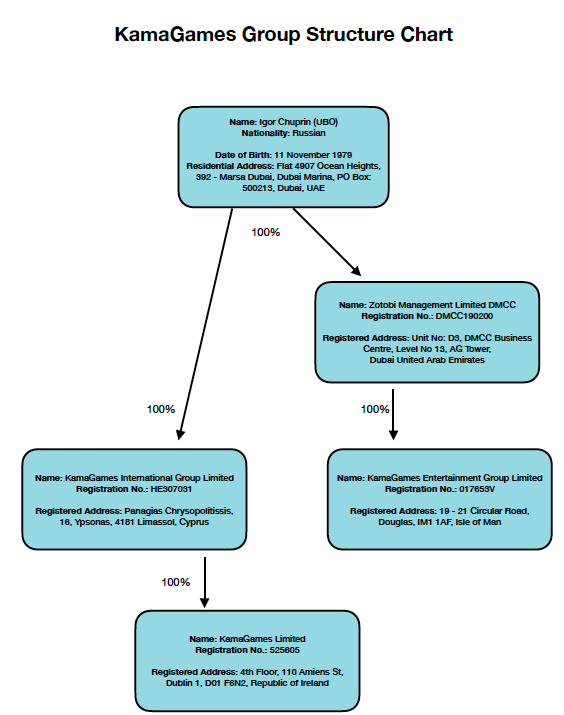
248. Although it does not include Wise Wave, which Mr Chuprin has also falsely claimed he owns beneficially, the chart demonstrates, at a glance, how Mr Chuprin has been able to exploit the position into which he was placed by the Founders, to perpetrate a massive fraud and breach of trust already. This he has done by exploiting the Founders’ strategic business pretence that he was the UBO of Zotobi, and them putting its cash dividends distributed to him as its legal shareholder and as trustee of the IC Trust, in bank accounts in his name (as will be explained in detail in the following sub-sections of this judgment). The chart above also demonstrates how, by the relief he seeks in these proceedings, Mr Chuprin is trying to expropriate from the Founders, all the KamaGames entities shown in the chart and their extremely valuable assets. The only thing that stands between him and success in that breathtaking, fraudulent enterprise, in which he has been assisted
by his witness Ms Kurulenko, is the valid and effective (as I hereafter find it to be), IC Trust.
C. g. Events leading up to the breakdown of the Parties’ relationship and the alleged removal of Mr Chuprin as trustee of the IC Trust on 4 November 2024.
249. Having considered all of the evidence and the Parties submissions relating to these events, I set out my findings of fact as follows. It is very clear to me from the content of the chats relied on by the Claimants at CWCS §559 et seq, which again I am satisfied are genuine and have not been forged that Mr Chuprin suffered a serious deterioration in his personal life and in his health resulting in separation from his wife. It is not clear when and for how long but it is recorded in Chat 4 at {G/622/277} row 4914 that in September 2023, he had rented an apartment from Ivan Tumakov and had moved out of the family home and was drinking excessively. It is also abundantly clear that he was struggling to cope with his work and complaining to Mr Sarapulov vociferously about the increasing burdens being placed upon him, about what he perceived as a lack of support from others in the business (particularly from the finance department) and about a lack of appreciation by his employers for the valuable work that he did, and the role he played. Whilst it is clear from the Claimants’ witness evidence, particularly that of Mr Butyrskikh to which I have previously referred, and the chats involving Ms Kurulenko who regularly upbraided him, that his performance of the administrative aspects of his work were not always diligent and efficient, and that he had to be reprimanded and told to perform them, he must have performed his principal role as the pretend UBO of the business with distinction. That is until the serious deterioration in his personal circumstances and health, and his dissatisfaction with his role and the way he was being treated by others in the business, led to him wishing to exit the business and demanding a massive pay off of USD 11 million from Mr Olomskiy. The Claimants have specifically asked me, at CWCS §566, to read Chat 4, rows 3460-3576 {G/622/192} in full. I have done so and find and accept as correct, the Claimant’s submission in that paragraph as follows:
“It illustrates (i) Mr Chuprin’s problems with alcohol, (ii) his increasing anger and desire to leave the business, and (iii) it provides the relevant context for what happened next. The chat also clearly records a point that Mr Sarapulov makes in his evidence: Mr Chuprin was tired of being a mere signatory, wanted to be taken more seriously, and was concerned about the introduction of new tax legislation and personal risks he might incur by continuing to sign documents.”
250. There is much in the chat to substantiate that submission. I found the exchanges on 24 March 2023, at {G/622/199} (following the advice of Mr Sarapulov which is quoted at CWCS §565) to be compelling evidence of all of the following: (i) Mr Chuprin’s role in the business; (ii) that he was not the owner of the company; (iii) that he had a drinking problem; (iv) that he was being urged to curb his drinking but rejected that advice; and (v) was in a very angry state of disgruntlement with his lot in the KG Business. In answer to Mr Sarapulov’s attempts to calm and placate him and his advice to stop drinking, Mr Chuprin responded thus:
“No. That’s not how we’re going to get through this crisis, Vyacheslav Ilyich. “Stop drinking” is a great mantra-answer, sure. You know the risks yourself. We’ve known each other for years, right? Don’t push me.
“Stop drinking” is a bad answer to specific questions. I raised those questions with AV [Ms Kurulenko’s forename initials] and with you. If neither of you has the competence to resolve them — I’m addressing the owner of the company.
Is that clear?
Vyacheslav Ilyich, I don’t really understand the ignoring?”
Mr Sarapulov tried again to placate him thus:
“Igor, no one is ignoring you. Get a good sleep, rest, regain your strength. And with a clear head we’ll discuss everything next week: what worries you, what concerns you, what ideas you have. Don’t wind yourself up. We’ll solve everything, we’ll overcome everything.”
After recognising the need for him to produce certain documents urgently, Mr Chuprin responded as follows:
“Vyacheslav Ilyich. My job for the last 15 years has been talking circles around people. Maybe I look to you like “the boy who signs documents”, but I instantly see when someone is giving me crap, ok? If you want to sit down and talk — the tone needs to change.”
251. I am also satisfied and find that from April 2023 (see the chat at {G/622/220}), Mr Chuprin’s role and status as a passport holder of an EU Country (Slovenia), which was vital for scheduled updating of KYC and UBO personal data by the banks holding IC Trust cash – and thus the continued availability of banking facilities for the KG Business and the IC Trust fund in Mr Chuprin’s name, was in serious jeopardy. Mr Chuprin had given details of his Slovenian passport to the banks and if it was discovered that the passport was a forgery (as it now transpires it was, from a letter from the Slovenian Ministry of Internal Affairs at {F/2713}) there was an obvious risk that the funds in the accounts might be frozen and the KG Business prevented from accessing its funds. I am satisfied and find that Mr Chuprin had told Mr Sarapulov there was a problem with the chip in his Slovenian passport before April 2023, but by November 2023, had to admit the passport was a forgery (see the chat at {G/622/282}). He told Mr Sarapulov he had bad news about the passport after making an enquiry at the embassy and had been told it was most likely forged. Mr Sarapulov had clearly understood the Slovenian passport Mr Chuprin had obtained was valid, and that there was only a problem with the chip. He was plainly incredulous on being told it was a forgery and questioned Mr Chuprin about the passport being accepted when he had flown with it, and it having passed checks with customs and banks. Mr Chuprin was rightly concerned that having flown with it, that made his situation worse. Mr Sarapulov was also concerned about Mr Chuprin’s use of a forged passport, and when he sought confirmation Mr Chuprin had handed it in at the embassy, and observed they must have assigned an application number, Mr Chuprin admitted that, “I gave it to the person who made it to have it changed” and Mr Sarapulov responded by saying “if he did anything illegal that's a serious offence”. Mr Chuprin then responded that we have the name and surname but “The person is nowhere to be found”. Mr Chuprin has plainly given false evidence to the Court in relation to his difficulties with the passport at Chuprin 8 §133(a), where he denied having any issues with any of his passports, in order to deceive me into believing that the particular chat referring to this difficulty, had been manipulated and forged.
252. Serious difficulties were plainly mounting for Mr Chuprin, and the next adverse event for him was the departure of his good friend (despite her stern treatment of him), Ms Kurulenko, from the KG Business. I am satisfied and find that she left the KG Business because her attendance and performance at work had deteriorated; and because of a serious deterioration in her working relationship with senior managers including Mr Kochubeev, who refused to work with her. In the result, her contract was terminated when she resigned pursuant to a settlement agreement dated 13 February 2024. It is clear and I find it to be the case, that she left the business embittered against Mr Olomskiy, at her treatment by him and with her termination payment. She claims she was wrongly accused of theft of a substantial sum of money prior to her departure; and that Mr Olomskiy had breached a promise she claims was made to her by him (which he denies making) in the early days of the KG Business, to give her a share of the business. She also alleges that she has been wrongly pursued in civil and criminal proceedings in Russia for the return of a Rolls Royce and properties she claims in her evidence to have bought for herself, but which evidence I find to be false. She also claims she has been intimidated by threats to her and her family, and by her husband being assaulted (which claims of intimidation I deal with specifically in Section D of this judgment below). Otherwise, it is not for this Court to determine the rights and wrongs of her treatment by Mr Olomskiy prior to, and upon her departure from the KG Business; nor is it necessary to decide precisely why she has been motivated (eventually) to come before this Court to tell many lies in support of Mr Chuprin’s false case, and in order to damage Mr Olomskiy. She has done this in the most argumentative of witness statements that have plainly been drafted for her by someone else, under Mr Chuprin’s guidance or prompting, and/or to accord with the details of his false case and evidence (which written evidence she was often unable or unwilling to substantiate under cross-examination). I am therefore satisfied and find, for all the same reasons I have found Mr Chuprin’s case and evidence to be lies and fabrications heretofore in this judgment, that Ms Kurulenko’s evidence in support of his case, is also a package of lies and fabrications.
253. It is against this background of disgruntlement and personal adversity that I find Mr Chuprin was seeking a way out of the KG Business with a substantial pay-off upon him leaving. I am satisfied that Mr Olomskiy has given a truthful account of Mr Chuprin’s approaches and proposals in this regard at Olomskiy 1 §§11.1-11.6, including the obviously drunken and threatening content of them at various times. Likewise, I am satisfied Mr Sarapulov has given a truthful account of Mr Chuprin’s desire to leave the KG Business, his demands for a pay out and his behaviour leading up to his removal as trustee of the IC Trust at Sarapulov 1 §§10.1-10.16. I have read and considered all of the exchanges in the Chat 16 relied on by the Claimants at {G/865} and as already made clear, I accept and find that they are genuine messages which have not been forged or manipulated in any way. All of that evidence, substantiates to my satisfaction the submissions and summary of facts leading to Mr Chuprin’s removal as trustee of the IC Trust on 4 November 2024, contained in the CWCS §§578 – 587. I accept those submissions as a true and accurate recounting of how Mr Chuprin acted and why it became necessary for him to be removed from his position as trustee. Extracting the more significant features from those submissions in summary, I am satisfied and find as follows:
(a) On 17 November Mr Chuprin sent Mr Olomskiy a message saying he would like to discuss his exit from the organisation (as he referred to the KG Business). Mr Olomskiy discussed him leaving with Mr Sarapulov, who then discussed the matter with Mr Chuprin. After saying he was emotional when he had contacted Mr Olomskiy in November and denying he had raised the question of him leaving, Mr Chuprin then said that if he was no longer needed, he would leave - subject to the parties mutually agreeing acceptable terms. When Mr Sarapulov asked him what terms he meant, Mr Chuprin said he had discussed an exit figure of USD 3.5 million with Mr Olomskiy in 2017 and that this was his benchmark. Mr Sarapulov discussed the matter further with Mr Olomskiy and reverted to Mr Chuprin with Mr Olomskiy’s requirements for Mr Chuprin, before he would discuss the terms of an exit, including solving the passport problem he had created by getting a backup pink slip to provide proof of EU residency for the purposes of complying with EU sanctions rules; and taking steps in the UAE, to put assets into a UAE fund to avoid falling foul of sanctions.
(b) Over 21 and 22 January 2024, Mr Chuprin contacted Mr Olomskiy who offered him an exit payment of USD 1.5 million, but Mr Chuprin stated he wanted 11 (million) which he also put in Chat 16 twice {G/865/8-9}. This was a chat in which Mr Chuprin was clearly emotional and was told by Mr Olomskiy he was drunk; and that once he sobered up tomorrow, (row 13), Mr Sarapulov would be in touch. Mr Chuprin at first denied being drunk, he wrote in a mixture of evident emotions of anger, respect, regret; and then admitted at one stage, that he was drunk. It was at this point and in this context, just before writing he would negotiate only with Mr Olomskiy and demanding 11 million (which he later helped himself to in Euros from a Trust Bank Account), Mr Chuprin wrote the words I have already referred to:
“For many years my profession was to lie masterfully. I am very good at it. A fucking virtuoso. Like in Hollywood movies. Don’t send that Ilych of yours to me. P.S. surprising that he even called me yesterday”
(c) A long gap in the chat ensued until 25 June 2024 when Mr Chuprin sent a message simply containing the number 11 – obviously the figure he was demanding for his pay-off. The next day, 26 June, Mr Chuprin asked, “Is there some valid reason you are not talking to me?”. There followed another conversation on the chat when Mr Chuprin was rude and respectful from one message to the next, and plainly emotional, with Mr Olomskiy offering to call him, telling him “well let me know when you are sober”.
(d) I accept Mr Olomskiy’s evidence, which is confirmed by the chat that on 7 July 2024, he spoke twice with Mr Chuprin who was drunk and asked him how he had arrived at the figure of 11 million he was demanding, but he did not have an answer to that question and the call ended. Mr Chuprin then called back but he was too drunk for Mr Olomskiy to speak to him. The chat shows {G/865/12} row 45 that after the call ended, Mr Chupin sent another message with just the number 11. He then wrote the threat,
“Something I forgot to say. Some very bad people are watching you.
“Everyone knows about us” (which Mr Olomskiy thinks is a typographical error and that Mr Chuprin meant to write “they know everything about us”)
And then another typographically messed up demand for his 11 million pay off “01:01” or “1:1”
(e) As for Mr Olomskiy’s evidence of his belief that Mr Chuprin had hired a hitman to kill him, and of him being told by a contact in law enforcement, that a man called Dynnikov was waiting to find ways to kill him, at paragraph 11.7 of his first witness statement, I do not doubt that Mr Olomskiy has formed that belief having regard to the threat Mr Chuprin made to him in the chat between them, the illicit payment of a large amount of IC Trust funds to Mr Borisenko by Mr Chuprin, and what he has been told about Mr Borisenko and Mr Dynnikov. I make it clear however, that I am not satisfied that Mr Chuprin has done what Mr Olomskiy believes he has done. The evidence before me does not justify such a finding, although it does make it easy to understand Mr Olomskiy’s belief arising, in the circumstances of Mr Chuprin’s threatening behaviour and his criminal associates, as Mr Olomskiy believed them to be.
(f) It is clear from the evidence of Mr Sarapulov, that from January, 2024, Mr Chuprin was, so to speak, going off the rails with drink, misbehaving and rude to fellow employees and not performing his fundamental duties as trustee of reporting financial matters to the financial department of the KG Business. Mr Misevich was so seriously concerned that on 23 August 2024, he wrote an email to Mr Sarapulov {F/2543T/1} expressing his concern that he and the Trust’s financial specialists had not received information about the balances in the trust accounts and what money had been used for, since the summer of 2023. He expressed the belief Mr Chuprin had simply stopped performing his duties as trustee and this required an investigation and decision on the matter.
(g) I am satisfied and find that Mr Chuprin was informed by Mr Sarapulov of the Founders' intention to open a new Bank Account for the IC Trust with the Emirates Investment Bank (“EIB”), that he also explained to him that EIB permitted trust accounts and that he was sent the account opening form which showed Mr Misevich as the UBO. It would have been obvious to Mr Chuprin from this development that his days as a pretend UBO (needed in other jurisdictions to satisfy KYC requirements of bankers holding Trust Funds), were numbered; and that he would lose legal control over the funds if, and when they were transferred into the EIB account. I am satisfied that the EIB bank “account opening pack”, disclosed by Mr Chuprin and dated 20 September 2024 {F/2545/1}, was sent to him exclusively via AnyTalk, as per Chat 8, rows 1511-1529 {G/722/77}; and that Mr Butyrskikh gave him detailed instructions on how to fill it in on 20 September 2024 in Chat 8 at {G/722/78}. That Mr Chuprin could see that any leverage he might have had, to extract a substantial pay-off from Mr Olomskiy, because of his previously crucial role as the pretended UBO bank account holder, was fast disappearing, is obvious from his question and Mr Sarapulov’s answers in Chat 8 at {G/722/77} rows 1524-7 as follows:
“IC What’s the plan with them [EIB], what for, what are the perks, and what will be required from me in the future?
VS They’re one of the few banks willing to open accounts for companies under a trust structure—as well as trust accounts themselves—quickly and on decent terms. We’ve got pre-approval, but either way, it’ll only be final once it clears compliance. This will allow us to operate officially with our real structure fully disclosed. It immediately mitigates risks with our current banks; if disclosing the trust to them makes it impossible to pass compliance—or if we simply prefer not to reveal the trust setup to them at all—we can just close those accounts once the ones at this new bank are active. This will ensure the business keeps running as usual
Since Vadim is the beneficial owner in the current structure, he’ll essentially be the primary focus for KYC and compliance checks every time
Also, with all the old, current banks, there’s a serious risk of them enquiring about the EU citizenship history—and we don't need those risks at all. If anything, we need to move faster to new banks with a proper structure as it stands. The trouble is, there aren't many banks like that willing to take us on.”
(h) It is clear and I find, that Mr Chuprin has lied repeatedly to me about the opening of this account and sought to deceive me and prejudice my view of matters from the early stages of these proceedings, and in his main evidence in Chuprin 8 for this trial, by his false narratives about it. His evidence in Chuprin 4 {E/31/5} §§22-26 and Chuprin 8 {C/13/398} §§116-126 in relation to the opening of this account is dishonest and misleading in its effect. I am satisfied that the true and correct evidence relating to the use of and payments into the two EIB accounts opened, is that provided by Mr Butyrskikh in Butyrskikh 2 §§2.4-3.12 and as provided by Trowers & Hamlins in their letter of 4 July 2025, to Mr Churpin’s solicitors, Bracewell at {F/2683}. I am satisfied and find that Mr Chuprin’s allegations that the Founders or Claimants, were secretly and unknown to him, opening the EIB account to siphon off Zotobi’s funds into Mr Misevich’s ownership, are also false, dishonest and without foundation. The proposed movement of funds from KGEGL to Zotobi was in the ordinary course of business and inter-company dealings within the KG Business and it was being frustrated by Mr Chuprin’s refusal to act in accordance with his duties as an employed trustee. It was effectively the start of his course of interference with, and then massive defalcations from the funds of the KG Business that were payable to Zotobi and ultimately into the IC Trust. Mr Chuprin has effectively suborned Mr Djibilyan a director of KGEGL in the Isle of Man, to act, refuse to act and give false evidence in support of his false case and his gross breaches of trust already committed, and the even worse breaches, which he is trying to perpetrate in these proceedings. It is unsurprising, as I find to be likely, that Mr Djibilyian has, at the eleventh hour, thought better of supporting Mr Chuprin (even though he has been persuaded to give false excuses of intimidation to be passed on to the Court, without any affirmation of the truth of them) and has refused to give oral evidence and be cross-examined on his behalf. I am satisfied and find that Mr Chuprin was a trustee who was obstructing the effective administration of the trust in breach of his duty, by refusing to assist in the opening of a new and advantageous EIB account to receive Trust Funds.
(i) I find and accept that it was in all of the foregoing circumstances of Mr Chuprin’s behaviour and persistent and repeated breaches of duty, that the Founders decided to replace him as trustee of the IC Trust on 4 November 2024, by Mr Sarapulov’s lawful exercise of his powers under clause 20.1(e) of Schedule 1 “Administrative Provisions” to the IC Trust. The Court did indeed wonder (as the Claimants recognised it would at CWCS §587) why it took the Founders so long to remove Mr Chuprin in light of his rogue behaviour. In my judgment, the convincing answer to that question, as it was put to Mr Sarapulov by Mr Cook - why was he left at the helm of this business until the tail end of 2024? - was given, poignantly, sadly, spontaneously and truthfully by Mr Sarapulov as follows:
“A. (Interpreted). This is not true. Chuprin was always a nominee. And in life of each one of us sometimes dark times happen. And the fact that Mr Chuprin ran into problems with his wife and that he stopped discharging his loan, and we discussed this with Evgeny and it's exactly for this reason, upon our discussions with Evgeny, we decided to increase his salary, which was done in August 2023. Chuprin continued to carry out his functions. And we continued to trust him right until the last moment. Trust is the last thing that we part with in our life. Only when his – only when he started to threaten Evgeny in the summer of 2024, only when he's completely stopped reacting to requests and questions from Vadim Misevich and completely went non-communicado. Only then we took a decision to replace him with another trustee. We have a trust which we're absolutely confident was protecting all our interests.”
(Day 3, 04/03/2026, 43:18-44:9, Mar. 04, 2026)
C.h. The events following Mr Chuprin’s alleged removal as trustee - what they amount to and what they demonstrate.
254. What Mr Chuprin was doing before his removal as trustee (when, as I have already indicated, he must have known he was about to be removed) and since; has been to act in the most flagrant breach of trust, involving serial misappropriations of substantial amounts of trust funds from bank accounts under his control, which the Claimants have estimated to be in the region of circa USD 28 million. This figure does not include funds misappropriated or misused from trust companies within the KG Business, also under Mr Chuprin’s control. Whilst the court is not in a position, on the basis of the evidence before it at trial, to quantify the total amount of fraudulent defalcations by Mr Chuprin (which will fall to be fully determined upon the inquiry and accounts I have ordered), I am satisfied they amount to many millions of US dollars worth of IC Trust Funds. In particular, I am satisfied and find that there are certain identifiable transfers and uses of IC Trust funds by Mr Chuprin, that have been proved (and in some cases admitted by Mr Chuprin) in the evidence placed before me in the course of the proceedings, which I am satisfied and find to be fraudulent defalcations by Mr Chuprin. I am also satisfied he has also sought to seize control, by fraudulent means, of what he calls the publishing side of the KG Business, which essentially comprises all the companies in the structure chart reproduced above and Wise Wave, which I will deal with next.
255. With regard first, to his defalcations from IC Trust funds, I am satisfied and find Mr Chuprin began emptying the IC Trust bank accounts in his name and under his control in October 2024. I accept the Claimants' submissions at CWCS §§589, 590, 592 as true and correct and find that Mr Chuprin committed the defalcations from IC Trust funds listed in those submissions. These defalcations are proved to my satisfaction by the admissions of Mr Chuprin that the funds have been transferred and disposed of in the amounts and to the persons named (or unidentified), in the manner described, and by the documentary records of the transfers eventually produced by him. A particularly useful exposition of Mr Chuprin’s defalcations has been prepared by the Claimants’ solicitor Mr Showler in his twelfth witness statement produced as Exhibit MS12 at {XB/2/4} – {XB/2/6}. This is a tabular compilation of transfers from Trust Accounts, between 4 August 2023 and 1 October 2025, which had been discovered by the Claimants, at the time it was produced (27 February 2026). The table has inserted in red type, starting with Mr Chuprin’s removal as trustee, significant events in the proceedings at various dates. These red insertions demonstrate a correlation of substantial defalcations from trust funds taking place at points in time and/or upon events occurring in these proceedings, when Mr Chuprin’s control of funds was under particular threat and he obviously decided to misappropriate more trust funds in case his depredations were to be prevented. The most striking example of this perhaps is at ({XB/2/5} row 61) which shows that following service of the proceedings upon him by Kashwani Law Firm (which Mr Chuprin refused to accept) on 30 December 2024, Mr Chuprin transferred EUR 11 million from a Zotobi bank account to his personal account, two days later, on New Year’s Day 2025. This is the number of millions (but in a different and more valuable currency) which Mr Chuprin had been demanding from Mr Olomskiy as the pay-off he claimed he was entitled to, upon leaving the business. I find this to be the most cynical of his depredations and probably reflects his deranged belief of entitlement, which (though he has misappropriated and is trying in these proceedings to misappropriate much more), first motivated his fraudulent breaches of trust, and his entirely false defences and claims before this Court.
256. This tabular compilation of defalcations at {XB/2/4} – {XB/2/6} was used to cross examine Mr Chuprin at {Day12MT1/93} et seq: references to row numbers hereafter are to rows in that table. It is suggested in the DWCS, that these extractions of what I find to be IC Trust Funds, should be recognised as withdrawals of funds by an honest man seeking to protect his assets which were under attack by a group of fraudsters in the persons of the Founders and Mr Abramenko. This is said to be evident from the fact that these extracted funds were not spirited away into untraceable and inaccessible holdings of cryptocurrency etc., but paid away in plain sight to himself, friends and family. I find this to be a thoroughly vacuous submission. Mr Chuprin decided to commit these massive frauds at a time when his life was in disarray (and his health and behaviour was affected by drink), when his vital position in the KG Business was about to be circumvented and it became clear to him that he was not going to get the pay-off he believed was entitled to, and was demanding. He had to act swiftly and did so, to perpetrate massive defalcations in various ways, which were probably the best he could devise in the circumstances. To give a sufficient flavour of what the documents eventually disclosed and cross examination about these depredations revealed, it is sufficient for me to recount my findings in summary as follows.
(a) Mr Chuprin started by misappropriating huge amounts of cash (AED1.6m in total on 30 and 31 October 2024), from IC Trust funds which he stashed in his deposit locker (without precise and certain identification of that locker “I think it was Emirates NBD”). He subsequently made further massive cash withdrawals which he has not accounted for, or disclosed their use or whereabouts. He has placed substantial funds in the hands of his wife, who must still be willing to hold funds and property he has misappropriated to his order, whatever their marital difficulties. She has not been called or come before me, to give evidence to explain or justify her receipt of such funds and property or tell me of the terms on which she received the funds. He has placed massive amounts in the hands of his brother, who, likewise, has not come before me to explain or justify his receipt of such huge amounts, or tell me of the terms on which he received the funds. On the same day, 6 November 2024, he paid over USD 1 million to his brother, he also paid the same amount to his friend Mr Borisenko.
(b) Mr Chuprin has used IC Trust funds to purchase real property in foreign jurisdictions and transferred large sums of money to unknown accounts in Russia. He paid for a Greek Golden Visa and paid a large amount to the Vanuatu passport programme and plainly has the means and a destination to flee to, if he so chooses; and of which flight, I find there is a high risk, upon this judgment being handed down. He has paid over USD 3 million to LLC Management Co Alpha Capital for a purpose which he has not explained.
(c) When Mr Chuprin was asked in cross-examination {Day12MT1/96:4} – {Day12MT1/98:17} about his near immediate response to being served with proceedings on 30 December 2024, being to take EUR 11 million from one of the Trust Accounts, he gave what I find to be a contrived and false answer that this was him taking his yearly dividend (though he admitted there had been no declaration of a dividend by Zotobi) saying he had studied the whole question of when unpaid dividends were supposed to be distributed with a reference to the audit report of Zotobi. When it was put to him it was the same number he had demanded from Mr Olomskiy, he lied and falsely denied he had made the demand, and was quick to point out that the withdrawal was in Euros. When he was asked where this EUR 11 million was now, his response was a model of imprecision, obfuscation and lack of particularity, which I find to be consistent with, and what would be expected from, a fraudster intent upon preventing tracing the destination and recovery of his ill-gotten gains.
“A. It was paid to my personal account and after I divide them for a different family needs.
Q. So you divide it amongst family members. You disbursed it amongst family members. Is that right? Is that your evidence?
A. I did not disburse it. It was already a number of needs, and I was actually expect the dividends to arrive to understand that my current financial picture, and the start, actually using the money.
Q. And there is no -- you don't -- in the details of the transaction -- give any detail or information as to where the funds were being transferred to, do you? You avoid doing that.
A. Majority of that funds went to my close family members only, or to my own account in the places of my presence or interest. Cyprus or Greece. Nowhere else. In general it is like -- the picture is like this.”
(Day 12MT1, 17/03/2026, 98:1-98:17, Mar. 17, 2026)
(d) Just as telling that this was a fraudster-in-action trying to conceal for as long as possible, the fact of his misappropriation of trust funds and his aim to put misappropriated funds beyond reach as far as he could, were Mr Chuprin’s further answers in cross-examination trying to explain away his obvious defalcations. One defalcation (Row 76) was a million Euros to “Supreme Ebanq Fintech Sarawak Berha[d]” which was explained thus:
“A. Yes. This was a payment on behalf of my friend who couldn't make it himself from Russia. It is a broker.
Q. I see, and in which jurisdiction did you say that was?
A. The bank I think, the broker himself, Indonesia, and the bank account I think Singapore, if I remember it correctly.”
(Day 12MT1, 17/03/2026, 101:25-102:5, Mar. 17, 2026)
Another model answer of imprecision, obfuscation and lack of particularity.
(e) Then what I find to be a most unlikely, and was an unsubstantiated, explanation for what Mr Reed reasonably suggested was the withdrawal of a suitcase full of cash AED 750,000 (Row 84) on 12 March 2025, which explanation was that it was normal practice in the UAE to use cash and it made him feel more safe. This he claimed, was in circumstances where he was receiving “enormous enormous requests” from banks with urgent KYC questions, and his bank manager had queried finding him in “World Check”. So, what does he do to deal with these problems? He goes into the bank (if not with a suitcase with some similar receptacle) and withdraws a huge amount of cash. I find that to be an incredible response to an incredible situation he claimed to be in; and simply another lie to explain away his defalcations from the IC Trust Fund.
(f) Finally, I mention in this summary of manifestations in the evidence before me of a fraudster taking action to conceal or not reveal misappropriation funds, conceal their whereabouts and frustrate tracing and recovery, Mr Chuprin’s inexplicable (if he were the true owner of the assets in dispute in this case and an honest man acting honestly in relation to them, before the Court) failure to plead to the Claimants’ pleading of the balances in the disputed Trust Accounts, with an honest and frank response that the balances are not correct and at least a summary explanation of and justification for what has become of the funds no longer in the accounts. Even more demonstrative of Mr Chuprin acting in bad faith and attempting to conceal his defalcations for as long as possible, was his refusal to produce the relevant bank statements on the plainly meritless ground that pursuit of them was an “Illegitimate fishing expedition”, and his failure to be open and frank with the court before and/or at the time of giving his undertaking to me of 28 March 2025. I found his explanation for this lack of frankness {Day12MT1/104:4-13} to be false and contrived to include his meritless, prepared answer and submission, that he did not conceal his ill-gotten gains in payments to virtual people or crypto currencies and that he was protecting his family. As I have found and demonstrated in this summary, Mr Chuprin’s serial and manifold methods of extracting funds from the IC Trust funds and his holding of them in manifold forms, achieved in a comparatively short period of time, has not been confined to placing funds or assets with family members. In respect of large amounts of cash or unknown recipients, it might just as well have been placed with “virtual people” and or in crypto currencies (in fact it I find it likely some trust funds have been placed in digital financial assets or crypto currency – see Row 48 – 31 million roubles or USD 403,930 potentially identified as a payment for digital financial assets). The excuse of protecting family members for not being frank with the Court from the outset, is impossible to accept as legitimate and genuine, in circumstances where it was Mr Chuprin who has decided to place what he claims to be his personal funds or assets purchased with them, with those family members. It is inconceivable he was not advised that he would be required to disclose what he had done with funds the subject of the dispute, eventually, in these proceedings. I find it much more likely that he was attempting to conceal, for as long as possible, precisely what he has done with Trust funds to facilitate their dispersal and concealment, and to the best of his ability, put them beyond the reach of the Claimants, and the processes of tracing and recovery.
257. As already mentioned, at the same time as Mr Chuprin was engaged in the extensive defalcations I have summarised above, he also embarked upon a course of conduct designed to exert his shareholder control over all of the KG Business corporate entities shown in the structure chart above. This was attempted with complete disregard for the fact that he held the shares as the trustee of the IC Trust and by carrying on the pretence that he was the real UBO, directly or indirectly, of all of the entities in that structure and also of Wise Wave.
258. I accept the Claimants' submissions at CWCS §591 that:
“On 31 December 2024, Mr Chuprin sent emails to all directors of KG Ireland, KG International, and KG Entertainment with his lawyers from Bracewell in copy asking them to comply with his instructions going forward. (at {E/43/66}, {E/43/85} and {E/43/86}) This was a step taken directly in furtherance of the corporate raid. It went so far as to require the directors to stop and report all communications from Mr Sarapulov, Mr Abramenko, and Mr Misevich, and sign a draconian Non-Disclosure Agreement, a breach of which could result in their “immediate termination” (at {E/43/78} Clause 3.3.1). That the directors of KG Ireland and KG International refused to comply and to do Mr Chuprin’s bidding is telling, and Mr Chuprin went as far as to seek to remove Mr Yuri Kharchenko for this reason. Copying Bracewell’s lawyers into the emails was undoubtedly intended to intimidate the KG employees.”
259. I also accept the truth, accuracy and characterisation of Mr Chuprin’s intimidatory conduct, supported by his lawyers Bracewell, in accordance with their instructions from him no doubt, as recounted in the Claimants’ submission at CWCS §595. Mr Djibilyan as a nominee director of KGEGL as I find in truth and reality he was, succumbed; and proceeded to act as if he was a real director (aided by a co-director, a Mr Krentz, who he appointed for back-up it seems) to help Mr Chuprin to fraudulently take hold and control of KGEGL in the Isle of Man. This, as I have explained, was the vehicle through which the substantial revenue from the games, on the Apple and Google platforms, was routed to Zotobi, by virtue of the Distribution Agreements, I have referred to above. The potentially devastating (of the whole KG Business) course of conduct the Directors of KGEGL embarked upon in support of Mr Chuprin’s fraudulent “corporate raid” as the Claimants’ have aptly described his conduct, is well described and substantiated in the evidence of Mr Abramenko at Abramenko 4 §§4.1-4.14, which evidence I accept as true and correct. That conduct, which in its most threatening aspects, involved termination notices of the Distribution Agreements, being served by Mr Krentz of KGEGL upon KG Ireland and Wise Wave, with threats to disclose them to Apple and Google, led to injunction proceedings in the Isle of Man. Those two sets of injunction proceedings were allocated to me in another role and office I coincidentally hold, as a Deemster of the High Court of Justice of the Isle of Man, and I became seized of them for return date hearings, as a result of the co-operation and agreement of the Chief Justices in the Isle of Man and in this Jurisdiction. Whilst it is true and I find, that Mr Abramenko was in breach of his duty of full disclosure to the Court in those proceedings, and was not open and frank in his evidence before the Court, I am now able to find and do find, that those injunction proceedings were entirely justified and necessary. Mr Abramenko’s conduct and actions in breach of his duties to the Court and in breach of the standards of conduct to be expected and required of a member of the legal profession, and of New York State Bar, are unacceptable; and something he may have to answer for elsewhere. They do not however detract from the truth of his evidence and justification for the applications for injunctions that were brought. His behaviour although inexcusable and not in any respect condoned by this Court, is perhaps understandable in a corporate, in-house trusts and tax lawyer, whose IC Trust, subsequent advice, business strategy and UBO pretence, had combined to equip Mr Chuprin with the means he was and is still employing, to expropriate the Founders, Mr Abramenko’s employers in effect. On any view, Mr Abramenko’s misconduct pales in comparison to the massive fraud and breach of Trust that Mr Chuprin has perpetrated and is still perpetrating. Having regard to all the evidence before me, the Claimants’ analysis in CWCS §596, of what Mr Chuprin was doing and intending, by orchestrating, or (even if I was wrong to make that finding) by allowing (when he could certainly have prevented it), what the Directors of KGEGL were doing in the Isle of Man to put the KG Business in such peril, serves to confirm all of my findings made hitherto, that Mr Chuprin was not a founder or owner of that business.
260. Finally in their written closing submissions (CWCS §597), the Claimants have referred to evidence of further misappropriation of Zotobi’s assets, which has been discovered as a result of further disclosures by Mr. Chuprin, pursuant to the order for such disclosure I made on 27 April 2026 {B/27/1}. These alleged misappropriations are detailed in paragraph 4.4 of the sixteenth statement of Matthew Showler dated 19 June 2026 {E/115/1} which was filed in support of the Claimants’ application of 22 June 2026, for the further interim relief recited in paragraph 1.4 of that statement. That application was stayed by my order of 25 June 2026 for reasons of impracticability and unfairness in dealing with it in advance of the final stage of the hearing in the trial. In those circumstances, the Defendant has not responded to the application but has had an opportunity to respond to what is alleged by the Claimants in Mr Showler’s sixteenth statement at §4.4 and in the table of alleged misappropriations from Zotobi he has presented at {E/115/35}, which is relied on in the CWCS at §597. This opportunity to respond was in circumstances where the Parties were asked to provide their suggested orders in the event either prevailed; and their submissions on the form of those orders, that should or should not be granted, depending on the findings that were made and which party or parties prevailed. Whilst there is strong evidence that has been placed before the Court of further substantial misappropriations by Mr Chuprin, of funds belonging to Zotobi, which is part of the IC Trust Fund, I do not consider it would be appropriate to make findings in this judgment relating to those allegations having regard to the fact that they were not canvassed in evidence at the trial and the application for relief in relation to them, has been stayed and not responded to. In my judgment, these allegations are matters that ought to be considered and resolved in the process of the inquiry and account I have ordered, in respect of the Defendant’s dealings with IC Trust assets. The position is entirely different with regard to properties purchased by Mr Chuprin in circumstances where I am satisfied and find on the balance of probabilities, from the evidence before me at trial, that Mr Chuprin has purchased those properties, using money he has misappropriated from the Trust Fund.
D: Issues arising from allegations of interference with the trial process.
a. Alleged intimidation of witnesses by the “Claimants and associates”
261. The Defendant has made serious allegations of witness intimidation against “the Claimants and associates” (as the allegation is generally levelled at DWCS §88), in which it is claimed they have intimidated Mr Djibilyan and Mr Minkov out of giving evidence on his behalf; and likewise with the same effect upon Ms Kurulenko, until in a late volte face, during the course of the trial, when she changed her mind and indicated that she would give evidence on Mr Chuprin’s behalf. The allegations of intimidation of Ms Kurulenko in Russia have been made and directed against Mr Olomskiy. The allegations of intimidation of Mr Minkov, have been made and directed against Mr Denis Dranitsyn a former shareholder in KG Moscow and associate of Mr Olomskiy, who is Mr Minkov’s landlord; and against Mr Abramenko, who is said to have exerted pressure on him not to give evidence, through a former business partner of Mr Minkov, a Mr Raitsyn. The allegations of intimidation of Mr Djibilyan, which are claimed to have intimidated him out of giving evidence orally at trial, as contained in his email of 12 March 2026 {E/89/4}, are based on two warning messages he claimed (to his solicitors but not to me in this Court) to have received without identifying who sent them or providing any verifiable details of the sending of them such as sender, date, time or medium by which they were sent. I am invited to accept they were sent and to infer they were sent by or on behalf of the “Claimants and associates”. Mr Chuprin has also alleged (Chuprin 8 §138-140) that he has been the victim of an attempt to kill him by poisoning whilst eating at a restaurant in Limsassol in Cyprus. He has embellished this allegation, as he has done with much of his false evidence before me, with what I find in this case, to be dramatic, and wholly unsubstantiated claims that:
“I have been informed by reliable sources that there is a credible threat to my life. This information came to me through officials working in the criminal investigation department of the Limassol police after I visited Cyprus in October this year.
I have since been advised by professionals with experience in intelligence services that an attempt on my life had likely been made while I was eating in a restaurant….I have been advised that they [his claimed symptoms of severely elevated blood pressure and heart rate] are typical bodily responses to techniques employed to create the appearance of a natural death”.
without identification of his “reliable sources”, or of the “officials in the Limassol CID”, or of the “professionals with experience in intelligence services”, or of the occasions and circumstances in which he was so informed or advised
262. After advancing his detailed submissions and references to the evidence of intimidation Mr Chuprin relies on at DWCS §§82-88 (which submissions and evidence, I have considered in depth and detail, but which it is not necessary to recite in in this judgment), Mr Cook made the following submission in conclusion, which contains the whole purpose and potential relevance of the allegations of intimidation placed before me:
“Accordingly, the Court should take these clear examples of witness intimidation into account when assessing the evidence, and the imbalance of witnesses between the Claimants and Mr Chuprin. Further, if Mr Chuprin were in fact a bare nominee as the Claimants allege, it is wholly implausible that the Claimants and associates would take such aggressive steps (including bombing the house of Ms Kurulenko) to dissuade potential witnesses from cooperating with him. The natural inference for why these steps were taken, is that Mr Chuprin is the true owner of the business, and the Claimants and their associates consider that the only way to stop the truth from coming out is through violence and threats.”
(emphasis added)
263. I have conducted the most minute and detailed chronological analysis of all of the evidence in this case, from before the founding of the KG Business, concerning Mr Chuprin’s involvement with it, and with Mr Olomskiy and his earlier businesses, all the way up to the trial before me. On that analysis, as is clear from all of my findings hitherto in this judgment, I am satisfied and have found that Mr Chuprin was in fact nothing more than a bare nominee. He played no part in founding the KG Business and was never anything more than a subordinate employee (albeit an increasingly important one); and he is not a true owner of any part of it. I have also found and am satisfied, that Mr Chuprin has committed and is continuing to commit, a fraudulent expropriation of IC Trust assets, which even so far, has been staggering in its brazenness and scale; but is even more staggering in its ultimate objective, which, in common parlance, is to steal the whole KG Business now held in a trust, from its Founders and true owners. In pursuit of his fraudulent objective, Mr Chuprin has managed to enlist the support of another, initially reluctant, disgruntled former employee, Ms Kurulenko, who has herself falsely claimed to own property of Mr Olomskiy or his company KG Moscow, which does not belong to her, and together, they have acted in concert, that is, conspired together, to give false evidence before me, in support of Mr Chuprin’s fraudulent case. In circumstances where the Founders and Claimants have throughout been aware of the truth of all of this, I have no hesitation in accepting the proposition in Mr Cook’s submission highlighted above, on the premise that Mr Chuprin was a bare nominee as I have now found to be the case. I therefore find, as Mr Cook put it, (including for the further reasons which follow in dealing with the specific allegations of intimidation) “that it is wholly implausible that the Claimants and associates would take such aggressive steps (including bombing the house of Ms Kurulenko) to dissuade potential witnesses from cooperating with him”.
Alleged intimidation by poisoning of Mr Chuprin
264. Dealing with specific allegations of intimidation, I begin by rejecting Mr Chuprin’s fanciful and wholly unsubstantiated allegations in {Chuprin 8 §§138-140} that “attempts have also been made to intimidate me”, with the objective of forcing him to give up his defence, that “there is a credible threat to my life” and that he had been advised “an attempt on my life had likely been made while I was eating in a restaurant”. Even Mr Cook, who has argued every other aspect of Mr Chuprin’s case with commendable vigour and distinction, could not formulate any argument to substantiate Mr Chuprin’s melodramatic and prejudicial allegations in the DWCS at §86, where the best he could submit was that “it is at least clear from his testimony that Mr Chuprin genuinely believed he had been poisoned”. Having heard Mr Chuprin cross-examined on this alleged poisoning at {Day12MT1/57:12} – {Day12MT1/59:24} it is clear to me and I find, that this story is another piece of incredible fiction, designed to further his fraudulent case and malign the Claimants. If Mr Chuprin did have a hypertensive incident and attend at a hospital in Limassol, of which there is no independent supporting evidence, and informed the staff that he thought he had been poisoned as he claimed; and was told they could not do the necessary blood tests and he would have to go to Nicosia and be hospitalised there; it is incredible there would have been no record or action taken by the medical staff (if only to protect themselves, including probably calling the police). It is also incredible that if he genuinely thought he had been poisoned, Mr Chuprin would have done nothing to have it investigated but instead, simply got on a plane back to Dubai when his blood pressure returned to normal.
Alleged intimidation of Ms Kurulenko
265. As for the allegation that Ms Kurulenko has been intimidated by agents of Mr Olomskiy, acting on his instructions, out of giving evidence for Mr Chuprin, this is an allegation which is made by a witness I have found to be a serial liar, an accomplice to Mr Chuprin in the fraud he has perpetrated and continues to perpetrate, who I have found on the evidence before me, has herself misappropriated valuable real and personal property, ultimately belonging to Mr Olomskiy or KG Moscow, and who has an axe to grind with him, concerning her treatment upon leaving the KG Business. She is not a credible witness and absent compelling independent or extraneous corroborating evidence confirming her evidence, it would be impossible to believe anything she has told me.
266. In contrast, I am satisfied that Mr Olomskiy has come before this Court and has told the truth to the best of his ability, recollection and involvement in the matters I am required to decide. In relation to these allegations of intimidation, I am satisfied and find that he has told me the truth when he denied instigating, or having anything to do with any intimidation of Ms Kurulenko (or anyone else) out of giving evidence for Mr Chuprin. I found his denials of the allegations and responses in support of them under cross examination, to be compelling, genuine and true. I found his evidence on {Day4MT1/85} - {Day4MT1/88} before Ms Kurulenko had decided she would give evidence, despite the alleged intimidation put to him, to have been calm, measured and genuinely revealed the truth of how he felt (and what he is doing in these proceedings and what they have revealed about Ms Kurulenko’s lies), when he said:
“Q. Now, Mr Olomskiy, you are behind these approaches and attacks on Ms Kurulenko, aren't you?
A. (Interpreted). No, that is not true. I'm quite upset actually when I read this document, because this is not the methods that we use. The methods that we use is file a complaint, file a claim, in order to obtain judicial relief and hopefully getting those assets back to us. Under the circumstances, there's absolutely no point in our even thinking about doing any of the things that are listed in this report.
Q. Well, Mr Olomskiy, I don't accept that; and I suggest that the reason why you did this was because you wanted to deter Ms Kurulenko from giving evidence in these proceedings, didn't you?
A. (Interpreted). I'm actually all in favour of Alena Kurulenko giving evidence. It would actually serve my interests if she were to give evidence. So that whenever she gives evidence under oath all the lies -- brazen lies that she -- that she raised in various documents would be dispelled and disproved.”
(Day 4MT1, 05/03/2026, 87:17-88:11, Mar. 05, 2026)
267. I reject entirely the Defendant’s submissions based on the Claimants fighting tooth and nail to oppose the admission of Ms Kurulenko’s evidence and the adjournment that its admission caused, was to prevent the truth coming out. It is now clear as found below, that her late volte face and decision to come and tell lies before me on behalf of Mr Chuprin, was a last ditch, disruptive and delaying manoeuvre to assist Mr Chuprin, that contributes to the finding that she was never at any time, a victim of intimidation designed to deter her from giving truthful evidence on Mr Chuprin’s behalf. The position taken by the Claimants in opposing the admission of her evidence and relief from sanctions, was a reasonable and understandable position taken to avoid the disruption and delay to the trial that has occurred – even though I ruled against them.
268. When Mr Olomskiy was further cross examined on Ms Kurulenko’s allegations of intimidation after she had given evidence, he was even more convincing in the evidence he gave, in response to what was put to him at {Day17MT1/37} – {Day17MT1/48}, that he had nothing to do with any intimidation of Ms Kurulenko and in the reasons and arguments he gave for why he would not, and did not act in that manner. I find it highly unlikely that he would be so stupid as to act in that manner, whilst placing his trust in the Courts in this jurisdiction and Russia to vindicate his rights. In circumstances where I positively accept Mr Olomskiy’s evidence that he did not instigate and had nothing to do with any intimidation of Ms Kurulenko, and thus reject Mr Chuprin’s case that he did; and where there are criminal proceedings on foot in Russia concerning Mr Olomskiy’s and KG Moscow’s claims that she has misappropriated his/its property; and concerning her claims that she has been intimidated, I consider it to be undesirable and inappropriate for this Court to make findings beyond those which are necessary and which it has made, that Mr Olomskiy had nothing to do with any intimidation of Ms Kurulenko. That is in case the making of findings on other matters, which are the subject of the criminal proceedings in Russia might trespass upon and/or prejudice them. Specifically, it is not necessary or appropriate for me (nor do I have the evidence or resources available to the Moscow police) to make any further findings in respect of what is alleged to have happened in the way of intimidation that Ms Kurulenko has alleged, or who else might have instigated it or orchestrated it. Mr Chuprin was in fact correct in his answer to me when giving evidence as follows:
“HIS EXCELLENCY JUSTICE MORAN: I'm sorry, your solicitor, who obviously takes instructions from you, has suggested that the claimants have intimidated Ms Kurulenko. Does that not come from you or is that something your solicitor has alleged of his own motion?
A. No. She was intimidated for sure and I know the whole story but I don't think I ever made like -- I can give my opinion about something but not allegation like, okay, it's again like for police and for court to decide in Russia, who to blame. I saw the material of the case and I know the number of the details but I'm far from point my finger to someone (cross talk).”
(emphasis added)
(Day 12MT1, 17/03/2026, 53:18-54:04, Mar. 17, 2026)
269. The undesirability (and difficulty) of trying to make further findings which are unnecessary, is also clearly evident from the various possible findings relating to the alleged intimidation, including ones that the Parties on either side have not been prepared to address for obvious reasons. I have considered, and it was necessary for me to determine, whether there was intimidation exactly as alleged, to deter Ms Kurulenko from giving truthful evidence for Mr Chuprin; and that it was instigated on the instructions of Mr Olomskiy. I have also considered, and it was necessary for me to determine, whether there was intimidation exactly as alleged to force Ms Kurulenko to hand back valuable property belonging to Mr Olomskiy or KG Moscow that she had unlawfully retained and misappropriated; and it was instigated on the instructions of Mr Olomskiy. I have rejected those allegations, because I believe and accept Mr Olomskiy’s evidence that he did no such thing. Another possibility that arose on the evidence before me (late in the proceedings and not put to Ms Kurulenko or Mr Chuprin), is Mr Olomskiy’s belief that Ms Kurulenko has made false allegations of intimidation by Mr Olomsky in response to being informed by Mr Chuprin in April 2025 (see her allegation in the protocol of confrontation at {F/2816T/13} to that effect), that Mr Olomskiy was intent on depriving her of her property and they have together orchestrated a so-called false flag operation, to damage his different cases against them both, for recovery of his property he alleges they are stealing from him - see {Day17MT1/24:18-19}. In his oral closing submissions {Day20MT1/67:8} –{Day20MT1/68:18}, Mr Cook made a powerful submission that I should reject this possibility, as utterly incredible. It is not necessary for me, nor am I able on the evidence before me, nor is it appropriate for me to accept or dismiss this possibility, where there are criminal proceedings on foot in Russia concerning these events, and in circumstances where I am satisfied that Mr Chuprin and Ms Kurulenko have lied serially in tandem before me, in what can only be seen as a joint effort to expropriate the Founders of their billion-dollar business. It is within the range of possibilities and the experience of this Court, that fraudsters on such a scale as this, might well engage in such tactics with the aid of criminal associates, to advance their fraudulent objectives. Another obvious possibility (which neither side before me would be inclined to advance) is that unknown to Mr Olomskiy, someone else at KG Moscow took it upon himself to threaten Ms Kurulenko to recover its assets. The Court does not have the evidence or means to determine these possibilities (and there may be other possibilities) that have been the subject of investigation by the Moscow police. It remains the case, after all this time (fifteen months as I write this part of the judgment) since the alleged intimidation began in July 2025, that no criminal proceedings have been brought against Mr Olomskiy or anyone else associated with him; but instead, criminal proceedings have been brought against Ms Kurulenko, in respect of her actions in securing the dismissal of KG Moscow’s civil claim against her, and in which her allegations of intimidation are under investigation. It is reasonable for the Court to weigh the fact that neither Mr Olomskiy nor anyone associated with him has been prosecuted after all this time, in his favour in its overall assessment of the probabilities of him being responsible for any intimidation, and in accepting his evidence and making its finding, that he was not.
270. There is more that contributes to my rejection of Mr Chuprin’s case that Mr Olomskiy embarked upon a course of unlawful intimidation of Ms Kurulenko to deter her from giving truthful evidence in his favour. This becomes apparent from a careful consideration of what action Mr Olomskiy has instigated against Ms Kurulenko, what her original position and intention was when asked to give evidence for Mr Chuprin, and, if it occurred, what the alleged intimidation was directed at achieving.
271. It is first alleged in the Defendant’s Skeleton Opening {AA/2/21} at §61.1, that the intimidation began with the initiation of an audit of expenditure by Ms Kurulenko (as financial director) and N. A. Zabelova (as chief accountant) on 7 April 2025 to 10 April 2025, by Mr Denis Dranitsyn, the General Director of Mobile Gaming Solutions LLC, - or KG Moscow as it has been referred to. The 7 April 2025 was the first business day after the filing of Mr Chuprin’s Defence (on 4 April 2025) in these proceedings, from which it would have appeared that he was being supported in his false defence and claims by Ms Kurulenko. This was followed by commencement of civil proceedings against Ms Kurulenko by KG Moscow in the Nikilinsky District Court of first instance, on 14 July 2025, to recover real property and the Rolls Royce and Mercedes Maybach vehicles, bought and registered in her name using KG Moscow’s funds, on the grounds of unjust enrichment. Even if I were to accept this was civil action taken against Ms Kurulenko at that time, because she appeared to be supporting Mr Chuprin in his false claims, I reject the submission that the bringing of the claim was intimidation designed to prevent her from giving evidence in these proceedings. Even if the Russian civil claim for vindication of property rights that had been left in abeyance and unenforced, was brought in retaliation for, and as a reaction to the fraudulent alliance between Mr Chuprin and Ms Kurulenko that was perceptible on service of the Defence and Counterclaim, and has come to full fruition in these proceedings, that does not amount to intimidation not to give evidence. It smacks of a normal human tit-for-tat reaction against a person joining in a (false) claim against him, by making a cross-claim in response. It is abundantly clear that Mr Olomskiy and Ms Kurulenko have their own separate and vigorously contested property dispute, which has become increasingly bitter. There is nothing unusual in such hard-fought litigation as this, about a plethora of claims and counterclaims being launched by the protagonists to fight on all fronts (and Ms Kurulenko, though not a party, is certainly a protagonist for Mr Chuprin). The bringing of the claim for recovery of property from Ms Kurulenko (including its continuance into the Russian criminal courts dealt with below) does not in my judgment justify a finding of intimidation by Mr Olomskiy on the basis of that claim being brought. The audit and the claim were initiated and brought by Mr Dranitsyn and even if Mr Olomskiy was behind it, he was entitled to arrange for this claim to be brought in Russia. Even if it was lately precipitated by Mr Olomskiy’s perception that Ms Kurulenko was supporting Mr Chuprin in his fraudulent attempt to steal his business, that does not lead to the conclusion that its purpose was to intimidate Ms Kurulenko out of giving evidence in these proceedings. It is quite plain that Mr Olomskiy had an independent claim and grievance against Ms Kurulenko for misappropriation of his or KG Moscow’s property, and even if he was spurred into bringing it by Ms Kurulenko’s support for Mr Chuprin’s fraudulent claims against him and his co-Founders, he clearly believed KG Moscow was entitled to bring the claim. The fact that the claim was dismissed at first instance and on appeal with a finding it was brought in bad faith at the appellate level, also does not establish its purpose was to intimidate Ms Kurulenko out of giving evidence in these proceedings. The dispute is clearly still being fought out between them.
272. The intimidation that is alleged, if it occurred, and if, contrary to my finding that he had nothing to do with it, it did so occur at the instigation of Mr Olomskiy, would require me to decide for what purpose was Ms Kurulenko being threatened, on the balance of probabilities? Was it being done for the purpose of intimidating her out of giving truthful evidence in these proceedings; or was it being done for the purpose of intimidating her into returning property she had allegedly acquired and kept, using KG Business funds channelled to her for the purpose of their acquisition, through KG Moscow? Before I could draw the inference I am urged to draw in the submission quoted in paragraph 262 above, Mr Chuprin not only has to satisfy me that the events relied on occurred, and were done at the instigation of Mr Olomskiy for that first mentioned purpose; but also that I should infer it was done to deter Ms Kurulenko from giving what would have been, and, in the event of her actually giving evidence, was truthful evidence in these proceedings. It is entirely conceivable that a man with a just and true cause, may, out of fear that his just cause will be defeated by fraudulent means and lies, misguidedly resort to unlawful action to prevent that injustice. Even if I was wrong to accept Mr Olomskiy’s evidence that he had nothing to do with intimidating Ms Kurulenko, and he did in fact instigate it, I cannot infer and be satisfied on the evidence before me, that he did so, for the purpose of intimidating her against giving truthful evidence in support of Mr Chuprin, for the further reasons which follow.
273. On the evidence presented before me concerning the alleged intimidation of Ms Kurulenko, the Parties have understandably taken their extreme positions and have not advanced alternative findings open to me on the evidence, as to the purpose of any alleged intimidatory actions. I consider it appropriate and necessary to highlight the purpose of the alleged intimidation put forward by Ms Kurulenko, in order to demonstrate how her claims as to its purpose have changed; and why the evidence she gave for changing her mind about giving evidence for Mr Chuprin were false. I find the relevant facts on the issue of purpose to be as follows.
274. There was a police inquiry into the early alleged intimidation of which Mr Olomskiy was being accused by Ms Kurulenko, before the explosive incident, but it was decided upon that inquiry, by one Police Lieutenant Zhiglov (and agreed by the Acting Deputy Head of the CID V.D. Kozlov) to refuse the initiation of a criminal case at {F/69/22}. Ms Kurulenko complained about this decision through her lawyer Mr Lipey on 2 September 2025, and her complaint was upheld by the Istra City Prosecutor’s Office and a decision made on 12 September 2025, that “In order to make a lawful and well-founded decision, the necessary instructions were given and the actions of the people mentioned in A.V. Kurulenko’s statement will be given proper legal assessment” at {F/69/28}. The explosive incident then occurred on 18 September 2025, and this was reported to the Head of the Department of the Ministry of Internal Affairs of the Russian Federation “Istrinskiy”, Moscow Region, Colonel of Police R.T. Kadyrov, by Mr Lipey with a brief statement at {F/69/31} on 22 September 2025. This was followed by the detailed statement from him about the explosive incident and transcribed threats at {F/69/35}. This was later followed by two complaints about police/prosecutorial inaction made by Mr Lipey on 13 and 14 October 2025, which I refer to below.
275. As I have accepted in my reasons for granting relief from sanctions, admitting Ms Kurulenko’s evidence and allowing an adjournment of the trial, there is an evidential basis for the allegations Ms Kurulenko makes, which stem from her reports to the Russian police that she and her family have been intimidated by Mr Olomskiy, in the way she has described in her evidence, including that on 18 September an “explosive device or pyrotechnic item”, as it was described by her lawyer at {F/69/47}, was thrown near her property. There is extraneous supporting evidence – most significantly, a video of a person on a motorised cycle going into the compound where she lives, followed by a flash and noise of an explosion of some sort, and some damage to the façade of the building, paving and a parked car. The incident is described in more detail by Ms Kurulenko’s lawyer in his statement to the police dated 29 September 2025 at {F/69/36} and in his complaints to the Istra City Prosecutor date-stamped 13 October 2025 and to the Ministry of Internal Affairs dated 14 October 2025, about inaction by the investigative authorities at {F/69/44} et seq.
276. On this issue of the purpose of any intimidation that took place, there are before me transcripts of recordings of telephone calls in which the alleged threats were made. It is important to note that there is nothing in the contents of the transcribed threats that suggests Ms Kurulenko was being intimidated not to give evidence for Mr Chuprin in these proceedings. There is no mention of her support for him in this litigation, or that she should not give evidence for him, or of any adverse consequences if she did give evidence for him. To the contrary, the threats are all directed at intimidating her to return the allegedly stolen property she is retaining and refusing to return, which is the subject of the Russian civil proceedings initiated by Mr Dranitsyn, and warning of the consequences for her and her family if she does not. Ms Kurulenko’s complaints are all about alleged extortion. This is clear from her statement made to the police on 9 July 2025 at {F/69/8} – {F/69/10} about the content of the threats. It is also clear from the transcript of the telephone call in threatening terms with someone calling himself Ali Maratovich, which runs to 34 pages of transcript, without any reference to Mr Chuprin, his dispute with Mr Olomskiy or these proceedings. Ms Kurulenko said at {F/2816/13} in a protocol of confrontation in the criminal proceedings instigated by Mr Olomskiy, that she had recorded this call on 17 July 2025. It is also clear from everything Ms Kurulenko’s lawyer, Mr Lipey, submitted to the Russian police about the threats and the explosive incident in the 75-page bundle of police documents at {F/69/1-75} which I have studied, in which I can find no complaint, allegation or perception from Ms Kurulenko that she was being intimidated out of supporting Mr Chuprin or giving evidence for him, in what she and her lawyer were complaining about. Finally, it is clear from what was allegedly said by the person who allegedly attacked Ms Kurulenko’s husband on 14 January 2026, even when these proceedings were coming close to trial, namely,
"You're fat rats, you stole (expletive) money from a respectable man. Do you really think you'll drive expensive cars? Aren't you afraid of being framed?".
Exhibit JCG11 {E/98/9}
277. Mr Chuprin relies on all of these threats as real and genuine threats; but the manifest purpose and content of them all, is intimidation of Ms Kurulenko to return allegedly stolen property. They run directly contrary to the inference that he asks me to draw in his skeleton argument at {AA/2/21} §61.1 that:
“It is to be inferred that the purpose of issuing proceedings against Ms Kurulenko was to place pressure on her not to co-operate with Mr Chuprin, rather than out of a genuine desire to obtain the chattels claimed.”
278. The reason for Ms Kurulenko’s refusal to get involved and give evidence in support of Mr Chuprin’s case, until she changed her mind, was revealed by her in the record of the Russian confrontation hearings placed before me at {F/2816T/12}, where it is recorded as follows:
“In October 2024 Igor Chuprin approached me with a request to help find lawyers in Dubai, saying that Olomsky E. had begun to “pressure” him regarding money and the business. I gave the contacts of lawyers known to me. From the words of Igor Ch. I understood that an international proceeding had begun between him and Olomsky E. regarding the division of the business.
In December 2024 Chuprin I. told me that he feared for his life and the lives of his close ones, since threats from Olomsky E. had begun to come to him. In January 2025 he asked me to meet with his lawyers, who asked me to give testimony in the international court in Dubai. I replied that I would give no testimony at all, since their dispute and their mutual relations do not concern me, ceased communication and went away on holiday.
Subsequently they repeatedly tried to draw me into a conversation about testimony in that court, but I did not enter into contact with them.”
(emphasis added)
279. I am satisfied by reason of all of the findings I have made in this judgment, and the lies she has now told me, that Ms Kurulenko was simply not willing to come before a court and give false evidence on Mr Chuprin’s behalf, until something or someone caused her to change her mind to do so. Even her claims of intimidation, which were exclusively on the basis that she was being intimidated to return Mr Olomskiy’s/KG Moscow’s property, did not move her from her resolved and determined position, not to give false evidence on Mr Chuprin’s behalf for many months. On her case and evidence to the Russian police, all the intimidation she complained about, was to force her to surrender what she claims to be her property, in apartments and motor vehicles, and nothing to do with deterring her from giving evidence for Mr Chuprin. So, when and for what reason did it come about, that she changed her mind and became willing to give false evidence for Mr Chuprin and also support his false claim that she has been intimidated up to then, out of giving evidence for him, by Mr Olomskiy?
280. As to the question when? - according to Mr Gilbert, Mr Chuprin’s solicitor in Gilbert 10 {E/93/3} §11, this must have been on or very close to 10 March 2026, when Mr Chuprin informed him, Ms Kurulenko had agreed to be proofed. It was just seven days before this volte face decision to give evidence, that on 3 March 2026, the criminal proceedings against her in Russia were initiated by a prosecutor (having been instigated by Mr Olomskiy as he admitted in cross-examination) {Day17MT1/48:17} – {Day17MT1/49:6}, concerning her misappropriation of his/KG Moscow’s property. I note that Ms Kurulenko was at pains to point out at the beginning of her second responsive statement at {C/42/2} §4 that the criminal case was initiated before it became known that she was willing to testify on behalf of Mr Chuprin, but she does not say when she first became aware of the fact that the criminal case had been initiated. Whether she knew the criminal proceedings had been initiated or not when she changed her mind to give evidence, she certainly knew she was involved in a bitter but separate personal dispute with Mr Olomskiy and KG Moscow (in which they had just lost an appeal from her first instance victory over them) and she had alleged, that she was being intimidated (exclusively and without mention of giving evidence for Mr Chuprin), in relation to that dispute. I am satisfied and find that the commencement of criminal proceedings by Mr Olomskiy and KG Moscow was them continuing their increasingly bitter dispute with Ms Kurulenko, by making criminal allegations against her. Mr Olomskiy’s action was, I am satisfied, not to deter her from giving evidence for Mr Chuprin, but pursuit of his own claims against her.
281. Ms Kurulenko has given no credible explanation for why she changed her mind to give evidence. I find the explanation tendered by Mr Gilbert on her behalf at {Gilbert 10 § 13} that:
“Ms Kurulenko indicated that, while she was scared to give evidence in these proceedings, she was aware that this was the last possible opportunity to do so and did not want it to pass. The fact that the trial has been proceeding remotely appears also to have been influential in her willingness to give evidence.”
to be untrue for the reasons advanced by the Claimants at CWCS §122.8. It is also contradicted by my analysis of her complaints to the Russian police, and by her statement in the confrontation hearing, I have quoted above, as to the reasons why she would not give evidence. That explanation remained unchanged until 11 March 2026, when she spoke to Mr Gilbert. I am satisfied, assuming she did not know of the initiation of criminal proceedings on 10 March 2026, that the Claimants' explanation and reasons for why she had refused to give evidence for so long, but was eventually persuaded to change her mind and file a witness statement, in CWCS §122.9, is probably correct. It is clearly the case that she had been assisting Mr Chuprin in the presentation of his fraudulent case, to support him and damage Mr Olomskiy, with whom she was in a bitter dispute of her own and had grievances against him. It is correct that other witnesses had refused to give evidence and had claimed to have been intimidated (which other claims of intimidation causing them not to give truthful evidence, I do not accept, for reasons given hereafter). It may well have appeared or been conveyed to her, that the trial was going badly for Mr Chuprin; and so she was persuaded to give the false evidence she has given before me, and to make the late and false allegation that she would have given evidence for Mr Chuprin earlier, but had been frightened to do so, because of intimidation by Mr Olomskiy.
282. Whilst there is no evidence before me that Ms Kurulenko was aware that Mr Olomskiy had initiated criminal proceedings against her before 10 March 2026, that serious escalation of their personal battle, has probably contributed to her late willingness to lie to the Court to support Mr Chuprin and damage Mr Olomskiy, since she became aware of it. Two further conclusions can also be drawn from the initiation of the criminal proceedings by Mr Olomskiy. The first is that it would have been clear to him and anyone, lawyer or not, advising him, that whilst up to the launching of the criminal proceedings Ms Kurulenko was refusing to give evidence against him, such nuclear action against her as instigating a prosecution, might well cause her to retaliate and damage him by giving false evidence against him in support of her friend Mr Chuprin. Secondly, he must have had no fear of and did genuinely wish for Ms Kurulenko to be giving evidence in these proceedings, so that the lies of Mr Chuprin she appeared to be supporting, on the face of Mr Chuprin’s pleadings, would be exposed – as indeed they have been.
283. This, in my judgment, on the balance of probabilities, is how and why it has come about that Ms Kurulenko has lately decided to come and give false evidence on behalf of Mr Chuprin; and how it is being falsely alleged that she has been intimidated out of giving evidence for him. In those circumstances, she has lately decided to give false evidence for Mr Chuprin against him for the reasons advanced by the Claimants; and lately made the false allegation of witness intimidation against Mr Olomskiy herself, that are found in her first witness statement and the protocol of confrontation at {F/2816T/16}. This was her joining in with Mr Chuprin’s early false allegation she had been intimidated out of giving evidence for him, when she had simply been refusing to do so “since their dispute and their mutual relations do not concern me”. I am satisfied and find that her story for why she was refusing to give evidence and changed her mind and decided to give evidence at Kurulenko 1, §5 {C/38/2}, is false.
284. It will be obvious from the foregoing analysis, reasons and findings, that I reject the Defendant’s submissions at DWCS §83 and those referred to in the Defendant’s skeleton argument at §61, to contrary effect. Mr Olomskiy’s proceedings, civil and criminal against Ms Kurulenko, are not vindictive or harassing; but hard and vigorous legal reactions against a person he rightly believes, as I have found, to be assisting Mr Chuprin in his attempt to steal his business. They are certainly not designed to deter her from giving evidence in these proceedings – indeed they are likely and could be seen to have been calculated to cause her to do precisely the opposite. I reject the suggestion that Mr Olomskiy was in a position to influence prosecutorial decisions and action in Russia (even Ms Kurulenko had to concede the curfew imposed on her must have been sought by the prosecutor and that it was not open to the complainants to make such an application {Day16MT1/65:4-16}). I also reject the Defendant’s submission and artificial construction, that the criminal allegation was based on false information. The essential allegation is that Mr Kurulenko acquired the property she holds as a nominee using KG Business funds and is falsely claiming that she acquired the property with her own funds and beneficially owns it all. Unsurprisingly, the same type of false claim that Mr Chuprin is making, in relation to his holding of assets belonging to the IC Trust.
285. I am satisfied for all the foregoing reasons that Mr Chuprin has failed to prove that there has been any intimidation of Ms Kurulenko to deter her from giving evidence before me and I refuse to draw the inference that she has been intimidated out of giving any truthful evidence. She was not intimidated by or at the behest of Mr Olomskiy to deter her from giving evidence for Mr Chuprin. She did give evidence for him. Her evidence was untruthful in all the significant respects I have found above.
Alleged intimidation of Daniil Minkov
286. Mr Minkov has made a written statement giving very limited support for Mr Chuprin’s false case before me, as I have summarised its limited effect in paragraph 208 y. above. I have considered the evidence of Mr Gilbert (Gilbert 8 {E/82/1} §§8-13) in which he recounts Mr Chuprin’s stories to him on 17 and 18 February 2026, of Mr Minkov being put under pressure not to attend Court and give evidence by Mr Dranitsyn (referring to “problems” in relation to Mr Minkov’s rental of an apartment in Dubai from him) and by his partner, Mr Raitsyn, (allegedly at the request of Mr Abramenko) and feeling unsafe. Mr Gilbert also recounts that the first explanation Mr Minkov himself gave to a member of his team for his inability to attend Court or give evidence remotely on 23 February 2026, was that he was travelling and unable to change his plans. It was only on 26 February 2026, after a number of attempts to contact him, that Mr Gilbert was able to make contact with Mr Minkov, and then with Mr Chuprin also in attendance on a video call, when Mr Minkov confirmed that pressure had been put on him and he was concerned about the consequences for him in the UAE and Russia of giving evidence or explaining why he was not prepared to do so. I have also considered the Defendant’s submissions at DWCS §85, based on that hearsay account given by Mr Chuprin to Mr Gilbert and confirmed in Mr Chuprin’s presence on a video call.
287. Upon that consideration, I find it highly unlikely that the Founders or Claimants would be so stupid as to arrange to put pressure on such a peripheral witness, giving such limited support to Mr Chuprin’s case as appears in his witness statement. I find the Defendant’s own submission at DWCS §85.3 begs the question, why on earth would the Claimants take any steps to intimidate such a witness? - of whom and whose evidence it is submitted:
“…..it is difficult to see much that could be said to challenge Mr Minkov’s evidence in this regard. Further, Mr Minkov also does not claim to know whether or not Mr Chuprin is the beneficial owner of Zotobi. It would therefore be easy to imagine Mr Minkov being subject to a similar line of cross-examination to that taken in relation to Mr Andrianov, where it was put to him that he is honest but mistaken about the importance of Mr Chuprin’s role.”
288. I find the Claimants’ submissions at CWCS §§122.4-5 persuasive and compelling that common sense suggests that to have sought to intimidate this witness would have made no sense. It is incomprehensible to me how Mr Raitsysn might have brought any pressure to bear on his former business partner – what leverage he had over him is wholly unexplained. It is telling that no particulars were given by Mr Chuprin or Mr Minkov to Mr Gilbert, about what this pressure was; or when and in what circumstances it was exerted. It does not appear that Mr Gilbert even asked any questions to elicit the details from Mr Minkov when he did speak to him. There was likewise no detail given of Mr Dranitysyn’s alleged urging not to give evidence – such as when and by what medium it occurred. These allegations of pressure all came in the first place from Mr Chuprin – and then a different explanation for his inability to give evidence, more likely due to his unwillingness to support Mr Chuprin, was initially given by Mr Minkov; and pressure not to give evidence was only confirmed in Mr Chuprin’s presence. I have carefully considered Mr Abramanko’s evidence on these allegations, particularly his answers in cross-examination at {Day8MT1/127} – {Day8MT1/131} which Mr Cook has heavily criticised because he found it “extraordinary” but I do not find it extraordinary at all. It was the reaction of a Russian in-house lawyer who is a party to these proceedings, represented by an eminent international law firm, who encountered an allegation of witness intimidation and who thought it better not to tax the alleged intimidator himself, so that it could not be suggested he had manipulated a response. Perhaps his choice of words “to keep plausible deniability” to explain his purpose for not taxing Mr Dranitsyn with the allegation, was not the best in a second language for him (he later explained it better saying “the wisest policy for me would be not to contact Mr Dranitsyn”), but I am satisfied he was telling me the truth that he did not bring any pressure to bear on Mr Minkov through Mr Raitsyn or Mr Dranitysn. I am satisfied that in all likelihood, Mr Minkov simply decided he did not wish to support Mr Chuprin’s fraudulent case even to the minimal extent he had provided; and that he has gone along with Mr Chuprin’s suggested intimidation tactic to explain his refusal to give evidence, to Mr Gilbert. I accordingly reject the Defendant’s submissions at DWCS §85 and am not satisfied there was any intimidation of Mr Minkov not to give evidence in this case.
Alleged intimidation of Mr Djibilyan
289. I have carefully considered the evidence and the Defendant’s submissions that Mr Djibilyan has been intimidated out of giving evidence found in Gilbert 9 §§10-11 and DWCS §87 and the Claimants’ submissions to the contrary at CWCS §122.6. Upon that consideration, I am not satisfied that Mr Djibilyan has been subjected to any threats or intimidation by or on behalf of the Founders or Claimants for the following reasons.
290. It is clear that Mr Djibilyan has firmly sided with Mr Chuprin in his dispute with the Founders and against the Claimants in this jurisdiction and in the Isle of Man. It is also clear that despite considerable pressure brought to bear in the litigation, to recognise the truth and reality of the Founders’ and Claimants’ cases and the falsity of Mr Chuprin’s case in both jurisdictions, he has been resolute in his stance, whether for honest or dishonest reasons, and has not been intimidated or deterred from giving evidence to support Mr Chuprin. That was the case until he wrote an email on 12 March 2026, mid-trial, to Rebecca Belgrave of Mishcon de Reya for sharing with Mr Gilbert. I do not consider that anything relied on by the Defendant prior to that date, in mid-2025, as pressure brought to bear on Mr Djibilyan, was intended to have, or in fact had any intimidatory effect against him giving evidence in the trial. In particular, I find that the letter of 12 May 2025, at {E/41/28} from Mr Abramenko, ten months before his refusal to give oral evidence, warning him about the effect and validity of the IC Trust, his engagements with Mr Chuprin and his solicitors, and his damaging behaviour as a director of KGEGL, was not trying to intimidate Mr Djibilyan into not co-operating with Mr Chuprin. It was designed to be protective of the KG Business and probably precautionary, to remind him of his position and duties, to recognise where the truth in the dispute lay, and it contained an implicit invitation to engage with the Founders and their lawyers.
291. In its material, but evidentially sparse part, the email of 12 March 2026, which is relevant to the allegation of intimidation out of giving evidence, Mr Djibilyan alleged as follows:
“However, I have been aware for some time of the serious allegations of physical violence – made by both parties – during these proceedings. Whilst those allegations have been of concern to me, recent developments have heightened the risk that I now face personally.
Specifically, I have very recently received two warning messages sent directly to me, which make clear that if I give oral evidence at trial my safety would be in jeopardy. These messages have substantially increased the concern for my safety and that of my family and have altered my assessment of risk that would arise from attending Court to give oral evidence.”
292. I have considered and accept the Claimants’ submissions at CWCS §122.6, that I should attach no weight to these wholly unparticularised allegations. I reject the Defendant’s submissions at DWCS §87.6 that I should find that the witness is too scared to share details of what he claims he has been subjected to and should accept the truth of his allegation that he has been intimidated. There is such scant detail in the email placed before me and no direct, verified assertion of fear addressed to the Court. I am unable to accept this indirect and unparticularised allegation of intimidation in the face of the unlikelihood of the Founders and/or the Claimants being responsible for any threats made to Mr Djibiliyan – especially at such a late stage in the trial and especially having regard to the limited value of the evidence in his statement which is before me. I have considered the Claimants’ submissions as to the limited value of that evidence at CWCS §124.6 and agree with those submissions. The notion that mid-trial, the Founders or Claimants would arrange for him to be intimidated in a manner, and by a means or persons not even described by him with details that would not identify them, out of giving evidence of such limited value for Mr Chuprin, is so improbable that I reject it. This is an allegation of intimidation, which is so sparse in its detail and is so easy to make and so difficult to refute, other than by the stark improbability of it being carried out, that I am not satisfied it occurred. I have therefore reached the conclusion that as the Claimants submit at CWCS §122.6 it is probably the case and right for me to infer:
“that Mr Djibilyan refused to give oral evidence because he did not wish to lie on oath and risk the consequences of perjury, or he realised ….. that Mr Chuprin was likely to lose.”
I leave out in my acceptance of that submission, the words “or was advised by Mishcon de Reya” because I accept Ms Belgrave’s assertion in her email to Mr Gilbert of 12 March 2026 at {E/89/4} that Mishcon de Reya had not shared transcripts or reported on the evidence to Mr Djibilyan. I find that Mr Djibilyan, like Mr Minkov and Ms Kurulenko has probably gone along with Mr Chuprin’s suggested intimidation tactic, to explain his late refusal to give evidence with the lie that he has been threatened, in the email he sent to Ms Belgrave, to be shared with Mr Gilbert.
293. In the light of all of those findings on the allegations of intimidation of witnesses made by Mr Chuprin, I am satisfied that there is no merit in the overarching submission made on his behalf, which I have quoted in paragraph 262 above. It is accordingly rejected in whole.
b. Alleged failure to call witnesses and inferences to be drawn from such failure
294. The Parties on both sides have made submissions concerning the others’ failure to call certain witnesses in support of their respective cases and the adverse inferences I should draw from such failures. I have considered these submissions and have concluded that it would be inappropriate, unnecessary and potentially unfair to draw adverse inferences against any party on the grounds of their failure to call the witnesses referred to in their respective submissions. This decision is made having regard (in overall summary) to the lack of adequate investigation and evidence before me concerning the following issues of availability, inquiry, requests, fitness, relationships, whereabouts and willingness of witnesses to give evidence in these proceedings on either side; and my recognition of the Parties’ obligations in relation to achievement of the Overriding Objective and proportionality in the presentation of their cases. I have followed the well-known principles the Parties have referred to in the skeleton arguments about drawing such inferences at {AA/1/13} §44 and {AA/2/19} §59 in reaching my decisions on this issue, and I can therefore deal with the various witnesses and submissions made, briefly as follows.
295. The Claimants submit I should draw adverse inferences against Mr Chuprin because of his failures to call his wife, Maria Vastou, his brother Andrey Chuprin, his friend Vadim Tsvetnikov, Mr Borisenko and his muslim Saudi Arabian co-director. I have considered the Claimants’ main submissions at CWCS §91 (re Maria Vastou), §125-126 (re Maria Vastou, Andrey Chuprin and Mr Vadim Tsvetnikov), and counsel’s suggestions to Mr Chuprin at {Day12MT1/54} - {Day12MT1/55} and {Day12MT1/51:8-19} concerning his failure to call these witnesses, and Mr Chuprin’s evidence, in response. I have also considered the Defendant’s submissions in response at DWCS §80. Upon that consideration I am satisfied that the Defendant has given understandable reasons for not calling the witnesses referred to, and that it would not be appropriate to draw any inferences about the evidence they might have given if they had been called. This finding is also made for the overall reasons in summary I have adverted to in the paragraph above. I would also add in the case of Mr Chuprin’s wife, that I have heard and accepted significant evidence about her difficult marital relationship and notwithstanding that evidence, of her receipt and holding of trust assets (as I have found them to be). That inconsistent evidence (which could not be the subject of submissions on behalf of Mr Chuprin for the obvious reason he denies such marital difficulty) leaves me in a state of ignorance and uncertainty as to the Chuprins’ current relationship and therefore of Ms Vastou’s willingness to give any evidence before me. It would also not be appropriate or fair for that reason, to draw adverse inferences against Mr Chuprin for his failure to call his wife to give evidence. My unwillingness to draw the inference that if they had been called, they would have given evidence contrary to Mr Chuprin’s case, does not alter the simple fact that there is no evidence from these witnesses supportive of his case.
296. Mr Chuprin has asked me to draw adverse inferences against the Claimants by reason of their failure to call Mr Kuznetsov (now known as Mr Smith) and Mr Davit Djibilyan in his skeleton argument at {AA/2/20} §60; and also for his failure to call Mr Tumakov and Mr Dranitsyn in the second part of the trial in response to evidence from Ms Kurulenko at DWCS §79. The Claimants have responded to the alleged failures to call Messrs Smith and Djibilyan at CWCS §§117-118 and made clear in their written and oral closing submissions at {Day19MT1/106:1} - {Day19MT1/107:5} what the Claimants’ case is in relation to the reasons for Ms Kurulenko’s departure from the business. It has nothing to do with any allegation made by Mr Tumakov of theft of monies. If the allegation was made by him, Ms Kurulenko appears to have dealt with it herself by demanding a recounting of money taken from the safe, and showing such a shortage was impossible. There is no evidence beyond Ms Kurulenko’s assertions (Kurulenko 1 {C/38/15} §56) that Mr Olomskiy or Mr Kochubeev were involved in that allegation being made or refuted; and it would reasonably not be seen as necessary for me to decide that issue by the Claimants, when deciding which witnesses to call.
297. Having considered the Parties’ submissions, I am satisfied that the Claimants' decisions not to call Mr Smith and Mr Djibilyan on issues comprehensively and knowledgeably covered by other competent witnesses in the case, particularly Messrs Sarapulov, Butyrskikh and Abramenko, were entirely reasonable and proportionate decisions taken in the conduct of the litigation. This was an expedited proceeding, requiring choices to be made conducive to fixing a speedy hearing of appropriate length. There is no basis for drawing any adverse inference for the Claimants not calling either of these witnesses, for the compelling reasons advanced by them in the submissions I have referred to at CWCS §§117-118.
298. Likewise, there is no basis for drawing any adverse inference from the Claimants’ failure to call Messrs Dranitsyn and Tumakov in the delayed second part of the trial, where hearing time was necessarily limited and the evidence it is suggested they might have given in response to Ms Kurulenko’s evidence, goes to issues which the Claimants and their advisers would have reasonably considered were peripheral and/or that it would not be necessary for the Court to determine. It would have been obvious to the Claimants’ advisers that this Court would be circumspect in dealing with issues arising in the Russian criminal proceedings and it was reasonable for them to conclude that calling Mr Dranitsyn to deal with his evidence at the confrontation hearing, was unnecessary and disproportionate. The Defendant tacks on the suggestion that he was also not called to avoid him being questioned on his alleged intimidation of Mr Minkov - but sensibly does not suggest his evidence would probably have undermined the Claimants' case that Mr Minkov was not intimidated, still less supported Mr Chuprin’s case that he was. I have decided that issue adversely to Mr Chuprin on the evidence before me, and it would be perverse to draw an inference that questioning Mr Dranitsyn would probably have led me to find that Mr Minkov had been intimidated by him.
c. Alleged breaches of disclosure obligations, access to and control of documents, and failure to deliver up devices for examination
299. The Parties have expended the digital equivalent of gallons of ink and reams of paper on their competing arguments on these issues, during numerous interlocutory applications and now in their submissions for the trial. It would be wholly disproportionate, inefficient and is unnecessary, to track back through the enormous procedural history and record of argument and previous decisions in these proceedings, much of which is re-visited in the trial submissions, on these issues, in this already unavoidably long and complex judgment, to decide every argument and contention before me on these issues. In those circumstances, I have examined what I consider to be the most important, disputed issues arising under this sub-heading, in order to determine if the matters in issue have affected the evidence placed before me, whether I should make any allowances for such effects in assessing witness evidence in reaching my determinations and what, if any, inferences might properly and fairly be drawn, from what has occurred in these aspects of the trial process.
300. The Claimants’ and their lawyers’ approach to the process of disclosure and the production of the Claimants’ and witnesses’ devices for examination and imaging has been set out in detail in the Claimants’ first document production statement at {H/6/28}, in summary in their skeleton argument at {AA/1/13} §46 and in the CWCS § 127. I am satisfied by the evidence and submissions before me that the Claimants’ disclosure exercise and production of devices, has been conducted in a most thorough and efficient manner under the full and proper supervision of their solicitors and reputable discovery service providers, TransPerfect. The Claimants’ first document production statement, containing 22 pages of detailed explanation of the processes undertaken, has obviously been prepared for them by the solicitors who undertook and/or supervised the work described in it. It is a statement which gives the Court the confidence to conclude, that the Claimants have done their best to comply fully with their disclosure obligations. I find it to be improbable that the Claimants or persons acting improperly on their behalf, would have been able to find, select, remove or conceal the existence of documents damaging to the Claimants’ case or supportive of Mr Chuprin’s case – if they existed - in the enormous population of documents generated by the work undertaken. The Claimants would have understood from the way in which Trowers & Hamlins and TransPerfect went about their disclosure work, that any attempt to take such improper action, would have been detected and prevented, by solicitors performing their professional duties owed to the Court. That due performance of their duties is manifest in what is described before me and its product.
301. I have considered the Defendant’s attempts to criticise the Claimants’ document production exercise in his submissions at DWCS §§96-100 and in his skeleton argument at §67, and find them to be exaggerated, heavily reliant upon a single alleged failing of the Cicero AI tool in respect of Document Request 12, search parameters, that occurred in the whole mammoth disclosure process that was undertaken. That single failing is no basis for the then much repeated but otherwise unsubstantiated claim that the tool was not working properly; and that the vast majority of documents reviewed were never seen by human eyes (see DWCS §96). In particular, I am satisfied that there is no valid basis for the Defendant’s submission at §96.3 that:
“The end result of this is that it is likely that: (i) documents that the Claimants or their witnesses remember, and believe support their case, would have been identified; while (ii) adverse documents are likely to have been lost as a result of the deficiencies in the AI tool used to attempt to locate them.
Abramenko v Chuprin - Defendant's Closing Submissions FINAL”
{AAA/2/51}
302. As for the submission at DWCS §§97-100 that there are strong reasons to believe that Mr Abramenko has deliberately deleted relevant documents, I have already dealt with a principal foundation for this submission at paragraph 229 r. of this judgment above and rejected it. Whilst Mr Abramenko’s conduct in the litigation in the Isle of Man was in certain respects improper and likewise his engagement in misleading service providers along with Mr Chuprin that he was the UBO of Zotobi and its assets, I reject the claim that the natural inference from that behaviour is that Mr Abramenko deleted relevant documents so that they would not be disclosed. This claim is also based on a single failure of disclosure by him in response to a request to produce “all advice given by Mr Abramenko in relation to the creation of the IC Trust and drafts of the IC Trust deed”, which he understood to refer to advice given to Mr Chuprin. I am satisfied, in circumstances where the whole thrust of Mr Chuprin’s case against him, is that he was advising Mr Chuprin as his personal lawyer to create a sham trust, he may well have misunderstood the request to be referring to advice given to Mr Chuprin. More importantly, I am satisfied that he could not have disclosed any advice in relation to the trust he gave to Mr Chuprin, because he gave no such advice to him; and satisfied that all the advice he did give in writing, has been disclosed by those who received it and had custody of it. There was thus no material breach by the Claimants, which of course includes Mr Abramenko, of their disclosure obligations.
303. The contrast between the Claimants' approach to disclosure, production of devices for examination and retention of evidence since the commencement of proceedings, and the Defendant’s approach to those duties is indeed stark as the Claimants submit at CWCS §128. In the following paragraphs up to CWCS §139, the Claimants have demonstrated to my satisfaction that Mr Chuprin’s approach to disclosure and production of devices, has been a dishonest endeavour to conceal the fraud he has perpetrated and is continuing to perpetrate in these proceedings. I am satisfied that despite the imbalance in access to and possession of KG Business documents, Mr Chuprin has not been disadvantaged to the extent that he has claimed. I find his all too convenient stories of wiping his devices, rather than simply using the in-built means of transferring all data from one device to another and passing them on to relatives, to be incredible as an explanation for why he has not retained and provided any of the multiple devices he has referred to, or their replacements, to his solicitors for professional imaging. This is especially the case with his iPhone 14, which he says he used from 2022 to “the fall of 2024”, the season when this dispute had arisen and in which, he had instructed Bracewell on 30 October 2024, but has refused to say precisely when it was wiped or disposed of. His failure to provide the hard drives on which he admits to saving documents from his old laptops to his solicitors for examination; but instead using unspecified “specialist assistance” to access the drives and export the data archives, is also incredible. Likewise, his varying and inconsistent stories about these old laptops and hard drives and why they were not available for examination. I find his story for not providing his personal Gmail inbox to his solicitors, for them to examine its contents and them to apply keyword searches, on the basis that he did not want to share sensitive personal data with his lawyers, because he is “an intensely private and security conscious person” and untrusting of anyone outside of the family – see DWCS §102 - to be incredible and astonishing. I find it astonishing, if he was the true owner of the KG Business and, as I have seen, used his personal Gmail account from the earliest times for some KG Business correspondence, that he would prejudice his position on his search for evidence of that fact, by not having his personal inbox examined and searched professionally. He has, at the same time, by acting in that manner, exposed himself to the allegation of suppression of harmful documents, which I am satisfied has been proved, for all of the reasons advanced by the Claimants in the CWCS §§128-139.
304. In reaching those findings, I have considered all of the Defendant’s submissions at DWCS §§101-106 and the evidence referred to therein, but am unpersuaded by any of them that Mr Chuprin has properly complied with his disclosure obligations arising by rule and order in these proceedings. The fact that some comparatively minor errors may have been made by counsel in putting suggestions to him in cross-examination about his disclosure failings, does not detract from the compelling picture of resolute and contrived avoidance of, and false and inadequate excuses for his non-compliance with disclosure and device production procedures, that would normally be followed in massive litigation of this type - which procedures were substantially adhered to by the Claimants. The only argument with any merit in those referenced submissions, is in §106, which I accept. I find it highly unlikely that seventeen years on from his emigration from Russia, Mr Chuprin has an archive of hard copy documents somewhere in Russia, which he ought to have had searched to comply with his disclosure obligations in this case.
305. Otherwise, I find the Claimants’ overarching submission at CWCS §131, which is worthy of citation in full, represents the true and correct position concerning Mr Chuprin’s approach to disclosure and production of documents and devices in these proceedings, and causes me to draw the inference I am invited to draw as follows:
“His approach to production of documents is extraordinary in the context of litigation about a business worth more than USD 1 billion, which Mr Chuprin claims to own. Any honest litigant in his position would have gone to great lengths to instruct suitably qualified professionals to find and produce the documents that would ultimately vindicate their position. Of course, he did not because he is lying and needed to avoid Bracewell being required to disclose documents that would give the lie to, or otherwise undermine, his narrative. The Court is invited to infer that he has carried out the exercise in this way because he is dishonest and has no documentary evidence to support his false case.”
Written Closing Submissions of the Claimants
{AAA/1/80} §131
306. For all these reasons, I am satisfied it is proper for me to draw the following further inferences, which support, and are supported by, the findings I have already made against Mr Chuprin on the evidence before me, about his role and status in the KG Business, namely:
(a) That emails in Mr Chuprin’s electronic mailbox not provided to Bracewell to be searched, contained documentary evidence adverse to his case.
(b) That the hard drives that Mr Chuprin has identified and not provided to Bracewell or for the Claimants’ inspection, contain documentary evidence adverse to his case.
(c) That Mr Chuprin wiped and disposed of his iPhone 14 because it contained evidence adverse to his case.
E: Overall assessment of the credibility and reliability of the witnesses
307. The Parties have made lengthy and detailed submissions about all the witnesses who gave evidence before me with references to their evidence, all of which I have considered in my making my judgments about the truth, reliability and accuracy of the evidence they gave on the issues they spoke to. I made those judgments applying the principles of approach I have set out in Section B above. Those judgments are evident from my detailed findings on the multiplicity of issues I have had to determine in this lengthy judgment and I will not lengthen it further, by repetitive analysis of evidence that the Parties have relied on, to praise or criticise the witnesses for and against them, in the sections of their written and oral submissions dealing with the witnesses. It is sufficient for me to record that I have carefully considered the Claimants' written submissions on witnesses at CWCS §§114-124, the Defendant’s written submissions at DWCS §§13-78 and their oral submissions to like effect, before making my own assessments of the witnesses and my judgments on the evidence they gave. I will therefore record these overall assessments as briefly as possible, dealing with specific criticisms or praise, only where I consider it to be necessary.
308. Dealing with the Claimants and their other witnesses first in overview of them all, I find that whilst their evidence was not perfect in every detail, I am satisfied that they were all knowledgeable (to the extent of their involvement in matters they spoke to), truthful and honest in the evidence they gave (notwithstanding that the manner of doing business by some of them, was in certain respects dishonest, for the reasons explained in my findings) and as reliable and accurate as the passage of time and human memory would allow. Their evidence was substantially consistent and coherent with the evidence of other witnesses for the Claimants, and with the extensive documentary record before me. Any conflicts or inconsistencies between them and the documents, were not such as to cause me to doubt the veracity of their evidence on the critical issues in the case. I reject the many suggestions made by Mr Cook (I stress - properly in accordance with his instructions and his duty), that any of the Claimants’ witnesses lied to me about those critical issues, on which this dispute turns.
309. I have already commented favourably on Mr Sarapulov and his evidence, and I accept the Claimants’ assessment of him and his evidence at CWCS §115.1-2. I reject the Defendant’s criticisms of him and his evidence at DWCS §16-21 as unfounded and lacking any sufficient substance to detract from the reliability of the evidence he gave. I am satisfied that he was able to cover so much in depth and detail, not because he had schooled himself to give evidence or act as an advocate, but because he had been intricately involved in arranging or managing events, was in full possession of all the facts he spoke to concerning them and had the hands-on experience and intellect to recount them. The contrast between him and Mr Chuprin could not have been starker, in terms of knowledge and competence, in revealing who were the Founders and in management and control throughout of this business and who was the subordinate nominee doing their bidding. I reject specifically the suggestion (DWCS § 18) that his evidence was shaped and informed by the litigation process, it was shaped and informed by his deep involvement in the development of the KG Business, and his understanding of how and why things happened in it; and an impressive capacity to deliver a true and detailed account of those happenings. He was not evasive in my judgment, and I have already explained how the manner of his questioning and his encyclopaedic knowledge of the business, sometimes led to him giving answers that were not to the point or contained more than was necessary. I do not consider the alleged shifting of his ground or inconsistency on the matters referred to in DWCS §20-21 to be significant or such as to undermine the fundamental truthfulness of his evidence, on critical issues.
310. I also found Mr Kochubeev to be a truthful, reliable and accurate witness on the critical issues he spoke to. He was another witness who was plainly skilled and competent in his areas of responsibility. Again, the contrast between his real grasp and understanding of the marketing and publishing functions of the business in relation to the games, and the inextricable meshing of those functions with the development function, and Mr Chuprin’s limited, rehearsed and deficient understanding of those matters, could not have been starker. I have found that Mr Chuprin’s role has been excessively denigrated on the Claimants’ side and Mr Kochubeev can be fairly criticised for being a party to that – but that does not detract from the fundamental truth of Mr Kochubeev’s evidence that Mr Chuprin was employed in a subordinate role and carried out the tasks allocated to him accordingly. I find Mr Cook’s attempts to suggest that Mr Kochubeev’s evidence was evasive and lacked credibility at DWCS §23 to be unfounded and wrong. His submissions depend on an obviously deliberate extraction of short passages of evidence, which misrepresent the whole truthful picture of Mr Chuprin’s subordinate role his evidence conveyed. As an example, the submission at §23.2 refers to a small extract of evidence in answer to me, but fails to refer to Mr Kochubeev’s earlier answer about why he explained user acquisition to Mr Chuprin at {Day3/103:14-16}, or the rest of his answer to me, after him saying that Ms Kurulenko told him to explain it, which was that it was, “to enlighten Mr Chuprin for Mr Chuprin to understand what it is he is signing and what sort of partners they are”. The fact of this enlightenment was nothing more than normal courteous and co-operative information being conveyed by the head of the department to the subordinate employee whose signature gives effect to the marketing efforts Mr Kochubeev was calculating and arranging. To argue that Mr Kashti’s evidence “fatally undermined” Mr Kochubeev’s evidence or that his evidence that that he was in charge of all marketing and publishing evidence is untrue, is hyperbole and nonsense. Mr Cook’s question quoted at DWCS §24 is a perfect illustration of a question that was bound to elicit a full account of the invention and development of a “model for engagement analytics”, which Mr Cook was asking about, but omits from the quotation of his question. I found Kochubeev’s answer to be a perfectly understandable, helpful and detailed recounting from a knowledgeable witness, telling the truth of the invention and specialist knowledge involved in the invention and development of the model. The criticism of Mr Kochubeev based on it, is unwarranted and rejected.
311. I have already commented on Mr Kashti and his evidence. I found him to be an impressive, honest, independent and truthful witness, with no axe to grind or purpose of his own to serve (beyond wanting to do the right thing) whose evidence has done much to expose Mr Chuprin’s lies and help reveal the truth of his role in the KG Business. I find the Defendant’s attempts to denigrate his evidence at DWCS §25, to be unfounded and ineffective. The matters relied on are insignificant, were well-explained by Mr Kashti and do not detract from the fundamental truth of his evidence about his role, Mr Chuprin’s subordinate role and the lies he has told me about it.
312. As for the “Boss” (as effectively I find him to be) Mr Olomskiy, again I have already commented on him and his evidence, and on his present difficulties with his health and inability to engage in the management of the KG Business as he undoubtedly did in its early days and subsequent development. It is plain he is now seriously disabled and that there is consequently scope for criticism of his evidence based on inaccuracy, failure of recollection and incapacity. Despite all of that, I am satisfied that he was an honest and truthful witness in the evidence he gave to me about the founding of his business and as he poignantly put it, the attempts now, of Mr Chuprin and Ms Kurulenko to steal it from him. I reject The Defendant’s submissions at DWCS §29 that his evidence was often evasive, misleading or lacked credibility and find that the features relied on are insignificant, explicable by reference to his illness and disability, and do not detract from the fundamental truths of his evidence that he was the original Founder of what became the KG Business and that Mr Chuprin had nothing to do with its founding or development until he was employed by it in Cyprus, in the role I have found.
313. Likewise with Mr Misevich, the other Founder as he became, for the reasons and in the circumstances I have found to be the case, I found him to be a truthful and honest witness. He has never claimed to be as involved as his co-Founders, but the truth of his involvement was clear to me from the evidence he gave, and the clear and confident way he gave it. The Claimant’s assessment and summary of his position and evidence at CWCS §115.7 is, in my judgment, a fair and accurate assessment of his performance as a witness and the evidence he gave. I find the Defendant’s assessment of him, particularly the snide opening remark at DWCS §30 that his “key skillset” at DRK was pretending to own a business for the purposes of Court proceedings, to be unwarranted; and contrary to the extent and importance of his role, as I have found to be the case. I consider the criticism of his answers to questions to be unjustified and explicable by reference to the lengthy question he was asked, with quotations from his statement brought into play, before a suggestion was put, which he was bound to deal with extensively. I do not accept he was dishonest in signing a statement of truth to pleadings containing the errors adverted to in DWCS §32. Listening to his evidence about when he joined DRK and how it, and the nascent KG Business were co-mingled in their operations, it is entirely understandable that a mistake, or lack of precision, might arise in drafting and signing the original pleading. Similarly, concerning the detail of where the revenue from the Apple App Store was received, having regard to Mr Misevich’s lesser and more detached role in the management of the KG Business at the time of pleading, innocent error by him is more likely.
314. I can deal with Mr Kliukin and Mr Kislov together as they were called to give evidence on discrete matters and I have made findings in respect of their evidence above, showing that they have given honest and truthful evidence about those matters to the best of their abilities having regard to both the passage of time and the fact that they were describing memorable events. I find Mr Cook’s submissions at DWCS §33 that Mr Kliukin came to court “with an axe to grind nursing two-decades worth of unrelated grievances with Mr Chuprin” to be, with all respect, an absurd and extravagant contention having regard to the trivial matters relied on to make that suggestion. His more moderate efforts to undermine his evidence were also to no avail as these were plainly matters he recalled. In relation to the claims about Biscorp and Mr Bokov, he obviously felt the need to investigate, before giving his evidence that seriously undermined Mr Chuprin’s case, and did so. Likewise, with Mr Cook’s attempt to criticise the evidence of Mr Kislov. I am satisfied he did have honest recall of the matters he deposed to and find it unlikely that he would be moved to fabricate such evidence.
315. I turn to deal with the Claimant Mr Abramenko. There are substantial grounds relied on by the Defendant to undermine his credibility at DWCS §§39-47, which I have weighed and considered very carefully. As he has admitted, Mr Abramenko has been directly engaged in a scheme of business which as a matter of routine necessity, involved him, Mr Chuprin and others falsely representing to Banks, regulatory authorities and other service providers that Mr Chuprin was the UBO of Zotobi and its assets. At that stage of his acting to present the false narrative about Mr Chuprin being the UBO of Zotobi, it was the commercial needs of his employer that drove his actions. At a later stage in the events with which I am concerned, his conduct and statements to the Courts which are rightly criticised by Mr Cook, were in the face of an attempted massive fraud being perpetrated in a breathtaking manner, in the face of those Courts, by Mr Chuprin, as I have found above. Mr Chuprin was doing that from the position of a trustee, in which Mr Abramenko had advised the Founders he should be placed, to safely protect their assets; and he had overseen giving him the documentary equipment and means, which Mr Chuprin is now using in these proceedings, in a false attempt to show that he was always the true UBO of Zotobi and all of its assets. Under that pressure and in those circumstances, whilst it was and remains inexcusable that he gave evidence that was not correct and breached his duty of full and frank disclosure to Courts, it is understandable why, as an in-house lawyer, in the circumstances of his acting to create the IC Trust (and equip Mr Chuprin with the means he is using to perpetrate a fraud); and the expropriatory threat to his employers, he acted as improperly as I find he did. There are other grounds relied on by Mr Cook in paragraphs 41-47 of his submissions I have referred to, which demonstrate that Mr Abramenko was an unsatisfactory witness. He did not correct a mistaken impression I had gained from his evidence that he had said it was the duty of the lawyer at Al Shamsi to advise Mr Chuprin on the signing of the IC Trust. He was argumentative, evasive and obtuse. I am not however satisfied he lied when he said Mr Chuprin was not with him and Mr Misevich at a meeting in Las Vegas with the Chairman of the Maltese Gaming Authority, Mario Galea, and that he did not interact with Mr Chuprin in Las Vegas in 2012, even though it is likely Mr Chuprin was in that city at the same time. His statement at §5.13 of Abramenko 7 {C/1/9} is ambiguous; in his answers on that issue in cross-examination {Day8MT1/19} – {Day8MT1/23} he was careful to say that he could not remember Mr Chuprin being there and did not interact with him. Mr Chuprin does not describe any interaction with Mr Abramenko in his ninth statement when describing his 2012 trip to Las Vegas (Chuprin 9 §105). The exchanges with counsel on the transcript concerning Mr Misevich’s evidence on the issue, provided no clarity. Despite all of this, and to an extent because of it, I am satisfied that Mr Abramenko’s evidence concerning the creation of the IC Trust is true and correct for all the reasons I have set out above. His evidence concerning the creation of the trust and reasons for it, and that he did not advise or act as Mr Chuprin’s lawyer or misrepresent anything to him or cause any mistake by Mr Chuprin, is consistent with all my other findings on Mr Chuprin’s role and with the evidence of witnesses and documents I have referred to in making those findings.
316. I have already referred to and accepted the evidence of Mr Butyrskikh as true and accurate on the important issues he deposed to. His value and quality as a witness is well-explained in the CWCS § 115.20, which submissions I accept, and I am satisfied it was honest, accurate and truthful evidence that he gave to me, that was well-supported by the documents he referred to. I accept that he was able to produce his old laptop for examination, on which the genuine Any Talk chats, which have helped to expose Mr Chuprin’s fraud and Ms Kurulenko’s lies on his behalf, were fortunately preserved. I find the Defendant’s submissions attacking his qualities as a witness, at DWCS §48, not only to be sparse, but they are also without any merit. Again, relying on the most vestigial of grounds of small gaps in his knowledge, the absurd submission is made that “large portions of Mr Butyrskikh’s evidence about how the business operated was, on his own admission, largely guesswork and supposition”. I read and listened to Mr Butyrskikh explaining the sometimes-labyrinthine financial workings of this business and its documentation; and I found him to have a comprehensive, learned experience and understanding of how the business operated, particularly in its financial aspects. He was, as even Ms Kurulenko was bound to concede {Day15MT1/57:1-8} a good accountant, and she had no grounds to question his judgment and integrity. I find he was a good and honest witness and find there are no grounds to question his integrity in the production of his truthful evidence before me.
317. Finally, I come to the first man, Mr Eroschuck, who came into the iPhone Project with Mr Olomskiy as the no doubt brilliant “techie” straight from University, who is now the head of the research and development department at KG Moscow. It was submitted (DWCS §51) that in his oral evidence Mr Eroschuck gave examples of various kinds of substantive and important work Mr Chuprin did in relation to the games and “this included” work on integration of payment systems and localising the games into Arabic (wrongly implying he gave evidence of other kinds of substantive and important work done by Mr Chuprin). Again, this is exaggeration in a submission of the effect of the witnesses’ evidence. He was asked questions about what was written in paragraph 7.2 of his witness statement {C/9/329} which was that “he [Mr Chuprin] messaged me once or twice …presumably about something related to localisation, like how to adapt our apps to the Arabic script which is read from right to left, or about payment systems in the UAE”. In the passage of oral evidence relied on {Day9/41} – {Day9/42}, Mr Eroschuck had been asked to expand on what he understood Mr Chuprin’s responsibilities to be in relation to the apps and so forth. He replied thus, still focussing on the questions he had been asked by Mr Chuprin:
“A. This is something that I am addressing in my next paragraph, 7.2. So far as I can recall, from the questions that he was asking me, these questions always had to do with the integration of overseas payment systems, and also various linguistic nuances related to the use of the Arabic language.”
318. Mr Cook then put the suggestion which was rejected as follows:
“MR COOK: So you recall Mr Chuprin working on matters relating to user experience and the game's payment systems; is that right?
A. I do not recall the time where I would be dealing with user experience. Nor do I recall any discussions between myself and him with respect to the integration details. We only discussed general, generic matters.”
319. It is unfair and incorrect for Mr Cook to submit that Mr Eroschuck:
“…was evasive and self-contradictory, denying that what he had said meant that Mr Chuprin was involved in user experience work or the integration of payments systems”
Abramenko v Chuprin - Defendant's Closing Submissions FINAL {AAA/2/26} §51
when the witness simply would not accept the inferential leap from an exchange of messages once or twice asking questions on these subjects, to “Mr Chuprin working on matters relating to user experience and the game's payment systems”. Mr Eroschuk was simply making the limited nature of the exchanges, and his limited involvement with Mr Chuprin clear. I reject the submission he was evasive and self-contradictory.
320. I am satisfied and find that he was a truthful and honest witness and accept the Claimants’ submission at CWCS 115.21, as to what his evidence reveals about who was behind the development of the Apps and the extreme improbability, “… that the first and most important developer would not have been aware of Mr Chuprin, if there were any truth in Mr Chuprin’s assertion that he had a significant role in the inception of the project.”
321. Turning to the Defendant and his witnesses, I have already made adverse assessments of the Defendant’s witnesses and of many specific aspects of their evidence, in reaching my extensive findings of fact above, accepting the evidence for the Claimants and rejecting the evidence for the Defendants, for the reasons given. Before doing so, I had of course weighed all the Parties’ overarching submissions as to how I should approach and assess the witnesses for each side. Those submissions from the Claimants, concerning the Defendant and his witnesses, are found principally at CWCS §124 and its sub-paragraphs; and those from the Defendant, at DWCS §§52-78. I do not, in the circumstances of my findings above and reasons for them, consider it necessary to deal with these separate competing submissions at any length, and will simply indicate briefly, which submissions I accept and why.
322. The Claimants’ submissions to the effect that Mr Rubets was not a reliable witness of truth at CWCS §§124.1-5, provide a compelling series of illustrations of that fact, by reference to his outright lies, inconsistencies in his evidence and occasional truthful contradictions of details of Mr Chuprin’s case. I reject the Defendant’s submission that he came to Court to tell the truth and made understandable mistakes having regard to the passage of time. I am satisfied he came to Court to tell lies on behalf of Mr Chuprin to support his case; and did a poor job of it, with his false, inconsistent and mistaken evidence, which included on occasions, truthful excursions that he could not avoid.
323. As for Mr Giorgi Djibilyan, I am satisfied that the Claimants’ summary of his position at CWCS §124.6 as being a nominal director who has been a (perhaps unwitting) proxy for Mr Chuprin, unable to give probative evidence of any value in this case, is correct. I reject the Defendant’s submissions about Mr Djibilyan and the truth of his evidence at DWCS §§66-69, which are founded on Mr Chuprin’s lies and the induced fiction that Mr Djibilyan narrated in his evidence before me in the related proceedings in the Isle of Man. I have accepted the evidence of Mr Butryskikh in relation to the false foundation for that false narrative and am satisfied that steps taken by the KG Business to protect its revenue and IPR were legitimate and done in response to Mr Chuprin’s fraudulent efforts, using Mr Djibilyan as his proxy, to expropriate the Founders.
324. The same inability to give probative evidence of any significant weight or value, in support of Mr Chuprin’s case, is true of the evidence of both Mr Minkov, and Mr Adrianov (who I found to be an honest witness doing his best, to tell me no more than what he observed) for the reasons advanced by the Claimants in CWCS §§124.7-8.
325. As for Ms Kurulenko, I found her to be a dishonest witness who plainly came before me to lie on Mr Chuprin’s behalf to support his false and fraudulent case in all the respects I have dealt with in dealing with Mr Chuprin’s evidence, which she supported. She did so in materially false witness statements she confirmed the truth and accuracy of; but often failed to substantiate in detail, or entered into obstructive argument about their content, when cross-examined. The evidence about how and by whom her statements in English or Russian were prepared and checked, was thoroughly unsatisfactory (as detailed by the Claimants in their submissions at CWCS §124.11). I am satisfied that however they were prepared and whoever was involved in their preparation, Ms Kurulenko’s statements were prepared and signed by her to provide false evidence and support for, and to argue Mr Chuprin’s case, in the most egregious breach of, and disregard for RDC 29.18(4). I found Ms Kurulenko’s evidence and assertions that she wrote the statements herself and her explanations in cross examination {Day14MT1/18} – {Day14MT1/24} for all of the defects in them put to her, unconvincing and untrue. In short, the Claimants’ criticisms of Ms Kurulenko and her evidence at CWCS §§124.9-124.22, are in my judgment, justified, well-supported and correct in all substantial respects. The Defendant’s attempts in his submissions at DWCS §§74-78 to characterise Ms Kurulenko as a credible witness, whose evidence I should accept were wholly unconvincing and are accordingly rejected.
326. Finally, I deal here with the competing submissions regarding Mr Chuprin very shortly indeed, having regard to the depth and detail of consideration I have given to him and his evidence, in making my findings above. I am satisfied and find that Mr Chuprin has behaved and given evidence in a thoroughly dishonest and fraudulent manner. He has lied to me and fabricated a fraudulent case, on issue after issue spanning many years, using as the tools for his attempted expropriation of a large part of the Founders’ KG Business, the documents and materials they devised and trusted him with, to promote that business. The examples of his modus operandi in perpetrating his fraud at CWCS §124 are but a small part and illustration of his wrongdoing and false evidence before me, which is comprehensively recounted in all my findings above. I reject without hesitation all of Mr Cook’s submissions at DWCS §§53-57, in which he has tried to persuade me Mr Chuprin was “overall a credible and honest witness.” I am satisfied and find he was an incredible and dishonest witness.
F: The relevant legal principles and issues arising on the facts as found
327. There are before me, reams of written and oral legal submissions on issues that might have arisen and been relevant under the law of trusts, the doctrine of sham, misrepresentation and mistake, which simply do not arise on the facts as I have found them to be in this case. I will not therefore engage in discussion or determination of issues which are academic or rendered moot by the findings of fact I have made in this case.
328. At various points in the CWCS, the Claimants have made the correct and obvious submission, which I accept, that none of Mr Chuprin’s defences and claims, based on his allegations that the IC Trust is a sham, and or was induced by misrepresentation and/or mistake (the burden of proof being on him), can succeed unless I am satisfied that he is the true legal and beneficial owner of the parts of the KG Business that he claims to own. In circumstances where I have found he never owned any part of the KG Business, was never anything other than a nominee holder of its assets and knew those facts very well before and at the time of the execution of the IC Trust, it is impossible for Mr Chuprin to satisfy me, and he has not satisfied me, that any of the required factual grounds for his claims of sham, misrepresentation or mistake existed.
329. It is worthwhile extracting and reciting the principal submissions of the Claimants to that effect from their CWCS, as follows:
“The central issue before the Court is whether Mr Chuprin has discharged the very heavy burden of establishing that the IC Trust Instrument was not legally valid on any of his three pleaded grounds: sham, misrepresentation, or mistake. The Court must keep firmly in mind that the starting point is that the IC Trust is a valid and properly constituted DIFC law trust. Applying the requisite and well-established objective standard to the construction of trust instruments, it is quite plain that, as regards the IC Trust, the essential elements for the creation of a trust at common law are satisfied as well as those found in Articles 23-24 of the Former Trusts Law and Articles 33-34 of the Current Trusts Law.”
Written Closing Submissions of the Claimant {AAA/1/2} §2
“79. Mr Chuprin’s case that the IC Trust was a sham fails for four principal reasons:
79.1. First, the detailed factual narrative above demonstrates convincingly that Mr Chuprin was never an owner of any part of KG Business, much less its founder. As a matter of fact, this is fatal to all of Mr Chuprin’s defences, each of which is pleaded on the basis that he was the true owner and, therefore, the IC Trust Instrument was entered into either as a sham, based on misrepresentation, or mistake. Therefore, if the Court cannot make a finding of fact that Mr Chuprin was the true owner of the KG Business (or at least of what Mr Chuprin describes as KG Publishing), that is fatal to his pleaded case without any further inquiry.”
Written Closing Submissions of the Claimants
{AAA/1/31} §79
“101. Mr Chuprin’s cases on mistake and misrepresentation suffer from three fundamental and fatal defects, such that the Court can dismiss them without engaging substantively with their merits:
….
101.2. Second, if the Court establishes as a matter of fact that Mr Chuprin was never the real owner of the KG Business or any part of it prior to the execution of the IC Trust Instrument, then his case on mistake and misrepresentation also fails, because he could not have believed that he was the owner of the so-called KG Publishing business, which is a necessary ingredient to these cases.”
Written Closing Submissions of the Claimants
{AAA/1/40} §101.2
“108. As to the deficiencies of Mr Chuprin’s pleaded case on mistake, none of the requirements set out in Article 24 of the DIFC Trusts Law and discussed at section B.6.a above are made out.
108.1. First, Mr Chuprin could not have made a mistake as to the transfer of the IC Trust property into the IC Trust, because he simply followed the instructions of the Founders. He acted within the parameters of his role as it has always been.”
Written Closing Submissions of the Claimants
{AAA/1/42}
“E. DETAILED FACTUAL NARRATIVE
185. This case predominantly rests on the factual question of whether Mr Chuprin was a true owner of the KG Business, or any part of it. Whoever's shamming intent is relevant, none of Mr Chuprin’s pleaded defences can succeed unless he can convince the Court that he owned the business or at least what he describes as KG Publishing prior to the IC Trust Instrument being executed. That is why the Claimants provide a detailed factual narrative of the twenty-year history of the KG Business below. The evidence that Mr Chuprin was not a founder of the business, was never its owner, and always simply acted as a nominee signing documents upon the instructions of others, is quite simply overwhelming. It is that evidence that he would need to persuade the Court to disregard or reject in order to discharge his burden of proof.”
Written Closing Submissions of the Claimants
{AAA/1/42} §185
330. In view of the factual findings, I have made and set out above; and my acceptance of those correct and compelling submissions just quoted, I will next consider whether the IC Trust is a valid and properly constituted DIFC law trust, on the facts I have found as to its execution and administration.
331. The applicable primary statutory law in DIFC Law pursuant to which the validity of the IC Trust falls to be determined in this case, is the Trust Law, DIFC Law No. 11 of 2005 (the “Former Trusts Law” or “Previous Law”) by virtue of Article 4 of the Trust Law, DIFC Law No. 4 of 2018 (the “Current Trusts Law”) which provides that:
“Scope of the Law
This Law applies to all DIFC trusts, other than trusts created under the Investment Trust Law (DIFC Law No. 5 of 2006), and to foreign trusts in respect of all acts, omissions or transactions occurring in the DIFC, whenever the trust was created, provided that all questions arising from acts or omissions occurring prior to the commencement of this Law shall be determined in accordance with the Previous Law.”
332. The applicable “Previous Law” (as I shall refer to it hereafter) is defined in Article 1 of the Current Trusts Law, as being the Trust Law, DIFC Law No. 11 of 2005 so that having regard to the date of the IC Trust, I must, and do apply that law in determining these issues save in respect of the defence or claim of mistake, which is now provided for in Article 24 of the Current Trusts Law. Articles 22, 23 and 24 of the Current Trusts Law provide as follows:
“22. Articles 23 to 28: Interpretation
……
(2) In Articles 24 and 26, “mistake” includes (but is not limited to):
(a) a mistake as to:
(i) the effect of;
(ii) any consequences of; or
(iii) any of the advantages to be gained by, a transfer or other disposition of property to a trust, or the exercise of a power over or in relation to a trust or trust property;
(b) a mistake as to a fact existing either before or at the time of, a transfer or other disposition of property to a trust, or the exercise of a power over or in relation to a trust or trust property; or
(c) a mistake of law including a law of a foreign jurisdiction.
23. Application of powers under Articles 24 to 28
Articles 24 to 28 apply in relation to the transfer or other disposition of property to a trust, or the exercise of any power over or in relation to a trust or trust property that occurs either before or after the coming into force of this Law.
24. Power to set aside a transfer or disposition of property to a trust due to mistake
(1) In this Article, “person exercising a power” means a person who exercises a power to transfer or make other disposition of property to a trust on behalf of a settlor.
(2) The Court may on the application of any person specified in Article 28(1), and in the circumstances set out in Article 24(3), declare that a transfer or other disposition of property to a trust:
(a) by a settlor acting in person (whether alone or with any other settlor); or
(b) through a person exercising a power, is voidable and:
(c) has such effect as the Court may determine; or
(d) is of no effect from the time of its exercise.
(3) The circumstances referred to in Article 24(2) are where the settlor or person exercising a power:
(a) made a mistake in relation to the transfer or other disposition of property to a trust;
(b) would not have made that transfer or other disposition but for that mistake; and
(c) the mistake is of so serious a character as to render it just for the Court to make a declaration under this Article.”
333. In the result, as the Claimants submit at CWCS §21, the questions relating to the creation of the trust, sham and misrepresentation fall to be determined under the Previous Law and the issue of mistake under Article 24 of the Current Trust Law. At CWCS §§22-26, the Claimants have referred to a number of authorities and principles demonstrating how I am entitled to have recourse to the so-called “common law of trusts” as found in other Common Law jurisdictions where necessary, and in accordance with well-established principles for such recourse to develop the law of trusts in this jurisdiction. I accept those submissions but, as will be apparent from what follows, the applicable DIFC statutory law, enacting as it does, what are basic and well-recognised principles of the common law of trusts in other jurisdictions, provides a clear and adequate basis (together with relevant academic and judicial commentary and guidance I refer to below) on which I am able to determine the issues concerning validity of the IC Trust which arises on the facts of this case, as I have found them to be.
334. In their material parts for this case, Articles 23 and 24 of the Previous Law provide for how and when a trust is validly created as follows:
“PART 4: CREATION, VALIDITY AND MODIFICATION OF A DIFC TRUST
23. Creation of a trust (1) A trust may be created by:
(a) transfer of property to another person as trustee during the settlor’s lifetime or by will or other disposition taking effect upon the settlor’s death;
(b) the transfer of property from one trust to another;
(c) declaration by the beneficial owner of property that the legal owner holds identifiable property as trustee; or
(d) exercise of a power of appointment in favour of a trustee. (2) A trust shall come into existence by an instrument in writing including a will or codicil.
Trust Law, DIFC Law No. 11 of 2005 (Consolidated Version), 01/05/2010
{AA/4/12}
24. Requirements for creation
(1) A trust is created if:
(a) the settlor has the capacity to create a trust;
(b) the settlor indicates an intention to create the trust;
(c) the trust either:
(i) has a definite beneficiary;
(ii) is a charitable trust, as provided for in Article 28; or
(iii) is a non-charitable purpose trust, as provided for in Article 29;
(d) the trustee holds or has vested in him or it property for the benefit of a beneficiary or for a purpose;
(e) the trustee has duties to perform; and
(f) the same person is not the sole trustee and sole beneficiary.
(2) A beneficiary is definite if the beneficiary can be ascertained now or in the future.
(3) A trust may have at the same time a definite beneficiary and a purpose.”
Trust Law, DIFC Law No. 11 of 2005 (Consolidated Version), 01/05/2010
{AA/4/12}
335. Considering those requirements, I am satisfied as my findings have made clear, that Mr Chuprin was, prior to the execution of the IC Trust and additions to it, a nominee holder of assets (and thus was a bare trustee of those assets) for the Founders, that were transferred to the IC Trust and became part of the Trust Fund as defined and added to. I am satisfied upon an objective construction of the trust deed, an instrument in writing, that Mr Chuprin indicated his intention to create a trust in the terms of the IC Trust by his execution of it, and that he had the capacity to create the IC Trust and transfer trust property to it. The Trust had identified beneficiaries as defined in Schedule 2 paragraph 2 a. and b. to it. Mr Chuprin, as trustee, held property for the beneficiaries, he had duties to perform and was not both the sole trustee and sole beneficiary. The statutory requirements for the creation of a trust were thus all satisfied. By way of cross-checking for validity, so too were the common law principles governing the creation of a trust, recognised in the authorities and academic commentary such as Underhill and Hayton – Law of Trusts and Trustees, where it was stated as follows:
“The following principles govern the creation of a trust for persons:
(1) No technical expressions are necessary for the creation of an express trust, which may be created without the settlor necessarily being aware of the legal consequences of his action, so long as he externally manifests an intention to create a state of affairs that can only be accomplished if it creates a trust. It is sufficient if the settlor indicates with reasonable certainty:
(a) an intent to create a trust forthwith, involving the trust property being intended to be kept separate from other property of the trustee and not being at his free disposal;
(b) the trust property;
(c) the persons (individual or corporate) intended to be beneficiaries; and
(d) the purpose of the trust so that the trust is administratively workable and not capricious;
providing always that for there to be a valid, and therefore enforceable, trust the trust must be intended to be directly (or possibly indirectly) for the benefit of persons (individual or corporate) so that some person has locus standi to enforce the trust…”
Underhill and Hayton - Law of Trusts and Trustees [10.1], 00/00/2022
{AAA/3.22/1}
336. In order to avoid those findings, Mr Chuprin has erected the false claim to challenge to the validity of the IC Trust that it was a sham intended to deceive his wife and possibly a court; and/or that he was induced by misrepresentation or mistake to execute it.
337. The factual requirements to establish that the IC Trust was a sham are evident from English and Australian authority (and from commentary in academic texts) relied on by the Claimants as follows. The leading authority and definition of a sham is that of Diplock L.J in Snook v London and West Riding Investments Ltd [1967] 2 QB 786 at 802 where he defined it, and its requirements thus:
“As regards the contention of the plaintiff that the transactions between himself, Auto Finance and the defendants were a "sham," it is, I think, necessary to consider what, if any, legal concept is involved in the use of this popular and pejorative word. I apprehend that, if it has any meaning in law, it means acts done or documents executed by the parties to the "sham" which are intended by them to give to third parties or to the court the appearance of creating between the parties legal rights and obligations different from the actual legal rights and obligations (if any) which the parties intend to create. But one thing, I think, is clear in legal principle, morality and the authorities (see Yorkshire Railway Wagon Co. V. Maclure 15 and Stoneleigh Finance Ltd. v. Phillips), that for acts or documents to be a " sham," with whatever legal consequences follow from this, all the parties thereto must have a common intention that the acts or documents are not to create the legal rights and obligations which they give the appearance of creating.”
Snook v London and West Riding Investments Ltd [1967] 2 QB 786, 00/00/1967
{AA/34/17}
338. This definition has been followed in England and Wales and elsewhere in the common law world notably in Hitch v Stone [2001] EWCA Civ 63 by Arden L.J. (as she then was) in which she gave the following five-point guidance:
“64. An inquiry as to whether an act or document is a sham requires careful analysis of the facts and the following points emerge from the authorities.
65. First, in the case of a document, the court is not restricted to examining the four corners of the document. It may examine external evidence. This will include the parties’ explanations and circumstantial evidence, such as evidence of the subsequent conduct of the parties.
66. Second, as the passage from Snook makes clear, the test of intention is subjective. The parties must have intended to create different rights and obligations from those appearing from (say) the relevant document, and in addition they must have intended to give a false impression of those rights and obligations to third parties.
67. Third, the fact that the act or document is uncommercial, or even artificial, does not mean that it is a sham. A distinction is to be drawn between the situation where parties make an
agreement which is unfavourable to one of them, or artificial, and a situation where they intend some other arrangement to bind them. In the former situation, they intend the agreement to take effect according to its tenor. In the latter situation, the agreement is not to bind their relationship.
68. Fourth, the fact that parties subsequently depart from an agreement does not necessarily mean that they never intended the agreement to be effective and binding. The proper conclusion to draw may be that they agreed to vary their agreement and that they have become bound by the agreement as varied: see for example Garnac Grain Co. Inc v H.M.F. Faure and Fairclough Ltd. [1966] 1 QB 650, 683-4 per Diplock LJ, which was cited by Mr Price.
69. Fifth, the intention must be a common intention: see Snook’s case, above.”
339. In Australia, a sham was defined in Sharrment Pty Ltd v The Official Trustee in Bankruptcy [1988] FCA 266 {AAA/3.4/11} citing with approval by the Australian High Court in Equuscorp Pty Ltd v Glengallan Investment Pty Ltd [2004] HCA 55; (2004) 218 CLR 471 at ¶46 {AAA/3.5/21}, as follows:
“A "sham" is therefore, for the purposes of Australian law, something that is intended to be mistaken for something else or that is not really what it purports to be. It is a spurious imitation, a counterfeit, a disguise or a false front. It is not genuine or true, but something made in imitation of something else or made to appear to be something which it is not. It is something which is false or deceptive.”
340. There are no DIFC authorities in which the requirements for establishing that a trust is a sham have been considered, but these authorities I have referred to (and others cited to me to like effect which need not be detailed in this judgment) are permissible sources of guidance for me to rely on in this jurisdiction. They are more than sufficient to demonstrate that on my findings of fact, the Defendant has failed to demonstrate a common subjective intention of the parties to the IC Trust, of the kind necessary to render it invalid on the grounds that it is a sham. I have found that it is no such thing. The common, objectively ascertained, and also the subjective intention of Mr Chuprin and the other persons and parties involved in the creation of the IC Trust, was to formalise an existing informal nominee and bare trust arrangement under which Mr Chuprin had previously been made the nominee legal owner and bare trustee of property that he declared he held as the Trust Fund of the IC Trust from 10 November 2016, for the Beneficiary absolutely. I am satisfied that in the creation of the IC Trust, there was no intention to deceive any third party (which on all the authorities is an essential requirement of a sham), in particular, Mrs Chuprin, on the part of Mr Chuprin or anyone else involved. There was on my findings, no fraud or dishonesty perpetrated by anyone involved in the creation of the IC Trust and it was not a sham.
341. The Defendant has sought to rely on the way in which the Trust was administered, which it is submitted, was not in accordance with its terms and not administered in the way of a discretionary trust, and that this should lead me to conclude it was a sham. This consideration is in accordance with the guidance of Arden L.J in Hitch v Stone (supra) that I should consider, “the parties’ explanations and circumstantial evidence, such as evidence of the subsequent conduct of the parties”. I have considered all the Defendant’s submissions that the IC Trust was a sham at DWCS §§315-340 and have rejected the fundamental factual basis for them all that Mr Chuprin was the true beneficial owner of the part of the KG Business he claims to own. Referring specifically to the section of those submissions at §§332-340, I am not satisfied that the alleged inconsistencies in the administration of the trust with its terms relied on, should cause me to find that the IC trust is a sham. It is certainly not the sham the Defendant has pleaded and contends it to be. In my judgment, these inconsistencies do not displace my findings that it was the common intention of the parties to the IC Trust to create a valid trust under DIFC Trust Law, that the requirements for the creation of a valid trust under DIFC Law have been satisfied and that there was no dishonesty nor any common shamming intent to deceive any third party at the time of the creation of the trust.
342. I accept the Claimants’ submissions at CWCS §§43-46 and the effect of the authorities referred to in in those paragraphs, to the effect that the mere taking of actions inconsistent with or in disregard of the terms of the trust are not, ipso facto, evidence that the settlor did not intend to create the trust at the time of its execution. Subsequent conduct demonstrating that the parties acted consistently with the existence of the trust is also relevant to my determination that there was no sham in the creation of the IC Trust. I am satisfied that the weight of evidence from the Parties’ dealings inter se with the trust assets, shows that the parties intended to create a trust and acted consistently with its existence, even if not strictly in accordance with its terms. This is well-demonstrated in all of my findings concerning its administration and by the Claimants’ submissions about Mr Chuprin’s post creation conduct at CWCS §§92.1-6 recognising the existence and validity of the IC Trust. His actions there relied on, carried out over several years until this dispute arose after the creation of the IC Trust, as the Claimants submit, “weigh strongly against a finding that he held any shamming intent at the time of executing the IC Trust Instrument.” This is far from a case of parties subsequently ignoring the letter and spirit of the trust instrument such as might justify a finding of sham at creation. I am satisfied that any departures from strict compliance with the letter of the IC Trust Deed in this case have been adequately explained by the background to its creation, the previous informal role of Mr Chuprin as a nominee/bare trustee and the continuing agreements of the Parties to the IC Trust Deed, concerning its administration. Insofar as there were breaches of its terms, they do not satisfy me that the trust was a sham at creation that should be treated as invalid.
343. I can deal with the alternative grounds of misrepresentation and/or mistake for invalidity of the IC Trust advanced by Mr Chuprin, very shortly indeed and do not need to have recourse to the extensive and elaborate submissions on these grounds, which have been placed before me. The claim of misrepresentation is based on Article 17 (2) c) of the Previous Law which provides that “a trust shall be invalid to the extent that its creation was induced by misrepresentation”. On the findings of fact I have made, this claim fails at the first hurdle, because the Defendant has failed to satisfy me that there was any misrepresentation made to him by Mr Abramenko concerning the IC Trust or its creation, and so its creation was not induced by any misrepresentation, and it is not invalid on that alleged ground.
344. As for the ground of mistake, on the findings of fact I have made, this ground also fails at the first hurdle. I am not satisfied that Mr Chuprin made any mistake within the definition of a mistake, in Article 22 of the Current Trusts Law. Accordingly, the circumstances prescribed in Article 24 (3) of that law have not arisen; and the Court cannot exercise its powers under Article 24 (2) of that law.
G: Determination of the list of issues and the relief sought and granted
345. The Court is now in a position to determine the list of issues in light of the factual and legal findings it has made above, in the following manner (with the determinations in bold script):
“Determination of issues
54. Did Mr Abramenko act as Mr Chuprin's personal attorney? No.
55. Did Mr Chuprin, Mr Olomskiy, and/or Ms Kurulenko, operate a business importing iPhones into Russia in around 2008? No.
56. Was Mr Chuprin involved with the KamaGames business before March 2011 and was his role as a founder of the business or as a subordinate and nominee? Mr Chuprin was not involved in the KG Business before March 2011 and his role was as a subordinate employee and nominee. He was not a founder of the business.
57. Were any of Mr Olomskiy, Mr Misevich, or Mr Sarapulov founders of the business? Is Mr Misevich's role within the business limited to acting as a nominee? All three of them were Founders of the business in their different roles at different times. Mr Misevich’s role in the KG Business was not limited to acting as a nominee.
58. What was Ms Kurulenko's role within the KamaGames business? Why did she leave the business? She was the Financial Director and left the business for a combination of reasons, and in the circumstances, I have found in paragraph 252 above.
59. Is KamaGames one single business, or divided into two businesses (being KG Development and KG Publishing) under separate control and ownership? The KG Business is one single business ultimately under the control and ownership of the Founders. It has never been divided into two businesses under separate control and ownership.
60. Was Mr Sarapulov the beneficial owner of KG BVI? Or did he own KG BVI as a nominee for Mr Chuprin? Mr Sarapulov was the beneficial owner of KG BVI.
61. Who was the beneficial owner of KG Cyprus? Mr Sarapulov.
62. Did Mr Chuprin move to Cyprus in 2011 as an employee and to act as a nominee for Mr Olomskiy, Mr Sarapulov and/or Mr Misevich, or on his own volition as the ultimate beneficial owner of KG Cyprus? Mr Chuprin moved to Cyprus in 2011 as an employee and to act as a nominee for Mr Olomskiy, Mr Sarapulov and Mr Misevich and not as the ultimate beneficial owner of KG Cyprus (which he was not).
In particular:
62.1. Was the nominee agreement dated 21 April 2011 effective in accordance with the terms set out in the document, or was it intended to be a document of no legal effect created only in order to be presented to the Cypriot authorities? The nominee agreement was a document that was effective in accordance with its terms.
62.2. Was the nominee director declaration signed by Mr Chuprin on 13 August 2013 intended to be effective in accordance with its stated terms, or was it intended to be of no legal effect? It was intended to be effective in accordance with its terms and have legal effect.
63. Did Mr Chuprin acquire Zotobi for himself, or was he acting as a nominee acting on instructions from Mr Sarapulov, Mr Misevich and Mr Olomskiy? Mr Chuprin acquired Zotobi acting as a nominee, on instructions from the Founders.
64. Has Mr Abramenko assisted Mr Chuprin in producing audited accounts and KYC reports, describing Mr Chuprin as Zotobi's ultimate beneficial owner? Yes.
65. Did Mr Chuprin send the following messages:
65 .1. To Mr Sarapulov on 24 August 2023 that he wanted an increase in his salary.
65.2. To Mr Olomskiy on 1 November 2020 in relation to the IC Loan.
65.3. To Mr Sarapulov on 19 November and 6 December 2023 to exit the KamaGames business.
Yes, Mr Chuprin sent all the messages described above.
66. Is the IC Trust a sham and/or has no legal effect under the DIFC common law of trusts and equity and/or under DIFC law generally? In particular: The IC Trust is not a sham.
66.1. Did Mr Chuprin, Mr Misevich, and Mr Sarapulov have the common understanding that the only effect of the IC Trust Instrument would be to shield Mr Chuprin's assets from claims in the event of divorce? No, they did not have that common understanding.
66.2. If so, is such an understanding sufficient for the IC Trust to be a sham? This issue does not arise.
66.3. If the IC Trust was a sham at inception, was the IC Trust rendered valid by the appointment of Mr Abramenko as trustee or by Ms Inna Olomskaya's reliance on the IC Trust? This issue does not arise.
66.4. Is Mr Chuprin barred from relying on his own shamming intent? This issue does not arise, and in any event, Mr Chuprin did not have a shamming intent.
67. Alternatively, is the IC Trust liable to be set aside for misrepresentation. In particular: No, there was no misrepresentation.
67 .1. Did Mr Abramenko represent that the sole effect of executing the IC Trust would be to protect Mr Chuprin's assets in the case of a divorce? No.
67.2. If so, was Mr Chuprin induced by such representation to execute the IC Trust? This issue does not arise as there was no such representation and there cannot have been any such inducement.
68. Alternatively, is the IC Trust liable to be set aside for mistake? In particular:
68.1. Did Mr Chuprin execute the IC Trust as a result of a mistake as to the effect and consequences of declaring a trust? Mr Chuprin did not execute the IC Trust as a result of a mistake as to the effect and consequences of declaring a trust.
68.2. If so, does the DIFC court have the power to avoid or revoke the IC Trust? This issue does not arise as Mr Chuprin made no such mistake.
68.3. If so, is or ought Mr Chuprin be entitled to avoiding or rescinding
(sic) the IC Trust? This issue does not arise.
69. If the IC Trust is valid:
69.1. What are the current assets of the IC Trust and do they include, shares in Zotobi, cash dividends and assets deriving therefrom, intellectual property rights, shares [in] KG Cyprus, and/or shares in KG International? The Current Trust Assets, as far as the Court is presently able to determine, are those declared to be such in the Main Order now made. They include those specified in the issue. The balance of assets will be determined upon the inquiries and account that the Court has ordered.
69.2. Is Mr Chuprin liable to account for the assets and what orders ought the Court make in that regard? Mr Chuprin is liable to account for the assets and the Court has made its orders requiring him to do so.
69.3. Are the Claimants entitled to trace into assets received by Mr Chuprin prior to January 2021, or have the rights to such assets been waived by Mr Misevich? Insofar as not dealt with in orders made, this issue will be considered further by the Court on the inquiries and account it has ordered.
69.4. What orders are necessary to transfer the current assets of the IC Trust to Mr Abramenko as trustee? The court has made the orders it considers necessary and is able to make at this stage to transfer the assets of the IC Trust to Mr Abramenko as trustee.
70. If the IC Trust is invalid, what orders ought the Court [to] make? This issue does not arise as the IC Trust is valid.”
H: Relief sought and ordered
346. I am satisfied that in the case of those defalcations found proved, the Court should act fairly and robustly to make immediately effective orders to secure, as speedily and as far as possible, the reconstitution of the IC Trust Fund, which has been subject to the massive depredations perpetrated by Mr Chuprin. This is essential to deliver effective justice. For the same reasons, where Mr Chuprin has demonstrated a capacity to act fraudulently and dishonestly on such a massive scale in his defalcations, and in his perjurious efforts before the Court to hold onto them; and to go further and try to misappropriate the whole KG Business and its assets from the Claimants and the Founders; and has put trust assets outside the jurisdiction and himself in a position to flee the jurisdiction; it is also necessary to make the Worldwide Freezing Order (“WFO”) and the Passport Surrender Order, in the terms I have ordered. I am satisfied that without these orders, there is a substantial risk that Trust Assets or their value will not be recovered, that they will be further concealed, dissipated or otherwise put beyond the reach of the Claimants, and that Mr Chuprin will flee the jurisdiction whereby, the further processes of inquiry, account and execution in this Court, will be frustrated or seriously impaired.
347. At the Court’s direction the Parties filed draft orders in the form they would seek with their written closing submissions and required the Parties to address it, on the orders sought in oral closings, contingently on the outcome. The Claimants have prevailed on every issue in the trial and seek orders in the terms sought in what have been referred to as their draft “Main Order” and at the same time, the WFO; both of which orders were to be immediately effective on the handing down of the judgment issued in draft for the Parties' suggestions for typographical and grammatical corrections. I am in no doubt for reasons which follow, that is the correct way to proceed. As a result of the Court’s directions, the evidence in the adjourned hearing concluded on Friday 17 July 2026. It was directed that the CWCS, DWCS and draft orders sought, were to be filed on 21 July and the Parties made their oral closing submissions for a day each, on 23 and 24 July. The filings were duly made on 21 July (although there were some comparatively minor amendments to the Claimants' draft orders filed on 22 July). On the final day of the hearing, 24 July, it became clear that there was insufficient time for the Parties to make all the submissions they wished to make on the draft orders sought by the Claimants in the event they prevailed, and I accordingly directed that they should make written sequential submissions. The Defendant was to file its written submissions by 4 August 2026 and the Claimants in reply, by 14 August. These filings were duly completed, with the Defendant also filing an amended form of the Main Order the Claimants were seeking, with their submissions, in the event that I was minded to make any order, contrary to his position that I should not make any order before holding a so-called “consequentials” hearing. Without permission, following the Claimants' reply filed on 14 August, the Defendant’s solicitor wrote to the Court with further submissions in reply, by email 20 August, complaining that the Claimants had raised matters for the first time in their Reply which the Defendant had not had a chance to respond to and then responded to those matters. The Claimants then responded on 21 August to point out that no further submissions had been invited beyond their Reply and that they did not propose to respond. It is sufficient for me to record, that I am satisfied that the Parties on both sides have had the fullest of opportunities to advance and respond to the orders now sought, both orally and in writing and I have proceeded to make the orders that I consider to be fair, just and necessary to do swift and effective justice, and to restore and protect the assets of the IC Trust, in this case.
348. The issues thus before me to be dealt with in this section of the judgment, are whether I should make any order on handing down the judgment and if, contrary to the Defendant’s position that I should not; and I do make both the Main Order and the WFO sought, what provisions should they contain? I have considered the Defendant’s oral submissions made to me, by Mr Cook on the final day of the hearing and the Defendant's written submissions to like effect that, in effect, I should do nothing; but am satisfied that it would be a complete failure to deliver speedy and effective justice as far as I am able, if I were to accede to them. This is not an ordinary case where trust assets are secure and leisurely chancery procedures of old can be adhered to, but a case of massive fraud and defalcations from a trust fund, that must be remediated as quickly as is practically and fairly possible. This, in my judgment, should be the aim of this international commercial court in rendering judgments and effective remedies, in international disputes under DIFC Trust laws, with their rich common law foundation, available to parties who choose this jurisdiction as the forum for determining their disputes. Accordingly, where orders are sought in relation to property, which I can now be satisfied, on all the evidence before me in the proceedings, is identifiable property forming part, directly or indirectly, of the Trust Fund and/or traceable from it, that is in the possession or control of Mr Chuprin, I must act immediately to declare it to be such, and make all necessary orders to secure its prompt return to the control of the current trustee, and reconstitution of the Trust Fund. It is only where orders are sought in relation to described assets that are not sufficiently identifiable or traceable as trust assets, and/or further inquiry and accounting is required, that I consider it to be appropriate to defer making orders, until those inquiries and accounts have been carried out. I have made orders which I consider the Defendant is capable of complying with but have afforded him liberty to apply, but strictly on terms that he demonstrates good and sufficient reasons for why he is unable to comply or requires further time to comply, with orders made. He knows he is the fraudster I have found him to be; and has known for months what orders might be made on the handing down of this judgment. He and his advisers ought to have been preparing to comply with them in short order.
349. The Defendant’s objections to the Main Order, delivered orally at {Day20MT1/213} et seq and in his Written Submissions on Draft Orders (“DWSDO”) at {AAA/2.4/1} et seq to the Main Order and WFO, are in most respects of the Main Order and some respects of the WFO, misconceived and exaggerated. They are reliant in major part on what are, in the circumstances, irrelevant technical legal aspects of company law and failure to comply with rule-derived procedural requirements for making applications to ensure fairness. These procedural requirements for fairness and a right to be heard, have been satisfied in a different way, by the directions I have given in relation to orders applied for and responses thereto. The Defendant’s submissions blithely ignore the enormity of the findings (now made) on which they were supposed to be premised, and the urgent need for the Court to remediate the massive fraud Mr Chuprin has committed and to immediately protect trust assets, from the moment Mr Chuprin is informed that his fraud has been recognised and prevented.
350. I accept the Claimants' overarching submissions in their CWFS §§2-5, and hold that the proper approach I should adopt and follow, a fortiori after judgment, where the Trust Fund has been plundered and assets remain in peril of further or continued expropriation, is to use my strongest powers to protect and preserve the Trust Fund. This robust approach is in line with the decision and principles referred to in footnote 1 to those submissions, and Lord Templeman’s famous dictum in Mediterranea Raffineria Siciliana Petroli SpA v Mabanaft GmbH, relied on by the editors of Civil Fraud at 29-028 {XB/32/1} that:
“A court of equity has never hesitated to use the strongest powers to protect and preserve a trust fund in interlocutory proceedings on the basis that, if the trust fund disappears by the time the action comes to trial, equity will have been invoked in vain.”
351. There are, however, some limited valid points in the Defendant’s submissions, and I have reflected these in the orders I have made, by refusing to make certain orders sought, limiting their mandatory requirements to the best of Mr Chuprin’s ability to comply, and affording more time for compliance.
352. I am satisfied that I have heard and seen enough evidence in the course of the proceedings, as referred to in extensive detail by the Parties in their written and oral submissions at trial and in (and produced as a result of) interlocutory applications; and as demonstrated by my findings in this judgment, to justify making the orders and declarations I have made in the Main Order. This includes Mr Chuprin’s admissions as to his use of what I have found to be Trust Funds as if they were his own, to acquire properties which are traceable into those properties. I reject the idea that any further evidence is needed for me to be satisfied that the assets declared to be trust assets in my Main Order, are indeed Trust Assets. Mr Chuprin has had the fullest of opportunities to demonstrate to me throughout the entire proceedings, weeks of trial and hundreds of pages of written and transcribed oral submissions, that the assets I have declared to be trust assets, were not trust assets but his personal assets, and he has wholly failed to do so, in his fraudulent endeavours before me.
353. I deal shortly with the defendant’s particular objections to the Main Order I have made as follows:
(a) The objections based on additional relief being sought in the order beyond the precise terms of the pleadings are without merit. The additions, such as the declaration the First Claimant was validly appointed as trustee of the IC Trust, are perfectly obvious and reasonable perfections to the relief sought, implicitly consequential on acceptance of the Claimants’ case and prayer for a declaration that Mr Abramenko is the current trustee at {A/10/20} §108.3 and they give rise to absolutely no surprise or prejudice whatsoever. The making of such meritless objections is telling of the Defendant’s apparent prime objective, which is obstruction of speedy and effective justice to rectify his egregious wrongs done to the Founders, their KG Business and their assets. There is no circumvention of any normal process of ordering an account, where I can be and am satisfied on all the evidence before me, that the assets I have declared to be trust assets are such. I accept the Claimants’ submissions at CFWS §§8-9 that these objections are a “confected distraction”.
(b) The technical company law point advanced at DWSDO §10 is also without merit for the reasons advanced by the Claimants, that to deny the relief sought, would be a triumph of form and technicality over the substantial truth and fact that the assets in question are ultimately assets belonging to a company which is part of the Trust Fund. It is necessary and desirable to recognise and declare that fact at the earliest opportunity as it will prospectively serve the overriding objective of dealing with the inquiries and account I have ordered in relation to assets not dealt with in my Main Order, fairly and efficiently.
(c) I reject the submission at DWSDO §11.1 that pleaded Cash Dividends and documented waivers, evidenced at trial, should not be declared to be trust assets because they need to be further identified by inquiries or the taking of an account. These are matters that can and should properly be declared now to be settled, to avoid further delay and wasting of costs in the processes of inquiries and accounts ordered. I accept the Claimants’ submissions at CFWS §12.2, which demonstrate the Defendant’s irrational and inconsistent position on this issue. I also accept the Claimant’s submissions at CFWS §12.3 and the validity of the principle relied on and stated in Oberman v Collins [2021] EWHC 2298 §35 {AAA/3.38/14}. I have considered the arguments advanced by Bracewell in paragraph 2 of their unauthorised submission by email of 20 August 2026, but am satisfied that the particular facts of that case do not detract from the principle relied on, when in this case, Mr Chuprin has now been found to be the trustee of these funds and had a full opportunity at trial to justify his dealings with them, and to resist this pleaded (at {A/10/20} §108.2) head of relief.
(d) Contrary to the submission at DWSDO §11.2, I am satisfied that the Claimants have amply demonstrated that the contents of the Schedule B Accounts are trust assets. Insofar as the Defendant might have contended any identifiable or segregated balance, held or previously held was his own personal money, he has had ample opportunity at trial, and in responding to and dealing with the proposed orders, to demonstrate that fact. He has failed to do so - and in relation to the one claimed possibility mentioned, of some residual balance of the loan approved by Mr Olomskiy for his property purchase in Dubai, being mingled in the balances declared to be trust assets, he has not identified in which balance it is co-mingled or the amount (so long after the loan was made and probably spent). I am satisfied that the Claimants submissions at CFWS §§12.4-12.7 are correct and I accept them. In particular, I find that the Defendant’s reliance on Serious Fraud Office v Lexi Holdings [2009] QB 376 at §§52-55 {AAA/4.24/19} is misguided for the reasons advanced by the Claimants at CFWS §12.7. I am satisfied that they have adduced the evidence to prove the necessary nexus between the funds in the Schedule B Accounts and trust assets and am satisfied that the Schedule B accounts and the monies therein are trust assets. I also accept that it is for the Defendant to prove otherwise; and that the principle stated in Lewin at §44.022 {AAA/3.32/7} applies with full force. This is particularly the case, where the evidence before me has shown that Mr Chuprin was aware of the need not to co-mingle his own funds in accounts in his name, that he agreed to use as trust accounts; and was also at pains to take steps to remove a small amount of funds from one of them that were his own, before it was designated and used as a Trust Account. It is a wholly inadequate objection and plea from the Defendant that I should not make the declaration at paragraph 4.5 of my Main Order that, “There may well be defences to individual payments” without identifying any that might be valid; and I accordingly reject it.
(e) As for the Defendant’s objections to the declarations at paragraphs 4.6-4.8 of the Main Order at DWSDO §11.3, these are also rejected for the reasons advanced by the Claimants at CFWS §§12.8-12.10, which I find to be compelling and persuasive of the need to make this declaration. It is another reliance on a technical company law point of no substance or merit, when one considers the 100% ownership in trust of the corporate assets and their undisputed ownership of the whole of the cash balances in respect of which the declarations are sought.
(f) As for the declaration in relation to the so-called Petty Cash held at paragraph 4.10 of the Main Order, the Defendant’s objection at DWSDO § 11.4, is simply wrong in its important parts. The Petty Cash balances in question were maintained, accounted for and reported by Mr Chuprin, in accordance with the established and documented practices of the administration of the Trust, in the Petty Cash Reports referred to by the Claimants at CFWS §12.12 and shown most recently at {F/2467}, in the sheets of the table referred to. It is therefore plain and obvious where the figures used in the declaration have come from. There is nothing absurd about declaring this identified (by Mr Chuprin in his reports) petty cash to be a Trust Asset in circumstances where this feature of the administration of the trust was dealt with extensively in the evidence at trial (contrary to the Defendant’s submission to the contrary) and Mr Chuprin is or should be in a position to demonstrate its current amount, its location and be able to restore it to the control of the current trustee. It is not a declaration that is too vague to be enforceable. I reject that submission; and the submission that making this declaration, should abide the outcome of the process of an account.
(g) As for the declaration in relation to cryptocurrency at paragraph 4.12 of the Main Order, I have given my reasons for making this declaration already at paragraphs 237 and 244 f., above.
(h) Insofar as the declarations in respect of the properties identified at paragraphs 4.13, 4.14 and 4.15 of the main order are concerned, and my refusal at this stage to make declarations in relation to the Rolls Royce Phantom or its purchase price of USD 850,000 (Draft Main Order §4.13) or in relation to the property or properties mentioned in paragraph 4.17 of the Draft Main Order, my reasons are as follows.
(i) I am satisfied that the real property assets identified in the referenced paragraphs of the Main Order I have made, are those which the Court can confidently find and declare at this stage, to be physical property purchased using funds from the Schedule B Accounts, which is therefore trust property in respect of which the Court ought to make a declaration now. I accept the Claimants’ submission that Mr Chuprin’s submission that I should not so declare, runs against well-established equitable principles and is legally unsustainable. This finding is based on Mr Chuprin’s pleadings, his case at trial, and the information he was compelled to produce pursuant to the information order of 27 April 2026 (by way of a report prepared by independent accountants at {XB/55/1} et seq. It would be utterly pointless and contrary to the overriding objective to hold off making these declarations until the process of inquiries and accounts is complete, in circumstances where, on Mr Chuprin’s own case and evidence put before the Court, the same declaration would inevitably have to be made, months from now.
(j) I am not satisfied that it is appropriate to make the declarations sought in respect of the Rolls Royce or funds used to purchase it, without further inquiry. In relation to the Rolls Royce, whilst I am entirely satisfied that the funds used to purchase the Rolls Royce were trust funds originally, the evidence before me is presently unclear, as to the status of those funds when in the hands of Mr Olomskiy, KG Moscow or Ms Kurulenko, before being handed over to the Rolls Royce vendor upon its acquisition. Having regard to the manner in which KG Moscow’s civil claim was presented before the Russian courts, which I have dealt with above, further inquiry and evidence is needed to establish whether the funds had been distributed from the Trust Fund or remained trust assets, when the Rolls Royce was purchased. In addition, I do not consider it appropriate to make the declaration sought at this stage, having regard to the extant Russian criminal proceedings relating to that asset, for the same reasons I have been circumspect, in making and limiting my findings concerning the alleged intimidation of Ms Kurulenko, given above.
(k) In relation to the unidentified properties purchased for an unidentified friend, I am satisfied that further inquiries and evidence are required before making any declaration in the circumstances of uncertainty before me. I have accordingly declined to make any declaration in relation to these properties or funds, at this stage.
(l) I have considered Mr Chuprin’s submissions at DWSDO §§12-16 objecting to the provisions of the Claimant’s draft Main Order and as will be apparent, have considered that there is some merit in them, and modified the draft order accordingly to remove the substantial grounds of objection.
(m) Finally, as to the claim for a payment of costs on account, there can be no doubt on my findings that Mr Chuprin should be ordered to pay the costs of these proceedings. In light of all of my findings, there is at least an argument that it would be an order for assessment on the indemnity basis. I have not acceded to that application and make it clear that I will hear all argument in due course before determining the basis of assessment. I have considered all the Claimants’ arguments at CFWS §21 and the schedule of costs which has been provided. The Defendant complains that he has not had an opportunity to respond to that schedule. He has not applied for an opportunity to respond; and has only complained (in Bracewell’s email of 20 August 2026) that he was not previously afforded the right to comment. It is clear to me that Mr Chuprin has elected not to respond in the hope that I would not make any order. It would have been obvious that if he had asked to respond to an application for an interim payment of costs on account, I would have allowed him to do so. It is also obvious that he would, in responding, have needed to detail his own expenditure on costs in these proceedings. I have no doubt they would be very substantial indeed and probably in excess of the amount I have ordered him to pay on account. In all the circumstances, I am satisfied that the Claimants are entitled to an order to be reimbursed a substantial portion of their costs immediately. For the present, I have fixed that amount at 50% of the amount sought; which is very much less than the amount incurred. This does not preclude the Claimants from making a further application for a payment on account at a later stage in these proceedings. If that occurs, I will issue directions for the Defendant’s response and determination of the application. In the meantime, I am satisfied that the order I have made is fair and just, at this stage of the proceedings.
354. Turning to the WFO I have made, I should first record that as a result of an unfortunate error, a partial draft of this substantial judgment that I had sent to the Registry for their review and proof reading, was issued to the Parties’ representatives on Monday 26 October 2026, for typographical corrections under the usual embargo terms. This draft up to paragraph 346 above, obviously revealed my decisions and intention to make a WFO. As soon as I became aware of the error on that Monday morning, by way of an email from the Claimants' solicitor seeking a copy of the WFO, I directed that the Parties be informed as follows:
"The Parties are hereby informed that in error, they have been sent an incomplete draft of the Judgment in this matter which the Judge has directed should be deleted in all copies and a solicitor's undertaking given that it has been deleted and if shared with the Parties, it is ordered by the Judge that they also delete any copies of it. The Parties will obviously be aware from the draft of the Judge's decisions. The Defendant is hereby notified on the Judge's instructions, that he is from the moment of receipt of this message, subject to a WFO substantially in the terms of the Claimants' draft orders, including a passport surrender order which the Judge will perfect in the course of the day. Likewise, the Judge will be perfecting the Main Order sought by the Claimants, which will also be in substantially the terms sought by the Claimants. The Judgment will follow as the reasons for these orders as soon as completed and perfected. The Parties solicitors shall immediately convey this message to the Parties and Bracewell will inform the Defendant expressly of the Penal Notice in the draft order sought and inform him that it applies immediately."
It should be recorded first, that the Defendant was very soon made aware of the fact that he was subject to a WFO and a Passport Surrender Order, after the inadvertent publication of my decision to make such an order; and, secondly, that so far as I am aware, he has complied with the Passport Surrender Order.
355. Although I had made my decisions on making these orders, I had not finalised the drafting of them or the reasons for making them. In view of the urgency, I drafted the orders and these were issued immediately on Monday 26 October 2026 and were immediately effective. Unsurprisingly, in view of the urgent need for haste in their production, as a result of the error of publication, they required minor corrections of typographical errors notified to me by the Claimants (two of which were not agreed by the Defendant) on 27 October. I dealt with that issue on 28 October and authorised the issuing of the amended Main Order and WFO of that date, which are now in effect. I could not complete this judgment on 27 October, by reason of an unavoidable prior personal commitment, but did so, on 28 October 2026. As soon as the draft was complete, it was sent to the Registry and on to the Parties for typographical corrections.
356. I have already characterised the tenor of the Defendant’s objections to the WFO sought in certain respects, as misconceived and exaggerated. This is particularly evident in the language and criticism employed in the DWSDO at §§17-25, which takes no account of the extraordinary circumstances of the Defendant’s fraud and his continued perpetration of it, right up to the end of the trial. Having considered the Parties' competing submissions carefully, I am satisfied of all the following facts and matters, justify the making of the WFO in the terms made, and demonstrate the fairness of the procedure prior to it being made:
(a) The exceptional situation at the end of the trial entitled the Claimants to seek a WFO contingently (and they did so on notice), and which, if it were to be made, needed to be made immediately, without giving the Defendant an opportunity to know he had failed in his fraud, and a further opportunity to dissipate trust assets or put them beyond reach;
(b) The usual procedural requirements for formal application for a WFO without notice were not engaged, practicable, necessary or desirable in the interests of doing effective justice.
(c) The Claimants’ submissions that the Defendant had full and adequate notice of the WFO relief the Court was being asked to make at the moment of finding (as it did) in the Claimants’ favour, are entirely correct;
(d) All of the substantial evidence on the basis of which, I have made the WFO, had been placed before the Court at trial under affirmation (for all practical purposes as if on affidavit) and had already been available to be contested by the Defendant. RDC rule 29.122 confirms the position, that all that is in the bundles before me is admissible as evidence of their contents, in the decisions I have to make, including the relief to be granted and the form of orders to be made;
(e) The Defendant had a full and complete opportunity to make submissions in opposition to what was sought in the WFO – in oral closing submissions (in accordance with directions given) and then additionally in subsequent written submissions;
(f) Those representing the Defendant thus had, in the ordinary way, the right and opportunity to object to the order sought, including dealing with all of the arguments that they could and ought to have anticipated being made by the Claimants/Applicants, who were entitled to the last word;
(g) Insofar as the Claimants did not present a draft WFO in their application, which conformed with standard forms in use in these Courts, or would have imposed unreasonable requirements if made, or did not contain the usual undertakings, I have accepted the Defendants’ submissions where appropriate, modified the terms sought and made orders having the same effect and protection as undertakings normally given that were required in this case. I did not make an order allowing expenditure in the ordinary course of business, because Mr Chuprin has never contended he has, or was involved in any business other than the KG Business; and he did not specifically complain in any of his submissions that the WFO sought by the Claimants would cause him damage in that respect;
(h) The terms of orders of injunction are sufficiently clear and precise for the Defendant to know what assets they apply to; and for a court to determine if they have been breached;
(i) There has been no breach of the duty of full and frank disclosure by the Claimants. It is doubtful the duty exists in the circumstances of this case, where although no formal application was made, notice of the relief sought in every detail was given. It was not an ex parte application without notice but an inter-partes application on notice, so that the underlying rationale for the full and frank disclosure rule was not present. The reality of this case is that I am so imbued with the detail of it; and the requirements of disclosure in making an application for a WFO, that the matters said not to have been disclosed or stated in error, were obvious to me and any non-disclosure was of no practical consequence, in the circumstances of this case. If there was any non-disclosure or misstatement it was not such as to justify refusal of the relief sought in this case, which justice requires. That is not for a moment to diminish the importance of that mandatory requirement in other cases.
(j) I accept and have proceeded on the basis that the relevant requirements for a post judgment WFO, are those set out by the Defendant at DWSDO §28, i.e., the existence of assets, real risk of dissipation and that it is just and convenient to make the order sought. I am satisfied all those requirements are met in this case. The Defendant has demonstrated extraordinary brazenness and determination to expropriate the Founders, and has already done so, of many millions of dollars. It would be a signal failure on my part if I were not to recognise that unless restrained in the most effective manner that justice allows, there is a serious risk of further dissipation of trust assets in his possession or control; obstruction of recovery of trust assets and a serious risk of him fleeing the jurisdiction to avoid the processes of inquiry, accounting and execution. I find that such serious risks exist; and that I am required to make orders to effectively guard against them materialising, and I have accordingly done so.
(k) I have also taken into account, the dictum of Justice Sir John Chadwick in Bocimar v Emirates Trading Agency [2015] DIFC CFI 008 (31 January 2016) at § 8.(1) {E/109/4} (relied on by the Defendant for a different passage in the judgment) that the Claimants, who are in the same position as judgment creditors, do not have to show an arguable case – they have proved their case - and are entitled to ask for the assistance of this Court, in enabling its judgment to be enforced against assets which are or may be available to satisfy it. The commentary of the learned editors of the DIFC Courts Practice (2nd Edition) §26 pages 533-5, where that case is cited, demonstrates, by the other authorities there referred to, that the Court should be more inclined to grant a post-judgment WFO, and that there are fewer restrictions to it doing so, than in the case of the pre-judgment WFOs.
(l) I reject the Defendant’s submissions at DWSDO §30, as another artificial reliance on a technicality to avoid the reality that the Defendant is in ultimate legal control of the assets referred to, the magnitude of which justified the amount of restraint at USD 300 million, stated in paragraph 6 of the WFO. If and when Mr Chuprin complies with the terms of the Main Order and the limited information order made in the WFO; and when these assets are restored to the ultimate control of the trustee of the IC Trust; and when it can be demonstrated, that the assets Mr Chuprin claims to own personally are substantially less than the amount stated in paragraph 6 of the WFO, he has liberty to apply to vary the amount in that part of the order. For the present, I am satisfied it is reasonably estimated and necessary. I accept the Claimants’ submissions at CFWS §33 as justifying the extent of the restraint I have ordered.
357. I have also included in the WFO, safeguarding provisions by order, to rectify the Claimants’ decision not to offer undertakings. I have refused to make any further disclosure orders of the type sought in the Claimants’ stayed Application dated 25 June 2026 for further disclosure, but instead removed the stay to enable any issues arising from any continued failure or refusal to disclose information requested, to be fully and properly argued in light of this judgment and orders made so far. I have, in the making of the order, rejected several of the Claimants’ proposed orders, in making what I consider to be a fair, appropriate and necessary order to do effective justice, as far as I am able. I have not restricted the Defendant’s ability to spend his money on legal fees but he must show to the Claimants’ representatives that anything done from now on by his solicitors in representing and advising him, is paid for, (whether from money held by them on account or to be paid to them in future), using money that he can show is his own money; and not part of, or derived indirectly and routed through third parties, from trust assets. This requirement is in my judgment entirely reasonable and necessary where it has been demonstrated by the disclosure and accountant’s report before me, that Mr Chuprin has spent money from what I have now found to be trust assets, on legal fees. The limited extent of Mr Chuprin’s personal means, apart from modest salary and bonuses received and spread over several years, has been a central issue in this case. Mr Chuprin has never demonstrated a source of funds apart from trust funds, from which he could have paid for the assets I have declared to be trust assets, or the substantial legal fees that I am nonetheless satisfied, he must have paid over to Bracewell. I am confident that Bracewell will in their own interests and duty, be astute to ensure this information requirement, as to source of funds for legal fees incurred, is properly and fully complied with, and I have therefore rejected the Claimants application to limit spending on legal fees to USD 10,000. Finally, I have given liberty to apply, if the Claimants or Defendant can show good grounds, not already considered by me in making this WFO, why it should be varied.
358. For all the foregoing reasons, I have made a WFO in the amended terms now issued.
359. Finally, I record that an application was made by letter to me dated on its face 5 November 2026, but seemingly not received in the Registry until 13 November 2026, that I should reconsider findings made in paragraph 259 above, which had been made available in draft to the Parties as explained above, concerning Mr Abramenko’s conduct in the related proceeding before me in the Isle of Man.
360. I have reconsidered those findings in light of the contents of the letter addressed to me. I have declined the implicit invitation to withdraw those findings. I am in no doubt that the findings I have made in that paragraph, are necessary, fair and appropriate in making and giving reasons for the balanced judgments I have had to make concerning Mr Abramenko’s credibility in his claim and the evidence he gave in these proceedings. They were findings made in relation to Mr Abramenko’s conduct in those proceedings, which were legitimately and heavily relied on by the Defendant in these proceedings to persuade me to reject Mr Abramenko’s evidence. They were findings made in circumstances where Mr Abramenko’s Counsel, no doubt on his instructions, had put in issue and expressly relied on his role as a practising US attorney to refute the “inherent implausibility” of Mr Chuprin’s case, which, it was submitted, involved Mr Abramenko’s participation in a conspiracy to defraud Mr Chuprin’s wife and mislead the Court in the event of a divorce (see CWCS § 18).
361. It is therefore entirely appropriate for me to refer to and recognise the fact that in my judgment, Mr Abramenko did not conduct himself as a witness in other proceedings before me, in a manner which I would expect from a member of the Bar in a respected jurisdiction. The finding was necessary so that the Defendant and anyone reading this judgment should know that I assessed the witnesses and the evidence they gave, having regard to all relevant factors and reached a balanced judgment, without giving undue weight to the position or status of any witness.
Issued by:
Delvin Sumo
Assistant Registrar
Date of issue: 18 November 2026
At: 3pm