


February 23, 2026 court of first instance - Judgments
Claim No: CFI 106/2021
THE DUBAI INTERNATIONAL FINANCIAL CENTRE COURTS
IN THE COURT OF FIRST INSTANCE
BETWEEN
BAM HIGGS & HILL LLC
Claimant
and
(1) AFFAN INNOVATIVE STRUCTURES LLC
(2) AMER AFFAN
Defendants
| Hearing : | 21 October 2024 to 1 November 2024 |
|---|---|
| Counsel : |
Lord Jonathan Marks KC instructed by DLA Piper Middle East LLP for the Claimant Riaz Hussain KC instructed by Horizons & Co Law Firm for the Defendants |
| Judgment : | 23 February 2026 |
JUDGMENT OF H.E. JUSTICE MICHAEL BLACK
UPON the Re-Amended Claim Form filed on 14 February 2023
AND UPON the Particulars of Claim filed on 20 March 2023
AND UPON the Defence with Counterclaim filed on 22 June 2023
AND UPON hearing Counsel for the Claimant and Counsel for the Defendants at the Trial held before H.E. Justice Michael Black held on 21 October 2024 to 1 November 2024
AND UPON the parties filing their written closing submissions on 31 January 2025
AND UPON hearing Counsel for the Claimant and Counsel for the Defendants at the Hearing for closing submissions held on 11 February 2025 before H.E. Justice Michael Black
IT IS HEREBY ORDERED THAT:
1. The Claimant’s claims against the Defendants are dismissed.
2. There shall be judgment for the Second Defendant on its Counterclaim against the Claimant in the sum AED 50,159,022.86.
3. All matters of costs and interest (including interest on costs) are reserved to be determined on paper after receipt of written submissions.
4. The parties shall file and exchange their written submissions on costs and interest within 10 working days of the date of the Judgment and written submissions in reply within 5 working days thereafter.
Issued by:
Hayley Norton
Assistant Registrar
Date of issue: 23 February 2026
At: 2pm
| GLOSSARY | |
|---|---|
| AESG | BAM’s technical experts |
| Dr Affan | Amer Affan, General Manager of, and 49% shareholder in, AFFAN |
| AFFAN | AFFAN Innovative Structures LLC |
| Mr Atherton | Graham John Atherton, director of Middleton Contracts & Cost Consultants LLC, Defendants’ quantum expert |
| BAM | BAM Higgs and Hill LLC |
| BHE | Buro Happold Engineering, Employer’s Representative |
| BIM | Building Information Model |
| BQ | Bill of Quantities |
| CATIA | Computer-Aided Three-Dimensional Interactive Application, an engineering and product-design software suite used for 3D modelling and computer-aided design |
| Ms Calvo | Marina Kindelan Calvo, Façade Director of AESG Middle East, BAM’s joint technical expert |
| Mr Cordon | Dean Cordon, Facades Technical Director of AESG UK, BAM’s joint technical expert |
| Mr Doyle | Dermot Anthony Doyle, Area Commercial Manager (MENA Region) of BAM |
| Employer | Dubai Future Foundation |
| Mr Florian | Michele Florian, BAM’s expert on CATIA |
| GFRP | Glass Fibre Reinforced Polymer |
| IFC | Issue For Construction |
| IPC | Interim Payment Certificate |
| Mr Kenyon | Michael Kenyon, Berkeley Research Group, BAM’s quantum expert |
| KAD/KD | Killa Architectural Design |
| Koltay Facades | BAM’s Façade Consultant who reviewed the tender on behalf of BAM |
| LOI | Letter of Intent |
| Meraas | Meraas Development, Employer’s Representative |
| Mr Morante | Technical Director of AFFAN from September 2015 to July 2019 |
| MOTF / MOTF/the Museum | Museum of the Future |
| North 25 | Employer’s Representative |
| Mr Smith | Austen Smith, Senior Associate of Hawkins (International) Limited, Defendants’ technical expert |
| OHP | Overhead and Profit |
| Rhino | A 3D modelling software used in architecture. Whereas Rhino is used for creating conceptual design, CATIA is used for designing complex, geometrically challenging structures. |
| VMU | Visual Mock Up |
1. The Museum of the Future (“MOTF” or the “Museum”), like the Burj Khalifa and the Burj Al Arab, is one of the instantly recognisable iconic buildings of Dubai. The Museum is a project of the Dubai Future Foundation (the “Employer”). Its shape is the Employer’s emblem.
2. The Museum’s shape is that of a "torus”. The Museum spans 7 floors. Its façade is inscribed with the poetry of His Highness Sheikh Mohammed Bin Rashid Al Maktoum, rendered in the calligraphy of Mattar bin Lahej. The inscribed text is glazed, pierces the façade, and acts as windows.
3. A torus is a geometrical figure generated by revolving a circle in three-dimensional space one full revolution about an axis. In its simplest form a doughnut shape is created. The MOTF is much more complex in that the revolving circle changes diameter and follows an elliptical path. This may be illustrated by the drawing below.
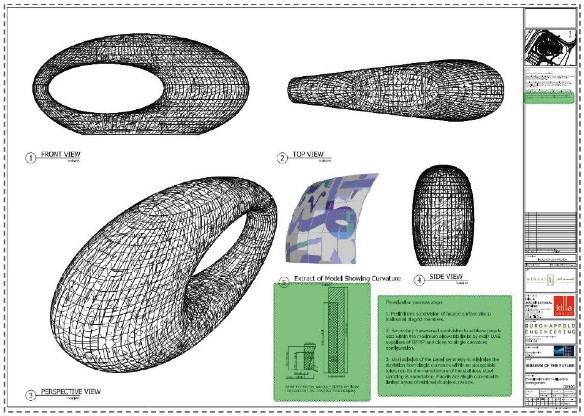
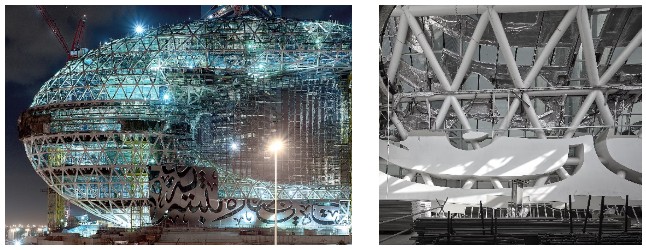
4. The façade comprises 1,024 panels manufactured by a specialised robot-assisted process, and covers a total surface area of 17,600m2. The Museum is 77m tall and occupies an overall area capacity of 30,548m2. The façade was fixed to an underlying structure called a “Diagrid”. Photographs on the Museum’s website illustrate the process:
5. The shape of the building, in particular the curvature, and the calligraphy means that each panel making up the façade is unique. The panels are composite in construction using Glass Fibre Reinforced Polymer (“GFRP”) with infill double-glazed units in the shape of the calligraphy. The outer finished surface is stainless steel polished, patterned, vacuum-bonded, and mechanically fixed to the panels’ outer surfaces and external reveals.
The Parties and Others
6. The Claimant (“BAM”) is a well-known construction company trading in the United Arab Emirates. It is a subsidiary of a Dutch group which is one of the largest construction companies in Europe, having been established for over 100 years.
7. By a contract (the “Main Contract”) executed in or around early September 2017, with a commencement date of 8 January 2017, BAM was appointed by the Employer as the Main Contractor for the MOTF project (the “Project”).
8. The Project architects were Killa Architectural Design (“KD”), an award-winning practice based in Dubai. The Consultant Engineers were the large international firm Buro Happold Engineering (“BHE”). The Employer’s Representative was Meraas Development (“Meraas”). Meraas was later replaced by North 25.
9. The First Defendant (“AFFAN”) is an experienced façade designer and manufacturer. The company was founded by the Second Defendant, Dr Amer Affan (“Dr Affan”). Dr Affan is General Manager of AFFAN, and also a 49% shareholder of AFFAN. Dr Affan holds a doctorate in Structural Engineering from the University of Cambridge.
10. On 8 January 2018, BAM entered into a Subcontract (“the Subcontract”) whereby AFFAN was to undertake the design, engineering, fabrication, and supply of the stainless steel external façade for the Project (“the Subcontract Works”), as described in and on the terms contained in the Subcontract for the lump sum price of AED 125,000,000 (the “Accepted Subcontract Amount”).
11. The Subcontract provided that “the law of the country governing the Main Contract shall apply to this Subcontract” (Clause 32.0). The law governing the Main Contract was “the Laws of the Emirate of Dubai and the federal Laws of the United Arab Emirates as applicable to the Emirate of Dubai” (Clause 1.4(a)).
The Dispute in Summary
BAM’s Pleaded Case
12. AFFAN commenced the Subcontract Works on the basis of a Letter of Intent dated 2 March 2017 (“LoI”) which was superseded by the Subcontract.
13. BAM says that in or about April 2018, AFFAN started to request payments in advance of the dates when the payment of such monies would fall due under the Subcontract. This was said to be in order to support AFFAN’s performance of the Subcontract Works and in particular to assist with its procurement of plant and materials.
14. In or about April 2018, AFFAN requested BAM to assist in procuring specialist equipment (the “CMS Equipment”) needed for the fabrication of the façade. The parties entered into a Memorandum of Agreement dated May 2018 (the “MOA”) under which BAM agreed to pay the supplier of the CMS Equipment the outstanding balance of approximately AED 4.7 million to enable the CMS Equipment to be released from Jebel Ali Port, Dubai. The MOA included a ‘Loan Recovery Schedule’ under which AFFAN was to repay BAM by way of deduction from the certified monthly progress payments.
15. In or about May 2018, AFFAN provided an undated security cheque in the sum of AED 4,322,177 (the “First Security Cheque”), signed by Dr Affan, as security for the sums paid under the MOA.
16. Between April 2018 and May 2019, BAM provided further financial assistance in consideration of AFFAN’s undertakings signed by Dr Affan that the monies advanced would be repaid to BAM or charged against future amounts falling due to AFFAN under the Subcontract.
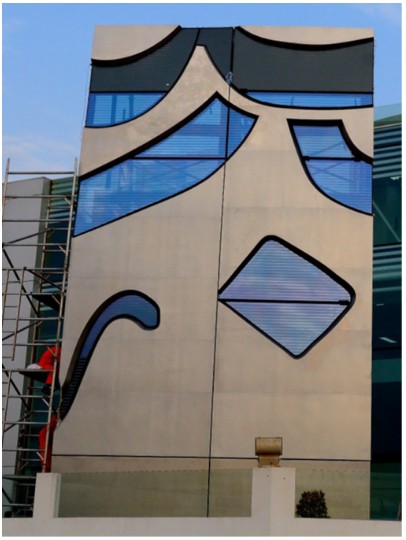
17. The parties executed an Addendum to the Subcontract dated 17 December 2018 (the “Addendum”) which set out the terms upon which BAM agreed to provide financial assistance to AFFAN in support of AFFAN’s performance of the Subcontract. The Addendum was signed by Dr Affan. There were 4 four categories of costs in respect of which BAM agreed to provide financial support:
(1) Historical Costs - the sum of AED 15 million for “project costs incurred”;
(2) Letter of Credit Costs - historical supplier costs against a letter of credit provided by ADCB;
(3) Production Costs - costs for staff, labour, services, materials, consumables, and other things provided for the completion, benefit and advancement of the Subcontract Works only; and
(4) Running Costs - costs for equipment, rent, maintenance, utilities, insurances, software, computing, and transport.
18. The Addendum made provision for verification of the costs and required AFFAN to provide a signed undated security cheque in the sum AED 7 million. There were particular terms obliging AFFAN to give BAM unimpeded access to and use of AFFAN’s staff, labour, equipment, documentation. and any other things required for the performance of the Subcontract Works. BAM was to have control over AFFAN’s manufacturing facilities and AFFAN was prohibited from interfering
19. In all, BAM made the following payments to AFFAN:
(1) AED 7 million on 19 December 2018;
(2) AED 4 million on 20 January 2019;
(3) AED 1,539,133.32 on 5 and 10 February 2019.
Each of the payments was supported by an undated security cheque signed by Dr Affan (together, the “Security Cheques”).
20. BAM claims that AFFAN failed to substantiate the costs in breach of the Addendum.
21. BAM claims that AFFAN failed to perform the Subcontract Works in accordance with its obligations under and the express terms of the Subcontract and the Addendum in that AFFAN:
(1) suspended the Subcontract Works, in breach of clauses 2.3, 4.1, and 16.1 of the Subcontract and Clause C1 of the Addendum;
(2) failed to provide sufficient labour and supervision to progress the Subcontract Works, in breach of Clause 4.2 of the Subcontract;
(3) failed to proceed and complete the Subcontract works in accordance with the Time for Completion, in breach of Clauses 2.3, 4.1, and 16.1 of the Subcontract;
(4) failed to use the facilities and resources solely for the purpose of the Subcontract Works, in breach of Clause A6 of the Addendum;
(5) failed to allow BAM control of the Facilities in breach of Clause A5 of the Addendum;
(6) blocked and disrupted the Subcontract Works, in breach of Clause B6 of the Addendum;
(7) delayed in submission of missing elements of the design, in breach of Clauses 2.3, 4.1, and 16.1of the Subcontract;
(8) failed to provide various quality records and design elements (including calculations), in breach of Clause 2.3, 4.1, and 16.1 of the Subcontract;
(9) removed assets and deactivated CMS machines legally belonging to BAM, in breach of Clause A1 and C6 of the Addendum;
(10) failed to carry out Performance Tests and obtain Performance Test approval in breach of Clauses 2.3, 4.1, and 16.1 of the Subcontract and Clause A8 of the Addendum;
(11) failed to remedy defects in the Subcontract Works in breach of Clauses 2.3 and 4.1 of the Subcontract and Clause B4 of the Addendum;
(12) failed to provide an undertaking letter for the cavity wall barrier systems which subsequently delayed the completion and submission of the Façade NOC Report to the statutory authorities for approval;
(13) failed to repay the loan amount and interest in relation to the CMS Machines in accordance with the MOA;
(14) failed to extend an Advance Payment Guarantee, in breach of Clause 18.3 of the Subcontract; and
(15) re-assigned key staff, and Dr Affan was personally absent from the UAE, in breach of Clause 4.6 of the Subcontract and Clause B7 of the Addendum.
22. BAM claims that by letter dated 23 June 2019, it exercised its rights under the Addendum to take over the Subcontract Works in consequence of AFFAN’s breaches and failure to execute the Subcontract Works. BAM says that it was entitled to take over the Subcontract Works under Clauses B1, B2, B5, and C7 of the Addendum.
23. In the following months, BAM alleges that contrary to Clauses B1 and B6 of the Addendum AFFAN sought to hamper and interfere with its performance of the Subcontract Works in that AFFAN:
(1) repeatedly contacted the Employer’s Representative making false allegations regarding the quality of BAM’s work;
(2) falsely claimed ownership of the material and equipment owned by BAM which was located in AFFAN’s premises; and
(3) commenced various court actions against BAM directly, as well as seeking to join and attribute liability to BAM in third party proceedings commenced by creditors and former employees of AFFAN.
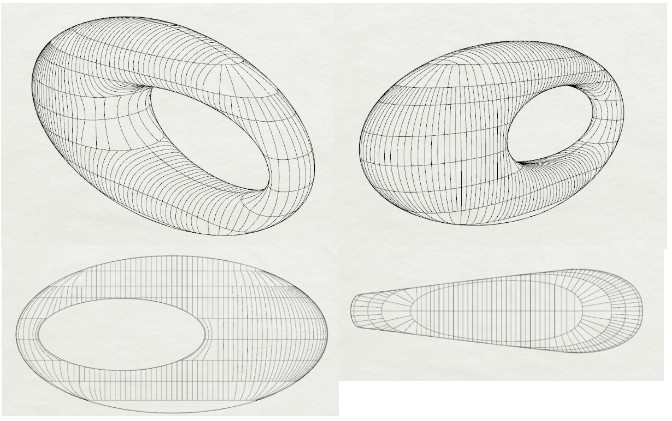
24. The Main Contract Works were Taken Over by 19 September 2021.
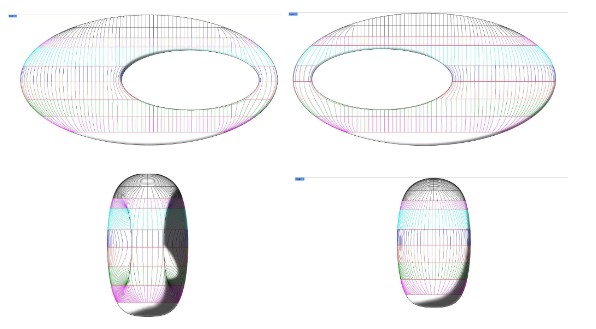
25. BAM makes the following claims against AFFAN: that it is entitled to all of its costs under Clause C6 of the Addendum and that it is entitled to be indemnified against any liability to the Employer and against all costs and expenses incurred by BAM by reason of AFFAN’s breaches of the Subcontract under Clause 2.4 of the Subcontract. It is not necessary to set out those costs in detail in this summary section of the judgment, but the heads of claim are:
(1) Progress payments paid to AFFAN;
(2) Historical Costs paid to AFFAN;
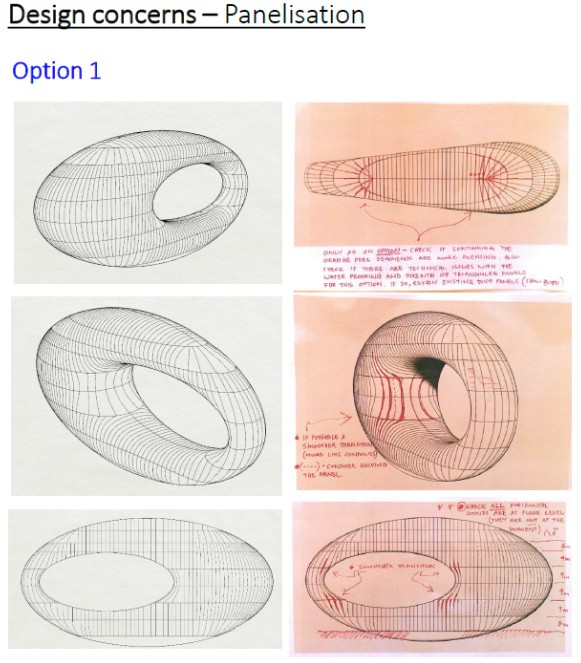
(3) Production Costs paid to or on behalf of AFFAN pursuant to the Addendum or incurred by BAM in completing the Subcontract Works;
(4) Running Costs paid to AFFAN;
(5) Finance & Miscellaneous Costs;
(6) Costs associated with BAM’s Investigation and Review of the Letter of Credit Costs; and
(7) Costs Incurred by BAM after 31 October 2021 in completing the Subcontract Works.
26. Against these sums, BAM gives credit for recovery under an Advance Payment Guarantee and a Performance Guarantee, as well as the assessed value of the Subcontract Works as recovered from the Employer.
27. In broad terms, the final valuation by BAM of its claim against AFFAN, based on a cost of the Subcontract Works of approximately AED 234 million less recovery from the Advance Payment and Performance Guarantees and less the agreed price of Subcontract works as adjusted for instructed variations, is approximately AED 105.5 million.
28. BAM also makes claims against Dr Affan personally under the provisions of the UAE Federal Law No. 2 of 2015 on Commercial Companies and the UAE Federal Law No. 32 of 2021 on Commercial Companies for damages for fraud and arising out of Dr Attan’s misuse, improper exercise, abuse of power, violation of law and/or serious or gross error [sic]. The bases for these allegations are:
(1) Dr Affan was responsible for AFFAN’s fraudulent and unlawful misappropriation of project costs;
(2) Dr Affan was responsible for AFFAN fraudulently claiming reimbursement for costs of materials related not to the Subcontract Works but to other works being undertaken by AFFAN;
(3) Dr Affan’s conduct in tendering to BAM the Security Cheques which were subsequently dishonoured, each of them being fraudulent. Specifically, Dr Affan knew that they would not be honoured on presentation (if presented), or alternatively Dr Affan had no honest belief that they would be honoured. Dr Affan knew when he tendered them that they did not represent good and valuable security for payment of the amounts due from AFFAN to BAM.
29. BAM claims:
(1) Repayment of monies falsely claimed as having been paid to suppliers under Historical Costs (AED 3,679,939.18), together with damages representing the cost of investigative measures;
(2) Damages representing the costs of investigating false claims for monies used for the purchase of materials used for other projects;
(3) Repayment of monies owed on dishonoured Security Cheques (AED 16,861,310); and
(4) Costs of investigating false claims for monies used for the purchase of materials used and for those used for other projects, unrelated to the Subcontract.
30. The total sum claimed as against Dr Affan personally is AED 20,566,242.
AFFAN / Dr Affan’s Pleaded Case
31. AFFAN submits that the Subcontract Works were the subject of an instructed variation driven by the aesthetic preferences of the professional team, and not due to buildability or fitness for purpose considerations. This resulted in the costs of the Subcontract Works increasing. BAM admitted that a variation occurred, and that the costs of the works would increase.
32. However, whereas the Employer informed BAM that no further monies would be paid, BAM continued to instruct a contractually valid variation under the Subcontract and impose the Addendum upon AFFAN. The decision by BAM to continue to instruct the variation was therefore at its own discretion and at its own risk, without further financial obligation on the part of AFFAN.
33. BAM’s reliance on and interpretation of Clause C6 of the Addendum is flawed. Whereas the Addendum does not include any express provision which requires AFFAN to indemnify BAM for additional costs incurred in the completion of the Subcontract Works it is submitted by AFFAN that Clause C6 of the Addendum is in any event inapplicable in circumstances where BAM continued to instruct AFFAN to carry out a valid variation pursuant to the Subcontract when it knew that the Employer was not prepared to make any additional payment.
34. AFFAN suggests that the effect of this will also be to cast serious doubt on BAM’s quantification of its claims, both as a matter of principle and of arithmetic. Based on the approach adopted by BAM, BAM contends in effect that it was entitled to the Subcontract Works free of charge.
35. AFFAN submits that by i) continuing to instruct AFFAN in respect of the variation, ii) imposing the Addendum on AFFAN (having already attempted to terminate AFFAN); and iii) failing to make payment to AFFAN in breach of the Addendum and/or the Subcontract, BAM has acted in bad faith and in breach of contract. It is therefore AFFAN which is entitled to further payment.
36. In respect of the allegations against Dr Affan, Dr Affan contends that BAM has failed to establish its allegations as a matter of fact or law. Moreover, BAM has failed to establish that the alleged actions by Dr Affan are such as to take Dr Affan beyond the actions of a general manager acting in the ordinary course of business so as to justify the exceptional relief of making Dr Affan liable in his personal capacity. The allegations made by BAM, it is said, frequently bear no relationship to the alleged facts or evidence relied upon by BAM and require significant leaps of logic. As the claim is put forward in damages, BAM has equally failed to establish the appropriate legal tests to be applied by the Court in assessing the claim or the quantum to be assessed thereunder.
37. AFFAN counterclaims that it is entitled to sums in addition to the Accepted Subcontract Amount of AED 125,000,000 in respect of:
(1) The increase in the panel sizes above those quoted in the tender (“panelisation”);
(2) The introduction of the “hexagons” at the joints between the stainless-steel sheets for the outer surface of the panels (“hexagonalisation”);
(3) Changes to the LEDs.
38. AFFAN also seeks to recover the sums paid under the encashed Advance Payment Guarantee and Performance Guarantee. AFFAN gives credit for the sums received from BAM.
39. The final iteration of AFFAN’s counterclaim in its closing submissions was approximately AED 60 million.
The Cases at Trial
40. Not unsurprisingly the parties’ cases had developed during the interlocutory stages.
41. On 21 October 2024, the trial commenced with the oral opening submission of the parties which continued into 22 October 2024.
42. In opening BAM’s case at trial, Lord Marks KC, identified what he called the “fundamental point in the case” as exemplified in paragraph 2.2 of AFFAN’s Particulars of Counterclaim:
“It is submitted, and this is the fundamental point in the case, that the adoption and evolution of the “Killa preferred scheme” represented a fundamental departure from the basis upon which the Subcontract Works had been tendered, and the basis upon which D1’s commercial proposal had been accepted. D1 submits that these changes increased the complexity of the Subcontract Works in terms of, inter alia, changes to the loading requirements of the building, changes required to achieve desired deflection and the size of gaps between panels, an increase in the complexity of the manufacturing process (including an increase in wastage of materials), and also resulted in changes to matters such as the calligraphy, lighting and tolerances. In turn, this resulted in an increase in the costs to be incurred in the completion of the Subcontract Works”.
43. This, in Lord Marks’s submission, boiled down to the difference between (1) AFFAN’s case that it tendered on the basis that the “nominal size” of the panels tendered for was 9m x 2.2m whereby the introduction of larger panels constituted a variation; and (2) BAM’s case that AFFAN did not tender by reference to the size of panels but on the basis of a full design responsibility, and accordingly there was no variation. Further and in any event, BAM disputed the extent to which AFFAN claimed the panels did exceed 9m x 2.2m.
44. The next point Lord Marks highlighted was that by the date of the Subcontract (8 January 2018), the panalisation was complete and so, as he put it, AFFAN was “seeking to establish, that the Subcontract was varied before it was even made”.
45. The “hexagonalisation”, it was said by Lord Marks, was to assist AFFAN with “drapabilty” of the stainless-steel outer surface of the panel (i.e. following the curvature of the panels) and “bondability” (i.e. fixing the stainless steel to panels). It was not linked to the panalisation and was not a variation.
46. Lord Marks sought to address a submission in AFFAN’s written opening submissions that there was no legal basis for BAM’s claim. He said that the claim was not made under the terms of the Addendum. Rather it was a claim for breach of the Subcontract, but that the Addendum also gave BAM “Step-in Rights” under Clause B. AFFAN was never terminated pursuant to the Subcontract.
47. Lord Marks did not address the claim against Dr Affan personally.
48. Lord Marks went on to make an application to amend the calculation of damages in the Particulars of Claim which was allowed.
49. Mr Riaz Hussain KC then opened the case for the Defendants.
50. He pointed out that BAM had made a claim against the Employer for an extension of time of 390 days and for additional monies in a sum just over AED 110 million (Contractors Claim Notification (“CCN 222”) in relation to ‘Façade Design Changes’). The claim related to (amongst other heads) panalisation, hexagonalisation and LEDs. Mr Hussain said there had been a settlement with the Employer, but AFFAN did not have details (they were subsequently disclosed - see paragraph 255 below).
51. The short point was that as BAM did not allege that AFFAN’s tender was under-priced, but the works cost twice as much, it meant, as Mr Hussain put it, “Something that changed, very fundamentally”.
52. Mr Hussain pointed to Clause 26 of the Subcontract, “Termination by Contractor”, and noted that it was common ground that the clause was not invoked. Instead, BAM took over the Subcontract works in reliance on Clauses B1, B2, B5, and C7 of the Addendum. Mr Hussain submitted that those provisions were to ensure that AFFAN completed the works not to confer Step-in Rights.
53. Mr Hussain went through the design development to demonstrate, as he submitted, that the works were varied both as to panelisation and hexagonalisation.
54. Mr Hussain submitted that BAM had changed its case from saying that Clause C6 of the Addendum entitled it to an indemnity to a claim for damages for breach of contract
55. He ended by addressing the detail of the claim against Dr Affan.
The Trial and Thereafter
56. The first witness was Mr Dermot Doyle who is employed as Area Commercial Manager (MENA Region) by BAM. He gave evidence on 22 and 23 October 2024.
57. I found Mr Doyle to be an evasive witness who had to be asked the same question more than once before he would give a direct answer. His witness statement was positively misleading at paragraphs 89 to 91 in seeking to suggest that Dr Affan was making “a blatant attempt at coercing BAM into making a payment for which there was no legal or factual basis” in his letter dated 8 January 2020 by representing that AFFAN needed AED 2 million to renew its trade licence and permit. It was misleading because Dr Affan did not say that in his letter. What he said was “Due to the violations made by BAM, AFFAN does not have sufficient funds to clear the minor cases blocking its trade license and to pay for the license and the civil defense permit.” What Dr Affan was clearly asking for was money “to clear the minor cases”. To Mr Doyle’s discredit he tried to defend his position in cross-examination, saying “he is asking for 2 million to effectively renew trade license”.
58. Mr Doyle was very free in making allegations of dishonesty against Dr Affan but when cross-examined in detail, the basis for the allegations appeared to be assumption rather than hard facts. As Mr Hussain put it in cross-examination, “Mr. Doyle, it seems like you've already made up your mind what you want to accuse Dr. Affan of, regardless of the facts.” I consider that to be a justified comment. For example, he was willing to allege that Dr Affan charged for material used on other projects without even undertaking the most basic step of undertaking a measure of the materials actually used and charged for on the Project.
59. I treat Mr Doyle’s evidence with considerable caution, but I can see why relations with Dr Affan broke down. It is clear to me from the correspondence that BAM understandably insists that, and may well train, its employees to be assiduous in “contractual” correspondence requiring compliance with any relevant provisions and seeking particulars of any claims. AFFAN on the other hand seems much more disorganised and lackadaisical. I can imagine that this was a source of frustration to Mr Doyle. However, to leap to infer dishonesty is in my view not justified, but once Mr Doyle had made that leap it coloured both his evidence and BAM’s approach to AFFAN during the Subcontract and these proceedings.
60. The next witness on 23 October 2024 was Mr Fernando Morante, who had been the Technical Director of AFFAN from September 2015 to July 2019. Mr Morante had minimal involvement in the panelisation tendering process but was able to cast more light on the hexagonalisation.
61. Dr Affan commenced his evidence later that day and continued giving evidence on 24 and 25 October 2024. Given that Dr Affan’s honesty is material I should observe that he is not above condoning false statements by his company for the purpose of inflating their capacities. He was taken to the statement in the Tender that “We have completed a CATIA model of the panels see below, with proposed panelisation”. What was below was not a CATIA model (CATIA being a type of design software to which I will return later in this judgment – “Computer Aided Three-Dimensional Interactive Application”) nor did it show the panelisation. He said that it was “a slip of the tongue” - which was not credible - and then more truthfully, “They just made it to impress the Architect that we are very keen, and we are capable. No more than that”.
62. I found some of Dr Affan’s evidence to be internally inconsistent. He would make sweeping statements and then try to recalibrate them when questioned further. There are parts of Dr Affan’s evidence about which I entertain serious reservations. He delivered many of his answers in a declaratory and didactic manner that gave the impression of an expression of achievement or self-satisfaction, as if he had solved a problem. One could not escape the conclusion that he was making up those answers as he went along.
63. On the other hand, Dr Affan was on occasion frank in his evidence; indeed, disarmingly so. He freely admitted that he regarded AFFAN to have breached the Addendum (of course whether that was the case is a matter of law, which was not for him to say, as Mr Hussain interjected) saying that it was entitled to do so because BAM did not keep up its end of the bargain.
64. He did have a tendency to distance himself from events when I suspect he must have been more closely involved given their importance. Lord Marks put it to him “you're saying, "I wasn't there. I was told the works were going on, but if they weren't going on and if there was a breach of Contract that was because I didn't have the money or AFFAN didn't have the money.” He replied “Hundred percent”.
65. Having seen him give evidence I do not find it hard to imagine that Dr Affan could be a difficult person with whom to deal. That would have been magnified by the “dire” situation in which he and his company were placed. I am sure that there were times when he felt that “his back was to the wall” and the existence of the business he had built was on the line
66. When assessing Dr Affan’s conduct, I am bound to accept that there may well have been an element of “robbing Peter to pay Paul” in the hope it would all resolve itself in the end and that he was fighting for the survival of his business.
67. Overall, I cannot accept all of Dr Affan’s evidence at face value. I consider that the lapse of time, his indignation at his perception of the way in which he was treated by BAM, the financial pressures on him with the resulting court proceedings, and his self-belief all conspired to construct a narrative that wholly vindicated his actions, albeit that it was neither entirely consistent with, nor supported by, the documentary evidence. I have no trouble in accepting his evidence where it is consistent with the written record. Where there is an absence of corroborative evidence, I must rely on the ostensible probabilities.
68. There was also further re-examination of Dr Affan on 12 December 2024 following the evidence Mr Paul Haslam. At the close of the hearing on 29 October 2024 the parties agreed that AFFAN would serve a Supplementary Memorial in relation to its Counterclaim. AFFAN served the Supplementary Memorial on 8 November 2024. BAM served its response on 20 November 2024 which annexed a witness statement from Mr Haslam. I directed that Mr Haslam would give evidence and be cross-examined on 12 December 2024.
69. Mr Haslam explained that during the hearing on 29 October 2024 Mr Doyle had contacted him and he agreed to give evidence. He had been employed by AFFAN as a Project Director from January 2013 to November 2018. In June 2018 he had resigned from the employment of AFFAN owing to the fact that it had failed to make payment of his salary for some months. He commenced proceedings in the Dubai Courts and was awarded approximately AED 385,000 but the judgment debt remains unpaid. I found Mr Haslam to be a relatively straightforward witness notwithstanding his issues with the Defendants. He was not, however, a technical person (rather, a commercial one) and was only able to give limited evidence on the design development.
70. The primary source of evidence should have been the documentary evidence, but the development and presentation of the parties’ respective cases substantially complicated the Court’s task. I did not find the documentary record wholly reliable. As will be seen below, there was a degree of "re-writing history" in BAM’s correspondence and the presentation of its case.
71. None of the witness statements contains a comprehensive or coherent narrative of all the relevant events.
72. The case was driven by AFFAN’s claims for variations, but Mr Doyle could give little evidence on the issues, and it was left to BAM’s experts to develop its case. This led to piecemeal evidence with BAM’s technical experts examined and cross-examined on two separate occasions.
73. Dr Affan’s written evidence was exiguous given the issues in dispute and had to be drawn out from him in cross-examination and re-examination; often by reference to documents and drawings that were not in the chronological bundle but exhibited to experts’ reports. The Court was not assisted by Dr Affan’s repeated assertions, noted above, that he had no involvement at certain important stages.
74. There was also late disclosure by BAM of highly significant documents.
75. All of this contributed to relevant documents being scattered across numerous electronic bundles which were not easy to navigate, some documents existing in hard copy only and, the necessity to engage in a detailed analysis of the transcripts of the oral evidence at trial for an explanation of the documentary record to a much greater extent than might normally be expected in a construction dispute. This made the preparation of this judgment extremely time-consuming.
THE FACTS
The Main Contract
76. BAM ultimately claimed an extension of time and prolongation costs against the Employer in a detailed claim document (see paragraph 50 above). It provides an insight into BAM’s internal perception of events, and I have therefore interpolated passages from the document in the narrative that follows.
77. The claim document introduced the Main Contract:
“Amongst the Contract Documents, the Specifications explain that the detailed design is to be provided by the Employer and it is for the Contractor, via one of the pre-vetted ‘permitted façade specialist subcontractors’ to integrate the detailed design with the selected specialist’s systems and proposed manufacturing solution. As such, prior to tender and prior to the engagement of BAM, the Employer and his Representatives vetted several specialist façade subcontractors and a small number (five), whom were found to be suitably experienced and qualified were listed within the Contract Documents as preapproved (Permitted) Subcontractors for the façade discipline. AFFAN Innovative Structures were one of the companies vetted and listed by the Employer as a permitted subcontractor.
Under the Specification requirements, … integration of Contract/IFC design with the specialist’s system is to be presented to the Employer in the form of Shop Drawings and following approval of those, a Visual Mock-Up is fabricated for use as a ‘quality benchmark’ for the subsequent permanent façade works. The Contractor has no authority or obligation for the aesthetic design, nor any enhancements or changes to the aesthetic design, which is provided by the Employer in the Contract/IFC documents and which must be maintained.”
AFFAN’s Tender
78. Mr Haslam gave evidence that AFFAN began preparing surface models of the MOTF as early as December 2015 using CATIA software in discussion with Mr Shaun Killa and BHE. He suggested that, at that stage, AFFAN’s strategy was to tender on the basis of double-curved panelisation, spanning floor to floor. In his witness statement he said at paragraph 27:
“… given the curvature of the building, D1 knew from its design development that some panels would necessarily be larger than 9 metres. At the time of tender, I recollect that D1 considered that it would be required to produce panels, likely up to 15 metres long, to accommodate the areas of greater curvature, particularly at the top and bottom of the building.”
79. On cross-examination he admitted that the lawyers had written that part of his statement for him and no human being said to him at the time of tender that they anticipated panels up to 15 metres long.
80. On 24 May 2016, BAM sent a formal invitation to tender to AFFAN.
81. On 16 June 2016 the Employer issued a Tender Query to BAM, “Please issue the proposed panelisation of the façade in 3D format”. BAM replied, “Refer attached 3D panelisation model. Note any panelisation models issued to the contractor indicate design intent only and are not to be used for manufacture [sic]. As discussed at the mid tender forum the contractor [sic] will be required [sic] to undertake a panelisation exercise based on their preferred module for fabrication or manufacturing purposes.”
82. On 17 July 2016, Koltay Facades (BAM's Façade Consultant who reviewed the tender on behalf of BAM) sent a number of queries to AFFAN. Query No. 12 asked,
“Please provide a brief production program and explain the type and number of machines to be used for panel production.”
AFFAN replied, “We will use 2 CMS machines to ensure milling of 4 No panels per day (9m x 2.2m). Approx monthly output 60–80 panels … each panel will take approx 5/6 days to complete”.
83. Between May and August 2016, AFFAN created a large-scale mock-up measuring 5.942 m wide by 11.554 m high. The mock-up was clad with stainless steel sheets running horizontally, with hairline joints between adjacent sheets. Either side of the hairline joint, the sheets were fixed to the composite panel with rivets.
84. Representatives from BAM, BHE, Meraas, and KD viewed the mock-up prior to awarding the Subcontract. On 4 August 2016, Mr Haslam wrote to BAM, “Further to the issue of our Tender Proposals dated 15th July 2016 we attach Addendum No. 1 to clarify points raised during the recent meetings and mock-up inspection.”
85. In a pricing document dated 1 September 2016 (part of the Summary Pricing Document dated 3 September 2016) subsequently issued as part of the Tender Bid, the pricing was based on a panel 9 x 2.2 metres.
86. On 11 December 2016, BHE issued the IFC (Issued for Construction) documents and, in particular, produced the “Scope of Works 034204, Revision C00”. At section 3.7.3 “Cladding and Facades” it was provided:
“The Contractor is responsible for the design and coordination of the following:
· Individual facade element (composite panels) to be contractors design
· Temporary installation to be contractors design
· Secondary cladding support structure to be contractors design
· Facade panelization (subject to contractors preference)”
87. Tender IFC Drawing 0121-P101-BUR-FAC-DWG-0901-000DP stated that typical modules were to be “2.5m x 4.5m or 9m x 3m, vertical span 4.5m or 9m typ (to preferred contractor module) panel depth”.
88. Tender IFC Drawing 0121-P101-BUR-FAC-DWG-0906-000DP described the intention that the façade skin would achieve a single curve by means of faceted panels (as BAM put it in its claim document):
“Panelisation process steps”:
1. Preliminary subdivision of façade surface along horizontal diagrid members.
2. Secondary transversal subdivision to achieve panels size within the maximum allowable limits by main UAE suppliers of GFRP and close to single curvature configuration.
3. Manipulation of the panel geometry to minimise the deviation from single curvature within an acceptable tolerance for the manufacture of the stainless steel cladding is undertaken. Panels are single curved with limited areas of minimal double curvature.
89. The drawing also showed “GFRP POTENTIAL MODULE SIZES/ OPTIONS (DEPENDENT ON CONTRACTOR DESIGN)” with 2.5m x 4.5m or 9m x 3m “optimal”.
90. Tender IFC Drawing 0121-P101-BUR-FAC-DWG-0934-000DP referred to “Panel height 4500 mm typical depending on contractor design”.
91. Also included in tender documents was a specification (the “Specification”). There were the following provisions of the Specification:
(1) DIVISION 010000 – GENERAL REQUIREMENTS, SECTION 014000 – QUALITY REQUIREMENTS, 1.3 DEFINITIONS
“C. Mockups: Full-size physical assemblies that are constructed on-site. Mockups are constructed to verify selections made under Sample submittals; to demonstrate aesthetic effects and, where indicated, qualities of materials and execution; to review coordination, testing, or operation; to show interface between dissimilar materials; and to demonstrate compliance with specified installation tolerances. Mockups are not Samples. Unless otherwise indicated, approved mockups establish the standard by which the Work will be judged.”
(2) DIVISION 06 00 00 – WOOD, PLASTICS AND COMPOSITES
(a) SECTION 06 83 16 – GLASS FIBRE REINFORCED PANELLING
(i) 2.5 TYPES OF CLADDING/ FEATURES, B. INSULATED COMPOSITE GRP PANEL CLADDING
c. External facing material: 0.8 mm thick stainless steel 316L sheet.
d. Pattern: 6WL
e. Finish: Brushed polish/ Bead Blast
(ii) 2.6 DESIGN/ PERFORMANCE REQUIREMENTS, A. CONTRACTOR'S DESIGN GENERALLY, 1. Design responsibility:
“a. Determine sizes and thickness of units and the type size, number and spacing of fixings”
(b) SECTION 06 83 17 – GLASS FIBRE REINFORCED PLASTIC PANELS WITH STAINLESS [sic] STEEL FACING, 1.1 RELATED DOCUMENTS, 01 90 00 – “Exterior Enclosure (facade) General and Performance Requirement”. It seems to be common ground that the provisions of 01 90 00 are repeated at 07 28 00;
(3) SECTION 07 28 00 – EXTERIOR ENCLOSURE (FAÇADE) GENERAL AND PERFORMANCE REQUIREMENTS,
(a) “1.1 SUMMARY”
A. The following requirements apply generally to all exterior enclosure systems. Where particular requirements apply, these are given in the relevant system section.
B. Drawings and information in this Specification are intended to show the general form and arrangement of the cladding, and basic cladding systems, including modules and envelopes of space allowed for cladding that must be adhered to. The contractor shall complete the engineering design of the cladding to comply with this Specification and shall be responsible for the design, supply and installation of the cladding.
C. The visual aspects of this design must be maintained. Within these constraints, the Contractor may propose alternative methods of construction for consideration by the Contract Administrator.
D. The Exterior Enclosure Specifications as a whole define the systems and materials to be used by the Contractor for the façade works. The Contractor shall apply these requirements to their Shop Drawings and provide necessary schedules and supplementary details to complete Shop Drawings. The Contractor shall verify that their shop drawing works comply with the performance requirements defined.
(i) “1.4 DESIGN RESPONSIBILITY”
A. This is a performance specification, accompanied by drawings showing the design intent. The contractor shall be responsible for the development of any information beyond IFC to reflect any specific design or technical aspects required by the specialist facade sub-contractor. The façade drawings issued as part of the tender package reflect the detailed design, and the specification outlines the required technical performance of the building envelope. The contractor is required to undertake their own design validation and engineering in order to manufacture and install the building envelope. The contractor will remain wholly responsible for the technical completeness and suitability of their design. The contractor should engage with the design team and client during the tender phase as necessary to ensure they correctly understand both the design and technical requirements as well as their responsibilities. Further to award of contract and during the construction period, the Contractor will also need to coordinate and submit all shop drawings in this regard.
B. Glass thicknesses and types, and other structural sizes shown on the drawings, are indicative of the Architect’s intent, and the Contractor shall be responsible for all final structural sizing.
C. The Contractor shall be responsible for all calculations related to the Works and is responsible for gaining the necessary local authority approvals for such calculations. These calculations shall include structural, thermal, condensation, acoustics and drainage calculations.
D. The Contractor shall complete calculations to demonstrate the suitability of all components used in the construction. These shall be carried out to the relevant standards cited herein. Where computer analysis is used, the Contractor shall include details of the software used, the method of analysis and assumptions used, input and output data, and interpretation of the results.
(ii) “1.38 SUBMITTALS”
G. The Contractor shall submit mill certificates for all stainless steel cladding indicating compliance with EN 10088 1-7. The stainless steel shall be as supplied pattern 6WL 2B Bright annealed by Outokumpu…
I. Post-contract drawings - the successful Contractor shall work with the design team to develop the design;
1. Based on the tender drawings and other documentation, the Contractor shall prepare Principal System Design drawings for comment by clients’ representative prior to commencing Detail Design drawings. The Principal System Design drawings shall include, but not be limited to, typical section details and key interface details. The Principal System Design drawings shall define the materials, finishes, material thickness, material grades, dimensions, drainage route, vapour control layer, airtightness and water tightness membranes, seals, gasket, fire and smoke stops and fixing brackets to the structure. It is anticipated that there will also be a series of design meetings with the design team members, to facilitate this process. During this stage, the Contractor shall submit for approval a schedule of all proposed standards and technical specifications.
J. Following successful completion of the Principal System Design stage, the Contractor shall develop the Detail Design drawings for the entire project, which shall be submitted for approval. The Detail Design drawings shall identify materials, finishes, material thickness, material grades, dimensions, vapour control layer, airtightness and water tightness membranes, seals, gasket, fire and smoke stops, all fixing and brackets. The Detail Design drawings shall show position and of their works in relation to structural members and/or the works of other trades.
(iii) “1.40 VISUAL MOCK-UPS”
H. The Contractor shall prepare mock-ups for acceptance of visual parameters prior to progressing with such installations and fabrications. These mock-ups are intended to establish quality benchmarks, minimize abortive work and resolve coordination issues. The installation of mock-ups shall supplement the shop drawing and coordination drawing requirements and precede the permanent construction of such installations. The Contractor shall not proceed with the permanent works until approval of the mock-up by the Contract Administrator.
92. The Tender documents also included a “Basis of Design”. Section 8 of the Basis of Design addressed “Facades Design Criteria”. It outlined the façade engineering design criteria. It made no reference to aesthetic criteria.
93. There was also a detailed design report issued as part of the tender pack for information only. The architectural section provided no information regarding requirements of the panelisation of the modules, nor the direction of the pattern on the stainless steel.
94. The main contract works commenced on 8 January 2017.
95. AFFAN put in its Tender Proposals on 25 January 2017.
96. Section 1.1 of the Tender Proposals – “Commercial, Scope of Works” stated:
“Advanced Structural composite façade panels, double curved, nominal size 9000 x 2200 …”
97. Section 2.1 of the Tender Proposals stated:
SYSTEM DESIGN & ENGINEERING
“Main Façade”
The Main Façade is composed of advanced structural composite panels with infill double glazed units in the shape of bespoke Arabic calligraphy. The outer finish surface is Stainless steel Gr. 316 6WL polished patterned, vacuum bonded and mechanically fixed to the panel’s outer surface and external reveals.
We have completed a Catia model of the panels, see below, with proposed panelisation.
[there were 4 illustrations – below are the first and second]
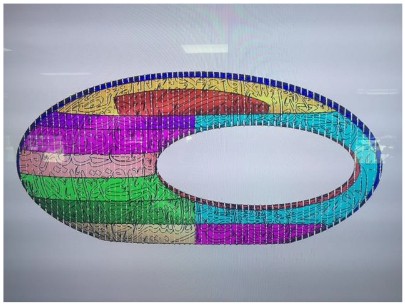
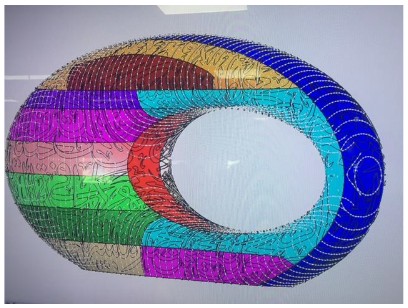
The panels will be formed from advanced fibre layups and bonded with fire rated resins.
The Panels of Main façade are proposed to be 9 Mtr. x 2.20 Mtr. in size with double curvature to achieve the required outer surface”
98. The “Structural Analysis of Mock-Up of Future Museum” stated that the panel length was 9,000.0mm and the panel width was 2.2000 mm
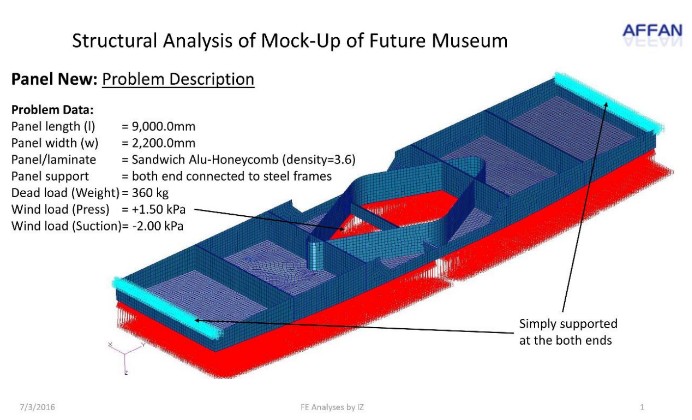
99. Section 2.4.2 of the Tender Proposals stated:
“2.4.2 Design
The design of the façade is heavily dependent upon full completion of the 3D model.
Upon award we will request issue of the full construction status model either in Revit or Rhino.
In the first 2 months we will work on completing the 3D model in Catia for issue/approval by the consultants.
Once approved we will then work on issuing 2D shop drawing for approval.
These will include:
• Full façade (EWS 01 to 04).
• North Elevation & South Elevation (EWS 06).
• Budge Glazing (EWS 08).
The fully coordinated façade model will also include the LED lighting.
Once we have approval of the model, bulk quantities will be issued for material procurement ie glass, stainless steel, resin & fibres.
The 2D shop drawings will provide all typical details ie plans, sections, elevations, connection details, glass fixing, waterproofing and LEDs. At present, we envisage approx. 700 panels, 9m x 2.2m and due to the calligraphy, each panel is unique.
The use therefore of the 3D model is critical in translating the design of the panels and then using the outputs of Catia, that are then used by the CMS machines to cut each panel individually.
The Catia model is then able to be exported for any required BIM model and likewise can be updated and issued for the “as built” submissions and O&M manual.
It should be made clear that we will not issue 700 No. individual panels for approval and therefore the correct and complete model for the calligraphy is an essential component for the design phase.”
100. Rhino is a 3D modelling software. Revit is similar. Both are widely used by architects and engineers. CATIA is more sophisticated and used less commonly. CATIA software is a very powerful parametric software with very advanced surface management capabilities. The parametric capability of CATIA allows the users to create parts that are linked with each other on a top/bottom strategy: once the links are activated, any changes to the reference geometry will be automatically implemented in the derived models.
101. Section 2.4.3 of the Tender Proposals, “Production & Supply Chain Management” provided:
“Affan will be implementing a new production line in a new facility specifically designed to suit the production of between 60-80 panels per month. (see below).”
102. Section 2.4.4 of the Tender Proposals, “Installation” “Method Statement for the Main Façade Installation of Composite panels at Museum of the Future, Dubai - U.A.E.”, showed drawings with a panel spanning between floors:
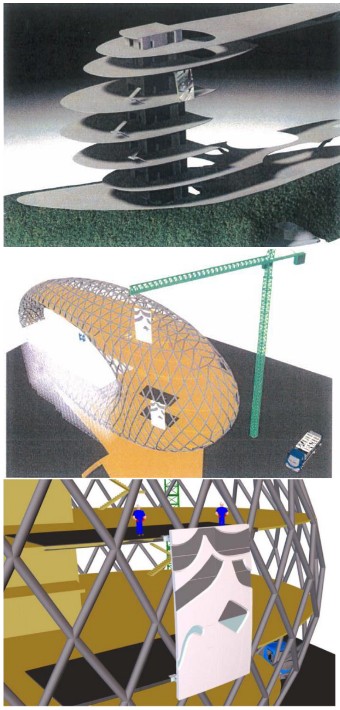
103. On 14 February 2017 AFFAN wrote to BAM:
“Further to our tender submission dated 25.01.2017 rev 03 and the recent meeting on site attended by Mr. Craig Foster, Dr. Amer Affan, Paul Haslam, Katia Pastro and yourself, we attach the following:
• Lump Sum Pricing Summary in the agreed amount of 125,000,000 (One Hundred Twenty Five Million UAE Dirhams Only).”
104. In the opinion of Mr Austen Smith, AFFAN’s technical expert, AFFAN’s tender proposal was “feasible”.
Design Development
105. BAM noted in its claim document that the Design Team subsequently instructed the Contractor to pursue an alternative smooth surface to the façade via an RFI response on 15th February 2017:
“Note that the final panelisation (configuration and size format (module)) of EWS-01 shall be proposed by the specialty facade fabricator and shall address the final calligraphy layout addressing the architectural intent of a smooth surface, legibility of the calligraphy, etc”
It states that such a smooth surface could therefore only be achieved by replacing the single-curve panels shown in the IFC/Contract Drawings with double-curved panels.
106. BAM continued that panelisation discussions kicked-off as early as 21 February 2017 when the first steel-façade weekly coordination meeting was held, and on the basis of delivering a smooth surface finish optimising the maximum panel size and minimising the number of horizontal joints.
107. On 22 February 2017, BAM wrote to AFFAN:
“We refer to your most recent quotation for the Museum Of The Future - Stainless Steel Composite External Facade Subcontract Works. Please confirm that this offer is fully compliant in all respects with the IFC drawings and specifications appended hereto.
The IFC information consolidates all previous Tender Queries, Tender Addenda and Value Engineering and these documents will form the basis of the Subcontract Agreement.
We require your confirmation within a period of 7 days from the date of this letter. In the event that you identify any changes from the previously issued tender documents, you are required to detail these changes in a schedule specifying the exact change in scope by referencing the relevant drawings/specification sections, quantifying the extent of the change and by providing the associated cost impact (if any).”
108. BAM continued, in its claim document, that weekly meeting #2 (27 February 2017) recorded that approximately 80% of preliminary panelisation agreed out was agreed and was based on a KD preferred scheme (later named option 1a); although BAM/AFFAN were instructed to explore alternative panelisation schemes which were subsequently presented during the following 5 weekly meetings, with BAM/AFFAN highlighting the schemes’ relative technical advantages and disadvantages.
Letter of Intent
109. On 2 March 2017, BAM sent the LoI to AFFAN for the attention of Mr Haslam. It contained the following terms:
“… Until such time that all of the outstanding terms of the Main Contract are agreed and formalised, we authorise and you agree to commence the works pursuant to the express terms of this Letter of Intent. It is the intention of the Parties to execute a formal Subcontract Agreement within 21 (twenty one) days of the signing of this Letter of Intent.
1. Scope of Work: The scope of work shall involve the design, supply, delivery, co-ordination and installation of the Stainless Steel Composite External Facade Subcontract Works and the remedying of any defects thereto inclusive of design development, preparation, finalisation and submission of the External Facade shop drawings, calculations, models and any required method statements, material submissions, etc. in accordance with the Project specifications and standard formats … It is understood and agreed that the Subcontractor shall fully develop the design and that any further required works shall be deemed to be included in the below mentioned Subcontract Price in order to fully complete and handover the works to the satisfaction of the Employer and its representatives and to achieve all required local authority approvals. When complete, the Subcontract works are to be fit for the purpose intended.
Subcontract Price: The agreed lump sum Subcontract Price (the "Subcontract Price") for the full and satisfactory execution and completion of the entire works including the remedying of any defects thereto is AED 125,000,000.00 (UAE Dirhams One Hundred and Twenty Five Million Only) and shall not be subject to re-measure. This Letter of Intent enables the release of an Advance Payment in an amount equal to 10% of the Subcontract Price. Until a Subcontract is executed the maximum liability of Barn Higgs & Hill L.L.C under this Letter of Intent shall be limited to AED12,500,000.00 (UAE Dirhams Twelve Million Five hundred Thousand Only).
…
4. Commencement, Milestone Dates and Completion: The date for commencement shall be considered as the 23rd February 2017 and you are required to immediately commence all activities necessary to execute the works.
…
16. Subcontract Agreement: Notwithstanding the provisions of clause 15 above, this Letter of Intent shall be automatically superseded upon the Contractor and Subcontractor entering into and signing a formal Subcontract Agreement in respect of the Project.”
110. The LoI attached an index of drawings and specifications which included those noted at paragraphs 87 to 93 above.
Panelisation
111. On the same day, BAM, via Aconex (the Project information management system), sent to AFFAN an email headed “Fwd: MoTF Issued for Construction BIM Models Vol 4 (02)” “Reason: Issued for Action”. The email attached Rhino Model 0121-P101-KLD-FAC-BIM-00001-0003D Revision C00, Revision Date 11/12/2016, titled “Architecture Mound, Lobby, Press Room & Aud. Rhino Models (ZIP)”. The model formed item 119 of the Index of Tender Documents.
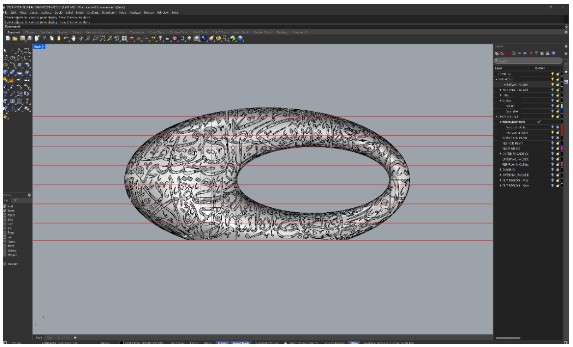
112. In its closing submissions, BAM seems to suggest there is something odd about the screenshot above because it ends in “[82].png”. PNG means Portable Network Graphics and is a well-known image format. Additionally, some software (Microsoft Office) sometimes adds numbers in square brackets to file names. Without more I am not willing to accept that the screenshot is anything other than genuine.
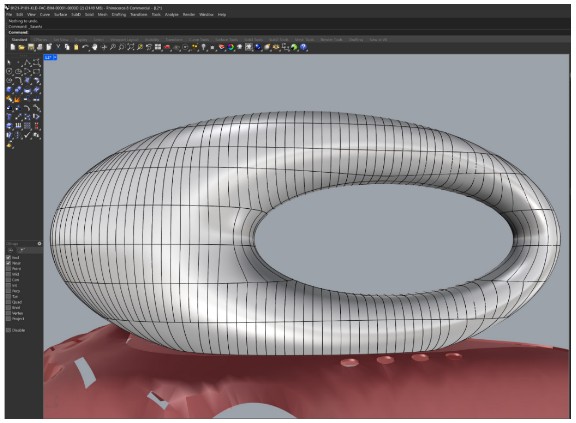
113. AFFAN says that a further revision of this model issued by Killa KD and dated 6 March 2017 shows the same panelisation with panels spanning floor to floor:
114. On 6 March 2017, there was a meeting attended by “Affan: Various Staff”, “Façade - Str. Steel Coordination Meeting – 03”. Item 3 of the “MEETING ACTION, DECISION AND NOTE LOG” recorded:
“Panelization/Calligraphy”
An RFI was raised highlighting the differences between the IFC drawings and the models. The response to RFI (BH-WTRAN-000335) states that Rhino model 0121-P101-KLD-FAC-BIM-00001-0003D is to be followed regarding the final calligraphy layout and extent of all glazing type (vision IGU & single laminated spandrel).
BAM presented the outcome of recent workshops on panelization. EVS noted that agreement had been reached with Shaun Killa on the location of larger panels (up to 9m x 6m) to rationalize the layout. There are now less than 800 panels.
It was agreed [sic] that BAM would send the previous and latest panelization [sic] models along with rendered models (still using the old calligraphy) to accurately showing the vertical and horizontal gap sizes to BHE/Meraas for review to determine if vertical joints are readable. It was noted that the Rhino model will not show the calligraphy [sic] reveals, however.
Once all parties are satisifed [sic] with the panelization, the process of sitting with the Catia model, which accurately reflects the reveals in the claligraphy, [sic] to make necessary tweaks will begin.”
115. The agenda for the meeting was in the form of a number of slides. Under “Design Concerns, Panelisation Principles” it was stated:
“Vertical alignment of panels”
• Directions from Koltay and Killa Design are to keep emphasis on the continuity of lines in the vertical alignment.
These need to look as smooth as possible.
Joining of narrower panels together to make larger panels:
• Thoughts on this are that this will make for less panels, to keep to around 1000 panels for installation.
• This is also to minimise excessive joints.
• There is a concern though that should the joined panels get too large, that there will be a higher rate of deflection especially as many of the panels joined will have a high curvature.
Roof Panels to be larger, to ensure less issues:
• Large roof panels will minimise joints in an area that will both be hard to get to, and will make for easier installation.
• Lines (both joints and facets) need to follow through and keep to the aesthetic of the design.
Additional mullions to be incorporated at higher levels to maintain visual effect:
• Extra mullions to be installed where the x-axis frequency on the roof panels increases as the z axis goes up, specifically on Level 7, to maintain the look of a mullion at every 1.5m from an internal perspective.
116. There followed a number of drawings, including:
117. Screenshots of a preliminary panelisation model were issued by AFFAN on 7 March 2017:
118. On 13 March 2017, there was a meeting attended by “Affan: Various Staff” – “Façade - Str. Steel Coordination Meeting – 04”
119. Item 3 of the “MEETING ACTION, DECISION AND NOTE LOG” stated:
“Panelization/Calligraphy
The response to RFI (BH-WTRAN-000335) states that Rhino model 0121- P101-KLD-FAC-BIM-00001-0003D [paragraph 111 above] is to be followed regarding the final calligraphy layout and extent of all glazing type (vision IGU & single laminated spandrel).
BAM presented that outcome of recent workshops on panelisation. Agreement had been reached with Shaun Killa on the location of larger panels (up to 9m x 6m) to rationalize the layout. Upon further review with Meraas, however, these panels have been deemed too large. There are now 4 options for panelisation [Killa preferred scheme, Kotay [sic] scheme, Diamond sheme [sic], and Heptagonal scheme]. BAM/AFN are working to complete a pros and cons table for each option (see attached Facade presentation).
It was agred [sic] that BAM would send the previous and latest panelizatoin models along with rendered models (still using the old calligraphy) to accurately showing the vertical and horizontal gap sizes to BHE/Meraas for review to determine if vertical joints are readable.
Once all parties are satisifed [sic] with the panelization, the process of sitting with the Catia model, which accurately reflects the reveals in the calligraphy [sic], to make necessary tweaks will begin.”
120. The agenda for the meeting was again in the form of a number of slides. Item 2 under the heading of “Design Concerns” was “Panelisation”. As noted in the minutes there were 4 options. It is only necessary to consider Option No. 1 the “Killa preferred scheme”. KD made manuscript alterations to the models:
and made the following comments:
“EXTRACT FROM SK CLARIFICATION 6 x MARKUPS -TO MERAAS
1. Regarding the horizontal joint lines, I do not know why they are not following the floor levels. The internal complications of visual overlapping panels should be done within the spandrel panel and then only the necessary glass supports at 1.5m on z axis. There [sic] horizontal joints at floor level. The enlargement of the horizontal joint and glass supports need to be considered in parallel with the panelisation (Affan need to draw 1:10 wall sections with steel diagrid and 1:5 or 1:2 of junctions at the same time as evaluating the panelisation - requested twice in previous meetings)
It is also critical that the horizontal joints also align with the diagrid on the roof which may not be the case at the moment
2. Smaller length roof panels are probably possible (reference to your comment below) however I am assuming that Affan are trying to reduce horizontal roof joints for waterproofing the roof If this is possible then the panels need to be studied in terms of span, transport logistics and getting under 5.5m bridges if there is significant curve in the panel (assuming the panels will be transported on their side). If this is possible that the long, approx. 12 to 16m roof panels are viable then the fewer joints on the roof is better. Width of lane is 3.5m so early morning delivery should be possible.
3. Wider panels at atrium need to be studied and limited for duel [sic] lane transport. The wide panels around the atrium area makes some sense due to less finishing work at height of the reveals. Logistics needs to be confirmed.
4. Regarding the panels, some areas have improved from Option A especially removing the staggered horizontal joint in the void. I suspect the horizontal joints will be more visible and therefore have to have primary logic. Vertical joints will be less visible and need to follow
5. The attached 6 markups show a smoother transition between some of the panels around the void. The solution is curving the panel slightly in the direction of the joint above. Affan to consider these
6. Only as an option, I have segmented the roof panels to either end to create continuity from the panels below. The existing and the segmented options need to be seen side by side as the existing may be better visually. Also both need to be considered for span, waterproofing, panel rigidity and internal glass segmentation though calligraphy. Both have pros and cons.”
121. The options were tabulated against various criteria, including “Aesthetic preference of the architect and client”.
122. It was noted that the Shop Drawings and Calculations were “subject to panelisation app.[roval]”. It was also recorded within a list of “Key approvals prior to procurement/production stage” “Approval of the panelisation layout”.
123. BAM referred in its claim document to Meeting No. 5 on 20 March 2017. It stated that of the options, KD’s design was split into two and so four panelisation options were presented in this meeting:
(1) Killa Design’s preference; option 1a (straight lines at roof) and 1b (curved lines).
(2) Koltay’s alternative (quadrilateral and radial modulation).
(3) Rhomboidal [sic].
(4) Hexagonal (6x triangles).
Options (3) and (4) were discarded by the Design Team and the Employer’s Representative as they would require a major increase in the total number of panels (and so of visible joints and secondary steel works which would also have architectural visual impact). It was during this meeting that AFFAN presented their first foam 3D model with KD preferred panelisation layout and unaltered calligraphy layout. Later 3D models followed after this to ease the review process by the Design Team and the Employer’s Representative.
124. The minutes of “Façade - Str. Steel Coordination Meeting – 06” on 27 March 2017 recorded:
“Panelization/Calligraphy”
The response to RFI (BH-WTRAN-000335) states that Rhino model 0121-P101-KLD-FAC-BIM-00001-0003D is to be followed regarding the final calligraphy layout and extent of all glazing type (vision IGU & single laminated spandrel).
There are now 4 options for panelisation [Option 1a, 1b, 2, and 3]. BAM/AFN are working to complete a pros and cons table for each option (see attached Facade presentation). Options 1a and 1b (rationalized rectangular panels) to be downselected to a final Option 1 and a decision is to be made between Option 1 and 2 (vertical curved panels). AFN stated that Option 3 (triangular/rhomboid scheme) requires 2000–3000 elements, secondary steel, and significant erection challenges. AFN stated that Option 3 has so many cons they do not consider it viable.
Meraas requested a report summarizing the pros and cons of each panelization scheme. BHE to prepare the report by 3/30/17.
AFN stated that they could produce a new foam model with the calligraphy to reflect the recommended panelisation [sic] scheme. A workshop [sic] held directly after the meeting highlighted several areas of the vertical curved panel scheme that needed to be tweaked. The intent is for that to be the recommended scheme.
Once all parties are satisfied [sic] with the panelization, the process of sitting with the Catia model, which accurately reflects the reveals in the calligraphy [sic], to make necessary tweaks will begin.
125. The accompanying slides indicate that AFFAN was producing models of both triangular and quadrilateral panelisation. The model of the latter bore the note, “Latest panelisation has combined aspects of Options 1 and 2 and into a solution with smooth joints and balanced panel lines”.
126. In closing submissions BAM made reference to the acceptance of the LoI and sent to BAM on 22 March 2017 (the “Acceptance”), as exhibited to BAM’s Responsive Supplementary Memorial dated 20 November 2024. The Acceptance enclosed a signed copy of the LoI. The Acceptance made comments and where required requested that documents should be modified and returned amended. The matters addressed were: “BAM template SubCA Major”; MOTF Bills of Quantities; MOTF Construction Program; MOTF Schedule of attendances and MOTF Scope of Works.
127. The seventh Steel Coordination Meeting was held on 3 April 2017. It was recorded:
“Panelization/Calligraphy
AFN presented the latest iteration of the agreed rectangular panelisation scheme that addresses the comments made by Shaun Killa and Matt Hendricks at the 3/27/17 panelisation workshop. BHE stated that a report recommending this scheme along with a discussion of previously considered schemes will be issued for Meraas approval. The model itself will be submitted with the report.
AFN stated that they could produce a new foam model with the calligraphy to reflect the recommended panelisatoin scheme. A worskhop held directly after the meeting highlighted several areas of the vertical curved panel scheme that needed to be tweaked. The intent is for that to be the recommended scheme.
Once all parties are satisifed with the panelization, the process of sitting with the Catia model, which accurately reflects the reveals in the claligraphy, to make necessary tweaks will begin. BAM presented agreed rules regarding the process of modifying the calligraphy to suit the chosen panelisation. It was noted that the statement "Only embellishments can be adjusted, scaled, or moved" is incorrect. The calligraphy itself can be adjusted subject to approval by the calligraphy expert.”
128. The accompanying slides identified “Key approvals prior to procurement/ production stage” to include:
(1) Approval of the panelisation layout;
(2) Acceptance of the agreed stainless steel finish;
(3) Agreement to the LED/Glass solution; and
(4) Finishing and approving the 4 no. small mock-ups to enable the large-scale mock- up to be completed, which formed the ultimate sign off.
129. Ms Marina Kindelan Calvo and Mr Dean Cordon, technical experts for BAM, in their first report, identify AFFAN's panelisation development during the period from March to June 2017. They tabulated the developmental history of the panelisation design, listing client comments and AFFAN's responses, as well as updated models where applicable. They summarised the models submitted by AFFAN to BAM; those models were then shared by BAM to BHE and MERAAS for their review and comments (I also add BAM’s own comments in italics):
(1) 17 April 2017: “Modifications were made to the model to prevent singularity” – I am not sure what this means. “N25 instructed changes to the size and edge curvature of numerous panels on 18th April 2017 via letter and BAM resubmitted the model for approval again on 19th April 2017 but no formal response was received from BHE after that”;
(2) 18 April 2017: Sketch of Comments from KD;
(3) 19 April 2017: Revised model addressing KD’s comments;
(4) 25 and 26 April 2017: Drawing submittals. “Weekly meeting #10 (24th April 2017); N25 provided additional mark-ups on the physical 3D model (shown in the presentation), making further changes to the size and edge curvature of numerous panels. Subsequently, a revised model was issued for approval on 27th April 2017 and approved on 7th May 2017 (B status) with additional comments”;
(5) 1 May 2017: “Weekly meeting #11 (1st May 2017); the Rev.00 B status model was presented during meeting and incorporated into the federated live model for the first time, having a total of 871 panels (main façade only with no escape doors or viewing platform), and later increased to 980 panels due to structural requirements. Panels were too big and needed to be reduced”;
(6) 8 May 2017: Model corrected to incorporate the client’s remarks;
(7) 22 May 2017: “Weekly meeting #14 (22nd May 2017); Calligraphy adjustment progress presented along with a target date for completing the process up to final Employer sign-off set for mid-July 2017”;
(8) 4 June 2017: Incomplete model;
(9) 5 June 2017: “Weekly meeting #16 (5th June 2017); Panelisation Rev.01 3D model issued on 9th May 2017 was formally rejected on 4th June 2017 (six days overdue), stating that the model wasn't the latest available (only issued via email on 15th May 2017 as the earlier was still under workflow and could not be loaded onto Aconex until the earlier revision was dealt with, i.e. approved or rejected). Rev.02 model was immediately uploaded to Aconex for 'formal ' submission on 4th June 2017”;
(10) 12 June 2017: “Weekly meeting #17 (12th June 2017); BHE agreed to close out Rev.02 panelisation model with B status including minor comments from N25 this was carried out via an issued letter. As a result of the panelisation taking so long, it was recorded in the minutes that the calligraphy adjustment target final sign-off moved to mid-August 2017”;
(11) 13 June 2017: Approval of sketch subject to minor adjustments;
(12) 29 June 2017: Revised Model. On 29 June 2017 the model was approved. “Rev.03 panelisation model was uploaded on 29th June 201715 and finally achieved A status on 11th July 201716. It was at this point where only the calligraphy adjustment could resume and be finalised.”
130. BAM describes this period in its claim document:
“On 14 June 2017 BAM had made the 10% advance payment of AED 12.5 million.”
131. On 17 August 2017, the Main Contract was executed between the Employer and BAM.
132. I summarise BAM’s account in its claim document of subsequent events:
(1) In July 2017, the calligraphy was adjusted with a target of the end of July 2017 for final approval. New calligraphy elevation drawings and 3D model were issued for approval on 23 July 2017;
(2) A further 3D model was issued on 14 August 2017;
(3) Subsequent design changes led to further revisions up to Rev. 05, and calligraphy signoff being achieved in October 2017 and further models incorporated subsequent panel split lines, splitting the glass panes and the introduction of the stainless steel hexagonal pattern;
(4) Only after the final panelisation Rev.03 model was signed-off on 11 July 2017 was the Contractor able to resume and complete the calligraphy adjustment model and was instructed to submit a set of OLD and NEW calligraphy layouts in 2D for information and approval respectively, the latter being formally returned B status on 14 August 2017 with additional comments addressed in a Rev.01 3D model returned B status on 11 October 2017; some 8 months after the initial discussions took place and 3 months after the panelisation Rev.03 approval, meaning that no design calculations could progress until such time.
133. On 8 November 2017, BAM paid AED 10,159,740.26 against work done less clawback of 10% by way of repayment of the advance payment referred to at paragraph 130 above.
The Subcontract
134. The Subcontract was executed on 8 January 2018. The Subcontract contained the following relevant terms:
(1) Clause 1.1(i)
““Site” means the construction site of the Contractor as defined in the Main Contract, unless the Contractor instructs otherwise.”
(2) Clause 1.1(m)
““Subcontract Variation" means any change to the Subcontract Works which is instructed and approved by the Contractor in accordance with Clause 20.0.”
(3) Clause 2.3
“The Subcontractor shall execute, complete and maintain the Subcontract Works up to the issuance of the Taking Over Certificate and remedy any defects therein in such good time and in such manner that no act or omission of his shall constitute, cause or contribute to any breach by the Contractor of any of his obligations under the Main Contract.”
(4) Clause 3.1
“The Contractor and/or his designated representative shall have the authority to give instructions in relation to the Subcontract Works and the Subcontractor shall comply therewith.”
(5) Clause 3.2
“The Subcontractor shall, in relation to the Subcontract Works, comply with all instructions and determinations of the Employer, the Engineer and the Engineer's representative under the Main Contract, which are notified to him in writing by the Contractor, irrespective of whether such instructions and determinations were validly given under the Main Contract.
If the Subcontractor receives any direct instruction from the Employer or the Engineer:
a) he shall immediately inform the Contractor and supply him with a copy of the direct instruction, or, if the instruction is verbal, he shall communicate its details; b) he shall not comply with such direct instruction unless and until it has been confirmed in writing as a Contractor's instruction.
If any instruction or determination of the Employer, the Engineer or the Engineer's representative, notified by the Contractor in writing, constitutes a Subcontract Variation, Clause 20.0 shall apply.”
(6) Clause 4.1
“The Subcontractor shall execute, complete and maintain the Subcontract Works and shall remedy any defects in accordance with the Subcontract and with the Contractor's instructions, and to the satisfaction of the Contractor, the Employer and the Engineer. If design by the Subcontractor of any part of the Subcontract Works is necessary or is provided for in the Subcontract, the respective part of the Subcontract Works shall, when completed, be fit for the intended purposes as are indicated or to be inferred from the Subcontract and/or the Main Contract”
(7) Clause 4.2
“The Subcontractor shall provide all labour, materials, Subcontractor's Equipment, temporary works and everything whether of a permanent or temporary nature required for the execution, completion and maintenance of the Subcontract Works, except as otherwise agreed in Annex 4 "Provided Facilities and Equipment", and shall execute all tests related to the Subcontract Works as required by the Subcontract and/or the Main Contract.”
(8) Clause 4.6
“The Subcontractor shall appoint an English speaking competent representative and shall give him all necessary authority to act on the Subcontractor's behalf and to direct the performance of the Subcontract. Such representative shall be on Site full time during the execution and maintenance of the Subcontract Works or the making good of any defects, or as requested by the Contractor.
The representative of the Subcontractor shall receive, on behalf of the Subcontractor, instructions from the Contractor.
The appointment of the Subcontractor's representative shall be subject to the Contractor's approval”
(9) Clause 11.1
“The Contractor shall from time to time make available to the Subcontractor such part or parts of the Site and such means of access thereto within the Site as shall be necessary to enable the Subcontractor to execute the Subcontract Works in accordance with the Subcontract, but the Contractor shall not be bound to give the Subcontractor exclusive possession or exclusive control of any part of the Site.”
(10) Clause 11.2
“The Subcontractor shall permit the Contractor, the Employer, the Engineer, their representatives, subcontractors, personnel, servants and agents to have full access at reasonable times to the Subcontract Works in order to examine, inspect, measure and test the materials and workmanship, and to check the progress of the Subcontract Works whether on Site or elsewhere, or to places where any materials or plant for the Subcontract Works are manufactured or stored.”
(11) Clause 16.1
“Within 10 days of receipt of the Contractor's written instructions to do so, or at such other time as may be agreed in Annex 3 "Subcontract Price, Commencement and Completion" hereto or otherwise, the Subcontractor shall enter upon the Site and commence the execution of the Subcontract Works and shall thereafter proceed with the same with due diligence and without any delay.
The Subcontractor shall complete the Subcontract Works in the manner and sequence and within the Subcontract Time for Completion specified in Annex 3 "Subcontract Price, Commencement and Completion" and the programme of the Subcontract Works (if any).
If it is proved that the delays are the sole responsibility of the Subcontractor and if the Subcontractor fails to complete the Subcontract Works within the Subcontract Time for Completion, or such extended time as may be allowed in this Subcontract, the Contractor, without prejudice to his right to claim compensation for any losses and damages, shall be entitled to deduct delay damages from the Subcontract Price for such default for every day or part of a day which shall elapse between the Subcontract Time for Completion and the date when the completion of the Subcontract Works is actually achieved in accordance with Clause 17.3. The rate of delay damages and the maximum amount of delay damages shall be stated in Annex 3.”
(12) Clause 16.2
“The Subcontractor shall be entitled, subject to Clause 28.0, to an extension of the Subcontract Time for Completion to the extent that completion of the Subcontract Works is delayed by any of the following causes:
a) any-circumstance or occurrence which entitles the Contractor to an extension of time for the completion of the Main Works under the Main Contract;
b) a Subcontract Variation;
c) any delay or prevention caused by the Contractor. In the event that sub-clause (a) of this Clause 16.2 applies:
(i) the extension of the Subcontract Time for Completion shall not be granted to the Subcontractor until the Contractor is granted an extension of time under the Main Contract;
(ii) the amount of the extension of the Subcontract Time for Completion shall not exceed the amount of the extension of time granted to the Contractor under the Main Contract.”
(13) Clause 17.1
“The Subcontract Works shall be taken-over by the Engineer and/or the Employer as an integral part of the Main Works or their sections in accordance with the respective procedures defined in the Main Contract.”
(14) Clause 18.1
“The Subcontract Price shall be the lump-sum Accepted Subcontract Amount and be subject to adjustments solely in accordance with the express provisions of the Subcontract.
…
No adjustment shall be made in respect of changes from whatsoever cause arising, including changes in any applicable laws and regulations, in the costs of the Subcontractor's Equipment, labour, plant, materials or any other thing necessary for the execution and completion of the Subcontract Works, unless otherwise provided in Annex 3 "Subcontract Price, Commencement and Completion".
(15) Clause 18.3
“Where an amount of advance payment is stated in Annex 3 "Subcontract Price, Commencement and Completion", the Contractor shall make such advance payment to the Subcontractor within the time period agreed in the said Annex. The advance payment shall be repaid through deductions in the payments due to the Subcontractor at the amortization rate stated in Annex 3.
If Annex 3 provides for the Subcontractor submitting an advance payment bond, the advance payment shall not be paid until such bond has been submitted to the Contractor. The advance payment bond shall be obtained in the form set out in Annex 6 "Forms of Bonds" and shall be issued by an entity approved by the Contractor.”
(16) Clause 20.1
“The Subcontractor shall make such variations of the Subcontract Works, whether by way of addition, modification or omission, as may be:
a) ordered by the Engineer and/or the Employer under the Main Contract and confirmed in writing to the Subcontractor by a Contractor's instruction; or b) ordered in writing by a Contractor's instruction.”
(17) Clause 20.2
“If the Subcontractor cannot readily comply with an instruction for a Subcontract Variation for any reason, in particular for lack of his production capabilities, he shall immediately give notice with supporting particulars to the Contractor, who shall cancel, confirm or vary his instruction.”
(18) Clause 20.4
“Save as aforesaid the Subcontractor shall not make any alteration in or modification of the Subcontract Works.”
(19) Clause 20.5
“Subcontract Variations carried out in accordance with this Clause shall be valued as provided in Clause 21.0 and paid for in accordance with Clause 18.0.
In the event a Subcontract Variation is ordered by the Engineer and/or the Employer under the Main Contract and confirmed in writing to the Subcontractor by the Contractor's instruction, the Subcontractor shall in no circumstances be entitled:
a) to be paid an amount greater than the Contractor actually receives under the Main Contract, less an amount in respect of Contractor's profit, overhead on costs, and attendances and other services and Contractor's costs, or to be paid earlier than the Contractor is paid under the Main Contract; b) to be granted an extension of the Subcontract Time for Completion exceeding the extension of time granted to the Contractor under the Main Contract.”
(20) Clause 21.1
“All Subcontract Variations shall be valued in the manner provided by this Clause and the value thereof shall be added to or deducted from the Subcontract Price.”
(21) Clause 21.2
“The value of all Subcontract Variations shall be ascertained by reference to the rates and prices (if any) specified in this Subcontract for the like or analogous work, but if there are no such rates and prices, or if they are not applicable, then such value shall be such as is fair and reasonable in all the circumstances. In determining what a fair and reasonable valuation is, regard shall be had to any valuation made under the Main Contract in respect of the same variation.”
(22) Clause 21.3
“Where a Subcontract Variation, which also constitutes an authorised variation under the Main Contract, is measured by the Engineer thereunder, then provided that the rates and prices in this Subcontract permit such variation to be valued by reference to measurement, the Contractor shall permit the Subcontractor to attend any measurement made on behalf of the Engineer and such measurement made under the Main Contract shall also constitute the measurement of the Subcontract Variation and it shall be valued accordingly.”
(23) Clause 21.14
“Where the Subcontractor has been ordered in writing by the Contractor to carry out any additional or substituted work on a daywork basis the Subcontractor shall be paid for such work under the conditions set out in the dayworks schedule included in the Subcontract, or, if so agreed by the Parties, under the dayworks schedule included in the Main Contract.”
(24) Clause 26.1
“If the Subcontractor:
a) fails to provide the performance bond in accordance with the Subcontract;
or
b) abandons the Subcontract Works or otherwise demonstrates his intention not to continue performance of his obligations hereunder;
or
c) fails to proceed with the Subcontract Works in accordance with Clause 16.1 or suspends the performance of the Subcontract Works;
or
d) fails to comply with the Contractor's instruction to make good any failure to carry out his obligations hereunder and to remedy it within a specified time;
or
e) refuses or neglects to remove defective materials or to make good defective work after being directed in writing to do so by the Contractor;
or
f) becomes bankrupt or insolvent, goes into liquidation, has a receiving order or administration order made against him, compounds with his creditors, or carries on business under a receiver, trustee or manager for the benefits of his creditors, or if an application is made to appoint such a liquidator, receiver or manager, or suffers or allows any execution, whether legal or equitable, to be levied on his assets or obtained against him, or if any act is done or event occurs which under the applicable law has a similar effect to any of these acts of events; or
g) assigns or subcontracts any part of the Subcontract without the required consent of the Contractor; or
h) must be removed from the execution of the Subcontract Works at the request of the Engineer and/or the Employer in accordance with the Main Contract; or
i) is in breach of any confidentiality obligations; or
j) gives or offers to give (directly or indirectly) to any person any bribe, gift, gratuity, commission or other thing of value, as an inducement or reward:
i) for doing or for bearing [sic] to do any action in relation to the Subcontract, or
(ii) for showing or forbearing to show favour or disfavour to any person in relation to the Subcontract,
or if any of the Sub-Contractor's personnel, agents or subcontractors gives or offers to give (directly or indirectly) to any person any such inducement or reward as is described in this sub-paragraph j),
then in any such event and without prejudice to any other rights or remedies, including the right of compensation for loss, costs, expenses and damages as a result of the aforementioned events, the Contractor may by written notice to the Subcontractor forthwith terminate the Subcontract, and, thereupon, may take possession of all Subcontractor's Equipment, Subcontractor's Documents, materials, plant and other things whatsoever brought on to the Site by the Subcontractor and may use them for the purpose of executing, completing and maintaining the Subcontract Works and may, if he thinks fit, sell all or any of them and apply the proceeds in or towards the satisfaction of monies otherwise due to him from the Subcontractor.”
(25) Clause 26.2
“After a notice of termination under Clause 26.1 has been given, the Contractor may:
a) withhold any payments to the Subcontractor until the costs of execution, maintaining and completion of the Subcontract Works and remedying of any defects, delay damages and all other costs incurred by the Contractor have been established;
b) recover from the Subcontractor all costs, losses and damages. The Contractor shall determine the value of the Subcontract Works properly executed by the date of termination and any other sums due to the Subcontractor, and, to the extent that and not earlier than such sums have been ascertained and paid by the Employer, the Contractor shall pay to the Subcontractor any balance left (if any) after recovering all costs, losses and damages incurred.
he Subcontractor shall not, in any event, be entitled to reimbursement of costs of removal of the Subcontractor's Equipment and personnel, any losses, damages, liabilities incurred as a result of such termination.”
(26) Clause 28.3
“If the Subcontractor considers himself entitled to any extension of the Subcontract Time for Completion and/or any additional payment, under any Clause of the Subcontract or otherwise in connection with the Subcontract, the Subcontractor shall proceed in accordance with the procedures of and requirements to the submission of notices and claims stated in the Main Contract, however all Subcontractor's submissions shall be delivered to the Contractor at least 7 days prior to the expiration of the time period for the Contractor's respective submissions to the Engineer and/or the Employer.
If the Main Contract does not provide for any procedures of the submission of notices and claims, the Subcontractor shall give notice to the Contractor describing the event of circumstance giving rise to the claim not later than 14 days after the Subcontractor became aware, or should have become aware, of the event or circumstance.
If the Subcontractor fails to comply with the procedures of submission of notices and claims under this Clause, or fails to comply with the requirements to the content of such submissions, or fails to submit any notice or claim within the above-mentioned time frame, the Subcontractor shall not be entitled to any additional payment or any extension of the Subcontract Time for Completion.”
(27) Clause 28.4
“Subject to the Subcontractor's complying with Clause 28.3:
a) the Contractor shall take all reasonable steps to secure from the Employer such contractual benefits, if any, as may be claimable in accordance with the Main Contract and the Subcontractor shall in sufficient time afford the Contractor all information and assistance that may be requisite to enable the Contractor to claim such benefits.
On receiving any such contractual benefits from the Employer, which include the extension of time and/or the payment being the subject of the Subcontractor's claim, the Contractor notify the Subcontractor accordingly and shall in turn grant to the Subcontractor such proportion thereof as may in all the circumstances be fair and reasonable;
b) where the Subcontractor has claimed an extension of the Subcontract Time for Completion and, as consequence of the Contractor's respective claim, the Engineer has determined an extension of time to which the Contractor is entitled, the Contractor shall, within 28 days from such determination by the Engineer, determine such proportion of any such extension which is in all the circumstances fair and reasonable to pass on to the Subcontractor.”
(28) ANNEX 2: SCOPE OF SUBCONTRACT WORKS
“◦ The design, design development, engineering, manufacture, fabrication and supply of all stainless steel composite facade; facade vision glazing, integral LED calligraphy lighting, all the necessary substructure, supports and fixings back to the steel structure (by others), access hatches, viewing platforms and balustrades, glazed louvres and entrance vestibules and entrance doors, fire stopping to penetrations passing through the composite facade walls and floors, decorative coatings
◦ Preparation of as-built drawings;
◦ Full Coordination of designed elements and engineering works as well as the Works on site with other subcontractors in order to achieve all required interfaces and setting out details to suit the Project”
(29) ANNEX 3 SUBCONTRACT PRICE, COMMENCEMENT AND COMPLETION
“2 Advance Payment
a)10% of Accepted Subcontract Amount - United Arab Emirates Dirhams 12,500,000.00 (Twelve Million Five hundred Thousand only)
b) Payment time limit - Within 14 (fourteen) days upon receipt of the advance payment bond
c) amortization rate of deduction of advance payment (% of interim payments) - 10% (ten percent) of interim payments
d) advance payment bond (% of advance payment) - 100% (one hundred percent) of advance payment
3 Payment
1. Part payment outside of the Letter of Credit
And
2. Part payment through an irrevocable, revolving unconditional and confirmed letter of credit in favor of Affan Innovative Structures LLC
Stage Payments as follows:
Payments outside the Letter of Credit, which are to be paid as follows:
AED 31,250,000 of the agreed subcontract price for design works carried out and completed on the Project
Payments;
1st Gross Certification -AED 12,699,675.32 (Twelve Million Six Hundred and Ninety Nine Thousand Six Hundred and Seventy Five
Further Certification of AED 12,400,000.00 (Twelve Million Four Hundred) - payable in 4 instalments of AED 3,100,000 (Three Million One Hundred) for the Months of December 2017, January 2018, February 2018 & March 2018) payable at the end of every month.
Balance Gross amount AED 6,150,324.68 (Six Million One Hundred and Fifty Thousand Three Hundred and Twenty Four) to be evaluated progressively during the currency of the design period and certified against satisfactory completion of design deliverables. (Design deliverables to be agreed within 1 week from signing subcontract agreement)
Payment for said Applications are to be submitted before the 23rd day of each month outlining the Works completed for the full month.
The Main Contractor shall, after receiving a Statement and supporting documents, not later than 35 days from the last day of the month in which the Interim Payment Application is received, issue to the Subcontractor an Interim Payment Certificate.
Except as otherwise stated, the Contractor shall pay to the Subcontractor the amount certified in each Interim Payment Certificate within 150 days (one hundred and fifty) from the date of the subcontractor's invoice which will be the last day of the month.
Payment through an irrevocable, revolving unconditional and confirmed Letter of Credit:
Payments under the Letter of Credit, which will be made through an irrevocable, revolving unconditional and confirmed AED 20,000,000 (Twenty Million) automatically renewable Letter of Credit, to be paid at 100 days from the date of the invoice. Revolving upto the total value of AED 75,000,000 capped at AED 20,000,000 at each instance over a period of 12 months.
Payment up to a maximum of AED 12,000,000 (Twelve Million) for the progressive fabrication and completion of panels based on the agreed production schedule which are properly stored, vested and insured offsite, claimed at a nominal rate of 5000/AED / m2, to be paid at 100 days from the date of the invoice.
Completed panels delivered to the site that are not installed at the end of each month shall be certified at a rate of 70% of the material cost and included in the monthly Interim Payment Certificate. All materials shall be subject to approval. The balance of the subcontract price shall be paid progressively at a Pro-rata in accordance with the progress of installation, which is to be paid at 100 days from the date of the invoice Interim Payment Applications for the above are to be submitted before the 23rd day of each month outlining the Works completed for the full month.
The Main Contractor shall, after receiving a Statement and supporting documents, not later than 35 days from the last day of the month in which the Interim Payment Application is received, issue to the Subcontractor an Interim Payment Certificate.
The Contractor shall pay to the Subcontractor the amount certified in each Interim Payment Certificate in 100 days (one hundred) from the date of the signed invoice.
9 Subcontract commencement date – 23rd February 2017
11 Delay Damages
maximum amount (%) – 10% of the Accepted Subcontract Amount – AED 100,969.31”
135. Appended to the Subcontract was a BAM document entitled “Museum of the Future – Dubai, United Arab Emirates Main Construction Works Package Scope of Works Stainless Steel Composite Façade Cladding”. By Clause 3 of that document, it was stated that “The Sub-contractor is to allow for all design changes of a ‘minor’ nature.”
136. BAM described the first 12 months of the Project in its claim document in the following terms:
“Similar to the delays in the Employer/Design Team completing their design, the Contractor’s progress was also frustrated by the time-frames taken to gain approvals on material submittals. The Contractor and Subcontractor were limited in material selection by the detailed design contained within the Contract/IFC documentation, and expected the required process of approval of already specified materials to be efficient and more of a formality. This proved not to be the case and exacerbated the design delays leading to late approvals of Shop Drawings and the subsequent Visual Mock-Up of the façade system.
Furthermore, it transpired that samples, models, mini mock-ups and the like were being reviewed and rejected on arbitrary aesthetic grounds notwithstanding there being no aesthetic criteria within the Contract Documents and therefore rejected without any reference to being non-compliant with the Contract Documents.”
Visual Mock-Ups
137. The visual mock-up (“VMU”) panels produced by AFFAN in January 2018 (VMU5 rev00) were rejected by BAM and BHE.
138. BAM described this in its claim document:
“… the Visual Mock-Up was intended to demonstrate the design as finalised and integrated with the specialist’s systems through the approved Shop Drawings in order to facilitate bulk procurement and fabrication of the permanent works and thereafter as a quality benchmark for the permanent works, as per the express requirements of the Specification.
In fact, the Design Team’s actual intention for the Mock-Ups contradicted that to which was recorded in the Contract Documentation in that they were incorrectly used to aestetically enhance the design. Upon inspecting the façade Visual Mock-Up, arbitrary, subjective and unspecified aesthetic criteria were used to unjustifiably reject the Mock-Up. In essence, the Employer/Design Team were dissatisfied with how their design actually ‘looked’ in reality and the aesthetically-based comments received with the “Revise and Resubmit” rejection of the Visual Mock-Up included an instruction to re-build incorporating such comments.
Various additional changes were instructed via the comments and beyond, culminating in a second Visual Mock-Up being presented after a further six weeks that received a status B approval, with yet further additional comments instructing change. These design changes after the first Visual Mock-Up that resulted in the revised presentation”
139. On 5 February 2018, BHE wrote to BAM with its VMU5 review comments. The letter states amongst other things:
(1) Surface depressions were observed within the outer panel surface.
(2) Localised surface ‘undulations’ were observed to the outer panel surface.
(3) Localised surface ‘peaks’ were observed due to the imprinting of the fixing studs.
(4) The joint (hairline and/or overlap joint), at the edges of adjoining sheets at the top apex line of the reveal, were not considered to meet the sub-contractor’s tolerance of +/-1mm in all locations.
(5) The sub-contractor’s proposal for the subdivision of the stainless steel sheets comprised three times the number of horizontal joints in comparison to the design intent. The vertical joint was facetted rather than curved. The joints were inherently readable/visible on the panel, and as such this higher number of joints was not acceptable aesthetically (it was in any case not as per the design intent).
(6) Uniformity in the direction of the ‘dimple’ pattern had to be achieved.
140. BHE stated in another letter of the same date that not enough 'development' had been put into the "subdivision or panelisation of the stainless steel' despite the issue never having been formally requested and not mentioned in the Contract Specifications. The letter went on to instruct the fabrication of various options for the Design Team's further consideration.
141. BAM stated that VMU 05 rev 0 was produced based on signed-off and approved Shop Drawings. Items such as the location of hairline joints had been illustrated on the Shop Drawings. Notwithstanding, the VMU was rejected on grounds that were not related to any non-compliance with the Specification but rather the Employer/Design Team appeared to be dissatisfied with the appearance.
142. BAM observed that the rejection took place without a single reference to any Specification or Contract Document non-conformance; another example of the use of the VMU for developing the Employer's design. Many of the photographs used to demonstrate the comments made were photographs from the earlier factory close-up inspections and not from the actual VMU 05 inspection.
143. On 8 February 2018, BAM reacted to the rejection of the VMU:
“BAM confirm our acceptance to proceed with the re-building of the VMU-5 panels but would like to note the following. VMU-5 submittal drawing was approved by BHE on 19th Dec '17 having been issued under correspondence BH-TRANSMIT-001712. The approved drawing showed the panel set out, glazing joints locations, restraint clip locations, stainless steel hairline joint locations and LED locations. These items form 50% of the comments returned with a 'C' status to the VMU-5
WIR. The access and maintenance anchor was agreed to be omitted in a workshop following the approval of the VMU-5 drawing on the condition it be included in the performance test panels and the Engineering notes will be considered and works are ongoing, but should not be attributable to a visual mock up being rejected and are therefore contested by BAM.”
144. BHE stated that it was agreed on 19 February 2018 that the first batch of drawings would be submitted on 22 February 2018 and were to include hexagonal scoring pattern in the stainless steel sheets.
145. On the same day, Maged Fares, BAM’s Operations Manager, wrote to Dr Affan:
“As per your personal discussion with Meraas/North 25 in the meeting held in DIP on the 12th February 2018 last, BAM wish to record your formal statement that laser cutting of the hexagonal pattern in the stainless sheet has no time impact on the process of panel assembly.”
146. BAM said that further revised Shop Drawings were approved with a multitude of comments on 25 February 2018.
147. On 26 February 2018, BHE wrote to BAM. It found the draft façade programme submitted to be unacceptable in terms of alignment with the mitigation measures presented to date and the updates provided by AFFAN. It drew a comparison between the baseline programme and the draft AFFAN programme. It stated:
“…It was agreed on 19/02/2018 that the first batch of drawings would be submitted on 22/02/2018 to include hexagonal scoring pattern in the stainless steel sheets…”
148. On 18 March 2018, VMU 05 Rev. 1 was offered for inspection by the Employer. On the same day BHE wrote to BAM with review comments attached, including:
“Hexagon Patterning
Comment/Action:
· The hexagon cutting pattern is to be rotated 90 degrees to that used on this mockup.
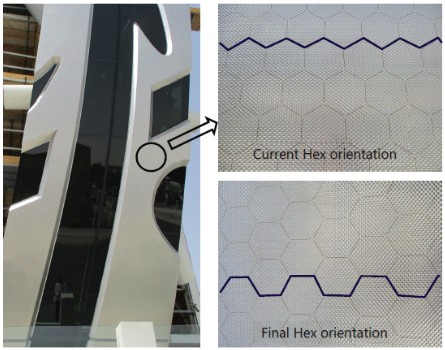
Supporting Commentary:
Descriptively, the parallel top and bottom facets of a typical hexagon shape are to run ‘across’ the panel in a generally horizontal orientation. See reference above for clarity.
Accordingly, the hairline joints between panels will be formed at the parallel facets of the hexagons (i.e. the resulting ‘staggered’ edge of the hexagons, rather than the ‘saw-tooth’ edge, as per this mockup).
The panelisation (setting out of hairline joints) and patterning (setting out of hexagon pattern) on each panel is understood to still be under development. This panelisation will be approved as a separate exercise (both holistically for the whole building, but also within each shop
drawing) since this is dependent on each panel’s own orientation on the building.”
149. Further revised Shop Drawings, also approved with more comments, were received on 21 March 2018. BHE wrote to Mr Fares on 25 March 2018:
“BAM presented the Revision 01 of Visual Mock-Up 5 (VMU-5) for review on the 18 March 2018 under Inspection Request ref no. 0121-AFN-FAC-IRE- 000002.
The review outcome for the VMU5 Rev01 Mockup is Status B Approved As Noted, with the exception of all gasket joints which are Status C Not Approved, Revise And Resubmit, and subject to subsequent review/approval within a separate mini-mockup.”
150. BAM said in its claim document that this demonstrated the continuous lack of clarity which was evident throughout the entire design process and contradicted the original intended purpose of producing VMUs in accordance with that which was stipulated within the Contract Specification.
151. On 26 March 2018, AFFAN wrote to BAM requesting an extension of time of 169 days. The claimed grounds included:
(1) The Panelisation had to be revised to meet the Employer's requirements (due largely to aesthetics) which resulted in further design development that was time consuming and delayed subsequent activities of the programme of works and critical path. Upon completion of the Panelisation in July 2017, the tasks of overlaying and fine tuning the calligraphy were the second main critical tasks. As per the Panelisation, a series of detailed workshops had to be implemented to check every letter, embellishment, and joint to ensure that not only was the calligraphy correct grammatically but also that the affected panels and most importantly the glazed units could be practically produced. In view of the above and the complex bespoke design of the project, the finalisation of the calligraphy caused further delays to the execution of the works.
(2) Having completed VMU 5 early in the New Year, the Client had expressed its concern over previously approved details and this had resulted in further design and engineering and a complete remodelling of VMU 5. These changes were summarised as follows:
(a) Changes to the stainless-steel hairline joint design resulting in the new hexagonal joint details.
(b) Complete change to the location and type of LED lighting together with a complete revision to the architectural intent of the LED lighting.
(c) Resultant changes to the previously agreed (and IFC-designed) sand blasted glass.
(d) Changing of the agreed black silicone joints to grey.
152. On 27 March 2018, BHE wrote to BAM instructing them to proceed with OSRAM LINEARLIGHT FLEX DIFFUE 600 SIDE (LFD600S) strips for the façade calligraphy reveal lighting. The next day, BAM forwarded the letter to AFFAN. On 29 March 2018, AFFAN submitted an extra over rate for the new OSRAM LEDs. BAM issued an instruction to proceed with the change in the LED bulbs.
153. On 30 November 2017, BAM had issued Payment Certificate No.6 in the sum of AED 9,896,000 for payment on 10 March 2018. It was in fact paid in 4 tranches – 2 January 2018, 22 February 2018, 7 March 2018, and 5 April 2018 after deduction of AED 750,000 paid to Koltay on behalf of AFFAN.
154. On 5 April 2018, BAM wrote to AFFAN to confirm that AFFAN had already received what it considered to be the instruction in relation to the LEDs, stating that costs would be determined in accordance with Clause 21 of the Subcontract (valuation of variations).
155. On 9 April 2018, BAM gave notice that it requested a formal Variation under the Main Contract from the Employer due to additional works to the façade outside of the Contract specification. BHE replied that they were unable to identify an event or circumstance that would give rise to any claim.
156. BAM noted the effect of the design changes on the fabrication of the façade panels:
“Whilst originally modularised, as a result of the multitude of design changes/Specification enhancements of the façade panels they became individually ‘bespoke’ and consequently resulted in changes to the fabrication process of the actual façade panels, culminating in the fabrication time for each panel increasing from 22 to 28 days and resulted in a significantly increased amount of wastage in the raw materials used
Throughout these many months of delay, the Contractor and specialist facade subcontractor have endeavoured to mitigate a large proportion of the delays imposed upon them through various measures, such as by commencing permanent panel production whilst a number of the final design changes/Specification enhancements were still being finalised by the Employer/Design Team.”
157. Dr Affan said in evidence that because of the increase in size of the panels instructed by BAM, AFFAN’s milling machines were not able to execute the job. The original machines were limited to panels of 9 metres by 2.2 metres. It was necessary to import a new larger CMS machine from Italy.
158. In their Defence and Counterclaim, the Defendants described the production process as follows:
(1) In order to accommodate the changes to the size of the panels and the hexagonalisation, AFFAN had to adopt the following processes which were set out in the panel production process document issued by AFFAN on 7 February 2018:
(a) AFFAN had to create a bespoke polyurethane foam mould for each panel. The manufacturing of each mould could take up to 72 hours.
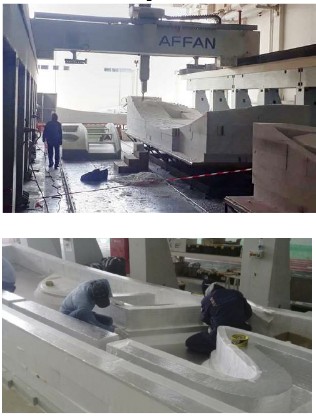
(b) Glass fibre/epoxy laminates were then cut and hand-laid into each mould to create what was referred to as a “layup”.
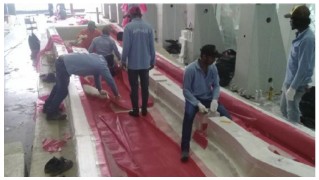
(c) The layups were then cured in ovens for up to six hours. These ovens were 20 metres by 8 metres, by 3 metres. Production rates were estimated based on the original planned size of the panels, permitting multiple panels to be cured at once. However, due to the increase size of some panels, the available capacity of the ovens decreased (fewer panels could be cured at the same time).
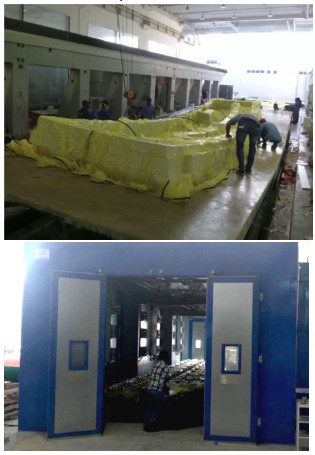
(d) Each panel then had to be demoulded and checked against digital files for compliance before being prepared for the bonding to the stainless steel.
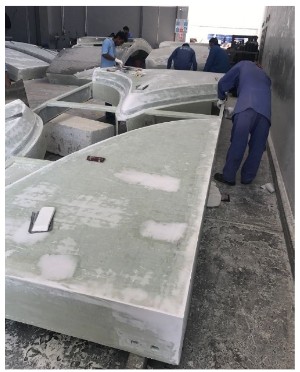
(2) What then followed was an inaccurate account of the process of hexagonalisation. It appeared to suggest that each hexagon was separate rather than a hexagonal pattern being cut into the stainless sheets. This was clearly a mistake on the part of the pleader that should have been picked up by AFFAN and Dr Affan. I do not consider that there was any sinister intent as there was no suggestion in evidence that the hexagons were individual units. This was self-evidently not the case:
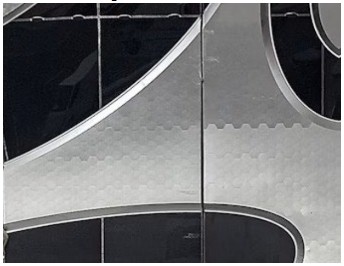
(3) AFFAN went on to allege that BHE introduced additional purely aesthetic requirements to the façade which had no technical benefit to the works:
(a) Requiring the gaps between panels to be reduced to mere “hairlines”;
(b) Requiring the hexagons on abutting panels to align so as to appear continuous, adding further design complications;
(c) Rotating the hexagons through 90 degrees for no apparent purpose;
(d) Specifying that the “dimples” in the façade should align from panel to panel:
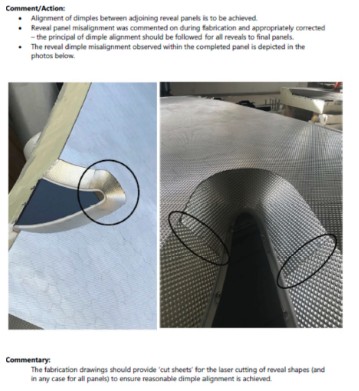
159. AFFAN claims that as a result of the changes associated with the “Killa preferred scheme,” the cost and complexity of the Subcontract Works increased, including:
(1) Approximately 70% of the panels were larger than the 9m x 2.2 metre panels which formed the basis of the tender;
(2) The larger panels required larger curing ovens, decreased the capacity of ovens, and increased curing times;
(3) The volume of wastage increased to 75% due to the complexity of the design, increasing the amount of raw materials required;
(4) Changes were required to the bracketry both due to the increased loading requirements of the larger panels, but also because:
(a) The design of the structural steel had been approved based on the original panel design meaning that the design was not optimised for the location of the panels; and
(b) The panels were only permitted to have a tolerance deflection of 2mm, whereas the structural steel was permitted tolerances of up to 10cm, making the design more complex.
This meant that instead of having standard bracketry, more complex bracketry had to be installed in order to achieve the Employer’s preferred deflection, and ensure safe loading, all as a direct result of the increase in panel size;
(5) Additional resources and time were required for the completion of the design;
(6) Additional labour and storage facilities were required;
(7) Additional transportation requirements had to be implemented due to the size of the panels.
Memorandum of Agreement
160. In April 2018, AFFAN requested financial assistance from BAM by way of advances to assist with the purchase of the CMS machine. The parties entered the MOA dated May 2018 whereby BAM (“First Party”) agreed to pay an Italian company the balance of monies owed for the supply of machinery needed to form the panels, in the sum of EUR 1,103,884. AFFAN (“Second Party”) agreed to repay BAM in accordance with a schedule attached. The following were terms of the MOA:
(1) Clause 6
“Until such time that the Second Party repays the full amount of the Financial Assistance to the First Party, ownership of the Specialist Equipment shall vest with the First Party and the Second Party hereby grants all legal title to the Specialist Equipment to the First Party.”
(2) Clause 7
“The Second Party undertakes to the First Party that the machines are for the sole and exclusive use for facade panel production for the Museum of the Future Project in Dubai, United Arab Emirates and that they are to supplement the current 2 machines being used for the production.”
(3) Clause 12
“The Second Party is to furnish the First Party with lease agreements for the facilities within which the machines are located and agrees to provide the First Party free unhindered access to the said facilities as and when requested.”
(4) Clause 13
“The Second Party will provide the First Party with a signed, undated security cheque in the amount of AED 4,322,177.00 (United Arab Dirhams Four Million Three Hundred and Twenty Two Thousand One Hundred and Seventy Seven) (Exchange rate is 0.2554 the BAM spot rate end of April) used as a security until such time that the Second Party has repaid the First Party the full amount of the Financial Assistance at which time, the First Party shall return the security cheque to the Second Party.”
161. In May 2018 AFFAN provided the First Security Cheque in the sum of AED 4,322,177, signed by Dr Affan, and undertook the fabrication of the panels.
162. On 23 May 2018, BHE sent drawings to BAM, and AFFAN “presented to us… pre- approved for the hex pattern”. It is not clear who presented the drawings. On the same day, AFFAN set out what it considered to be additions to and omissions from the Subcontract Works, including as additions –
(1) Hexagon pattern to stainless steel;
(2) Led type;
(3) Led cables; scope gap; and
(4) Led spares requested by N25.
163. From around June 2018, AFFAN started to make further requests for financial assistance on the basis that it would be back-charged for the amounts. There were more than 500: Mr Doyle states that there 535 totalling AED 97,103,100.54. Some were quite trivial (e.g. a spare blade for a bandsaw worth AED 2,500), others more substantial (e.g. glass sheets worth AED 1.8 million).
Hexagonalisation
164. On 21 June 2018, BAM wrote to AFFAN providing approval (with comments) on document 0121-AFN-FAC-RPT-00005. The approval stated: “Approval for arrangement of the hex pattern” for L1-L4 and included the comments “Ensure the hex pattern is shown on the panelisation drawings that must be submitted for approval”.
165. On 27 June 2018, BAM reiterated to AFFAN that it was to “provide a detailed shop drawing schedule covering the future panel production priority considering that the LI- L4SS hexagon pattern model is approved.” It is said that drawing 0121-AFN-FAC-SDS- 000144 was approved on this date but the hyperlink provided in electronic bundle is to a different document.
166. On 1 July 2018, BAM replied to AFFAN’s claims for variations of 23 May 2018. Notwithstanding BAM’s 6-week delay in replying, BAM demanded AFFAN’s immediate attention in providing full and complete backup to all variations. BAM requested a complete itemised register detailing all of the “alleged” variations, including all necessary particulars surrounding the same for BAM’s review and comment.
167. On 2 July 2018, AFFAN wrote to BAM seeking a variation relating to the introduction of the hexagonal pattern pursuant to Clause 20.1(c) of the Subcontract on the grounds that the aesthetic requirement of the hexagon pattern was not a requirement of the specification.
168. BAM wrote to BHE on 3 July 2018:
“The specific event being claimed is the additional works and requirements being requested and instructed by means of items within the visual inspection report.
These additional items not included in any of the original IFC documentation include;
Hexagonal Patterns - Introduced by the Employers design team to enhance the malleability of the specified S/S sheet thickness. This has in turn increased the required engineering / design time required to align and detail the said patterning within the differing planes and locations.
Hairline Joint Setting Out – Whilst intrinsically linked to the abovementioned item this was never part of the Contract requirements and the instruction to include and detail within the shop drawing submissions has again incurred additional engineering / design time.
Hairline joint installation tolerances – Associated with the above.
Reveal Panel Lengths – This was an instruction given so that it minimised hairline joints by maximising the length of the reveal which in turn has created additional engineering time and additional materials and fabrication time.
Reveal Dimple Orientation – This requirement is not specified with the Contract requirements.
Revised LED specification – Revised LED has been instructed at a late stage (additional cost covered under separate CCN)
Bespoke glass restraint clips - Additional requirement
It is our opinion that the above list equates to enhancement of the original specification for which BAM/AFFAN have still proactively incorporated into a revised mock up.”
169. BAM wrote again the next day:
“We are in receipt of the enclosed AFFAN letter ref. Affan-LETTER-000264 regarding the hexagon patterns to stainless steel and write to advise that we believe the changes detailed in the letter constitute a Variation to the Contract under Sub-Clause 13.1(c). For practical purposes we take your approvals of the hexagon patterns as an instruction to proceed, however we would request the formal Variation Instruction from the Employer as required under Sub- Clause 13.l(d).
In the meantime, as the changes are likely to result in additional costs and may delay the Works, for which the Contractor would consider itself entitled to additional Costs/payment and/or an extension to the Time for Completion we hereby give notice of such entitlement pursuant to Sub-Clause 20.1 (c), pending the finalisation of the revised Employer's requirement …”
170. BHE replied 2 weeks later on 18 July 2018:
“The hexagonal patterns were not part of the specification. They were introduced to assist Affan due to their inability to resolve the curvature and bonding issues of the stainless steel to the GFRP that was evident in the original VMUS mock-up. The hexagon patterning has provided Affan with the means to achieve the fundamental design intent of stainless steel bonded to the GFRP over a doubly-curved surface, and to do so in the required robust manner. This has mitigated a significant project risk for BAM/Affan. Also note that Affan have had every opportunity to assess any solutions they wish to resolve the related issues, and the hexagon pattern has been expressed and readily adopted by Affan as a favourable option (i.e. it has not been forced upon Affan by the design team as the only acceptable or required solution).
Having been adopted by Affan as the solution to the curvature and bonding issues, the development of acceptable pattern arrangements for the hexagons was a consequent necessity in order to achieve an acceptable visual appearance of the facade panels.
It is not accepted that the development of the hexagonal patterns is a change instigated by the Client/consultant team and it is considered that there is no basis for an entitlement for this event.”
171. Mr Smith disagrees in his First Report dated 17 May 2024:
“7.4.3 The tender mock up and the first version of VMU 5 showed that AIS’s proposal for the façade was buildable, albeit workmanship and quality issues required improvement based upon VMU 5. It appears the introduction of the hexagonal pattern was an aesthetic one based upon a desire to remove the visibility of the hairline joints between the stainless steel sheets as per section 6.2.10. Comments were made stating the jointing shown by AIS was not as per the design intent. However the IFC documentation showed no information relating to how the joints should be set out, or in which direction the 6WL pattern should run.”
172. BAM seems to have agreed with Mr Smith in its claim document:
“8.5.1 The Design Team were unhappy with how their designed panelisation ‘looked’ in VMU 05 Rev. 0 presentation and subsequently instructed incorporating hexagonal patterns in the stainless steel to overcome the resistance of the sheet thickness as the Specified 0.8 mm Grade 316 6WL to being double-curved to the upgraded geometries of the project's panels. Comments received back on VMU 05 Rev. 0 included the rejection of vertical hairline joints in all locations and instructed that full width panel lengths of stainless steel, more extensively curved, be used instead to reduce the number of vertical hairline joints. The use of hairline joints, or restrictions in using them was not covered in the Contract Specification.
8.5.2 The only way AFFAN could accommodate the curvature of the façade panels using the specified stainless was to introduce vertical and horizontal joints indiscriminately. It should also be noted that the approved shop drawing for VMU05 Rev. 0 clearly showed the locations of the intended hairline joints and were approved by the Employer's Representative.
...
8.5.4 BAM/AFFAN could not have been aware of this issue at tender because of the generally specified single-curve, nor would any allowance have been made for the arbitrary manner in which it would eventually be signed off. It is not possible for a Contractor to consider criteria which have not been defined within the contract specifications.
8.5.5 This in turn led to instructions from the Design Team during on-going workshops to co-ordinate hexagonal patterns, not only within the confines of individual façade panels, but also from panel to panel on each level and each connecting level.
8.5.6 … Special software ('Catia'), had to be used to complete this task, along with an onerous approvals process through a lengthy 'workshop' … Only upon selection of the pattern could the exercise begin in terms of superimposing the chosen pattern onto the surface plane of the building and coordinating it across the 1024 panels which make up its surface. The Design Team's expectation was to align and coordinate all the hexagonal patterns from one individual panel, to the panels left and right and above and below that particular panel so that the hex pattern remained 'on datum' throughout the entire façade elevation.
…
8.5.7 This process continued even after VMU05 Rev 1 was approved with comments culminating in a delay up to 13th May 2018 when AFFAN issued the first four panels showing hexagonal patterns for final approval before being able to go into permanent production. This was approved by BHE on the 23rd May 2018 … thereby demonstrating a delay in permanent panel production directly attributable to signing off of 'hexagonal patterns' which was never envisaged as it was not included in the Contract/IFC Drawings or Specification.
8.5.8 A further contributory complexity was added because of the introduction of the hexagonal patterns, coupled with the hairline joint setting out,… that being the requirement for the use of templates for each and every stainless sheet to be used. This is also linked to the two-stage curing process …, due to the complexities in aligning hexagonal sheets and the mechanisms of the steel behaviour in forming curves; but all are intrinsically linked and each change to the Design/Specification had a knock-on effect to follow-on sequence methodologies.
8.5.9 The instruction to split the panels into hexagonal pieces vastly increased the time required for laser-cutting the raw stainless steel sheets and increased the ratio of material wastage.
8.6.1 Whilst intrinsically linked to the introduction of hexagonal patterns, the Design Team were similarly dissatisfied with the aesthetics of the vertical hairline joints, despite having approved Shop Drawings.
8.6.2 Hairline joints were never part of the Contract requirements and the subsequent changes again incurred additional engineering/design time. The complexities involved in attempting to complete this task, again with no definitive clarity as to what was being measured against, led to prolonged and unnecessary indecision and ultimately late progression of processes…. In addition, the physical capability constraints of the specified material (0.8mm), meant that it was not possible to complete the reveals in 0.8mm stainless, and so 0.4mm had been introduced in the early stages of the project. Without having a set of parameters to be measured against, subjective opinion was again used as rationale for Shop Drawing rejection further resulting in an overly onerous and prolonged process.
8.6.3 ... The instruction to include the location of the hairline joints on Shop Drawings, again which was not specified, also lead to a prolonged engineering and approvals process which was not allowed for in tender...
8.7.1 As a consequence of there being no Specification relating to the need for hairline stainless-to-stainless steel joints or their location, no account of tolerances were made in the Contract Specification for such hairline joints....
8.7.2 Following the negative comments from ERG/Design Team during various mini mock ups and factory inspections regarding such joints being considered unsatisfactory, in the absence of any Specification tolerance upon which to base such comments, ultimately the Specialist Subcontractor, AFFAN, resorted to suggesting a set of tolerances based on what they believed to be reasonably achievable during production in the factory, in order to avoid the seemingly endless contractually-baseless criticism.
…
8.7.5 Even at the stage of presenting the VMU 05, there were no defined tolerances, yet the ER deemed the achieved joints unacceptable.
8.7.6 Resolving the issue and achieving the ER's acceptance and sign off of subsequent works based on undefined criteria led to further delay and disruption in production of panels. It is clearly impossible for the Contractor to be held accountable for the imposition of new, yet undefined, constraints that did not exist within the Contract Documents.
…
8.9.2 Following the inspection of VMU 05 Rev. 0, BAM/AF FAN were then instructed to have the dimples running plumb to a level datum across all panels, but the expectation was also to align the dimples between sheets when cut. Again, none of this was clearly or formally instructed until as recently as 12th November 2018, when BHE finally issued what they intended to be clarity on the ongoing development of their 'perceived' quality bench marks for the facade panels delivered up to that time. This led to further increases in time for engineering and approvals along with costs associated with the unforeseen wastage not originally tendered for.
…
8.10.3 Having followed the instruction to provide 'double-curved' panels, some minor 'undulations' were evident during the VMU 05 Rev. 0 presentation and among the comments received from VMU05 Rev 0107, the ERC referred to such undulations as being 'particularly visible in direct sunlight reflections' …
…
8.10.7 In subsequent workshops held after 8th February 2018, it was found that these undulations could only be alleviated by incorporating the two-stage process in terms of the carcass manufacturing of each panel.
8.10.8 AFFAN had subsequently to adopt this two stage curing process, filling the undulations post stage one curing, and applying additional layers of GFRP during the second stage along with the stainless application. … This resulted in another onerous and non-envisaged process which incurred additional time, labour and cost implications.” [emphasis added]
173. Mr Doyle was given the opportunity to comment on the contents of the claim document in cross-examination but declined to do so on the grounds that these were technical matters of which he had no knowledge. I find it hard to believe that Mr Doyle was not intimately involved in the preparation of the claim document and consider that he was affecting ignorance in order to avoid answering questions about matters that were clearly inconsistent with the case as presented in his evidence.
AFFAN’s Costs Claims
174. On 11 October 2018, AFFAN wrote to BAM:
“Further to our letter dated 26th March 2018 and discussions held during the meeting of 8th October 2018 we write to advise of significant cost escalations on the design and production of the façade panels.
As you are aware production has commenced in earnest and installation is proceeding essentially at risk in an effort to mitigate the above issues.
However we are experiencing significant cost overruns to develop and deliver the panels at the levels now finally accepted by the Client.
We anticipate being able to provide further and better particulars of all the issues related to the "betterment" by the end of next week with an estimate of the time and cost involved.”
175. On 29 October 2018, AFFAN wrote to BAM with regard to “Costs Associated with Design Betterment and Panel Aesthetics”:
“… we have now compiled our initial assessment of the forecast costs to complete the facade production and installation. This document is prepared based upon the time and materials taken to complete the first 100 no. panels and we acknowledge it identifies a significant increase over and above the contract sum agreed.
As to the next steps we would be very happy to review the numbers in detail with your commercial team to validate the increase to the forecast, prior to an eventual submission to the Employer.
As you are aware production is ongoing and with the influx of the new facilities with additional labour, we expect the panel outputs to increase dramatically over the next couple of months.”
176. The document forecast an outturn price of AED 259,781,938 as opposed to the Accepted Subcontract Amount of AED 125 million. It first addressed design:
“1.1 Panelisation
The panelisation at IFC stage clearly identifies a single curved 4m panel, which is taking support mid span between the main die grid members. The option of moving to a floor-to-floor span was considered possible and better aesthetically. This led to the introduction of panels up to 18m in length with far more complex geometries.
The resulting process of developing the panelisation became a more aesthetically challenged process in trying to identify how the lines between panels and between floors could be achieved. This ultimately had to be approved by N25
The initial solutions were created in 3D using 3D Catia but finally 1:100 scale models with the panelisation had to be made to fully appreciate the panel lines and directions.
The panelisation ultimately extended to a 4 month period before all stakeholders were able to accept the model.”
177. At section 1.7 it addressed Panel Types:
“As the design has progressed so it has become apparent that the faced panels now fall into 5 generic types rated for their complexity
Panel type A represents the level 6 nominal 9000mm x 2200mm up to Type E which represents the largest and most complex double-curved panels on the project
This assessment affects both the production times which is further detailed in section 15, the planning and production sequencing and the final installation on site”
178. At section 3 it was noted that the foam had to be significantly enlarged to enable production of the panels from 9m up to 17m. In addition, the type of the foam had been upgraded to a high-density PU foam which is quicker to mill as part of the mitigation measures.
179. There was a knock-on effect on insulation, it was said at section 11, as the panel sizes had significantly increased and so the method of fixing the insulation had been varied to utilise both acrylic glue and clips. This had resulted in an increase to the consumables costs (as said at section 13). In a similar vein to the insulation and accessories, as the panel sizes had increased, the consumables involved in the pre-preg production had increased. This included vacuum accessories, intumescent film, adhesives, tapes etc
180. At section 15, it was noted that the effect of all items detailed was to impact each stage of the production with the consequence of significant additional hours being spent on each stage. This had been assessed based on the first 100 No. panels produced and was an estimate of the outturn cost which might vary when more information was available to assess the Type D and E panels.
181. BAM replied on 6 November 2018 asking for details of the clause of the Subcontract under which AFFAN was issuing its letter and if it was a claim pursuant to the Subcontract. BAM requested further substantiation.
182. On 12 November 2018, BAM wrote to Dr Affan:
“BAM draw your attention to Affan-LETTER-000563 dated the 31 Oct 2018 and received on the 11 Nov 2018 which stated AFFAN’s consent to cooperating fully with the commencement of supplementary milling in Emirates Boats LLC. BAM also note that since the 5 Nov 2018 5 no. panels have been successfully milled in Emirates Boats, inspected and signed off by AFFAN QA/QC. BAM are therefore at a loss as to why, on the morning of the 12 Nov 2018, you personally instructed your staff to not cooperate with either Emirates Boats or BAM staff in continuing the supply of tables with foam block build up and software files which would allow Emirates Boats to continue milling.
BAM wish to formally put on record your personal response during a phone conversation on the morning of the 12 Nov 2018 with our Project Manager Shaun McGinley as to why you instructed the above, that being, until you receive the monies requested in Affan-LETTER-000513 issued on the 6 Nov 2018, works will be stopped. BAM fail to see under which clause of your subcontract agreement it states where AFFAN can cease their works when unsubstantiated requests for monies are made? BAM also draw your attention to the response contained within BHH-LETTER-005104 issued on the 6 Nov last and further note AFFAN’s noncompliance with Clause 30 of your Subcontract Agreement which we believe constitutes yet another breach of contract.
AFFAN are again instructed to comply with the previous instruction contained within both BHH-LETTER-004967 and BHH-LETTER-004985 issued on the 29 Oct last and reminded of your full liabilities in failing to observe same.”
183. It is said in the Agreed Chronology that on 26 November 2018 AFFAN requested AED 15 million “on account”. Most of the letter appears to be missing from the trial bundle (it appears to be page 1757A which I noted was not in the bundle but was not thereafter supplied by BAM) but (what I assume to be) the last page reads, “We are unable to sustain such an increase in the project costs without your continued support and would request you to release the requested amount at the earliest.”
184. Mr Doyle says that on 27 November 2018, he attended a meeting with Dr Affan and individuals from the Employer’s team to discuss AFFAN’s work stoppage. Dr Affan reiterated that they needed AED 15 million to move forward, and that the additional costs related to design changes.
185. Instead of providing further financial assistance to AFFAN, BAM’s response was to make a claim under the Advance Payment Guarantee in the sum of AED 9.375 million the next day, on 28 November 2018.
186. On 29 November 2018, AFFAN submitted a revised summary of the assessment of the forecast costs to complete the façade production and installation. It is not clear whether AFFAN knew that the Advance Payment Guarantee had been enforced at the time of writing. On 1 December 2018, AFFAN followed up with a detailed comparison of the façade costing as per IFC and as per final approvals.
Addendum to the Subcontract
187. Mr Doyle entered into negotiations with Dr Affan on 5, 6, and 9 December 2018 for the Addendum whereby BAM would provide financial support to AFFAN to ensure the continuity and completion of the Subcontract Works. Mr Doyle suggested that because they were using AFFAN’s design solution, once the Subcontract Works were underway, they could not replace AFFAN without having to replace the full façade (essentially starting over) which simply was not feasible. I am not sure this is correct as Clause 26.1 of the Subcontract enabled BAM, in the event of terminating the Subcontract, to take possession of all of AFFAN’s Equipment, Subcontractor's Documents, materials, plant and other things whatsoever brought on to the Site by AFFAN and use them for the purpose of executing, completing and maintaining the Subcontract Works. The more likely reason for BAM’s reticence to terminate the Subcontract was disclosed in his oral evidence by Mr Doyle:
“… So we were obliged to have a specialist for that. If we had terminated them, we would have been in breach of that obligation. The other important point was that AFFAN was in the process of securing authority approvals from the local authorities. They were registered to do so. And again, if we had terminated AFFAN, we would have great difficulty in obtaining those authority approvals in order to hand over the building.
LORD JONATHAN CLIVE MARKS: Of those authorities, which was the most important?
DERMOT DOYLE: The Dubai Civil Defence.
LORD JONATHAN CLIVE MARKS: And what would have been the effect on the Dubai Civil Defence of AFFAN's departure and the termination of the Subcontract?
DERMOT DOYLE: So there was... specific fire testing was required. VMU testing mentioned in the Addendum and AFFAN was obliged to demonstrate that their Works would satisfy local authority, particularly, Dubai Civil Defence fire regulation tests. If that had not continued and we could not secure that, they would not have issued a Completion Certificate for the building and we would never been able to hand over the building to the Client. Simply as that. They were controlling all of the documentation and the processes for achieving those fire tests.
…
CROSS-EXAMINATION OF MR. DERMOT DOYLE
Q1. So, just to understand, after the facility, in your words, was taken over, is it your evidence that you continue to represent to the authorities that AFFAN, and who was a licensed Specialist Subcontractor, was still working on the Project. Is that what your evidence is?
A: AFFAN, was effectively, still working on the Project. They hadn't been terminated.
Q2. And you've continued to benefit from their license because otherwise, you would have to stop the work?
A: No, it was their obligation on the Addendum to secure those agreeables.
Q3. So, I'm asking you a question. Just focus on the question. You continue to benefit from their license as a Specialist Subcontractor, because without a licensed Specialist Cladding Subcontractor, you couldn't continue with the manufacture?
A: I think, we could continue with the manufacturing but for security final approvals, it was necessary.
Q4. So, you continued to benefit from their license?
A: [INAUDIBLE] yeah.”
188. The Addendum was made on 17 December 2018. It recorded in relevant part:
(1) “Section A
1. The Subcontract shall continue to be in full force and effect. This Addendum is of the highest priority in the order of precedence of the documents making up the Subcontract. Any clause or part of the Addendum or the Subcontract which may be unlawful or unenforceable in any way shall not prejudice the continued use of the remaining parts of the Addendum or the Subcontract. However, the Parties shall cooperate to amicably resolve any part of the Addendum which is unenforceable .
2. Twenty-four hours prior to the signature of the Addendum , the Contractor shall be allowed to place security staff and management in the Facilities (as defined below) and regulate the movement in and out of the Facilities of any asset or material which is necessary for the successful completion of the Subcontract works. The Subcontractor is not permitted to remove any asset or material relating to the MotF project from the Facilities without the prior approval of the Contractor.
…
5. This language of this Addendum shall in all respects be English and the law and jurisdiction shall be the that of Dubai and the UAE [sic].
6. The allowance for the access and use of the Facilities and Resources required for the fulfillment of the Subcontractor's obligations under the Subcontract is limited to the production and completion of the Works and obligations related to the Museum of the Future only.
7. It is understood that the Contractor has no right to approach or hire any of the Subcontractor's employees. Any provision of this Addendum shall lapse immediately upon the Subcontractor breaching any provision of this Addendum as notified in writing by the Contractor.
…
12. if the subcontractor breaches any provision of this addendum, then the contractor's undertakings in section c below shall cease to apply with immediate effect. likewise, if the contractor breaches any of its undertakings, the subcontractor' s obligations shall cease to apply.”
(2) “Section B
1. The Subcontractor will allow the Contractor full unimpeded access and use of the Subcontractor's staff, labour, equipment, documentation and any other things required for the fabrication of the Subcontract Works as completed and not installed, partially fabricated, in the factories as stock, ordered and to be delivered and to be determined (the Resources) and to the factories and facilities that are required for the fabrication , dispatch and installation of the Subcontract Works; including but not limited to DIP-Affan Plot 597 -581 , Al Tayer Plot 0599 -0967, Gulf Gypsum Industries 0599-0851, Kalki Metal Industry Plot 599-1035 (signing tenancy contract is in process) all in Dubai , UAE and any other location where any part of the Subcontract Works are being fabricated or performed (the Facilities) . The definition of 'the Site ' under the terms of the Subcontract and/or Main Contract shall henceforth be extended to include the Facilities as described herein.
2. The Contractor will take full benefit for the scope of the works related to MotF only in terms of the Facilities and Resources until completion of the Subcontract Works save that the Subcontractor shall remain liable to obtain and maintain all legal and regulatory approvals and documents for both the Facilities and the Resources all by agreement under this document.
…
4. The quality of the panels and any necessary approvals to satisfy the Subcontract shall remain the responsibility of the Subcontractor.
5. The Contractor shall control the Facilities and put in place its own security measures together with the Subcontractor 's measures including its own security guards. Practical arrangement for access shall be permitted for the Subcontractors operations.
6. The Subcontractor shall not be allowed to blockade, embargo, disrupt or interfere in any way with the operation of the Facilities or the Resources, including acceptance that no legal remedy or injunction of any kind may be raised in this regard against the Contractor in respect of the Facilities or Resources.
7. The management of the Subcontractor shall remain fully available at 24 hours' notice to attend the Facilities unless any longer period is agreed in writing by the Contractor as requested.
8. The Subcontractor shall employ at his own expense a claims specialist quantity surveyor, from a recognized and reputable provider of such services, to work on substantiation of entitlement for variations and change to the Subcontract Works on an intensive and continuous basis thereby seeking to secure payment for such changes and variations as have been instructed by the Contractor and Employer on the Project.”
(3) “Section C
1. Upon entering into this Addendum, over a seven (7) day period, the Parties shall conduct a joint audit wherein the Parties shall identify and audit the schedule of costs that the Subcontractor requests the Contractor to pay on its behalf (the "Audit of the Historical Costs") related to the running of the Subcontractor's operations in satisfaction of the Subcontract. On the day of entering into the Addendum, the Subcontractor shall provide a signed, undated security cheque in the amount of AED 7m (UAE Dirhams seven million). The Contractor shall pay an initial on-account payment of AED 7m (UAE Dirhams seven million) within 7 days of the date of this Addendum to the Subcontractor. Following the conclusion of the Audit of Historical Cost, the Contractor shall pay the remaining amount identified and justified in the Audit of Historical Cost (if any) which in all events shall not exceed AED 8m (UAE Dirhams eight million). The approved amount shall be paid by no later than 15 January 2019 against an additional signed, undated security cheque from the Subcontractor which shall be equal to the approved amount. All these cost and payment trails for these payments and future costs and payments shall be auditable with complete transparency and assistance from the Subcontractor and the bank(s) of the Subcontractor. The Contractor shall return both security cheques upon the delivery of 500 completed panels to the MotF project site.
2. It is also understood that there are committed costs for materials of approximately AED 30m which will be facilitated through existing Letter of Credit arrangements from the Contractor to the Subcontractor's bank by way of a schedule of payments to be agreed with the Subcontractor's bank. These costs shall be identified and signed off by the Contractor as related to the Subcontract. All these cost and payment trails for these payments and future costs and payments shall be auditable with complete transparency and assistance from the Subcontractor and the bank of the Subcontractor.
…
4. In addition to the payments that will be made in accordance C1 and C2 above, from the date of the Addendum, the Contractor shall pay on a monthly basis any further legitimately substantiated costs for the staff, labour, services, materials, consumables and other things provided for the completion, benefit and advancement of the Subcontract Works and the Subcontract Works only, (the "Production Costs"…
5. It is also expected that the Subcontractor shall incur additional costs ("Running Costs") for the Subcontractor owned equipment, rent, maintenance, utilities, insurances, software, computing and own transport which shall be substantiated in support of any claim made in respect of the Subcontract and at financial audit. The Contractor shall pay the legitimately substantiated Running Costs on a monthly basis which shall be subject to audit for scale and credibility.
6. Any and all costs incurred (including but not limited to those costs already incurred by the Contractor prior to the Addendum, materials costs incurred by the Contractor subsequent to the signature of the Addendum, costs related to C1 and C2, the Production Costs, the Running Costs, financing costs and any loss or damage levied by the Employer in respect of this Addendum or the Subcontract shall be recoverable against the value of the Subcontract Works, which is the Subcontract Price plus, the value of any variations to the Subcontract works agreed with the Employer and the Contractor. For the avoidance of doubt, the ownership of the panels produced flowing from the cost paid by the Contractor under C1, 2, 4 and 5 and shall pass fully and legally to the Contractor.
…
7. Full use of any equipment, material or thing within the Facilities upon taking over or subsequently delivered to the Facilities shall be to the benefit of the Contractor until completion of the production of the panels in the event of any breach, repudiation, default or liquidation (in any form) of the Subcontractor during the life of this Addendum.”
189. The Addendum was an extraordinary document. It essentially meant that AFFAN was to cede control of its own premises to BAM and undertake its work under the watchful eye of BAM staff backed up by security guards who would monitor the movement in and out of the premises of any asset or material. In return BAM was not conceding that AFFAN was entitled to any variation of the Subcontract Works. On the contrary, the onus was squarely placed on AFFAN to establish any such entitlement. It is true that BAM was offering financial support, but not in excess of anything that was originally payable under the Subcontract, and it was to be partially secured by cheque and recovered against payments otherwise due under the Subcontract, including financing costs and any loss or damage levied by the Employer.
190. I cannot imagine any business entering into such an arrangement if it were not desperate. Dr Affan accepted in evidence that in December 2018 the financial position was dire. He said that AFFAN was forced to sign the Addendum due to threats to encash its bonds. Indeed, by 28 November 2021, BAM had already started the process.
191. On 19 December 2018, BAM paid AED 7.35 million to AFFAN (inclusive of VAT). In return AFFAN provided the undated Second Security Cheque in the sum of AED 7 million signed by Dr Affan.
192. AFFAN wrote to BAM on 8 January 2019 with reference to the Addendum Clause C.1 with a summary for the payment of AED 8 million expected to be released by 15 January 2019:
| Sl No. | Description | T/Value AED | Remarks |
|---|---|---|---|
| 1 |
License Renewal, Sponsor Fees and Labour Fees |
750,000.00 | |
| 2 |
Group Medical Insurance |
624,148.53 |
2 QUARTERS AND FOR ADDTL MEMBERS |
| 3 |
Group Medical Insurance (additional for NANONITE visas) |
10,028.13 |
1st quarter due on 25-11-2018 |
| 4 |
General Insurances (PL-WC-PL-G.I.) |
237,865.08 |
Invoices to be printed out |
| 5 |
Kanoon labour outsourced |
1,860,732.05 |
Apr-July Invoices |
| 6 |
Al Waha labour outsourced |
216,029.25 |
July - Sept Invoices |
| 7 |
City Crown |
49,980.00 |
May to Nov Invoices |
| 8 |
DIP Fees |
269,072.66 |
Invoices to be printed out |
| 9 |
Transworld (clearance and transports) |
202,745.15 |
July to Nov Invoices, Invoices to be printed out |
| 10 |
Diab - Foam material |
632,563.66 |
Invoices to be printed out |
| 11 |
December 2018 Salaries and Gratuities |
3,100,000.00 | |
| 12 |
Premium for Professional Indemnity |
70,564.38 | |
|
Total Amount |
8,023,728.89 |
||
It was said that the supporting documents for the above would be ready for collection within the week from AFFAN’s office in a folder as the size of the file was large.
Variation Claims
193. There was a meeting between BAM and AFFAN about the variation claims on 15 January 2019. The minutes recorded:
(1) BAM explained that it had approached the Employer with a view to agreeing a fast- track process for the early resolution of the façade variations being claimed by AFFAN. The Employer had in principle, expressed a willingness to adopt such an approach.
(2) The parties agreed that a comprehensive list of the façade variations should be circulated so that consensus on the ones to proceed with could be reached. BAM enclosed its list of identified variations. AFFAN was to review and provide feedback.
(3) BAM explained that it was preparing a detailed chronology of the façade variations for incorporation into its Extension of Time (“EOT”) request. BAM agreed to circulate the chronology/narrative once substantially complete.
(4) AFFAN had already prepared a high-level cost assessment of the variations that it had identified. AFFAN was to issue this to DGA.
(5) Once the parties had finalised the agreed list of variations, individual files could be prepared incorporating extracts from BAM’s chronology/narrative and AFFAN’s high-level cost assessment. These could then be developed in support of each individual variation.
194. The file referred to on 8 January was handed over on 17 January 2019. On 20 January 2019, Mr Doyle wrote to AFFAN accepting around half the amount claimed and offering a further AED 4 million against a security cheque, which was paid on 20 January 2019. The Third Security Cheque was supplied.
195. BAM followed up the meeting on 15 January 2019 with a letter dated 24 January 2024:
“We refer to your letters ref. Affan-LETTER-000679 and 000686 dated 29 November 2018 and 1 December 2018 issued in response to BH-TRANSMIT- 002053 – Visual Inspection of Mock-up 5 and the changes in the façade design recorded therein.
The changes in design are noted as:
1. Hexagonal Patterns
2. Hairline Joint Setting Out
3. Hairline Joint Installation Tolerances
4. Reveal Panel Lengths
5. Reveal Dimple Orientation
6. Revised Curing Process
7. Bespoke Glass Restraint Clips
The above list is similar to that which was forwarded to you as an attachment to minutes of a meeting held in your office on 15 January 2019 (further copy attached for ease of reference) with one exception in that BAM recorded a revision in the LED specification as a variation rather than the revision of the curing process as noted by you. Under item A.3 of these minutes, AFFAN was requested to provide feedback on the list so that a consensus may be reached on the variations to pursue under both the Subcontract and Main Contract. BAM is currently awaiting AFFAN’s formal response on the same.
Notwithstanding the aforesaid list, it is noted your submission provides details of costs under 23 separate heads, with design engineering, foam, prepeg- grp, joint sealant, workshop labour, overheads and profit attracting the highest values. Furthermore, cost have been allocated to LED and accessories which AFFAN does not consider to be a variation attributable to the visual inspection of mock-up 5 given its absence from the above list.
There appears to be a disconnect between cause and effect as there is no direct correlation between the heads of cost and the variation works AFFAN has identified within its submission. In order to address this anomaly, BAM requests AFFAN to first provide its feedback on the list of variations issued under the minutes of meeting for our agreement and secondly re-submit your variation account wherein the quantum of cost under the 23 heads is properly allocated to the agreed variations. As confirmed under minute A.7 of the meeting, the variations shall be evaluated based upon new Subcontract rates.
As confirmed during the meeting on 15 January 2019, DGA has been engaged by AFFAN for this specific purpose and we would therefore welcome your formal confirmation of the date AFFAN / DGA will be able to complete this particular exercise wherein both parties are satisfied to proceed with the formal submission of your variation account to the Employer for agreement and payment.”
196. On 27 January 2019, AFFAN wrote to BAM:
“… kindly find the attached summary of the additional supporting documents related to the historical cost for the 15 million requested from BAM. Supporting documents will be sent to you via we transfer due to the large size.
The hardcopies of the same can be collected and discussed at our offices.
Secondly, with reference to the letter of credit documents, as conveyed the bank is still chasing us for the payment.
Further clarifications can be provided and we request your presence here at our office to close these two urgent issues at the earliest.
Kindly confirm back to us your availability to sort the above.”
197. BAM replied on 28 January 2019:
“We have received a soft copy of the additional supporting documentation in relation to the historical costs of AED 15 million. We are reviewing the same and will advise any further clarifications or queries in due course.
With reference to your request regarding the letter of credit payments, please note that we still await the submission of supporting documentation from Affan requested via. Aconex letter ref. BHH-LETTER-006470, dated 21st January 2019. Kindly advise when this will be provided?”
198. AFFAN responded the same day:
“Thank you for your reply and we look forward to hearing from you regarding the release of the balance 4 million as we need to settle few of our major suppliers, insurance and visa issuances as soon as possible. The invoices / supporting documents for the visa issuances and PRO activities cannot be produced until we proceed with the payment first. We have already submitted all the proofs possible till date.
Meanwhile, with reference to the letter of credit payment for the supplier Notus, as discussed yesterday over the phone, we would be glad to assist you with all the details we have related to the shipment of the same. At this moment record that the documents submitted to the bank related to the payment for the supplier Notus has been already forwarded to BAM along with the purchase orders and the BOE (Bill of entry of the materials with complete description (which is a clear proof of the materials being delivered to AFFAN).
The same material has been used in the panel fabrication and as mentioned in our purchase orders. As explained to earlier, the purchase order for Notus has been revised several times based on the current requirement for the fabrication and to relate these purchase order with delivery notes and invoices will be not an easy task. In fact the value will not match until the delivery has been 100% complete. If the supplied material was for a smaller quantity we would be able to do comparison with each delivery notes and purchase orders.
Understanding the payment is overdue since more than a month and the bank chasing us continuously, we request BAM to kindly release the payment and to do the comparison of material delivery once the final purchase order is confirmed with Notus. We, AFFAN is still willing to clarify your queries our best possible way for the materials being supplied as conveyed.
Also, you are welcome to go through each delivery notes files for all the deliveries if needed at our offices.”
199. Notwithstanding the offer of “open book” access in accordance with Clause C.2 of the Addendum, this prompted an intemperate reply from Mr Doyle the following day (29 January 2019):
“I don’t understand your comment that you would be glad to assist us. I have lost count of the number of times I have explained to you/ Affan that it is your responsibility to provide all the required substantiation in an auditable and verifiable manner. But let me clear once again, we will not be issuing any payment certificates for the LC payments until you provide us with what we have been asking for weeks now.
We want a clear reconciliation of the orders placed to Notus with corresponding delivery notes (not BOE – I have no interest in these at all) and the relevant invoices to Affan all signed and stamped by Affan and relating to the MOTF project only.
I am completely astonished that you cannot provide these simple requirements in a timely manner as these are the basic accounting principles of ordering materials, recording deliveries and certifying invoices.
Please do not waste anymore of our time with meaningless excuses. Your time is better spent in producing the documents.
This also applies to the substantiation requirements for the historical costs. We have made reasonable requests in line with the Addendum but you seem more intent on confusing matters than providing the required back-up. For the last time I am asking that you stop this practice now and just get on with doing what you are supposed to do!”
200. At the same time, BAM served a contractor’s interim claim document for the Extension of Time for Completion and Prolongation Costs associated with Contractors Claim Notification (CCN) No 222 – Façade Design Changes Rev A on BHE.
201. On 4 February 2019, AFFAN sent to BAM a list of claimed variations to date. This included:
(1) Hexagonal Patterns - Introduced by the Employer’s design team to enhance the malleability of the specified S/S sheet thickness. This had in turn increased the required engineering/design time required to align and detail the said patterning within the differing planes and locations.
(2) Hairline Joint Setting Out - Whilst intrinsically linked to the abovementioned item, this was never part of the Subcontract requirements and the instruction to include and detail within the shop drawing submissions had again incurred additional engineering/design time.
(3) Revised LED Specification - Revised LED had been instructed at a late stage (additional cost covered also under separate CCN).
(4) Panelisation: (Design delay, substantial increase in material and production) - The panelisation at IFC stage clearly identified a single 4m faceted panel which was taking support mid span between the main diagrid members. The option of moving to a floor-to-floor span was considered possible and better aesthetically. This led to the introduction of panels up to 18m in length with far more complex (double- curved) geometries.
202. On 5 February 2019, BAM produced an interim valuation of historical costs “subject to additional substantiation” at AED 12,529,133.32. On 9 February 2019, BAM produced a Payment Certificate in the sum of AED 1,539,133.32 plus VAT. It included a valuation of the Subcontract Work at AED 31.25 million, plus the value of materials on site at AED 1,672,233.92 and AED 13,932,370.35 on account of variations. BAM made payment on 10 February 2019.
Rejection of AFFAN’s Claims
203. On 28 February 2019, AFFAN wrote to BAM. The letter is not in the hearing bundle, but it apparently alleged that BAM was in breach of the Subcontract and Addendum in failing to make timely payments to AFFAN. This provoked an angry response from Mr Doyle:
“We are in receipt of your letter ref. L777-241-AFN-BAM-MOF-2019 dated 28 February 2019 which is not only factually incorrect and contractually untenable, it is extremely disappointing to note that Affan has once again resorted to threatening BAM despite Affan being solely responsible for the late and/or deficient provision of documents in support of its purported costs.
For the total avoidance of any doubt, BAM vehemently [original emphasis] denies all allegations made by Affan and rejects that BAM is in breach of any of its obligations either under our Subcontract Agreement or the Addendum to the Subcontract. This whole matter has arisen solely because Affan is unable or unwilling to provide proper substantiation and justification of claimed costs despite this being an explicit requirement of the Addendum to the Subcontract. A typical example of this occurred during the meeting of 21 February 2019 (which was attended by representatives of ADCB at Affan’s request) whereby Affan stated that they were unable to provide delivery notes for materials supplied by Notus specifically in relation to the Museum of the Future (MotF) project. Affan further suggested that it was highly likely that material supplied from Notus were used on other projects
We take this opportunity to remind Affan that any payments to be made by BAM under the Addendum to the Subcontract have to be [sic] fully justified.
… [he cited the Addendum and various correspondence] …
In view of the above, BAM completely rejects Affan’s letter of 28 February 2019 in its entirety as it is wholly evident that Affan has failed in all respects to comply with the strict requirements of the Addendum to Subcontract as set out above. Moreover, BAM insists that Affan’s letter, given that this is a serious breach of all professional and ethical standards, is withdrawn immediately.”
204. The situation deteriorated further when a Mr McGinley of BAM wrote to Mr Bachar Chehabi, AFFAN’s Project Director, on 9 March 2019 in response to a letter dated 7 March 2019 (which also does not appear in the hearing bundle). Mr McGinley wrote:
“BAM are in receipt of Affan-LETTER-001077 issued on the 7 March 2019. We will respond in greater detail to the grossly factually incorrect statements within said letter early next week but wish to put on record that Affan-LETTER-001077 was received minutes after AFFAN lodged a BAM cheque for 2,292,301.89 AED.
We also wish to note the inaccuracies contained within Affan-LETTER-001077 to that which you personally conveyed to us in a meeting in your factory on the 5 March 2019. In addition to telling myself, Mr. Dermot Doyle and Mr Craig Foster, in the presence of your own Mrs Thanuja Rebba Jayan, about your unwillingness to not allow your personal principles cloud your business principles and etiquette, you conceded in said meeting that 50% of the substantiation which AFFAN have submitted for the 30m value against the LC’s was actually for other projects aside from Museum of the Future. You also confirmed, much to my personal dismay, that you saw no illegitimacy in knowingly applying for payment of materials for projects other than the Museum of the Future even though we highlighted to you the illegality of same. You can therefore appreciate why we take such issue with the inaccurate content Affan- LETTER-001077.
Holding meetings to discuss these issues is therefore a pointless exercise when AFFAN say one thing in meetings and write the complete opposite within 48 hours. Suggesting, as you have in Affan-LETTER-001077, that “BAM’s staff witnessed that the production capacity of AFFAN’s plant was completely dedicated to the Museum of the Future Project” amongst the other lies calls into question your own personal credibility particularly when BHH-LETTER- 006831 (Record of non MotF elemental works in Al Tayer) was issued to AFFAN on the 12 Feb 2019 and shows pictorial evidence to the contrary. BAM note that to date, this letter and the questions posed therein, have not been responded to.
With regard to what equates to the ultimatums in the conclusion section of Affan-LETTER-001077, BAM formally request that these same ultimatums are made and signed off by AFFAN’s principle [sic] and signatory of the Addendum to the Cladding Subcontract: H16060 dated the 17 Dec 2018, namely Mr. Amer Affan.”
205. Mr Bachar replied on 12 March 2019:
“We note receipt of BAM letter# BHH-LETTER-007279 dated 9th March 2019 and would respond as follows.
1. BAM's letter includes various statements, which are alleged to be verbally stated by AFFAN's personnel. Despite the fact that quoting informal verbal discussions is not up to the professional level, AFFAN observes that BAM quoted parts of the verbal discussions happened, and not all of it; therefore, AFFAN rejects any responsibility in relation to the statements alleged to be stated by AFFAN.
2. The relation between BAM and AFFAN is a commercial relation governed by the contract and the applicable laws; therefore, personalizing matters is not a healthy practice. BAM attempted to personalize the current matter between BAM and AFFAN through stating "which you personally". AFFAN would like to remind BAM that this is company to company transaction only.
3. BAM used inappropriate language such as and not limited to " ... amongst the other lies calls into question ... " Such mode of language is unacceptable and will not be tolerated if it repeats hereafter.
4. As a brief response to BAM's letter:
a. The invoices which are not related to MOTF were clearly identified in the submitted files to Mr. Dermot.
b. AFFAN stated during the same meeting that such materials procured for other projects were used in the MOTF Project, the same was confirmed to BAM various times by AFFAN.
c. During the same meeting, BAM stated that up to 50% of the material invoices are related to other projects, AFFAN, then immediately requested BAM about the reason of not releasing the remaining monies which BAM is of the opinion that they are related to the MOTF Project (BAM stated that it is under review with BAM).
d. In relation to the letter of BAM BHH-LETTER-006831 dated 12 February 2019, this letter was responded, in a transparent manner with full explanation in AFFAN's letter L743-241-AFN- BAM-MOF-2019 dated 23rd February 2019.”
206. As neither Mr McGinley nor Mr Bachar gave evidence, and Mr Doyle did not give evidence about the meeting, I can make no findings as to which account is correct, but the correspondence serves as useful background.
207. I do note that the “Agreed Chronology” appears to have been drafted in very partisan and incomplete fashion. AFFAN’s letter is cited in the Agreed Chronology but under the rubric “Affan claimed in a letter to BAM that it was acceptable to use inventory for other projects”. In fact, what was said was that “materials procured for other projects were used in the MOTF Project”. The “spin” given to those words betrays an attitude held by BAM that permeates these proceedings.
208. The “Agreed Chronology” stated that “Affan’s Project Director conceded to BAM that 50% + of the substantiation submitted by Affan for historical costs related to other projects (not MOTF)”, without citing AFFAN’s reply. This is not helpful to the Court and again is “spinning” the facts.
209. Those advising AFFAN cannot escape criticism. They should not have agreed to a chronology that was drafted in such a way as to reinforce BAM’s case. It is only by a careful reading of the documents highlighted and others that the Court has avoided being misled.
210. It is said that on 10 March 2019, Dr Affan stated that AFFAN could not further substantiate costs. This is a summary of paragraph 83(b) of Mr Doyle’s First Witness Statement which stated:
“On 10 March 2019, I attended a meeting to discuss the Letter of Credit documents with D2 and D1’s Project Director and Commercial Manager. During this meeting, D2 confirmed to me that they were unable to reconcile the documents any further, and that the documents which had been provided did not actually demonstrate delivery to or receipt of the materials, but that this was normal. D2 also confirmed that not all of the payments claimed were specifically for the Subcontract, and that they (D1) would not be providing any further substantiation. By this point, D2 was effectively insisting that BAM make the payments irrespective of the lack of supporting documents.”
211. This is a disputed narrative. Dr Affan said that certain generic items were used for projects interchangeably. The Project was delayed and, in order to avoid materials degrading, they were used on other projects, and equally materials procured for other projects were used later on the Project. At the end of the day, the quantities used can be ascertained by a measure.
212. The “Agreed Chronology” asserts that on 26 March 2019, “Affan submits letter relating to alleged delay events”. In fact, the letter was sent in 2018 (see paragraph 150 above).
213. On 28 March 2019, Mr Doyle wrote a lengthy letter to AFFAN concerning the alleged difficulty that BAM had encountered in attempting to audit the deficient and incomplete documentation provided by Affan. Mr Doyle recorded his account of what he said had occurred:
“…
2. At the meeting held at Affan’s office on 6 January 2019, BAM provided Affan with a list of cost substantiation requirements. BAM noted that all costs are subject to proof that they relate to the MOTF Subcontract works. In respect of the LC payments, the required substantiation was to include “all necessary supporting documents including copies of LCs, purchase orders, delivery notes, etc.”
3. Following this meeting, Affan initially provided approximately 5 documents in support of costs related to Notus, however, this was clearly insufficient. Affan subsequently provided further documents, however, most importantly, there was no reconciliation of the documents and no delivery orders confirming receipt of the materials by Affan (specifically relating to the MOTF project) was provided. This was raised by BAM on 8 January 2019 and despite BAM insisting that further substantiation and a full reconciliation of the documentation be provided by Affan, Affan advised that no further substantiation would be provided. At this juncture, the status of the required substantiation was as follows;
- A full statement of account relating to Notus had not been provided. Affan advised that the orders being placed are not project specific so an accurate statement cannot be provided for only the MOTF project
- A full set of all Purchase Orders and delivery notes related to the material deliveries by Notus had not been provided. Affan had only provided a few Purchase Orders and these do not reconcile back to the LC amounts. Affan had not provided any proper delivery notes verifying delivery and receipt of materials specific to the MOTF project.
- Affan had not provided a proper reconciliation of the Notus payments linking apparent LC payments with invoices, purchase orders and delivery orders all specific to the MOTF project as explicitly required under Clause C2 of the Addendum.
- Affan had not provided any substantiation in relation to any other supplier on its list of LC payments.
4. Despite BAM repeatedly advising Affan of the deficiencies in the supplied documentation as highlighted above, Affan failed to address these deficiencies and instead, attempted to coerce BAM into paying the amounts claimed for Notus and then doing a reconciliation later
5. Subsequently, at a meeting held on 21 February 2019 (which was attended by representatives of ADCB at Affan’s request) Affan produced 10 files of documents which Affan assured they contained full substantiation of all the LC payments for all suppliers in a summarised and reconciled manner. When asked by BAM if the documents included proper delivery notes in relation to the Notus supplied materials, Affan stated that they were unable to provide delivery notes for materials supplied by Notus specifically for the MOTF project. BAM subsequently replied that it would be practically impossible to audit the documents in the absence of such critical documentation. Affan further suggested that it was highly likely that materials supplied from Notus were used on other projects.
6. Upon the detailed review of the 10 files, BAM discovered that approximately 50% of the documents were actually not related to the LC payment schedule. To date, Affan has not provided BAM with a satisfactory explanation as to why this non-related documentation was issued which clearly caused BAM to spend unnecessary time reviewing it….
7. BAM subsequently raised the matter with Affan at meetings on 6 and 10 March 2019 whereby Affan confirmed that the provided documentation in relation to the Notus materials;
i. does not actually demonstrate delivery and receipt of materials by Affan;
ii. has not been (or can be) properly reconciled and that all of the requested payments relate specifically to the MOTF project
Affan further stated that they would not provide any additional documents or even a proper reconciliation of the documents provided.”
[emphasis added]
214. The letter then went on to state BAM’s findings from ten files of information supplied by AFFAN in relation to the following suppliers:
(1) Notus;
(2) Merint:
(3) Rimex;
(4) Kanoon;
(5) DBMSC;
(6) Debbas;
(7) Hidayath.
The upshot was that the documentation was inadequate and that BAM could not complete its audit.
215. A further summary in the “Agreed Chronology” bordering on misstatement is the suggestion that on 31 March 2019 “Affan withdraws substantiation of historical costs”, no doubt influenced by Mr Doyle’s statement that AFFAN stated it would not provide any additional documents.
216. This was reflected in what, on rereading the transcript, I consider to be an unfair line of cross-examination of Dr Affan. The letter written by Mr Chehabi in question reads:
“In response to above mentioned letter ref# BHH-LETTER-007671 dated 28th March 2019, please refer to Affan-LETTER-001146 (L828-241-AFN-BAM- MOF-2019), copy attached, which states that "all documentations submitted for the purpose of substantiations are rendered irrelevant and Affan hereby withdraws all of these documents".”
217. The cross-examination proceeded as follows: first, Dr Affan was taken to that letter. He was then taken to Mr Doyle’s letter of 28 March 2019. He was then asked the following question:
“Q930. You said in relation to Notus materials that you were unable to provide delivery notes and material supplied by Notus specifically for the MOTF project. BAM replied it would be practically impossible to audit the documents in the absence of such critical documentation. AFFAN further suggested highly likely the material supplied from Notus were used on other projects. Upon the detailed review of the 10 files, BAM discovered that approximately 50% of the documents were actually not related to the Letter of Credit Payment Schedule. To date, AFFAN has not provided BAM of a satisfactory explanation as to why this non-related documentation was issued which clearly caused BAM unnecessary time in reviewing it. As it transpired the documents were incomplete and BAM raised the matter with AFFAN at meetings on the 6th and 10th of March, whereby AFFAN confirmed that the provided documentation in relation to Notus doesn't actually demonstrate delivery and receipt of materials by AFFAN, and has not been reconciled or can be that all requested payments relate specifically to the Notus, to the MOTF project. And then we've seen that you withdraw them. Your explanation is still the one you gave that these could be generic projects, generic products?” [emphasis added]
218. The obvious impression that was sought to be conveyed by the question was that AFFAN was caught out in attempting to pass on unrelated costs to BAM and, rather like when the Watergate scandal broke and it was shown that the Nixon administration had been lying, it was said that all previous statements were “inoperative”. If there were any doubt that this was the intention, that doubt is dispelled by paragraph 168 of BAM’s Closing Submissions:
“It is a reasonable inference that the lack of specific delivery notes (though many deliveries were marked clearly on the invoices, may have been the reason why on by email dated 31 March 2019 Affan withdrew all the substantiation it had previously provided, stating that "all documentations submitted for the purpose of substantiation are rendered irrelevant and Affan hereby withdraws all of these documents". It is significant that BAM had repeatedly asked for delivery notes as substantiation …”
219. The unfairness of the cross-examination is that Dr Affan was not taken to Mr Chehabi’s letter of 24 March 2019, which predated Mr Doyle’s letter (which he ignored), headed “Formal Withdrawal of substantiation and further supporting documents submitted in relation to Addendum to Cladding Subcontract clause Cl, C2, C4 and CS dated 17th December 2018” which stated:
“We are pleased to inform you that the costs incurred by AFFAN is calculated and substantiated by an independent third party consultant, Consultant House. Please find enclosed summary of the substantiation cost It is worth noting that their work has been regularly reviewed by BAM.
Consequently, all documentations submitted for the purpose of substantiations are rendered irrelevant and AFFAN hereby withdraws all of these documents.”
220. AFFAN was not withdrawing the documents without explanation in the face of Mr Doyle’s forensic challenges. On the contrary, it was offering substantiation by an independent third-party consultant. The letter of 31 March 2019 was therefore taken out of context.
AFFAN Suspends Work
221. It is not wholly clear from the evidence, but apparently some time before 28 March 2019 AFFAN suspended work. BAM wrote to AFFAN on 31 March 2019:
“Further to BAM letter ref BHH-Letter-007648 dated 28 March 2019 regarding the unauthorised suspension of Works we write to record as follows;
We hereby give you notice that AFFAN are in default of your Sub-Contract Agreement dated the 8 Jan 2018. AFFAN are also in default of the subsequent Addendum to the Cladding Subcontract: H16060 dated the 17 December 2018.
In reference to said breaches AFFAN have;
- Failed to proceed with the Subcontract Works consistently, diligently, expeditiously and in a safe, proper, workmanlike and competent manner to the satisfaction of the Contractor.
- Failed to provide all the required labour, materials, Subcontractor’s equipment required for the execution and completion of the Subcontract Works.
- Failed to proceed with the Subcontract Works and carry out the Works in accordance with the Scope of Works detailed in Annex 2 and Specific Scope of Works documentation as per your Subcontract Agreement.
- Failed to proceed consistently, diligently, expeditiously and in accordance with the Programme and timescales set out in Appendix 3 and Contract Programmes as per your Subcontract Agreement.
- Have caused and still in the process of causing further delays to the Project as well as delays to separate follow on trades. .
- Failed to adhere to numerous conditions set out in Clauses A, B and C of the Addendum to the Cladding Subcontract: H16060.
AFFAN have failed and continue to fail in their obligations under the Contract to mitigate any delays incurred, either directly attributable or otherwise, and have continuously reneged on both formal and informal completion dates for multiple disciplines and elements of the works ….
…
It is therefore, with regret, that unless the current unlawful suspension of works is not lifted immediately then we shall have to consider the full set of remedies available to us including but not limited to the following;
1. Encash cheque ref 10553122220001 in the value of AED 7,000,000.00
2. Within 48 hrs of this letter advise our Bank of our wish to cancel the currently open LC reference 032LULO180930001 to the value of 30m AED.
3. Encashment of Advanced Payment Guarantee ref 799T40317440005
4. Encashment of Performance Bond ref 799T402180180503
BAM will not serve any further notice or warning in relation to the implementation of the above or any other available remedy.”
222. BAM wrote to Dr Affan on 3 April 2019:
“This morning we have been informed yet again of another unauthorised suspension of your works for the MotF. This is despite your personal commitments to the contrary in a meeting on the 1 April 2019 in your factory in the presence of Mr David Fagan of North 25. In said meeting, you personally committed to recommencing the works and BAM confirm that this indeed happened on the 2 April 2019 where milling recommenced in both Al Tayer and DIP’s facilities. BAM record that you personally signed a document in said meeting which was co-signed by Mr David Fagan and myself.
Please confirm that AFFAN have yet again voluntarily suspended your works without authorisation or notification. BAM also note AFFAN personnel’s informal approaches to BAM staff to use CMS machines in Al Tayer on the 2 April 2019 for a separate project to that of the MotF. We again note that this is a further breach of Addendum to the Cladding Subcontract: H16060.
Please note that the implications as included in BHH-LETTER-007731 issued on the 31 March 2019 are now reactivated, namely;
· Encash cheque ref 10553122220001 in the value of AED 7,000,000.00
· Within 48 hrs of this letter advise our Bank of our wish to cancel the currently open LC reference 032LULO180930001 to the value of 30m AED.
· Encashment of Advanced Payment Guarantee ref 799T40317440005
· Encashment of Performance Bond ref 799T402180180503”
223. It is unclear whether there was one meeting between BAM, AFFAN, and North 25 on 1 April 2019 or also a second on 9 April. There is a signed record of what was agreed said to have been taken from a whiteboard. It is possible that “01” was misread as “9” in a subsequent letter from BAM on 24 April 2019.
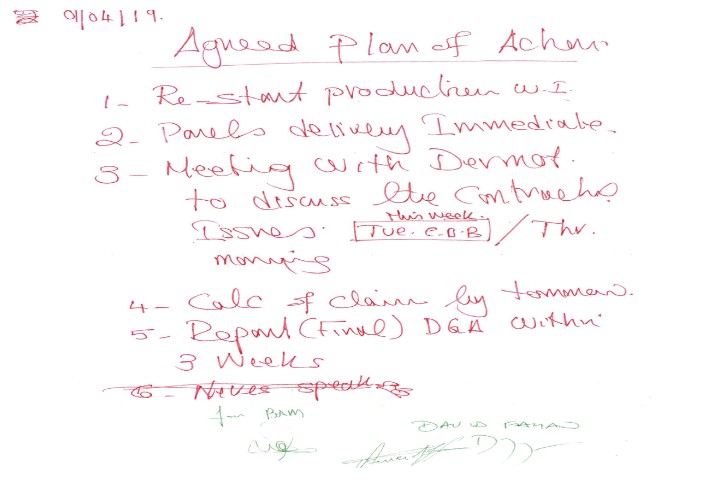
AFFAN Returns to Work
224. It appears to be the case that AFFAN recommenced work and that on 18 April 2019, AFFAN submitted a claim under the Subcontract and Addendum for costs associated with design changes as Variation No.2. The claim was for a total of AED 330,569,706.30 including profit and overheads. It was supported by a 45-page narrative and ten Annexures.
225. The Executive Summary stated:
“The Subcontractor (AFFAN Innovative Structures) was awarded the project of the Museum of the Future façade works under Subcontract Reference No. H16060 with a total value of AED 125,000,000. The façade consisted of 17,706 m2 of panels as per the model given in the IFC drawings. The total number of panels in the model were estimated at 2,442 panels which gives an average of 7.25 m2 per panel. The panelisation intent described in the facade Contract document 0121-P101-BUR-FACDWG-00971-000DP-PDF clearly defines the façade skin to achieve a single curve by means of faceted panels. The scope of work included the Design, Construction, Commissioning, Testing and Completion of the Façade panels works. The Subcontractor started with the design based on the IFC drawings and developed the 1st Mock up with facetted panels. The Design Team subsequently instructed the Contractor to pursue an alternative smooth surface. Such a smooth surface can therefore only be achieved by replacing the single-curve panels in the IFC/Contract Drawings with double-curved panels which implicated different dimensions and shapes from the IFC panels.”
226. BAM described this summary as follows in its opening submissions:
"The Subcontractor was awarded the project under Subcontract reference... Façade consisted of 17,706m2 of panels as per the model given in the IFC Drawings." So, they're quite clear that the IFC Drawings were with them there as well. "The total number of panels in the model were estimated at 2,442, which gives an average of 7.25m2 per panel." That's simply wrong. "The panelisation intent described in the façade Contract document clearly defines the façade skin to achieve a single curve by means of faceted panels." Again, that is simply wrong. We've seen the Tender Proposals, they talk about 9 X 2 and they talk about double curvature. "The Subcontractor started with the design based on the IFC Drawings and developed the 1st Mock ups with facetted panels." Again, I don't understand where they got that from. The Tender Proposals were based on the IFC Drawings and showed... so, we've seen double curved panels. "The Design Team subsequently instructed the Contractor to pursue an alternative smooth surface. Such a smooth surface can therefore only be achieved by replacing the single-curve panels in the IFC/Contract Drawings with double-curved panels, which implicated different dimensions and shapes from the IFC panels." And that is simply make believe. Double-curved panels from the outset. And the double-curve panels were what would give the smooth surface. And that is reflected in the Tender Proposals.”
227. The submission that it was “simply make believe” to suggest that the Design Team instructed AFFAN to use double-curved panels to achieve a smooth surface is diametrically inconsistent with what was said in BAM’s claim document. Indeed, Counsel for BAM was driven to submit that the CCN 222 document was “inaccurate in a number of respects. It talks about change from single curvature to double curvature. It was always going to be double curvature. It talks about the panels being originally modularized and then becoming bespoke.”
228. It is true that AFFAN’s tender did refer to “Advanced Structural composite façade panels, double curved, nominal size 9000 x 2200” from the outset, but even after the LoI, AFFAN’s Tender Design was only one of four options under consideration and the Tender Instructions had required “Manipulation of the panel geometry to minimise the deviation from single curvature within an acceptable tolerance for the manufacture of the stainless steel cladding is undertaken. Panels are single curved with limited areas of minimal double curvature.” Further, there were two options at Steel Coordination Workshop No. 4 on 13 March 2017 which appeared to show single-curved, facetted, modular panels:
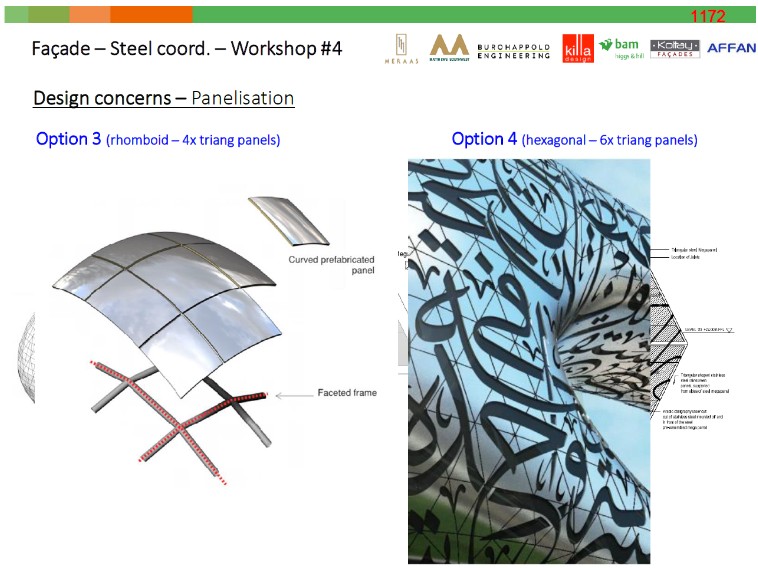
229. It would therefore appear that the contemporaneous documents issued by both parties are more accurate than Counsel’s submissions illustrating what BAM described in its claim document as the Design Team having “constantly and repeatedly changed, developed and enhanced their own design following protracted periods of indecision”.
230. AFFAN wrote to BAM on 24 April 2019 setting out its perception of the situation in some detail, accusing BAM of reneging on the agreement it said was reached on 1 April 2019:
“A variation was initiated and acknowledged by all parties, AFFAN fulfilled its obligations and provided BAM with full submission including all substantiations to the value of the variation, and it is the Main Contractor's (BAM) responsibility to obtain the approval on the variation from the Employer. AFFAN does not have any contractual relation with the Employer, AFFAN's contractual relation is limited to BAM.
AFFAN's revised contract value exceeds 250% of the original contract value. AFFAN does not have the capability or the responsibility to solely finance the works, especially after the significant increase in the volume of the work due to the panels' variation.
BAM attempted to pay very little amounts to AFFAN, such amounts were only sufficient for AFFAN to survive and for the production of the panels to keep ongoing; however, such payments have never covered all of AFFAN's expenses which caused major losses to AFFAN due to the increased accounts payables to others on daily basis. BAM picked some items to pay on behalf of AFFAN such as and not limited to material and salaries; however, BAM disregarded the fact that AFFAN has a running cost which BAM rejected to pay.
BAM has been using the substantiations and justifications not to pay AFFAN; for the records, and in order to expose BAM's hidden agenda not to pay AFFAN; the amounts as agreed in Addendum to Cladding Subcontract ref. H16060 (Annexure l) were completely justified and substantiated but BAM rejected to pay them. This reveals the fact that BAM had the intention to pay AFFAN just enough to keep the production ongoing and to make sure that AFFAN is sinking in accounts payable; this is for BAM to be able to fully control AFFAN through payments.
On 01/04/2019, a meeting was held between North 25, the Contractor and the Subcontractor in order to jointly work on resolving the Project's issues. The parties signed an "Agreed Plan & Action" document attached herewith (Annexure 2}, that:
1. AFFAN to restart the production; (AFFAN re-started the production on the same day 09th[sic] April 2019)
2. AFFAN to restart the panels delivery immediately; (AFFAN re- started the delivery on the same day 09th[sic] April 2019).
3. BAM to meet AFFAN to discuss the Contract issues, on Thursday morning; (BAM changed the time of the meeting to Sunday 12th April 2019, the meeting was held without any results).
4. Calc & Claim by tomorrow (10/04/2019 [sic]); and (This was sent as draft on the 04th April 2019 to Brian by email).
5. Variation Report (Final) within three weeks (30/04/2019). (This was sent as draft on the 04th April 2019 to BAM through Aconex and the final was sent on 18th April 2019 through Aconex via AffanLETTER- 001238).
AFFAN complied with the commitments made in the above-mentioned meeting; AFFAN continued with the production and installation of the panels. However, BAM failed to act in accordance with the agreement. BAM and AFFAN held the agreed meeting but BAM's representative maintained the same position which has been taken by BAM during the last 4 months.
BAM threatened AFFAN via official letters that BAM has the intention to deposit the security cheques which were given to BAM by AFFAN in the bank, this is despite the fact that BAM knows that AFFAN's accounts do not have the sufficient funds and that the cheques will bounce back. This act is another example of BAM's unprofessional behavior. BAM is still trying to micro manage AFFAN through threatening AFFAN's leadership with criminal proceedings as a result of the bounced cheques.
…
In accordance with the Addendum's structure of payments, AFFAN calculated the value of the total contract including the variation related to the change in the panels, the variation's calculations were submitted to BAM on 18th April 2019 via AFFAN's letter Affan-LETTER-001238; moreover, a hard copy was submitted to BAM on 21st April 2019 via AFFAN's letter Affan-LETTER 001239. The calculations and the justifications are BAM's property as of the date of this letter, AFFAN's position is that immediate payments shall be made to AFFAN in accordance with the revised contact value considering the value of the variation with a total of net AED 330,569,706,30.
Based on the attached Annexure 3, which is self-explanatory, AFFAN should be immediately paid an amount of net AED 46,682,644.93;
…
AFFAN's demands have all been agreed earlier with BAM as the purpose of the Addendum as mentioned earlier is BAM to finance AFFAN until the variation's figures are cleared; as mentioned above, BAM failed to fulfill its obligations and breached all the agreements made with AFFAN.
BAM shall be notified that all the works including fabrication, delivery and installation will be completely suspended starting from 26th April 2019 and until the abovementioned amount is fully paid to AFFAN. It is AFFAN's right not to fulfill its obligations in the situation that BAM fails to fulfill its obligations in accordance with the Subcontract and the applicable laws.
In the situation of lack of payment by BAM and subsequently stoppage of work by AFFAN, BAM is warned not to access any of the fabrication plants. AFFAN will immediately approach the authorities in order to avoid any trespass by BAM. BAM's decision to take over any of AFFAN's plants by force will be dealt with by our legal representatives this time.” [original emphasis]
231. Again, the “Agreed Chronology’s” description of this letter is selective and misleading: “Affan letter to BAM stated that the security cheques would bounce back because Affan’s relevant bank accounts did not have sufficient funds”.
AFFAN Stops Work Again
232. Whatever the precise chronology, it seems that AFFAN had ceased work by 24 April 2019 and that on 27 April 2017 BAM wrote “for record purposes” with “photos showing evidence of the unauthorised suspension of works at all of AFFAN’s facilities.”
233. Meanwhile, the next day BAM submitted “Re: MOTF: Claim Notification (CCN 222) Facade Design Changes - Submission of Extension of Time Claim” to the Employer. The covering letter stated:
“Further to our letter ref. BHH-LETTER-002661 dated 09 April 2018 providing formal notice pursuant to Clause 20.1 (c), we enclose for your review our detailed claim for the variation costs associated with the façade specification enhancements in the sum of Dhs 233,238,773.65.
For clarity, this claim shall be construed and read in reference to the detailed narrative provided under our interim claim for an Extension of Time and Prolongation Costs submitted via letter ref. BHH-LETTER-006548 dated 27 January 2019.
This submission details the extensive changes to the façade design instructed by the Engineer and accordingly we request receipt of the Employer’s formal variation instruction pursuant to Clause 13.1 (a) of the General Conditions of Contract.
Reference is made to the ‘Road Map’ dated 16 January 2019 wherein the Employer and the Contractor agreed to expedite the resolution of this façade claim in a structured, coordinated and transparent manner. Accordingly, we look forward to the Employer’s Representative earliest confirmation of the consultation arrangements.
Please note that we intend to provide an updated assessment of the prolongation costs associated with CCN 222 and other delay events in the very near future. For the avoidance of doubt, this submission does not include such prolongation costs” [original emphasis]
234. The same day (28 April 2019), BAM again wrote to AFFAN “For record purposes, please see below photos showing evidence of the unauthorised suspension of works at all of AFFAN’s facilities.” This was repeated on 30 April 2019 (twice) and on 1 and 2 May 2019.
235. On 30 April 2019, BAM responded to the claim for the variation costs enclosing its initial comments which comprised substantially in excess of 100 requests for documents and calculations.
AFFAN Starts Work Again
236. On 26 May 2019, BAM noted that notwithstanding that AFFAN had voluntarily recommenced works from 22 May 2019, most of the works on different stages of production had not yet fully recommenced. On the same, BAM also wrote to AFFAN about the AED 9.375 million Advance Payment Guarantee that was due to expire on 30 June 2019.
237. On 10 June 2019, BAM wrote to AFFAN claiming that AFFAN was in breach of Clause C.1 of the Addendum in failing to provide evidence of Historic Costs. BAM made particular reference to Kanoon Marine Eng. LLC, claiming that it had paid the full amount of AED 1,860,732 to AFFAN for payment to Kanoon but that AFFAN had only paid AED 200,000 to Kanoon.
238. On 15 June 2019. Dr Affan wrote to Mr David Fagan of North 25 (and to BHE):
“I am writing to draw your attention that BAM has occupied and restricted the access of Affan employees to its facilities at Al Tayer and at GGI factories. We believe they are attempting to fabricate the panels themselves or together with their partners Fiberex as we have been informed by BAM. I would like to put on record that the production of panels of your museum of the future is very specialised and neither BAM nor its partner have the experience nor the skills to carry out this task. In the following, I shall give some details:
1. The panels of the museum of the future use epoxy prep reg having fire retardant properties. In fact, this prepreg is the first of its kind in the world and was specially developed for the museum of the future.
2. The prepreg (fibers pre-impregnated with resin) needs to be laid up in a predefined sequence and cured under a controlled environment in specialised ovens to attain their desired properties, both mechanical strength and fire resistance.
…
Furthermore, the correct lay-up, accuracy and adhesion of the stainless steel skin involves a lot of handwork skills, gained over many months by Affan employees. I think your architect and your consultant are best positioned to evaluate and advise you whether the panels, made by BAM independently, meet the required specifications and desired visual appearance.
I would like to confirm that Affan had so far produced 468 panels (out of 1024) whereby the last 70 panels did not go through the rigorous quality control procedure and have been forcefully taken to site by BAM without a quality certificate of Affan. Some of these panels are being installed by BAM independently: Affan refused to install them.
I would also like to confirm that there has been no production of panels by Affan since 25th April 2019: BAM is still to honour its financial commitments and pay its dues to Affan.”
239. Dr Affan was cross-examined about the assertion that, “this prepreg is the first of its kind in the world and was specially developed for the museum of the future”. He volunteered that while he thought it was the first epoxy prepreg having fire retardant properties when he wrote the letter, it was not the first.
BAM Takes Over AFFAN’s Works
240. On 23 June 2019, BAM write to AFFAN stating that it was exercising its rights under the Addendum to take over the Subcontract Works:
“Within the past thirty days, we have recorded numerous instances of Affan’s failure to comply with its contractual obligations as evidenced by the following formal correspondence: …
The breaches recorded in the aforementioned correspondence as well as other breaches include:
• Unauthorised suspension of the façade works in breach of Clauses 2.3, 4.1 and 16.1 of the Subcontract Agreement and Clause 1 of the Addendum to the Cladding Subcontract.
• Failure to provide sufficient labour and supervision to progress the Subcontract work in breach of Clause 4.2 of the Subcontract Agreement.
• Failure to proceed and complete the Subcontract works in accordance with the Time for Completion in breach of Clauses 2.3, 4.1 and 16.1 of the Subcontract Agreement.
• Failure to use the facilities and resources solely for the purpose of the Museum of the Future façade works in breach of Clause A6 of the Addendum to the Cladding Subcontract.
• Failure to allow the Contractor control of the Facilities in breach of Clause A5 of the Addendum to the Cladding Subcontract.
• Unauthorised blockage and disruption to Subcontract Works at the Facilities in breach of Clause B6 of the Addendum to the Cladding Subcontract.
• Failure to provide panel calculations following months of requests from the ERC.
• Failure to provide any of the requested items as per Clause B9 of the Addendum to the Cladding Subcontract.
• Unauthorised deactivation of CMS machines legally belonging to BAM in breach of Clause B6 of the Addendum to the Cladding Subcontract and unauthorised removal of assets in breach of Clause A1 of the Addendum to the Cladding Subcontract.
• Failure to provide organogram of key personnel, method statement and planned schedule related to testing and commissioning activities.
• Unauthorised absence of Subcontractor’s authorised representative in breach of Clause 4.6 of the Subcontract Agreement and Clause B7 of the Addendum to the Cladding Subcontract.
• Failure to carry out and pass the Performance Tests in breach of Clauses 2.3, 4.1 and 16.1 of the Subcontract Agreement and Clause A8 of the Addendum to the Cladding Subcontract. It is further noted that The Addendum to the Cladding Subcontract is fully contingent upon Affan securing Performance Test approval for the Subcontract Works something which Affan has failed to achieve in the 6 months that has elapsed since signing the Addendum to the Cladding Subcontract.
• Failure to remedy defects in the Subcontract works in breach of Clauses 2.3 and 4.1 of the Subcontract Agreement and Clause B4 of the Addendum to the Cladding Subcontract.
• Failure to provide an undertaking letter for the cavity wall barrier systems which has delayed the completion and submission of the Façade NOC Report to the statutory authorities for approval.
• Delay in submission of missing elements of the design in breach of Clauses 2.3, 4.1 and 16.1 of the Subcontract Agreement.
• Failure to provide quality records for circa 100 panels since 29 January 2019 despite receipt of several reminders.
• Failure to extend Advance Payment Guarantee in breach of Clause 18.3 of the Subcontract Agreement and despite BAM extending the letter of credit issued in favour of Affan.
• Failure to repay loan amount and interest in relation to the CMS machines Memorandum of Agreement.
• Failure to repay amounts paid by BAM that have not been properly disbursed under the Addendum to the Cladding Subcontract in breach of Clause C1 thereof.
• Failure to provide full substantiation of claimed variations and failure to employ a claims specialist on an intensive and continuous basis as required pursuant to Clause C8 of the Addendum to the Cladding Subcontract
Pursuant to Clause C6 of the Addendum to the Cladding Subcontract, any and all costs incurred by the Contractor and any loss or damage levied by the Employer shall be recoverable against the value of the Subcontract works plus any variations agreed by the Employer. Due to Affan’s failure to properly substantiate the claimed variations (in breach of Clause C8 of the Addendum to the Cladding Subcontract) and as a consequence of Affan’s failure to proceed with and complete the Subcontract works, BAM is exposed to significant losses and damages including delay damages. BAM further reserve all our rights in accordance with Clause 23.0 of the Subcontract Agreement.
As a consequence of the above and Affan’s continued and wilful neglect of its obligations under the terms of the Subcontract and Addendum to the Cladding Subcontract despite being in breach of numerous provisions of the Contract and the Addendum to the Cladding Subcontract, BAM is left with no option other than to impose all available contractual and legal remedies against Affan in order to;
1. Take over and complete the Subcontract Works all at Affan’s costs and risk.
2. Take over all of the facilities listed in the Addendum to the Cladding Subcontract.
3. Legally enforce all provisions of the Addendum to the Cladding Subcontract.
4. Second key employees of the Subcontractor.
5. Reinstate the deactivated CMS machines at Affans cost.
6. Recover the loan amount and interest in relation to the CMS machines.
7. Recover amounts previously paid to Affan that have not been disbursed in accordance with the Addendum to the Cladding Subcontract.
8. Recover all costs paid by BAM on Affan’s behalf including advance payments.
9. Recover all losses incurred by BAM due to Affan’s breaches of the Subcontractor [sic], Addendum to the Cladding Subcontract or otherwise incurred.
10. Provide proper substantiation to support all claimed variations at Affan’s cost and risk.” [emphasis added]
241. On 25 June 2019, BAM dated and presented the Security Cheques for payment, but they were returned unpaid. BAM also encashed the Advance Payment Guarantee and the Performance Guarantee totalling AED 21,875,000, although the date(s) do not appear in the evidence. Mr Doyle denied in cross-examination that there was a balance due to AFFAN under the Subcontract at the date of encashment.
242. On 28 June 2019, Dr Affan wrote again to Mr Fagan, thanking him for his acceptance to mediate between BAM and AFFAN:
“The dispute between BAM and AFFAN is purely commercial: we are owed a lot of money (around AED 30 Mio) as per the terms of our contractual agreements with BAM. This money is for the ADCB bank, who financed our project, and BAM has even opened an L/C of 30 mio for that purpose. However, BAM has so far avoided making the payment citing insufficient substantiations. Your mediation would be greatly appreciated.
With this financial pressure, AFFAN would not be able to complete the facade work. I hereby request you to ask BAM to operate our entire facilities until the completion of the museum of the future project. This means:
• Paying a monthly lump sum (4.0 Mio AED) related to running cost & productions cost (Utilities, maintenance, Insurance, depreciation of facilities and equipment approx. AED 2 mio per month + Salary of staffs until the completion of project approx. AED 2 mio per month). This value can be determined by a third-party consultant.
• It is worth noting that BAM has avoided making this monthly payment in full since the beginning of 2019 and consequently Affan has not been able to pay the salaries of its staff for the last three months. It is urgent to pay the due salaries as a priority.”
BAM Rejects AFFAN’s Variation Claim
243. BAM rejected AFFAN’s claim for a variation on 15 September 2019 on the basis that there was no contractual basis for BAM to value or determine any entitlement under Clauses 16 and 21 of the Subcontract.
244. This is to be contrasted with what BAM told the Employer in its claim documents:
“The Specialist Façade Subcontractor was not in a position to evaluate the direct costs of the changes until such time as the enhancements in design and the various iterations thereof had been finalised, the visual mock-up approved and the mass production of the panels undertaken.”
245. On 8 January 2020, AFFAN wrote to BAM:
“We hereby write this letter to record the below:
1. Affan has not received any payment from BAM since March 2019.
2. This situation put our company in huge financial difficulties. Moreover, AFFAN's trade license has been expired and the civil defense approval of the panels is done on Affan's Trade License. If we lose the Civil Defense approval, AFFAN will require over 1 year to carry out tests locally and internationally for reobtaining it.
3. Due to the violations made by BAM, AFFAN does not have sufficient funds to clear the minor cases blocking its trade license and to pay for the license and the civil defense permit.
4. BAM is immediately requested to release an amount of AED 2 Million to AFFAN, this amount to be on account subject to final settlement for the MoTF Project.
5. In the situation that the license and permit are not renewed promptly, the MotF Project will be further delayed for more than 1 year.
6. If BAM does not respond positively to this letter within 24 hours, AFFAN will communicate the same with Meraas.”
246. Mr Doyle asserted in his evidence:
“This letter was a blatant attempt at coercing BAM into making a payment for which there was no legal or factual basis. Aside from the fact that fees associated with licence renewals were D1’s responsibility under clause 10 of the Subcontract, the sheer sum being demanded was significantly overinflated - a typical trade license renewal fee is approximately AED 15,000 (based on what BAM would pay as a main contractor), and the fee associated with D1’s Trade License renewal in 2019 was far less than this, at only AED 1,670.”
247. If Mr Doyle had not been so blinded by his desire to characterise every action of Dr Affan as fraudulent, he might have read the letter with a little more care – the sum claimed was said to relate to “clear the minor cases blocking its trade license and to pay for the license and the civil defense permit” [emphasis added].
Takeover of the Project
248. Thus, BAM took over the Subcontract Works, and the Project was formally handed over to the Employer on 19 September 2021, 2 years and 3½ months late (the scheduled completion date being 4 June 2019).
249. The “Summary - Statement at Taking Over” showed that BAM claimed AED 421,407,587 in respect of an EOT in addition to the value of the Contract Works at approximately AED 790 million, making a claim in the sum of AED 1.277 billion. In his evidence on 23 October 2024, Mr Doyle said that the figure of AED 421.4 million included AED 200 million claimed by AFFAN:
“Q373. Now, if we go back to... bear in mind that 5 million figure. If we go back to Tab 3 and the Taking over Certificate. Your Honour, we're looking at the figure marked under EoT 421 million. 5 million over 27 months is far less than 421. It's roughly 140 million. So, is it correct or do you know whether the 421 million also includes direct costs of doing the Work?
A: Yes, it includes the variation claim submitted by AFFAN in April 2019 that was passed [up] the line.
Q374. Thank you. So, the 421 includes AFFAN's claim?
A: Yes, because...
Q375. ... but AFFAN's claims obviously where for a certain amount. But does it include your own direct costs of fabricating the panels and so on?
A: No.
Q376. Well, it must do. How is he going to the 421?
A: So it includes... AFFAN claim was over 200 million.
Q377. Yes, but that 200 million was based on a forecast of the total cost of producing these panels. So, you passed that on to the Client, did you?
A: We've disclosed that we submitted that to the Client in April 2019, and it came back rejected.
Q378. Right, so you're still pursuing that in the Statement of Taking Over?
A: We included it, yes.
Q379. And then, that formed part of the negotiations, which led to a successful cancellation of the delay damages, correct? That was a good profile, wasn't it?
A: I can't say. I wasn't part of those final series of meetings.
Q380. That's very fair. But certainly it's included in that 421?
A: It's included in that.
Q381. Why didn't you say that when you were explaining the documents in the first place? Is there a reason?
DERMOT DOYLE: Explaining which documents?
RIAZ HUSSAIN: When you're explaining the document to Lord Marks, why didn't you say that that money was included in the 421? Is there a reason for that?
A: No.”
250. It would therefore appear that BAM had claims for an EOT in addition to that in respect of the façade. The Employer’s claim for penalties/delay damages was “to be advised”.
BAM’s Claim against the Employer
251. The planned duration was 2 years and 5 months, so the works took twice as long as planned. The overall causes of delay were not canvassed before me, but the delay may begin to provide some explanation for BAM’s conduct. In the final iteration of BAM’s claim for an EOT, it attributed 390 days to “delays in the Employer deciding his design requirements for the rather unique façade of Museum of the Future to a sufficient level of completeness to facilitate commencement of actual production of the façade panels”.
252. The claim document sets out the effect of the delays on AFFAN in the Employer deciding its design requirements. It noted that AFFAN’s price and associated programme were based on the Contract/ IFC Contract Documents. The numerous design changes instructed between February 2017 and June 2018 delayed the design process. Approval of Shop Drawings and the production of the VMU 05 resulted in a direct impact on the panel fabrication process of AFFAN, both in terms of extending the duration of certain activities as well as necessitating additional activities being incorporated into the process. Not only did the changes and additional activities increase the panel production time but also increased the need for additional space. The average panel production cycle increased from 22 days to 28 days. The panels being required to stay longer in the factory during production decreased the production output.
253. In addition to an EOT, BAM claimed prolongation costs of AED 110,070,149.95. Of that sum, AED 25 million was attributed to additional costs and charges incurred (my emphasis) by AFFAN (i.e. 22.75%).
254. In his evidence, Mr Doyle first suggested that the façade was on the critical path, it was the dominant delay on the Project, and there was not potentially sufficient entitlement to cover the entire period of delay for the Project. The claim document related to the period 4 June 2019 to 28 June 2020, not to the actual handover on 19 September 2021. However, almost immediately Mr Doyle then said that the delay to the façade did not justify any of the delay to the Project. In my judgment, he realised that if part of the delay could be attributed to the façade, it would undermine BAM’s case against AFFAN and so he beat a hasty retreat.
255. On 14 July 2022. BAM entered into a settlement agreement (the “Settlement Agreement”) with the Employer. The Contract Works were valued at AED 795 million and the Employer waived any claims save for defects, thus encompassing any delay claims. There was clearly a very substantial claim for delays. Mr Doyle described the purpose of CCN 222 as “a defence against Delay Damages. The façade was on the Critical Path and it was a document produced to try to secure an Extension of Time for obvious delays in the project”.
Financial claims and payments
256. BAM’s claim as pleaded was to recover from AFFAN AED 104,713,976.00 as damages for breach of the Subcontract and Addendum representing:
(1) the total costs incurred by BAM in relation to the Subcontract Works across seven distinct categories (items 1-7);
(2) less the amounts recovered by BAM from AFFAN’s Advance Payment and Performance Guarantees (items 9 and 10); and
(3) less the value of the Subcontract Works recovered from the Employer (item 11 in the table below) calculated as follows:
| # | Description | Amount (AED) |
|---|---|---|
| 1 | Progress Payments (paid to D1 pursuant to the Subcontract) | 33,969,969.82 |
| 2 | Historical Costs (paid to D1 pursuant to the Addendum) | 12,539,133.32 |
| 3 | Production Costs (paid to or on behalf of D1 pursuant to the Addendum and / or incurred by the Claimant in completing the Subcontract Works) | 177,015,186.44 |
| # | Description | Amount (AED) |
|---|---|---|
| 4 | Running Costs (paid to D1 pursuant to the Addendum) | 3,769,306.38 |
| 5 | Finance & Miscellaneous Costs (paid pursuant to the Subcontract and Addendum) | 4,861,419.46 |
| 6 | Costs associated with BAM’s Investigation and Review of the Letter of Credit Costs | 53,310.00 |
| 7 | Costs Incurred After 31 October 2021 (incurred by the Claimant in completing the Subcontract Works) | TBC |
| 8 | Sub-total | 232,208,325.42 |
| 9 | Less Recovery of Advance Payment Guarantee | -9,375,000.00 |
| 10 | Less Performance Guarantee Encashment | -12,500,000.00 |
| 11 | Less Assessed value of the Subcontract Works recovered from Employer | -105,619,349.42 |
| Total | 104,713,976.00 | |
257. As to item 7, BAM pleaded: “At this stage, the costs claimed by the Claimant are for the period up to 31 October 2021 only. The Claimant has incurred additional costs beyond this date, including (without limitation) in relation to completing outstanding works, carrying out water-tightness tests and other testing, rectifying defects, cleaning the façade in preparation for final handover, and the preparation and submission of as as- built drawings. The Claimant intends to quantify and substantiate these costs in the same manner as the other categories claimed, and expressly reserves its right to amend these Particulars of Claim once this exercise is complete”.
258. Thus, BAM was claiming the full actual cost of the façade works which it valued at more than AED 232.2 million.
259. In opening the case, Lord Marks said that line 11 of the table above was wrong. The sum was not the amount recovered from the Employer but an assessment of the Accepted Subcontract Amount adjusted for instructed variations. I gave permission to amend and directed that that an amended document be served.
260. Lord Marks based his submission on the quantum experts’ First Joint Minute dated 1 September 2024. In fact, the Minute reached a fourth iteration on 6 December 2024. There was a large measure of agreement between the quantum experts, and I note that line 7 was agreed at AED 5,153,843.89.
261. The final position after the experts’ agreement was as follows:
| 1 | Progress Payments | 33,969,969.82 |
| 2 | Historical Costs | 12,539,133.32 |
| Sub-Total Amounts Paid to D1 | 46,509,103.14 | |
| Additional Amounts | ||
| 3 | Production Costs | 173,658,462.53 |
| 4 | Running Costs | 3,639,340.17 |
| 5 | Finance & Miscellaneous Costs | 375,863.39 or 372,300.00 plus 4,457,088.00 |
| 6 | Costs associated with BAM's Investigation and Review of the Letter of Credit Costs | 53,310.00 |
| 7 | Costs Incurred After 31 October 2021 | 5,345,193.05 |
| Sub-Total Additional Amounts | 187,337,907.98 | |
| 8 | Sub-Total Subcontract Works | 233,847,011.12 |
| Amounts to be credited by BAM | ||
| 9 | Less Recovery of Advanced Payment Guarantee | -9,375,000.00 |
| 10 | Less Performance Guarantee Encashment | -12,500,000.00 |
| 11 | Less the agreed price of subcontract works adjusted for instructed variations | -106,483,893.08 or -107,395,347.63 |
| Sub-Total | -128,358,893.08 or -129,270,347.63 | |
| Total | 105,488,118.04 or 104,576,663.49 | |
262. These figures are, of course, subject to liability.
263. The figures demonstrate that the actual cost of the Subcontract Works as asserted by BAM was AED 233.85 million as against a price of AED 125 million – a 187% difference.
264. The experts also examined the state of payments against the valuation of the Subcontract Works as at June 2019. On a valuation according to the Subcontract Stage Payment Schedule, BAM’s expert assessed that AED 43.2 million was due to AFFAN and AFFAN’s expert assessed this figure at AED 41.5 million. BAM submits that this does not demonstrate that AFFAN was “starved of cash” as it alleges that one must also factor in what was paid out by BAM after June 2019, which yields a balance in BAM’s favour of AED 43 million.
265. I do not consider this to be a good point. The relevant enquiry in relation to AFFAN’s “starved of cash” submission is the period before June 2019. What I must determine is whether AFFAN’s inability to proceed with the Subcontract Works was caused by an expansion in work-scope coupled with an underpayment of the sums to which it was entitled, leading to a crisis in funding.
266. The figure for Progress Payment of AED 33,969,969.82 is derived from a table appearing in the First Report of Mr Kenyon, BAM’s quantum expert. The Subcontract provided for AED 31.25 million to be paid in respect of the design works by the end of March 2018. Mr Kenyon’s table shows that BAM in fact paid AED 31,805,740.26 by 2 April 2018.
267. In addition, BAM paid AED 12,539,133.32 in respect of Historical Costs in accordance with the Addendum in three payments: 19 December 2018, 20 January 2019, and 11 February 2019. I compare this with the statement CCN 222 that AFFAN had incurred costs of AED 25 million, which I have no reason to believe was not a genuine figure ascertained by BAM through no less rigorous an audit than that insisted upon by Mr Doyle is his correspondence with AFFAN.
268. It therefore appears that prior to June 2019, BAM had not made any Progress Payments to AFFAN for 16 months and had only paid half of AFFAN’s costs that it had told the Employer were actually incurred by AFFAN.
BAM’S CLAIM AGAINST AFFAN
The Pleaded Case
269. BAM pleaded that AFFAN was in breach of the Subcontract and Addendum in:
(1) Failing to substantiate the amounts claimed for payment under the Addendum; and
(2) Failing to perform the Subcontract Works in accordance with its obligations and the express terms of the Subcontract and the Addendum, namely,
(a) unauthorised suspensions of the Subcontract Works, in breach of clauses 2.3, 4.1, and 16.1 of the Subcontract, and Clause C1 of the Addendum;
(b) failing to provide sufficient labour and supervision to progress the Subcontract Works, in breach of Clause 4.2 of the Subcontract;
(c) failing to proceed and complete the Subcontract Works in accordance with the Time for Completion, in breach of Clauses 2.3, 4.1, and 16.1 of the Subcontract;
(d) failing to use the facilities and resources solely for the purpose of the Subcontract Works, in breach of Clause A6 of the Addendum;
(e) failing to allow BAM control of the Facilities in breach of Clause A5 of the Addendum;
(f) unauthorised blockage and disruption to Subcontract Works, in breach of Clause B6 of the Addendum;
(g) delay in submission of missing elements of the design, in breach of Clauses 2.3, 4.1, and 16.1 of the Subcontract;
(h) failing to provide various quality records and design elements (including calculations), in breach of Clauses 2.3, 4.1, and 16.1 of the Subcontract;
(i) unauthorised removal of assets and the unauthorised deactivation of CMS Equipment legally belonging to BAM, in breach of Clauses A1 and C6 of the Addendum;
(j) failing to carry out Performance Tests and obtain Performance Test approval in breach of Clauses 2.3, 4.1, and 16.1 of the Subcontract and Clause A8 of the Addendum;
(k) failing to remedy defects in the Subcontract Works in breach of Clauses 2.3 and 4.1 of the Subcontract and Clause B4 of the Addendum;
(l) failing to provide an undertaking letter for the cavity wall barrier systems which subsequently delayed the completion and submission of the Façade NOC Report to the statutory authorities for approval;
(m) failing to repay the loan amount and interest in relation to the CMS Equipment in accordance with the MOA;
(n) failing to extend an Advance Payment Guarantee, in breach of Clause 18.3 of the Subcontract; and
(o) unauthorised re-assignment of key staff, and Dr Affan’s personal absence from the UAE, in breach of Clause 4.6 of the Subcontract and Clause B7 of the Addendum.
270. BAM claimed that as a result of AFFAN’s ongoing breaches and failure to execute the Subcontract Works, by letter dated 23 June 2019, it exercised its rights under the Addendum to take-over the Subcontract Works. BAM’s take-over of the Subcontract Works was undertaken in accordance with the express terms of the Addendum, “including specifically” (phrases like this should never be used in a pleading due to their ambiguity, I disregard the word “including”) Clauses B1, B2, B5, and C7. BAM claimed that, notwithstanding that BAM’s conduct was authorised by the Subcontract and Addendum, in the months that followed AFFAN and Dr Affan sought to hamper and interfere with BAM’s performance of the Subcontract Works contrary to the express terms of the Addendum, namely Clauses B1 and B6.
271. BAM pleaded the following causes of action against AFFAN. It is important that I set out the pleading verbatim:
“51. The Claimant’s claims against D1 arise out of D1’s breaches of the Subcontract and the Addendum. The Claimant refers to paragraphs 42 to 44 42 above, as well as (without limitation) its letter of 23 June 2019 and the correspondence referred to therein as substantiation for D1’s various breaches.
52. The provisions of the Subcontract and the Addendum entitle the Claimant to recover all of the costs it has incurred in completing the Subcontract Works on behalf of D1. The Claimant refers to, without limitation, its rights under the following clauses (emphasis added):
52.1 Clause C6 of the Addendum, which relevantly provides:
“Any and all costs incurred… shall be recoverable against the value of the Subcontract Works, which is the Subcontract Price plus, the value of any variations to the Subcontract works agreed with the Employer and the Contractor.”
52.2 Clause 2.4 of the Subcontract, which relevantly provides:
“The Subcontractor shall indemnify the Contractor against any liability to the Employer under the Main Contract and shall hold the Contractor harmless from all claims, demands, proceedings, damages, costs and expenses made against or incurred by the Contractor by reason of any breach by the Subcontractor of the Subcontract.”
53. The Claimant has consistently made its reliance upon the above provisions clear to D1, including by periodically updating D1 as to the costs being incurred and the status of the final account through issuance of monthly payment certificates identifying the accrued contra-charges and making express reference to its intention to recover the amounts from D1.36 Copies of the monthly payment certificates issued by the Claimant to D1 and D2 have been exhibited to these Particulars of Claim.
…
88. As summarised in the Table below, the Claimant seeks to recover a total amount of AED 104,713,976.00 from D1 as damages for breach of the Subcontract and Addendum. This sum represents:
88.1 the total costs incurred the by the Claimant in relation to the Subcontract Works across seven (7) distinct categories (items 1-7);
88.2 less the amounts recovered by the Claimant from D1’s Advance Payment and Performance Guarantees (items 9 and 10); and
88.3 less the value of the Subcontract Works recovered from the Employer (item 11 in the table below).
89 The Claimant’s approach is in accordance with Clause C6 of the Addendum, which relevantly provides (emphasis added):…” [emphasis added]
272. As noted at paragraph 259 above, in opening the case Lord Marks said that line 11 of the table above was wrong. The sum was not the amount recovered from the Employer but an assessment of the agreed price of the Subcontract Works adjusted for instructed variations. Mr Hussain was highly critical of the application to amend saying that it betrayed BAM’s refusal to disclose the sums it had received from the Employer.
BAM’s Case in Written Opening
273. It also necessary to set out BAM’s case in written opening verbatim:
“76. BAM's claim is a claim for damages for breach of contract. Affan was in breach of the Subcontract and the Addendum (see PoC, §39-44 (Bundle A03, pg 19 – 20)). As a result of those breaches BAM took over the Works (see PoC §45 (Bundle A03, pg 20), as it was entitled to do under the undertakings in Part B of the Addendum. For later breaches, see PoC §46 and 47 (Bundle A03, pg 23), and importantly, PoC §51 (Bundle A03, pg 24). BAM had to finish the Works and pay for so doing. Had it not been for the breaches BAM would not have taken over the Works, Affan would have had to finish them and what BAM would have ended up paying was the adjusted contract price. That is the basis for the computation of BAM's damages claim at PoC §88-105 (Bundle A03, pg 33 – 38). That computation represents the damages required to put BAM into the position it would have been in had Affan performed its contract. The payments made to Affan under the Addendum are part of the outlay that BAM actually expended in bringing the Works to completion. Against that outlay BAM gives credit for those sums recovered (Advanced Payment Guarantee and Performance Guarantee encashment) and the adjusted Subcontract price, which it was contractually bound to pay Affan for the Works. This is in line with the ordinary computation of damages.
The Construction of Clause C6
77. At the PTR on 20 September 2024, Mr Riaz Hussain K.C., Affan's counsel, produced a Note dated the same day in which he maintained that "It appears that the Claimant's case is that, under Clause 6 of the Addendum, it could have the Sub-Contract Works completed at D1's cost, even if it had not paid D1 the Sub-Contract Price." That is not the case. It is submitted that the construction of Clause C6 (Bundle E71, pg 1968) is relatively clear: all the costs incurred by BAM and listed in that clause (together with damages, if any, payable to the Employer) (the listed costs) are recoverable against the value of the Works, such value being defined as "the Subcontract Price plus the value of any variations ..agreed with the Employer and the Subcontractor". Thus, BAM would be entitled to set off all such costs against any monies payable to the Subcontractor for the contract price and variations. That does mean, for example, that were Affan to succeed in its variations claim, any money due from BAM to Affan in respect of such variations would be reduced or extinguished by any listed costs that had been paid by BAM, pursuant to Clause C6 and irrespective of the outcome of BAM's claim for damages.
78. However, the construction of Clause C6 has no impact or implications for BAM's claim for damages, which is squarely brought against Affan for breach of contract, as above. It has nothing to do with an indemnity. All that is said by BAM in the PoC at Para 89 about the effect of recoverability under Clause C6 is that the damages claim is "in accordance with" Clause C6, which it is. However, nothing turns on that.”
BAM’s Oral Opening
274. In oral opening submissions, Lord Marks submitted:
“And the point made by Mr. Hussain on C6, and he suggests that the particulars of claims set out to claim under C6, and I'm going to invite you to read the particulars of the claim to see that that's not the case …
And if you look at C6, that is exactly the way that it reads. It's recoverable against the Subcontract Works. And when Mr. Hussain submitted, as he did in the note to you, in the pre-trial review, what we were looking for under a claim under Clause C6, which this is not, it's a claim for damages, was an indemnity to be made whole and to recover under C6, the whole of the costs that have been incurred by BAM in finishing the work, he was well wide off the mark. What we have to prove is the Step-in Rights under the addendum, the breaches of Contract that AFFAN was guilty of, that left us with no option, we say, but to exercise the step-in rights, sort of exercise them more strongly than we previously had and effectively to take over the Works, and that caused the loss which was the overrun, because we then continued to pay for them.
The only significance of C6 in a contractual sense, is that that would substantially reduce the counterclaim for the value of any variations if the Defendants did establish such a variation, contrary to our primary case.”
BAM’s Closing Submissions
275. BAM made reference to its notice of 23 June 2019 and provided a table setting out details of the breaches alleged in the notice. Inexplicably, neither the pleaded case set out at 269(2) above nor the table follows the order of the notice.
276. BAM explained the rationale of its claim for damages. BAM's case on its damages claim in summary is that as a consequence of breaches of the Subcontract and the Addendum by AFFAN, it had no option but to take over the Subcontract Works from AFFAN and to pay for their continuation and completion to enable handover to the Employer. If the Subcontract Works were not varied by the disputed alleged variations, as BAM contends, then BAM was entitled to have the Subcontract Works completed by AFFAN at the adjusted Subcontract price at AFFAN's cost.
277. BAM denied that it is obliged to show what particular costs are attributable to what individual breaches of contract. The multiple breaches of contract on the part of AFFAN obliged BAM to exercise its powers under the Addendum fully to take over the Subcontract Works and to pay for them. BAM also denied that BAM's remedy in damages for the costs of completing the Subcontract Works could only have been available in the event of a termination of the Subcontract.
278. Article 267 of the UAE Civil Code provides:
“If a contract is valid and binding, none of the contracting parties may revoke, modify or rescind it, except by mutual consent, order of the court or a law provision”
“The contract for work shall come to an end by the completion of the works or by rescission of the contract by mutual agreement or by order of the court”
which appears to be in similar terms, but BAM says does not apply to the facts of this case. It is true that the case cited in connection with the Article (Abu Dhabi Court of Cassation Case No. 204 of 2015) addresses termination for convenience rather than cause, but it should be noted that while Article 267 is in the part of the UAE Civil Code that deals with contracts generally, Article 892 is in the section addressing “contracts for work” (“Muqawala” contracts), which include manufacture, construction and engineering contracts.
279. Article 389 of the UAE Civil Code provides:
“If the amount of damages is not fixed by law or in the contract, the judge will assess it to be commensurate with the prejudice effectively sustained when it occurred."
280. BAM referred to Dubai Court of Cassation Case no 155-2012,27 in which the court stated:
"According to Article 389 of the Civil Transactions Law, as clarified by the explanatory memorandum of this law, if compensation is not predetermined in the law or the contract, the judge shall assess it based on the actual damage incurred at the time it occurred. This compensation includes both the loss suffered by the creditor and the gain missed, provided these are natural consequences of the failure to fulfil the obligation or the delay in fulfilling it."
281. The “explanatory memorandum” is the Ministry of Justice Commentary which states:
“Any such damages shall include the creditor’s loss and lost profit provided that this comes as a natural result of failure to discharge or delay in discharge.
Damage shall be natural result if the creditor could not avoid it with due diligence.
After all, as for the contractual obligation, a debtor that did not commit fraud or serious fault shall have only to be committed to such damages that the debtor could reasonably expect at the contract time.”
282. BAM submitted that it was very important to BAM that the Subcontract remained in force, even in the event of breach by AFFAN:
(1) AFFAN had designed the concept of the cladding and BAM was tied to AFFAN to complete the Subcontract;
(2) BAM was required by the terms of the Main Contract with the Employer to have a contracted specialist façade subcontractor;
(3) termination of the Subcontract would have entailed significant delays to the Project as a whole;
(4) AFFAN had obtained the necessary permits and regulatory approvals for the façade; and
(5) any of AFFAN’s workforce were working in Dubai on the strength of visas that would only permit them to work for AFFAN.
283. BAM referred to the passage in the letter of 23 June 2019 referencing Clause C6 of the Addendum, as set out at paragraph 240 above. BAM suggested that its recital of Clause C6 of the Addendum was entirely accurate. BAM stressed that its costs would be "recoverable against the value of the Subcontract Works plus any variations" (i.e. they could be set off against the adjusted contract price) but that in the present case BAM did not instruct any variations.
284. BAM contended that the effect of Clause C6 of the Addendum would be that if AFFAN did, contrary to BAM’s case, have a claim for additional payment for variations, any sums due would fall to be set off, along with the balance of the Accepted Subcontract Amount, against BAM’s recovery of the costs.
285. BAM submitted that given the breaches of contract by AFFAN, the provisions of the Addendum, the letter of 23 June 2019, and BAM’s effective takeover and completion of the Subcontract Works, it is artificial and incorrect to suggest that there is an onus on BAM in mounting a claim for damages against AFFAN to demonstrate which particular breach by AFFAN of the Subcontract or Addendum caused which particular element of BAM’s loss. All the breaches played their part, possibly to a greater or lesser extent individually, cumulatively, and by individual contribution to BAM's legitimate decision to “take over” the Subcontract Works by its letter of 23 June 2019. Once the decision was made to take over the Subcontract Works, the costs of completing them followed directly from the package of breaches that made the decision necessary.
286. In his oral submissions, Lord Marks said that: “It's not a claim brought under Clause C6 of the Addendum and never was. And it's pleaded in conventional terms in particulars of claim.”
287. Lord Marks said that it is clear from the UAE cases that in a main contractor- subcontractor relationship, it is open to a main contractor where a subcontractor is not performing the subcontract works in compliance with the subcontract to take over the works and to claim the extra cost of completing the works from the non-performing subcontractor. Damages can be awarded on that basis by the judge for breach of contract in the amount of the extra over cost of completing the works. He pointed to the decision of the Federal Supreme Court 446 of 2021:
“the subcontractor shall be bound to perform the work assigned thereto by the original contractor and in the manner agreed upon in the subcontractor's contract and under the conditions stated therein….If the [sub]contractor breaches his obligation to perform the work, and violates the terms and specifications agreed-upon … or shows shortcomings in the technical competence or wrongly selects the material used in the work, or fails to act with ordinary diligence in the implementation of his commitment or delays in the completion of work without reason, his liability shall be deemed materialised and in this case, the original contractor may either request in kind implementation or rescindment, and the original contractor must summon the subcontractor to abide by the terms of the contract and rectify, within a reasonable time, the manner in which he is performing the work, and if at the expiration of the fixed delay, the subcontractor fails to comply with this requirement, the original contractor may ask the judge to authorize him to hand over the completion of the work to another contractor at the expense of the first contractor, if such execution is possible. In case of urgency, the original contractor may execute the obligation at the expense of the subcontractor without a judicial authorization; as well, if the parties agree that in the case of the subcontractor's delay, the original contractor shall have the right to withdraw the work therefrom and complete it through others. In this case, the assessment of the delay in completing the work shall be assigned to the original contractor. The judge shall then decide whether or not the contractor is right in his estimation, the works withdrawal and assignment to another contractor.”
288. He also referred to Sader’s Annotated Commentary on the Civil Code on Article 877. Sader translates Article 877 as follows:
“The contractor shall perform his work according to the conditions of the contract. If his work is defective or contrary to the agreement, the master may ask the immediate rescission of the contract, if remedying the situation is impossible, otherwise the master may summon the contractor to abide by the terms of the contract and rectify, within a reasonable time, the manner in which he is performing the work. If at the expiration of the fixed delay, the contractor fails to comply with this requirement, the master may apply to the judge for the rescission of the contract or authorize him to hand over the completion of the work to another contractor at the expense of the first contractor.”
289. Sader states:
“Whereas the appellant does not contest that it is in default of executing the works agreed upon in the contract concluded with the respondent and that the latter was entitled to execute the work through specific performance and without permission of the court due to delegating the execution of the contract to another contractor, and consequently it assumes all costs expended by the respondent in this respect, including the difference in value between the contract for work concluded between the appellant and the respondent, and the one concluded between the latter and the substitute contractor.”
290. BAM’s written submissions also referred to Dubai Court of Cassation Case 77 of 2011:
“… it is prescribed as per Articles 872, 877 and 894 of the Civil Transactions Law that a contracting agreement is a contract whereby one of the parties thereto undertakes to do manufacturing tasks or perform a work in return for a remuneration paid by the other party, and the contractor shall accomplish the tasks in accordance with the contract's terms. If it appears that the accomplished works are defective and do not meet the stipulated conditions, the owner may request terminating the contract immediately if no repairs may be made. However, if any repairs may be made, the owner may request the contractor to adhere to the contract's terms and repair the works within a reasonable time-limit. Should said time-limit lapse without the repairs being done, he may ask the judge to terminate the contract or authorise him to assign it to another contractor to complete it at the expense of the first contractor, unless there is an emergency event requiring the performance of the work without obtaining such authorisation, and such matter shall fall within the exclusive power of the trial court provided that it bases its ruling on valid grounds.”
291. Lord Marks’s submission based on the foregoing authorities was that, as a matter of common sense from the legal structure in UAE where a termination without the court's involvement is not permitted and you have to go to court, on a default by a non- performing subcontractor there is a right to replace the subcontractor's labour with his own subcontractor because the system does not leave it open to the innocent party to accept a repudiatory breach of contract. He said that BAM's case on this point is “strengthened” by the step in rights and powers contained in the Addendum which AFFAN expressly agreed that BAM should have.
292. Lord Marks then addressed AFFAN’s case that particular breaches must be shown individually to have caused BAM's loss. He submitted that AFFAN’s argument was narrow and inapposite, because the fact that a particular breach did not lead to a specific item of loss does not mean that that breach did not contribute to BAM’s having no option but to conclude rightly in this case that AFFAN was a non-performing subcontractor and was failing to comply with the requirement to complete the work in accordance with the Subcontract. The nature of BAM's loss is not that it is a loss caused by the individual breaches of the subcontract by AFFAN. The reality of the answer to the loss question is that BAM, faced with multiple and repetitive breaches of the Subcontract by AFFAN, and having warned AFFAN to remedy its performance on numbers of occasions, could not secure compliant contractual performance from AFFAN. It followed that BAM was right to view AFFAN as a non-performing subcontractor and was right to take a view that it had no option but to take over the contract of the subcontract works and pay the extra cost of so doing, which, in the real world, AFFAN was not going to meet.
293. I asked Lord Marks what would be the case if BAM were responsible for AFFAN’s non- performance due to being starved of cash and having to fund additional varied work. His response was:
(1) There was a contractual mechanism for staged payments. Those payments were made. There was a contractual mechanism for variations. That mechanism was not activated at any relevant time;
(2) But if they were getting an instruction to do different Works from those they expected, then they should have said so. And they certainly should not have gone ahead and signed the Subcontract in January 2018;
(3) They did not claim a variation. They did not object, saying Works were not the standard or that they bore the risk. They did not operate the contractual mechanism;
(4) After AFFAN signed, if they said the Works were varied, they could have put in an application for variation. They did not do that and that payment for variation will be determined in accordance also of the Contract. And so, they have absolutely only themselves to blame for this;
(5) BAM’s position is that AFFAN tendered for the Subcontract Works that were actually done and that they had only themselves to blame for getting it wrong;
(6) There is no claim for any variation that had been established and there is no evidence of BAM withholding payment to which AFFAN was entitled either under the Letter of Intent or under the Subcontract.
294. Lord Marks went on explain the Step-In rights granted by the Addendum. Effectively, AFFAN staff were seconded to BAM and remained in AFFAN's employment.
295. Lord Marks disputed that AFFAN had not been paid for the work it performed. He referred to the quantum experts’ Fourth Joint Minute. He said it was a misreading of the quantum experts’ valuations of AFFAN’s Counterclaim in the respective sums of AED 43,217,476.71(Mr Kenyon) and AED 41,495,732.25 (Mr Atheron) because it failed to take into account any of the sums paid by BAM on AFFAN's behalf. The experts agreed the total sums paid by BAM on AFFAN’s behalf in the sum of AED 179,588,743.71, although they differed on the allocation by timing. The figure is higher at AED 187,284,598.08 if it includes sums paid to Affan Building Systems LLC.
296. Lord Marks summarised the position: Mr Kenyon values the amounts paid by BAM on AFFAN’s behalf pre-1 June 2019 at AED 71,089,507, comprising production costs, running costs, finance costs, and miscellaneous costs. Mr Atherton's valuation is AED 76,359,646 and those are amounts which are payable by AFFAN to BAM under Clause C6 of the Addendum. If one adds to those figures to the sums paid by BAM on AFFAN's behalf, the total is AED 119 million against a valuation of AED 76 million meaning that AFFAN had been overpaid by AED 43 million. I think it is fair to observe that Lord Marks did not fully explain how the figure of AED 119 million was calculated, but the bottom line, he said, was that the submission that AFFAN has not been paid the value of the work it has done was simply wrong when you take into account the sums paid by BAM on AFFAN's behalf, that were payable by AFFAN under the Addendum by the 1st of June.
AFFAN’s Closing Submissions
297. AFFAN submitted that the claim against it is without legal basis. Mr Hussain submitted in oral closing that it is difficult to follow the logic of the claims.
298. The claim as originally pleaded (paragraph 271 above) was that under Clause C6 of the Addendum, AFFAN undertook liability to BAM to be liable for the costs of the Subcontract Works less any sums received from the Employer. That was the case put – that AFFAN would pay BAM’s costs of the Subcontract Works. This was plainly wrong, and this position was no longer pursued. Instead in Opening, and by way of an amendment proposed the day before the Hearing started, BAM now averred that its claim is for the costs of the Works “above the Sub-Contract Price” and that this is a claim for damages for breach of contract. This is not a pleaded claim
299. AFFAN disputed that, as a matter of UAE law, a main contractor is entitled to damages for any breach of contract by a subcontractor for costs incurred for completing the Works above the agreed price of that subcontract, in particular in the absence of termination of the subcontract.
300. AFFAN asserted that no alleged breach was causative of any loss claimed. Indeed, the letter of 23 June 2019 said that Clause C6 of the Addendum was the basis for claiming the costs of carrying out the Subcontract Works (see paragraph 240 above)). This was now said to be wrong. Mr Hussain said that the claim was now presented as damages for breach of contract, but it was accepted that there was no particular damage said to have arisen from any particular breach of the Subcontract or the Addendum.
301. AFFAN denied that the Addendum entitled BAM to take over the Subcontract Works or that there was anything in the Subcontract or UAE Law that entitled BAM (in the absence of a termination under the Subcontract or under UAE Law) to claim the alleged additional costs incurred in completing the Subcontract Works
302. Mr Hussain submitted that the only route for BAM to claim damages would have been either to get a cancellation of the Subcontract from the court, which was deliberately not done, or to operate a contractual termination which is permitted under UAE Law. The authorities do not establish a legal basis whereby a contractor can simply say, “well, your breaches are really bad, I feel like I want to carry out the Works myself. I'm not going to terminate you, but I'm just going to withhold your management and control of the Works and charge you the extra of a cost of carrying them out myself”.
303. Mr Hussain submitted that there was a contractual right to terminate under Clause 26 of the Subcontract (paragraph 134(20) above) but BAM deliberately refrained from exercising it.
304. AFFAN analysed the Addendum as follows:
(1) Clause A1 provided that the Subcontract would remain in full force and effect. The Addendum did not allow a “take over” whereby AFFAN’s management could be removed from Site and BAM would manage AFFAN’s work;
(2) Clause A7 of the Addendum prohibited the actions taken by BAM under the label of “taking over”: “It is understood that the Contractor has no right to approach or hire any of the Subcontractor's employees”. AFFAN submitted that BAM breached this clause whereby it was discharged from its obligations under Clause A12, but this is an unpleaded point on which I heard no argument and I disregard it;
(3) BAM relies on the following wording in Clause B1 “The Subcontractor will allow the Contractor full unimpeded access and use of the Subcontractor's staff, labour, equipment, documentation and any other things required for the fabrication of the Subcontract Works” to mean that BAM had the right to remove AFFAN’s management from AFFAN’s facilities and recover any additional costs going forward above the Accepted Subcontract Amount. That is not what Clause B1 said. When he was pressed, BAM’s Counsel stated that this Clause does not operate on breach and could be operated at any time. The suggestion that the parties agreed such a unilateral right with no restrictions would need the clearest wording, something which was absent from Clause B1. The true meaning of Clause B1 was that for AFFAN to be paid for the facilities, BAM would have access to inspect the facilities, and the facilities would be focused on working for the Project. Mr Hussain submitted that even if the Clause allowed BAM to take over the Subcontract Works, it would also have to provide that AFFAN would be liable to pay the actual cost of completing the works (which it did not);
(4) BAM relies on Clause B2 which provided that “The Contractor will take full benefit for the scope of the works related to MotF only in terms of the Facilities and Resources until completion of the Subcontract Works”. The Clause does not state that BAM can “take over” AFFAN’s Facilities (let alone that BAM can recover the additional costs of directly carrying out the Subcontract Works while also using the Facilities). The first sentence refers to the Facilities only being used for the Subcontract Works (to benefit BAM). Mr Hussain submitted that what all this was geared to was that the Facilities would not be used for other works. It did not mean that BAM had a right to exclude AFFAN's management from site, let alone to then charge AFFAN for the cost of BAM carrying out the Subcontract Works itself;
(5) BAM relies on Clause B5 “The Contractor shall control the Facilities and put in place its own security measures together with the Subcontractor's measures including its own security guards. Practical arrangement for access shall be permitted for the Subcontractors operations”. This only refers to maintaining security. Again, it was submitted that it did not mean (a) that BAM could exclude AFFAN's management; and (b) having done so, that BAM could claim the extra over costs of carrying out the Subcontract Works itself;
(6) BAM relies on Clause C7 “Full use of any equipment, material or thing within the Facilities upon taking over or subsequently delivered to the Facilities shall be to the benefit of the Contractor until completion of the production of the panels in the event of any breach, repudiation, default or liquidation (in any form) of the Subcontractor during the life of this Addendum.” This Clause says nothing about AFFAN’s management being excluded from the Facilities or AFFAN being liable for the alleged additional costs incurred by BAM itself managing the Subcontract Works.
305. Given that there was no contractual termination, AFFAN submitted that BAM’s rights were prescribed by UAE law and that there was no right to exclude AFFAN from the Facilities or “take over” the Facilities. AFFAN pointed to Article 272 of the UAE Civil Code:
“In bilateral contracts, if one of the parties does not perform his contractual obligations, the other party may, after serving a formal notification to the debtor, demand the performance of the contract or its rescission.”
and Article 877 (see paragraph 288 above). Mr Hussain criticised Lord Marks’s reliance on Federal Supreme Court Case 446 of 2021; but in my judgment the passage cited at paragraph 287 above did no more that expand upon Article 877.
306. AFFAN then addressed what it said was BAM’s submission that Article 389 (paragraph 279 above) of the UAE Civil Code allows the Court under UAE Law to award damages not actually caused by an alleged breach. AFFAN says this is wrong. UAE Law is clear that damages are compensatory and require there to be causal link between any breach and the alleged damages claimed:
(1) Article 385 of the UAE Civil Code provides:
“After specific performance has been carried out or when a debtor has persisted in his refusal to perform the obligation, the judge shall fix the amount of damages that the debtor is bound to pay, taking into consideration the prejudice suffered by the creditor and the unjustifiable attitude of the debtor.”
(2) Article 386 of the UAE Civil Code provides:
“When the specific performance by the debtor is impossible, he will be condemned to pay damages for non-performance of his obligation, unless he establishes that the impossibility of performance arose from a cause beyond his control. The same principle applies, if the debtor is late in the performance of his obligation.”
(3) In Dubai Cassation Case No. 33 of 2019, it was said;
“… liability, whether contractual or based on tort, does not take place except upon the presence of its three elements together: breach, damage and The Claimant’s approach is in accordance with Clause C6 of the Addendum. The court cannot grant compensation unless the three elements have coexisted altogether. Breach, as a standalone factor is insufficient to establish the Defendant's liability and obliging the Defendant to settle compensation. The burden of proving the alleged damage lies on the shoulders of the creditor.” [AFFAN’s emphasis]
(4) In Dubai Commercial Appeal 445/2020/1034 (23 December 2020), it was said:
“As for the causal link, it is supposed by the establishment of fault and damage and the debtor can discard it only by establishing the force majeure, foreign cause, the fault of the creditor or the act of a third party, that it is established that liability, whether contractual or tortious, can only arise when its three elements - fault, damage, and a causal connection between them - are present. If any of these elements is absent, the liability as a whole is invalid. The determination of whether fault is established or negated is a matter solely within the discretion of the trial court. This precedent emphasizes that the causal connection between fault and damage is an essential element for liability to be determined, whether contractual or tortious.” [AFFAN’s emphasis]
307. AFFAN submitted that none of the alleged breaches was shown to have increased the cost of carrying out the Subcontract Works at all. The claim for costs incurred above the Accepted Subcontract Amount is not a claim for damages for any of the beaches alleged in the Statement of Claim (paragraph 269 above). Where the breaches relate to suspension or delays, there is no evidence or quantification of any delay-related costs incurred by BAM (no delay damages were paid to the Employer at all). Mr Hussain pointed out that there is no suggestion that 'x' amount of money was lost because of a period of suspension. Likewise, with regard the allegation of failing to provide sufficient labour and supervision to progress the Subcontract Works, there is no suggestion that 'x' amount of money was lost either because of delay damages up the line or because particular staff had to be employed in the period of breach. There is no causal connection between the damages being claimed and the alleged breaches. That is because there is no causative connection. The elements required to establish an entitlement to compensation pursuant to UAE law do not, therefore, exist.
308. Mr Hussain went on to cite further breaches alleged, namely: “Failing to provide various quality records and design elements." He asked rhetorically what that had to with the hundreds of millions being claimed now.
Discussion
309. I agree with Mr Hussain that BAM’s claim is legally incoherent. The initially pleaded claim was at least consistent with the facts and internally consistent – subject to the Court accepting BAM’s interpretation of the Addendum. I could see that BAM could say that it was entitled to seek to recover its additional costs in managing the Subcontract Works under Clause C6 of the Addendum which stated that, “Any and all costs incurred including but not limited to those costs already incurred by the Contractor prior to the Addendum, materials costs incurred by the Contractor subsequent to the signature of the Addendum, costs related to C1 and C2, the Production Costs, the Running Costs, financing costs … shall be recoverable against the value of the Subcontract Works”.
310. Indeed, the table in the Statement of Claim set out at paragraph 256 above does make the claim by reference to Production Costs, the Running Costs and financing costs. Both the letter of 23 June 2019 (paragraph 240 above) and paragraphs 52, 53, and 89 of the Statement of Claim (paragraph 271 above) can only sensibly be understood as a claim under Clause C6 of the Addendum.
311. Yet Lord Marks contended that “It's not a claim brought under Clause C6 of the Addendum and never was” and that “the only significance of Clause C6 to this case and to this claim is that if there were a claim for variations that succeeded, then that would have to have set against it the value of the subcontract works”. Why was he driven to such distortions of the true position?
312. The answer is to be found in the definition of “Subcontract Works” in Clause C6 of the Addendum: “which is the Subcontract Price plus, the value of any variations to the Subcontract works agreed with the Employer and the Contractor.” That is why the unamended Statement of Claim was perfectly correct at paragraph 88.3 to deduct the value of the Subcontract Works recovered from the Employer, demonstrating that claim was unarguably under Clause C6 of the Addendum.
313. But BAM clearly did not wish to disclose what it had received from the Employer. That is why, on the first day of the trial, BAM applied to amend that paragraph to substitute an assessment of the Accepted Subcontract Amount adjusted for instructed variations on the demonstrably false pretext that it was “wrong” in some undisclosed way (paragraph 259 above). As will be seen from what follows, it was not “wrong” to deduct the value of the Subcontract Works recovered from the Employer, whether the claim was for indemnity under the Addendum or was for damages.
314. The figure pleaded as “Assessed value of the Subcontract Works recovered from Employer” was not a genuine figure – hence the amendment. The truth only emerged after, on the second day of the trial, I made an Order that BAM disclose (amongst other documents) the CCN 222 and the Settlement Agreement entered into with the Employer.
315. The problem facing BAM was whether it could recharacterise the pleaded claim for an indemnity under Clause C6 of the Addendum as a claim for damages for breach of contract.
316. In order to do that, it had to assert that the alleged breaches said to justify taking over the Subcontract Works, on its construction of the Addendum, also gave rise to a claim for damages equivalent to the total cost of the Subcontract Works less what they had been paid, less sums recovered on calling the Advanced Payment and Performance Guarantees and less the Accepted Subcontract Amount adjusted for instructed variations.
317. There are several conceptual difficulties with that approach: first, even on that approach, I do not consider that BAM could escape disclosing what it had received from the Employer (indeed, this seems to be recognised in the Particulars of Claim at paragraph 88.3 under the claim for damages). The claim is for damages for breach of contract, not an assessment of what AFFAN was due under the Subcontract. BAM did not wish to limit its claim to what AFFAN was due under the Subcontract even though it says that AFFAN was overpaid (see paragraph 296 above). Had it so limited its claim, it might have been possible to argue that what BAM received from the Employer was irrelevant. BAM, however, wanted more: it wanted AFFAN to indemnify it against the entire cost to it of the façade works.
318. It can be deduced that the whole Project was in trouble and that was why BAM wanted to maximise its recovery from AFFAN. The planned duration of the Project was 2 years and 5 months. The Project was formally handed over to the Employer on 19 September 2021, 2 years and 3½ months late (the scheduled completion date being 4 June 2019). The Statement at Taking Over showed that BAM claimed AED 421,407,587 in respect of an EOT in addition to the value of the Contract Works at approximately AED 790 million. Of that sum, AED 200 million comprised AFFAN’s claim. Of the 2 years and 3½ months approximately half was attributed to delays in deciding design requirements for the façade to a sufficient level of completeness to facilitate commencement of actual production of the façade panels.
319. The Main Contract provided for delay damages of AED 489,555 per day capped at 10% of the Contract Price. It provided that in the event a delay exceeded 60 days, the Employer reserved the right to recover the maximum amount of the delay damages with immediate effect. The Employer did not apparently do that, but the maximum was clearly reached. 10% of the Contract Price was AED 86.16 million.
320. The Settlement Agreement valued BAM’s final account at AED 795 million, just over AED 7 million more than the Employer’s Representatives’ assessment in the Statement at Taking Over. Taking into account the damages for delay waived, the settlement can reasonably be assumed to have been worth just over AED 93 million. It is unknown how much of the settlement amount was attributable to the façade Subcontract and AFFAN’s work – it could be AED 218 million (AED 125 million + AED 93 million), it could be less.
321. Once BAM phrases its claim as one for damages, leaving aside the issue of causation, it is common ground that BAM must prove actual loss (see paragraphs 279 to 281 above). Taking BAM’s claim at its highest, the value attributed to the Subcontract Works is AED 233,847,011.12. From that sum falls to be deducted AED 9,375,000.00 and 12,500,000.00 in respect of the Guarantees called (AED 21,875,000). If AED 218 million were added to that sum, not only would BAM have suffered no loss but there would be a balance in AFFAN’s favour of AED 6.028 million. This is, of course, a theoretical exercise because BAM has not disclosed how the settlement amount was calculated but it illustrates the first conceptual difficulty with BAM’s damages claim.
322. The second conceptual difficulty is how BAM was entitled to take over the Subcontract Works and back-charge AFFAN for the actual costs without reliance on Clause C6 of the Addendum. This involves consideration of three sub-issues: (1) on the proper interpretation of the Addendum, was BAM entitled to take over the Subcontract Works; (2) if so, absent reliance on Clause C6 of the Addendum, would that of itself give rise to a claim in damages; and (3) if not, would BAM be obliged to raise a separate freestanding claim in damages.
323. BAM relies on Clauses B1, B2, B5, and C7 of the Addendum to provide it with takeover rights. There is no doubt that the Addendum is a very poorly drafted and ambiguous document. I agree, for the reasons submitted by AFFAN set out paragraphs 304(4), (5), and (6) above, that Clauses B2, B5, and C7 cannot on any sensible interpretation be regarded as conferring on BAM a right to take over the Subcontract Works.
324. The phrase in Clause B2 of the Addendum, “full benefit for the scope of the works related to MotF only in terms of the Facilities and Resources until completion”, does not make grammatical sense and in an attempt to give the phrase some meaning, it can only connote an obligation to devote the “Facilities and Resources” to the Subcontract Works. I am not even sure that one could spell out an obligation to devote the Facilities and Resources to the Subcontract Works to the exclusion of other works.
325. Clause B5 of the Addendum is equally ambiguous: “The Contractor shall control the Facilities and put in place its own security measures together with the Subcontractor's measures including its own security guards. Practical arrangement for access shall be permitted for the Subcontractors operations.” There is no indication what is meant by “control”, but the clause seems to indicate that “control” will be shared and that it will be AFFAN who will be operating the Facilities.
326. The operation of Clause C7 of the Addendum is conditional on “any breach, repudiation, default or liquidation (in any form) of the Subcontractor”. BAM claims there were breaches and I assume that is correct for the purposes of argument. Clause C7 of the Addendum then provides that “Full use of any equipment, material or thing within the Facilities … shall be to the benefit of the Contractor until completion of the production of the panels”. The Clause does not say the use by whom. On a plain reading, if the use is for the “benefit” of the Contractor (BAM), that would indicate the use was not by the Contractor but by another person.
327. When read in the context of the Addendum overall it must mean that the Subcontractor was operating the Facilities for the benefit of the Contractor. Clause A7 of the Addendum prohibited the solicitation by BAM of any of AFFAN’s employees who remained employed by BAM. By Clause C4 of the Addendum, AFFAN was obliged to submit substantiated claims to BAM for staff, labour, services, materials, consumables, and other things provided for the completion, benefit, and advancement of the Subcontract Works, indicating that it was AFFAN (not BAM) that was carrying out the Subcontract Works. Clause C5 of the Addendum expressed the expectation that AFFAN (not BAM) would incur the Running Costs for equipment, rent, maintenance, utilities, insurances, software, computing, and transport.
328. Only Clause B1 of the Addendum comes close to suggesting that BAM had a right to take over the Subcontract Works:
“The Subcontractor will allow the Contractor full unimpeded access and use of the Subcontractor's staff, labour, equipment, documentation and any other things required for the fabrication of the Subcontract Works as completed and not installed, partially fabricated, in the factories as stock, ordered and to be delivered and to be determined (the Resources) and to the factories and facilities that are required for the fabrication , dispatch and installation of the Subcontract Work” [emphasis added]
329. Again, this is something of a grammatical mess. It is unclear to what BAM is to be granted access and of what it is to be granted use. One possible reading is that BAM is granted access to AFFAN’s staff, labour, equipment, documentation, and any other things required for the fabrication of the Subcontract Works, and to the factories and facilities that are required for the fabrication, dispatch, and installation of the panels and use of the panels as completed and not installed, partially fabricated, “in the factories as stock, ordered and to be delivered and to be determined”. The language is unnatural but would be consistent with a scheme whereby, on the one hand, BAM wanted access to ensure that AFFAN was progressing the works without interruption and in order to ascertain the costs, and on the other, wanted to take possession of any panels, fully fabricated or not.
330. An alternative reading is that BAM was entitled at any time to use AFFAN’s staff, labour, equipment, documentation, and any other things required for the fabrication of the panels. Such a reading does not give sensible meaning to the phrase “completed and not installed, partially fabricated, in the factories as stock, ordered and to be delivered and to be determined”. Such a right at any time would be inconsistent with the preconditions to the operation of Clause C7 of the Addendum as well as the Clauses set out paragraph 327 above.
331. In my judgment, the reading whereby “use” is confined to the panels and access is directed to AFFAN’s staff, labour, equipment, documentation, and any other things required for the fabrication of the panels is to be preferred. I do not therefore consider that Clause B1 or any of the Clauses of the Addendum gave BAM a right to take over the Subcontract Works and it follows that if BAM is to claim the cost of completing the Subcontract Works it must do so on the basis of a freestanding claim for damages.
332. Thirdly, if BAM is to make a freestanding claim for damages for the full cost of completing the Subcontract Works, AFFAN contends that as a matter of UAE law it could only do so if it had terminated the Subcontract; something it deliberately chose not to do. BAM disputes this. It draws an analogy with a supplier of regular consignments of goods who may be liable to his customer for damages for the extra costs of acquiring replacement goods in the event of one or a series of missed deliveries – and for other damages thereby sustained by the customer – without the contract for future deliveries being terminated. I do not find this example either analogous or helpful - the customer is not seeking to replace the supplier either by procuring the goods itself or appointing a new supplier. The claim would simply be a claim for breach of a supply contract.
333. BAM contends that under Article 267 of the UAE Civil Code (paragraph 278 above), in UAE law there is no right for a party unilaterally to terminate a contract in the absence of a court order or an applicable provision of law. Instead, the Court may award damages for breach of contract without a termination in accordance with Article 389 of the UAE Civil Code (paragraph 279 above). Lord Marks submitted that it is open to a main contractor where a subcontractor is not performing the subcontract works in compliance with the subcontract to take over the works and to claim the extra cost of completing the works from the non-performing subcontractor and that this is clear from the decision of Federal Supreme Court 446 of 2021.
334. I do not read that case expressly to state that a main contractor may take over the works and compete them at the expense of the subcontractor. The decision was based on Article 877 of the UAE Civil Code which allows a main contractor to apply to the court for the rescission of a contract or permission to hand over the completion of the work to another subcontractor at the expense of the first subcontractor.
335. I had some difficulty in following Lord Marks’s submission. I fail to see the relevance that in general there is no right for a party unilaterally to terminate a contract in the absence of a court order when Article 877 of the UAE Civil Code expressly authorises a party to apply to the court for the rescission of a contract or permission to hand over the completion of the work to another subcontractor and indeed without the court’s fiat in cases of urgency.
336. The question must turn on the meaning of Article 877: is it implicit in the handing over of the work to another contractor that the original contract remains in force by reason of it being an alternative to rescission? I am of course conscious that “recission” is an English legal term of art and it is necessary to be circumspect when dealing with the laws of other jurisdictions in translation. It seems most appropriate to speak in neutral terms of the termination of the contract.
337. I am reinforced in that view by Dubai Court of Cassation Case 77 of 2011. I find that case extremely helpful in understanding how Article 877 is interpreted by the UAE Courts. The court speaks of the innocent party asking the judge to terminate the contract or authorise him to assign it to another contractor to complete it at the expense of the first contractor. I understand this to mean either the contract shall be terminated for all purposes or the employment of the contractor under the contract shall be terminated and another contractor shall be employed.
338. What UAE law does not appear to contemplate is the contractor or subcontractor remaining employed under the contract but the employer or main contractor executing the remaining works itself. In the absence of express contractual provision, it is difficult to see how such an arrangement might work. As I have found, that was not the arrangement under the Addendum.
339. Accordingly, I agree with AFFAN’s submission that as a matter of UAE law it is not conceptually possible for a main contractor (in the absence of express contractual provision) to take over the completion of subcontract works without terminating the subcontractor’s employment under the subcontract. This would preclude a freestanding breach of contract claim on the facts of the present case.
340. Fourthly, if a freestanding breach of contract claim were possible, did BAM have to link the losses claimed to specific breaches? To digress briefly, it is worth examining the pleaded case, not to take some arid pleading point, but to see how BAM puts its case more broadly. The Re-Amended Claim Form claims “a money judgment in relation to a debt claim for unpaid amounts owed by the First Defendant to the Claimant pursuant to their respective rights and obligations under the Subcontract and Addendum to the Subcontract and/or for damages for breach of contract against the First Defendant”. Thus, the primary claim was for sums due under the Subcontract and the Addendum. The damages claim was the secondary claim.
341. This was how the claim was pleaded in the Particulars of Claim. AFFAN’s breaches of contract were pleaded at Section II.G. It was said at paragraph 44: “As a result of D1’s ongoing breaches and failure to execute the Subcontract Works, by letter dated 23 June 2019, the Claimant exercised its rights under the Addendum to take-over the Subcontract Works”.
342. At section III.A, the causes of action against AFFAN were set out. Paragraph 51 stated: “The Claimant’s claims against D1 arise out of D1’s breaches of the Subcontract and the Addendum. The Claimant refers to paragraphs 42 to 44 above, as well as (without limitation) its letter of 23 June 2019 and the correspondence referred to therein as substantiation for D1’s various breaches.” The next paragraph sought recovery of all of the costs BAM had incurred in completing the Subcontract Works under Clause C6 of the Addendum and Clause 2.4 of the Subcontract. The claim under Clause 2.4 of the Subcontract was never pursued.
343. Paragraph 88 of the Particulars of Claim does say that BAM claims damages but paragraph 89 says that “the Claimant’s approach is in accordance with Clause C6 of the Addendum”. Paragraph 105 asserts that “for the reasons set out in these Particulars of Claim, the Claimant has suffered loss and damage”.
344. I am willing to accept the Particulars of Claim just about plead a claim for damages for breach of contract, but save for the bald statement in paragraph 105, nowhere is there an attempt to indicate which breaches caused what damage. Instead of seeking to remedy this deficit, BAM argues that in the circumstances of this case it is not necessary for BAM to show what particular costs are attributable to specific individual breaches of contract. The multiple breaches of contract on the part of AFFAN obliged BAM to exercise its powers under the Addendum fully to take over the Subcontract Works. All the breaches played their part, cumulatively and by individual contributions, in BAM's legitimate decision to “take over” the Subcontract Works and the costs of completing them followed directly from the package of breaches that made the decision necessary (see paragraph 285 above).
345. This is a hopelessly muddled argument, conflating as it does the grounds for exercising the step-in rights under the Addendum and the costs that flowed from them (should the individual grounds constitute actionable breaches). It is an attempted and impermissible resurrection of the claim under Clause C6 of the Addendum to claim not only any costs allegedly incurred pursuant to the breaches said to justify the takeover but also the totality of the costs incurred to compete the Subcontract Works.
346. Not all of the alleged breaches were actionable, and not all could be said to be causative of loss. It is hard to see how “Failure to provide full substantiation of claimed variations” and “failure to employ a claims specialist on an intensive and continuous basis as required pursuant to Clause C8 of the Addendum to the Cladding Subcontract” as alleged in the 23 June 2019 letter can be said to have caused loss to BAM. On the contrary, it provided BAM with a reason to withhold payment to AFFAN. Further, as Mr Hussain observed how could “Failing to provide various quality records and design elements" cause millions of dirhams in losses.
347. More fundamentally, if (as I find) the Addendum did not entitle BAM to take over the Subcontract Works, the argument that costs simply flowed from the decision to take over the works falls away and BAM must justify the sums claimed on the basis of each of the breaches on its own merits. No attempt has been made to do this. UAE (in common with any developed system of law) requires that if damages are to be claimed in respect of a civil wrong, it must be proved that the loss was caused by the wrong (see paragraph 306 above). As stated in Dubai Commercial Appeal 445/2020/1034 (23 December 2020), the absence of a causal connection between fault and damage renders the claim invalid. BAM’s approach to proof of loss is therefore conceptually unsound.
348. All of the foregoing conceptual difficulties mean that BAM’s claim against AFFAN fails in limine and must be dismissed.
THE CLAIMS AGAINST DR AFFAN
The Pleaded Claims
Introduction
349. BAM pursues the following claims against Dr Affan in his personal capacity:
(1) A claim for damages for fraud pursuant to Articles 84 and Article 162 of the Commercial Companies Law 2015, alternatively of the 2021 Law;
(2) A claim for damages arising out of Dr Affan’s misuse / improper exercise / abuse of power and/or violation of law and/or serious / gross error pursuant to Articles 84 and Article 162 of the Commercial Companies Law 2021.
350. While UAE law is the governing law of the Subcontract and the Addendum, the adjectival law is that of the DIFC. Dr Affan refers to (1) Amira C Foods International DMCC (2) A K Global Business FZE vs IDBI Bank Limited and Karan A Chanana [2018] DIFC CFI 027, (7 October 2019), in which the DIFC Court confirmed that it applies the principles in Browne v Dunn (1893) 6 R 67, in which Lord Hershall said:
"My Lords, I have always understood that it you intend to impeach a witness you are bound, whilst he is in the box, to give him an opportunity of making any explanation which is open to him; and, as it seems to me, that is not only a rule of professional practice in the conduct of a case, but is essential to fair play and fair dealing with witnesses.”
Lord Halsbury added:
“To my mind nothing would be more absolutely unjust than not to cross- examine witnesses upon evidence which they have given, so as to give them notice, and to give them an opportunity of explanation, and an opportunity very often to defend their own character, and, not having given them such an opportunity, to ask the jury afterwards to disbelieve what they have said, although not one question has been directed either to their credit or to the accuracy of the facts they have deposed to.”
351. In Kapgold Limited and Another v Colonia Insurance Company (UK) Limited [1990] EWCA Civ J1108-12 (applying Browne v Dunn), the Court established that in relation to allegations of fraud or dishonesty, the advocate during cross-examination must distinctly state that the truth of the witnesses testimony is not accepted
“In the present case I have every sympathy with Mr Padfield, who found himself cross-examining a witness who did not speak good English, and sometimes had difficulty in understanding Mr Padfield's questions. But this did not absolve Mr Padfield from putting the defendants' case. Mr Padfield submitted that so long as Mr Atilla had advance notice of the fraud alleged, and had an opportunity to put his version of events in chief, then he, Mr Padfield, did not have to put to Mr Atilla specifically "this is where you are lying". I cannot agree with that submission, and I can find no authority for it in Browne v Dunn, on which Mr Padfield relied. Of course, counsel does not have to say in so many words that a witness is lying. But he must make it clear to the witness where he does not accept the truth of what he has said, and in what respect. When the charge is fraud, he must bring home to the witness the dishonest knowledge (or recklessness) on which he relies to make good his case.”
352. I take it as uncontroversial that allegations of fraud must be distinctly pleaded and distinctly put in cross-examination.
353. Articles 84 and 162 of the 2015 Law provide:
“Article 84
Liability of the Company Manager
1. Manager of a limited liability company shall be held liable towards the company, partners and third parties for any fraudulent acts committed by him, and shall compensate the company against any losses of expenses incurred thereby due to misuse of his powers or violation of applicable law… or any serious error on the part of the Manager, and any provision in the MOA or manager’s appointment contract to the contrary of this provision shall be null and void.”
“Article 162
Liability of the Board of Directors
1. Members of the board of directors shall be liable towards the company, shareholders and third parties for fraudulent acts and misuse of power, as well as for any violation of the law, Company’s AOA and mismanagement and any provision made to the contrary hereof shall be null and void.”
354. Articles 84 and 162 of the 2021 Law provide:
“Article 84
Liability of the Company Manager
1. Every Manager of the Limited Liability Company shall be held liable vis-à vis the Company, the partners and third parties for any fraudulent acts committed by such manager. He shall also be liable for any losses, or expenses incurred by the company due to improper exercise of the powers or violation of the principles of any law in force, the MOA of the Company or the appointment contract of the manager or for any gross error committed by the manager. Any provision in the MOA or the appointment contract of the manager’s in conflict with the provisions of this clause shall be null and void”.
“Article 162
Liability of the Board of Directors
1. The directors and executive management officer shall be liable vis-à vis the Company, shareholders and third parties for all acts of fraud, abuse of power and violations of the provisions of this Decree Law and the AOA of the company. Every condition to the contrary shall be null and void.”
355. BAM pleads at paragraph 55 of the Particulars of Claim that it pursues the following claims against Dr Affan in his personal capacity:
(1) A claim for damages for fraud pursuant to Articles 84 and Article 162 of the 2015 Law, alternatively of the 2021 Law; and
(2) A claim for damages arising out of Dr Affan’s misuse / improper exercise / abuse of power and/or violation of law and/or serious / gross error pursuant to Articles 84 and Article 162 of the 2021 Law.
356. I can immediately dismiss the second limb of the claims because on a harmonious reading of the two provisions, liability for misuse / improper exercise / abuse of power and/or violation of law and/or serious / gross error is directed to losses or expenses incurred by the company, not to liability to a third party.
357. Even if I am wrong in that interpretation of the 2021 Law, BAM’s pleading makes it clear that its case is confined the first limb, namely fraud. Paragraph 56 of the Particulars of Claim states that BAM’s case is based on three allegations:
(1) That Dr Affan was responsible for AFFAN’s fraudulent and unlawful misappropriation of project costs (“Allegation I”);
(2) That Dr Affan was responsible for AFFAN fraudulently claiming reimbursement for costs of materials applied not to the Subcontract Works but to other works being undertaken by AFFAN (“Allegation II”); and
(3) That Dr Affan’s conduct in tendering to BAM the Security Cheques that were subsequently dishonoured was fraudulent in that Dr Affan knew that they would not be honoured on presentation (if presented), or alternatively had no honest belief that they or any of them would be so honoured. Dr Affan knew when he tendered them and each of them that they did not represent good and valuable security for payment of the amounts due from AFFAN to BAM in respect of which they were tendered as security (“Allegation III”).
358. Thus, in relation Allegation I, BAM must prove that:
(1) AFFAN fraudulently and unlawfully misappropriated project costs; and
(2) Dr Affan was personally responsible for such misappropriation in that he had the necessary fraudulent intent.
359. In relation to Allegation II, BAM must prove that:
(1) AFFAN fraudulently claimed reimbursement for the costs of materials applied not to the Subcontract Works but to other works being undertaken by AFFAN; and
(2) Dr Affan was personally responsible for those claims and that he had the necessary fraudulent intent.
360. In relation to Allegations III, BAM must prove that:
(1) On the dates on which the Security Cheques were given, they would be dishonoured if and whenever presented. and on the date they were given did not in consequence represent good and valuable security for payment of the amounts due from AFFAN to BAM in respect of which they were tendered as security;
(2) Dr Affan knew that they would not be honoured on presentation (if presented), alternatively had no honest belief that they or any of them would be so honoured; and
(3) The cheques were lawfully presented for payment and dishonoured.
361. The test of fraudulent intent is pleaded at paragraph 58 of the Particulars of Claim, namely acting or making representations knowingly without any honest belief in their truth and / or recklessly, careless whether they were true or false. This is the test under English law. Indeed, BAM expressly references the seminal English case of Derry v Peek [1889] UKHL1 in its Closing Submissions. That case is of no assistance in ascertaining the meaning of fraud for the purpose of the UAE Commercial Companies Laws.
362. BAM does refer to Dubai Court of Cassation Case No. 393/411/2021(26 September 2021). The translation borders on the incomprehensible and seems largely concerned with the duties of court experts and the reliance to be placed on their findings. It is, however, possible to pick out what might be some relevant expressions of general principle. First, the manager of a limited liability company shall not be liable for the company’s dispositions except in the case of “fraud or clearly apparent deceit”. Second, “fraud or clearly apparent deceit” are not presumed, they must be alleged and proved by evidence. The appeal was dismissed for lack of proof and the impermissibility of challenging the findings of fact in courts below before the Court of Cassation.
363. Doing the best I can on the limited material presented to me, it does appear that UAE law requires proof (to adopt the English terminology) of acting, or making representations, knowingly without any honest belief in their truth but that making representations careless as to whether they were true or false might not be enough to satisfy the “clearly apparent” test of deceit. If I am right then for practical purposes, if the conduct alleged does not satisfy the English test, a fortiori, it will not satisfy the UAE test.
364. The evidential rules governing the proof of the elements of fraud, being part of the adjectival law, are to be found in DIFC law. The DIFC Courts have largely followed the English Courts in analysing how fraud may be proved and in particular the principle that fraud will not be inferred if the conduct is consistent with innocence (Three Rivers District Council v. Governor and Company of The Bank of England [2001] UKHL 16). This approach appears to be the same as that taken by the Dubai Court of Cassation in stating that fraud will not be presumed.
Allegation I
365. BAM cross-refers to paragraphs 67 to 77 of Mr Doyle’s First Witness Statement. This is not good pleading practice. Especially in relation to allegations of fraud, it is incumbent on the party making the allegations to set them out clearly and unequivocally in its pleading so that the opposing party may know the case it is to meet
366. Mr Doyle alleged:
(1) “Kanoon labour outsourced” was one of the items originally listed in Dr Affan’s letter of 26 November 2018 requesting payment of AED 15m from BAM ‘on account for the project costs incurred’ (i.e. Historical Costs). The sum claimed at that time was AED 2,339,041.42, which was subsequently revised to AED 1,860,732.05 by AFFAN’s email of 8 January 2019. The amount was intended to cover ‘Apr-July invoices’;
(2) BAM paid AFFAN a corresponding amount of AED 1,860,732.05 for ‘Kanoon labour outsourced’ within BAM’s Payment Certificate issued on 9 February 2019;
(3) Subsequently, in or around June 2019, BAM was approached directly by Kanoon in relation to outstanding amounts owed by AFFAN. Of the AED 1,860,732.05 paid by BAM, only AED 200,000 had been paid to Kanoon, with the balance of AED 1,660,732.05 being misappropriated or otherwise diverted by Dr Affan. BAM raised this in a letter to Dr Affan on 10 June 2019;
(4) BAM demanded that AFFAN return the amount of AED 1,660,732 within 48 hours and requested that AFFAN provide proof of payment for all other suppliers in relation to the Historical Costs paid by BAM. BAM never received a response to its letter;
(5) Mr Doyle spoke with the Managing Director of Kanoon on the morning of 21 July 2022. He confirmed to Mr Doyle that Kanoon was only ever paid AED 200,000 by AFFAN and that Kanoon subsequently sued AFFAN for the full balance of the Statement of Account (AED 3,456,168.40) and was successful in its action;
(6) As such, due to Dr Affan’s dishonest conduct and behaviour, BAM ultimately found itself in a position where it had paid AED 12,539,133.32 toward costs which:
(a) were never properly substantiated;
(b) in some cases, were misappropriated away from their intended recipients; and
(c) had been secured by defective security cheques;
(7) It was Dr Affan who presented these costs to BAM in the first instance, who personally conveyed to BAM that they had in fact been incurred and would be substantiated, and who personally signed off on the Security Cheques provided to BAM as an assurance that the substantiation for the payments would be forthcoming.
367. The pleading proper continued: in addition to the previously identified AED 1.66m in relation to Kanoon Marine, BAM’s subsequent inquiries with the other suppliers identified in AFFAN’s claim for Historical Costs discovered further instances where amounts paid by BAM to AFFAN were not subsequently paid to the intended supplier. These included:
(1) AED 116,029.25 which remains unpaid and owing to ‘Al Waha labour outsourced’;
(2) AED 202,745.15 which remains unpaid and owing to ‘Transworld (clearance and customs)’;
(3) AED 632,563.66 which remains unpaid and owing to ‘Diab – foam’; and
(4) AED 1,039,652.32 which remains unpaid and owing to ‘Armcell – foam’.
368. Each of the above suppliers was listed in Dr Affan’s letter to BAM of 26 November 2018 requesting payment of AED 15m ‘on account for the project cost incurred’ (i.e. Historical Costs) (see paragraph 183 above).
369. Additionally, the sums claimed for each of the suppliers (save for Armcell) were revised by AFFAN’s email of 8 January 2019, which further identified (as shown below):
(1) in relation to Al Waha labour outsourced, that the sum requested (AED 216,029.25) was intended to cover ‘July-Sept invoices’ (see item 6); and
(2) in relation to Transworld, that the sum requested (AED 202,745.15) was intended to cover ‘July to Nov. Invoices’ (see item 9).
370. AM’s Payment Certificate dated 9 February 2019 confirms BAM paid the following amounts to AFFAN in respect of each of the above-mentioned suppliers:
(1) AED 216,029.25 (Al Waha labour outsourced) (see item 11);
(2) AED 202,745.15 (Transworld – clearance and transports) (see item 18);
(3) AED 632,563.66 (Diab – Foam) (see item 19); and
(4) AED 1,039,652.32 (Armcacel – Foam) (see item 20).
371. BAM’s subsequent inquiries established that, in relation to the first item above, only AED 71,783.25 was actually paid by AFFAN to the intended supplier (Al Waha labour outsourced), leaving a balance of AED 2,019,207.13 unpaid and owing. When the sum of AED 1.66m paid on account of Kanoon is included, the total amount misappropriated comes to AED 3,679,939.18. In the premises, Dr Affan claiming the above sums on behalf of AFFAN on the basis that AFFAN had paid or would pay the relevant suppliers was fraudulent and dishonest. Alternatively, Dr Affan was reckless in presenting the said claim, advancing it/them without any honest belief that they were genuine.
372. The Particulars of Claim then made reference to a document said to emanate from Dr Affan identified only as “DAA2” but without a date. The document was said to be dishonest. I eventually located the document. It is a quote from paragraph 1.1 of a witness statement from Dr Affan dated 22 August 2022 given in relation to Application CFI-106-2021/2 which was an application by BAM to re-amend the Claim Form.
373. It was alleged that prior to BAM making the second payment of AED 4m, AFFAN and Dr Affan were fully aware of which specific costs had been accepted by BAM.
374. It was alleged that as a result of Dr Affan’s dishonesty in claiming Historical Costs on behalf of AFFAN, BAM paid AED 12,539,133.32 toward costs which:
(1) were never properly substantiated;
(2) in some cases (at least to the value of AED 3,679,939.18), were misappropriated and never paid to their intended recipients; and
(3) had been secured by defective security cheques (discussed further at paragraph 382 below).
375. Accordingly, BAM claimed that it was entitled to damages of at least AED 3,679,939.18 from Dr Affan in respect of the losses incurred a result of Dr Affan’s fraudulent claims for costs which were not paid to their intended beneficiaries but were misappropriated.
376. In addition, BAM claimed that it incurred costs in investigating the claims made by AFFAN and advanced by Dr Affan which were never paid to their intended beneficiaries, which costs were wasted as a result of Dr Affan’s fraudulent presentation of these claims, and that BAM was entitled to damages in respect of such wasted investigation costs.
Allegation II
377. BAM again refers to Mr Doyle’s First Witness Statement as establishing that Dr Affan was knowingly responsible for AFFAN claiming reimbursement for costs of materials which had not been and were not applied to the Subcontract Works.
378. Mr Doyle alleged:
(1) BAM never paid any of the claims made because none of AFFAN’s submissions could be verified back to the Subcontract, and in many cases, included claims for items which were clearly intended for other projects;
(2) At a meeting on 21 February 2019, Dr Affan advised that he was unable to provide delivery notes for materials supplied by Notus Composites linking them to the Subcontract, and that it was highly likely that material supplied from Notus Composites was used on other projects. Mr Doyle responded by advising that this would make auditing the costs very difficult. Dr Affan in turn assured him that the folders provided contained all of the documents necessary to substantiate AED 30m in material costs;
(3) Despite “proclaiming” (Mr Doyle’s word) during the meeting that the folders contained all the relevant documents necessary to substantiate the full AED 30m in material costs, BAM’s subsequent audit of the documents revealed that this was far from the truth. In fact, over 50% of the material invoices submitted to Mr Doyle on that day were unrelated to the Subcontract or the Project. None had been properly identified, meaning that many hours were wasted by BAM (and Mr Doyle specifically) studying material which was irrelevant;
(4) The fact that Dr Affan had knowingly submitted invoices for materials unrelated to the Subcontract was acknowledged to BAM on a number of occasions, by both Dr Affan himself and his employees. For example:
(a) On 5 March 2019, during a meeting at AFFAN’s factory which Mr Doyle attended along with several other representatives from BAM, AFFAN’s Project Director conceded that as much as 50% of the substantiation submitted in support of the AED 30m being claimed against BAM’s Letter of Credit facilities was for other projects unrelated to the Subcontract. “Much to our alarm”, AFFAN’s Project Director claimed there was nothing illegitimate about knowingly applying for payment of materials for projects other than the Project.
(b) On 10 March 2019, Mr Doyle attended a meeting to discuss the Letter of Credit documents with Dr Affan and AFFAN’s Project Director and Commercial Manager. During this meeting, Dr Affan confirmed to Mr Doyle that they were unable to reconcile the documents any further, and that the documents which had been provided did not actually demonstrate delivery to or receipt of the materials, but that this was normal. Dr Affan also confirmed that not all of the payments claimed were specifically for the Subcontract, and that AFFAN would not be providing any further substantiation. By this point, Dr Affan was effectively insisting that BAM make the payments irrespective of the lack of supporting documents.
(c) In a subsequent letter dated 12 March 2019, AFFAN referred to the 10 March meeting and advised that while there might be some errors in the submitted documents: “In the manufacturing industry, it is acceptable to utilize the available materials in the inventory for various Projects”. This letter did not dispute that over 50% of the invoices submitted by Dr Affan were related to other projects, and instead, questioned why BAM had not yet paid the other 50%;
(5) In addition to the above correspondence, Mr Doyle recalled having telephone conversions with AFFAN’s Commercial Manager after the 10 March 2019 meeting in which she admitted that Dr Affan had instructed her to issue the documents to BAM knowing that they did not support the claimed amounts and were unrelated to the Project, but that she felt she had no choice but to do so;
(6) Mr Doyle addressed the above issues in his letter of 28 March 2019 (see paragraph 213 above);
(7) Mr Doyle could not think of any honest reason that explains AFFAN’s and Dr Affan’s persistent inability and unwillingness to properly document the costs that were being claimed, or why invoices unrelated to the Subcontract Works had been included in the submissions handed to him by Dr Affan during the meeting on 21 February 2019;
(8) Shortly thereafter, BAM received a letter from AFFAN on 31 March 2019 which abruptly advised that all the substantiation submitted to BAM was “rendered irrelevant” and withdrawn and not to be reviewed further by BAM (see paragraphs 216 to 220 above);
(9) AFFAN and Dr Affan subsequently sought to repackage the Addendum claims as part of a variation for design betterment.
379. The pleading proper was largely a repetition of Mr Doyle’s witness statement at paragraphs 73, 75, and 76.
380. BAM again referred to the undated document DAA2 (paragraph 1.2 of the witness statement from Dr Affan dated 22 August 2022) and claimed that it did not explain why the Defendants were not able to substantiate the costs and demonstrate that the materials had been used in the Subcontract Works. Nor did Dr Affan’s account seek to explain or excuse the clear breach of Clause C2 of the Addendum, which provided: “These costs shall be identified and signed off by the Contractor as related to the Subcontract”. Moreover, it was not accepted that such a practice of using materials interchangeably was “typical for a business in this field”. Any claim for reimbursement should have been clear and should have provided sufficient detail to enable BAM to substantiate the claim, including establishing that the claim related to materials used for the Project. Dr Affan should not have advanced any cost claims without proper substantiation linking the materials to the Project.
381. BAM alleged that Dr Affan’s claim for payment of sums allegedly paid for materials for use by AFFAN in performing the Subcontract Works when a high proportion of the same were used for other projects unrelated to the Subcontract was fraudulent and dishonest. Alternatively, Dr Affan was reckless in presenting the said claim, advancing it without concern as to whether it was true or false. In the premises, BAM was entitled to recover from Dr Affan the wasted costs it incurred in investigating the claims.
Allegation III
382. Once again BAM referred to Mr Doyle’s First Witness Statement. Mr Doyle alleged:
(1) During the course of the Works, BAM received the Security Cheques from Dr Affan, with a total value of AED 16,861,310, in order to secure various payments it had made to AFFAN. These included:
(a) Three security cheques totalling AED 12,539,133 as security for the on- account payments made by BAM in respect of Historical Costs; and
(b) An earlier security cheque in the amount of AED 4,322,117 as security for the payment made by BAM of certain items of specialist equipment (including the CMS Equipment) on behalf of AFFAN. The terms of this arrangement were captured in the MOA signed in May 2018;
(2) The Security Cheques were tendered by Dr Affan and accepted by BAM on the basis that they were good and valuable security for AFFAN’s payment obligations to BAM, and that they would be honoured upon presentation by BAM if AFFAN defaulted on those obligations;
(3) In each instance:
(a) Dr Affan was the signatory to the underlying agreement to provide the security cheques (i.e., the Addendum and the MOA);
(b) Dr Affan’s personal signature appeared on the face of the security cheque; and
(c) The security cheques were dishonoured when BAM subsequently sought to cash them;
(4) BAM sought to cash the Security Cheques on or around 23 June 2019, at the same time it exercised its rights to take-over and complete the Subcontract Works. All four were returned on 26 June 2019 due to ‘Insufficient funds.’
(5) As such, it was apparent that the Security Cheques were issued and signed by Dr Affan despite AFFAN’s accounts not having sufficient funds to honour them. That AFFAN’s accounts did not have sufficient funds was confirmed in AFFAN’s letter to BAM dated 24 April 2019, which claimed BAM’s intention to deposit the Security Cheques was ‘unprofessional behavior’ given that AFFAN’s accounts “do not have the sufficient funds and that the cheques will bounce back”.
383. The pleading repeated the contents of Mr Doyle’s witness statement. The pleading referred back to paragraph 37 which recorded the dates of the second, third and fourth cheques, namely, 19 December 2018, 20 January 2019, and 10 February 2019.
384. BAM claimed that Dr Affan must have known, given his position in AFFAN, that the Security Cheques would be dishonoured upon presentation, or, alternatively, had been reckless as to the prospect of their being so dishonoured, having no honest belief that the Security Cheques would be honoured upon presentation. In the premises, it is BAM’s case that the tendering of the Security Cheques by AFFAN to BAM was fraudulent and dishonest.
385. After another reference to DAA2, it was noted that Dr Affan was at the time of issuing the Security Cheques relying upon the prospect of future payments from BAM in respect of the Subcontract Works for the funds needed to enable the Security Cheques to be honoured. However, given that the Security Cheques would only be liable to be presented by way of enforcement of AFFAN’s obligations to BAM if AFFAN were in breach of the same, it was overwhelmingly likely that no such payments would be forthcoming from BAM so as to be available to fund the respective accounts and enable the Security Cheques to be honoured.
386. BAM relies upon the unreliability of Dr Affan’s explanation for passing the Security Cheques to BAM given his state of knowledge and/or belief and the overwhelming likelihood that no payments would be available to fund the respective accounts to enable the Security Cheques to be honoured. BAM contends that the inevitable inference is that Dr Affan acted fraudulently and is therefore liable to BAM under Articles 84 and 164 [sic] of the Commercial Companies Law 2015, alternatively of the 2021 Law for fraud and for violation of applicable law and for abuse of his power as manager, which, BAM contends, arose because Dr Affan failed to act in accordance with his commercial duty to act honestly, lawfully, and in good faith towards BAM.
387. BAM claims that, by reason of the dishonour of the Security Cheques, BAM suffered loss and damage in the sum of AED 16,862,310 (being the total sum that ought to have been secured pursuant to the Security Cheques), plus the cost of investigation of the false claims by AFFAN and/or Dr Affan.
Dismissal of Claim under Allegation II
388. I consider the claim under Allegation II to be unarguable.
389. The claim is not for any sum paid out in reliance on a fraudulent representation. It is for the costs of investigating claims which BAM claims were inadequately substantiated and refused to pay out.
390. BAM would have incurred those costs under Clause C2 of the Addendum whether the claims were good or bad. There is nothing in the Addendum that expressly states that BAM’s own costs in assessing any claims made under Clause C2 would be recoverable. I accept that an argument could be made that BAM’s own costs might be recoverable under Clause C6 but it is unnecessary to address that argument as BAM expressly disavows any claim under Clause C6. When BAM tries to reframe the claim as one for damages, it runs into the insurmountable obstacle identified in AFFAN’s written closing submissions - it was Mr Doyle’s job to review claims. He did not receive any extra pay for the time spent doing what he was meant to do in the first place.
391. I am content to dismiss the claim on this ground alone, but I will nevertheless consider the merits below.
Adequacy of Pleading Allegations I and III
392. I accept that under Allegation I, it is pleaded that AFFAN fraudulently and unlawfully misappropriated project costs. It is also pleaded that Dr Affan claiming those sums on behalf of AFFAN on the basis that AFFAN had paid or would pay the relevant suppliers was fraudulent and dishonest.
393. As to Allegation III, the pleading is less adequately pleaded. It is pleaded that there were inadequate funds to meet the Security Cheques when presented but there is no direct allegation that there were inadequate funds when they were tendered. It is expressly alleged that it is BAM’s case that the tendering of the cheques by AFFAN to BAM was fraudulent and dishonest. It is not alleged that there was a continuing duty to ensure that there would be sufficient funds to honour the Security Cheques until the date of their presentation or that Dr Affan represented that there would be.
394. At its highest, BAM seeks to infer that Dr Affan’s state of knowledge and/or belief at the time of tendering the Security Cheques was that no payments would be available to fund the respective accounts to enable the Security Cheques to be honoured.
395. I consider that the claim under Allegation III escapes being struck out by the narrowest of margins.
396. Whether Allegations I and III are made out on facts is, of course, quite another matter.
Putting the Case to Dr Affan
397. In his oral opening Lord Marks did not mention the case against Dr Affan at all. It is true that the claims were canvassed in BAM’s written opening, but nevertheless I find the omission remarkable. I should have expected Dr Affan to have been given the opportunity to hear how the case is put against him at least in general terms before cross-examination.
398. It is, however, the Defendants’ submission that the case was not adequately put to Dr Affan in cross-examination either. They refer to an exchange on Day 6 of the trial:
“LORD JONATHAN CLIVE MARKS: Well, so, am I. The other point is that Mr. Hussain suggested and you tended to agree with him, I think. But I hadn't put the case on the three allegations of dishonesty against Dr. Affan squarely to Dr. Affan. I hope that I did.
JUSTICE MICHAEL BLACK: Well, that will be a matter of submission. LORD JONATHAN CLIVE MARKS: That will be a matter of submission, looking at the transcript. But certainly, they are maintained and I may have been too polite to...
JUSTICE MICHAEL BLACK: We've all fallen to that trap.
RIAZ HUSSAIN: Well, Your Honour, it's not question of politeness. I need to put down the record. I will be taking a point that it was not put to the witness on each of the three allegations that he acted dishonestly and I will be taking the point that if and to the extent, the case could have properly been maintained, before the cross-examination, which I said couldn't, it shouldn't properly be maintained now. Just want to get that on record.
JUSTICE MICHAEL BLACK: That's... as I say, those will be matters of submission. I will review the transcript and clear take on, have to come to a decision on judgment.”
399. The Defendants suggest that BAM realised that this was a problem and tried to “have a second bite of the cherry” when Dr Affan was recalled on 12 December 2024 but which I refused to permit.
400. As noted in the extract of transcript above, it has been necessary for me to review the transcript to see if BAM did put to Dr Affan on each of the three allegations that he acted dishonestly. The cross-examination of Dr Affan occupies 225 pages of transcript. At no point during his cross-examination was it put to Dr Affan that he acted dishonestly.
401. In particular, Dr Affan was not even taken in relation to Allegation I to the passage in paragraph 1.1 of his witness statement of 22 August 2022 that was expressly pleaded to be dishonest at paragraph 67 of the Particulars of Claim (“D2’s explanation cannot be truthful”).
402. Nor was Dr Affan’s evidence in relation to Allegation III (that at the time he drew the Security Cheques he had no reason to believe that the cheques would not be honoured) challenged. Dr Affan’s evidence that he personally checked at the date of issuing the First Security Cheque that there was money in AFFAN’s bank account to cover it was not challenged. It was put to him that he had an obligation to fund a cheque at the time of presentation, but as I observed at paragraph 393 above, that was not part of the pleaded case.
403. I will not hold at this stage that these manifest failures to put the case in dishonesty to Dr Affan are of themselves necessarily fatal to BAM’s claim, but I am bound by the principles set out at paragraphs 350 to 352 and 361 to 364 above to take them into account when assessing the overall merits.
The Merits
Dishonesty in General Presentation of AFFAN’s Case
404. Not only were the pleaded allegations of dishonesty not put Dr Affan in cross- examination, BAM raised an entirely new and unheralded case of general dishonesty in its written closing submissions.
405. It was alleged that a number of features of this case demonstrate the lack of honesty and straightforwardness of Dr Affan in relation to the Subcontract and its performance, in the way in which he has conducted this litigation generally, and in his evidence. These features were said to “include” (albeit no other matters were relied on) the following:
(1) Dr Affan's mounting a case based on the minutes of the Structural Steel Coordinating meeting when it was not credible for such minutes to found a claim for payment for variations, which he knew, it is contended, could only be based upon an instruction in writing for a variation;
(2) AFFAN’s changes of case, pivoting from reliance on the 13 March Structural Steel Coordinating meeting to reliance on Tab 15, which he testified was an instruction to AFFAN on 2 March 2017, and then to reliance on the red line model as an instruction to vary the proposed panelisation, coupled with the averment that Tab 15, transmitted to AFFAN on 6 March 2017,
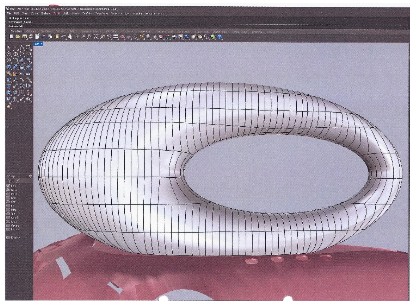
showed the same panelisation as the red line model [the drawing at paragraph 111 above],
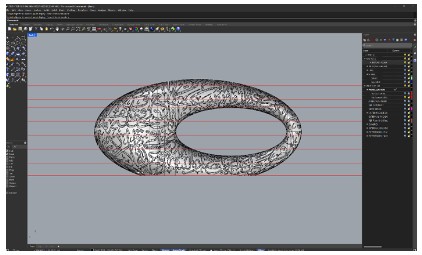
which it plainly did not;
(3) Affan's untruthfulness in evidence about the history of the CATIA model, including about the existence of the CATIA model prior to the Tender Proposals made on 25 January 2017 and the statement in the tender proposals that "We have completed a Catia model of the panels see below, with proposed panelisation". It is contended that the evidence of Mr Haslam is to be preferred to that of Dr Affan on this issue, particularly as the evidence of PH1-1 is conclusive;
(4) The evidence concerning the CATIA inspection on 11 November 2024, from which the following inferences fall to be drawn:
(a) that AFFAN staff were instructed by Dr Affan or someone on his behalf to tell the experts that the master file was unavailable, when it could have been offered to the experts for examination;
(b) that the files on the laptop shown to the experts were deliberately moved to that laptop in order to remove evidence of their provenance and development history;
(c) that the master file would have shown that the initial CATIA model for the Museum’s cladding was created in 2015, well before AFFAN’s tender proposals were submitted in January 2017;
(d) that accordingly Dr Affan lied on oath in his evidence that he did not know that the files shown to the experts were created on 4 November 2024 or thereabouts, so that their development history was not available and that he had given no instructions that any files held on the master model were to be withheld from BAM’s experts’ inspection.
406. Dr Affan was subject to further cross-examination on 12 December 2024 following the experts’ inspection on 11 November 2024. The substance of these allegations relates to AFFAN’s Counterclaim and I will address it below. I do, however, observe, having re- read the 43 pages of transcript devoted to Dr Affan’s further cross-examination, that there was no suggestion to him that:
(1) his evidence about the history of the CATIA model was untruthful;
(2) AFFAN staff were instructed by Dr Affan or someone on his behalf to tell the experts that the master file was unavailable, when it could have been offered to the experts for examination. He was simply asked whether he gave any instructions that any of the available files on the Q drive were to be withheld from the experts for BAM, which he denied. That answer was not challenged and there was no suggestion that the master file was available for inspection;
(3) there was no suggestion that the files on the laptop shown to the experts were deliberately moved to that laptop in order to remove evidence of their provenance and development history, merely that they had been transferred to the laptop on which they reviewed them on 4 November 2024 and that the development history was therefore not available. It was asked of Dr Affan whether a CATIA model started for the Project in 2015. He said no and that if Mr Haslam said so he was not a technical person and was mistaken; and
(4) there was no suggestion that Dr Affan lied on oath in his evidence that he did not know that the files shown to the experts were created on 4 November or thereabouts, so that their development history was not available and that he had given no instructions that any files held on the master model were to be withheld from BAM’s experts’ inspection.
407. The first opportunity the Defendants had to address these new allegations of dishonesty was in oral closing submissions. Mr Hussain submitted that the allegations were “entirely improper” and were “self-evidently flawed and unsubstantiated”. I agree.
408. I do not consider that the allegations of dishonesty add anything to BAM’s case on the merits of the Counterclaim but do assist more generally as insight into BAM’s interactions with the Defendants and whether, as Dr Affan contended in cross- examination, BAM deliberately stalled on approving the offered substantiation of AFFAN’s costs in order to starve AFFAN of funds.
Allegation I
409. In closing, Lord Marks was very keen to refute the suggestion that he did not put BAM’s case to Dr Affan. Cutting to the gravamen of his submissions, it was that the historical costs were paid to AFFAN on the strength of a clear representation that the money was to be spent for the listed bills, not to be spent as Dr Affan pleased.
410. This was not, however, the pleaded case. The pleaded case was that each of the suppliers was listed in Dr Affan’s letter to BAM of 26 November 2018 requesting payment of AED 15m ‘on account for the project cost incurred’. There is no dispute that the costs had been incurred, indeed it is an intrinsic element of BAM’s case that the costs had been incurred.
411. The questions are whether AFFAN fraudulently and unlawfully misappropriated project costs; and whether Dr Affan was personally responsible for such misappropriation in that he had the necessary fraudulent intent.
412. What was put to Dr Affan in cross-examination on 24 October 2024 was:
“Q597. And you were saying that, in respect of the Contractors on the list, that you needed to pay the 15 million Dirhams to, but those were costs you'd already incurred. And you said to Mr. Doyle, you implied to Mr. Doyle, that they'd been paid.
A: No, I did not imply. I said incurred. Please refer, incurred means I have a liability. I did not even pay the salaries that was on that list.
Q598. And the clear implication of what you were saying was that if this 15 million was paid, his recollection is that you were going to use it to replenish your funds in order to get on with the...
A: No, that was simply to pay the people.
…
Q600. And you were effectively saying, you wanted the money to pay those bills.
A: Exactly what I did. I have to pay the staff their salaries.
Q601. And you had to pay Kanoon, for example, for that...
A: Yes, I had to pay Kanoon.
Q602. For the invoices?
A: Yes. If I had received the money, I would have paid him.
…
Q606. You then, group medical insurance, general insurance, and then you're asking for money to pay for Kanoon labour outsourced at 9.
A: Yes.
…
Q612. And you were plainly making it clear to him that there's money was required in order to meet these costs, were you not?
A: Yes. This liability which I had already incurred was not something that I was paid, and I was going to be replenished with. No. We had to pay it.”
413. There does not seem to be much of an issue, but that Dr Affan was asking for a payment to replenish AFFAN’s funds in order to meet liabilities it had incurred.
414. Dr Affan was not challenged on his evidence that he did not receive all of the monies requested and that he therefore allocated it between liabilities.
415. Indeed, it would have been wholly wrong to have challenge this evidence in the light of Mr Doyle’s evidence on 22 October 2024:
“JUSTICE MICHAEL BLACK: I'm sorry. I'm sorry to interrupt in middle of the cross examination, but what you said in your first reference to this meeting was, he made it clear. I'm looking at transcript. "I think he tried to say and he made it clear. Sorry again. This letter was preceded by a meeting on the 20th November that I attended with D2. And he made it clear, as I think he tried to say in this letter that these were costs incurred and that they were looking for 15 million to replenish their finances." Are you retreating from that evidence now?
DERMOT DOYLE: No.
JUSTICE MICHAEL BLACK: Well, I think that's dispositive to the point, isn't it?
Q209. I think... Just I am clear... I am just saying, he didn't say to you that he had paid this already?
A: He didn't itemize them in the meeting. He said he will provide it. He said he has spent much more, he spent costs these incurred costs, spent money from his own resources, and he wanted assistance from us to replenish that finance.
Q210. So there was no statement in the meeting about Kanoon being paid, yes?
A: Not Kanoon. There was no mention of anyone specifically.”
416. There is no suggestion that the monies were fraudulently or unlawfully misappropriated or that Dr Affan personally had any fraudulent intent.
417. This allegation is unsustainable and must be dismissed.
Allegation II
418. As indicated above at paragraph 391, this allegation fails in limine. Lord Marks tried to justify the claim for wasted costs in closing by asserting:
“It claimed as losses and expenses under Articles 84 and 162 of the Commercial Companies Law and the point that there's no loss, which is a point made by the Defendants, … is a point that would be applicable to any claim for expenditure of management time, and Your Honour will be very familiar with claims for waste of management time. And there's no answer to such a claim that basically the Manager's time could be better used and could not be used. Because the claims succeed because the Manager's time could be better used elsewhere than taken up in a wasteful pursuit of issues like this one. And it's a BAM job... It's a BAM point that it was Mr. Doyle's job to review claims... And certainly, it's right that he has to review claims, but not bogus ones taking enormous amounts of waste of time.”
419. But that is all bald, unsupported, and unquantified assertion. Even if one were able to overcome the conceptual difficulty that it was Mr Doyle's job to review claims, there was no attempt to quantify the additional increment of his time attributable to those claims alleged to be fraudulent.
420. If it were necessary to consider the underlying the merits, I should take the view that the allegation is based on wild unsupported speculation out of touch with reality, as demonstrated by Lord Marks’s closing submissions:
“Whether the prepreg was generic or not, as he said, it was quite clear to him that the whole story about Palm Jumeirah and generic prepreg diverted from a delayed project in Jumeirah to the Museum was untrue. The Dubai Mall Project, after all, was right in the central downtown Dubai, miles from Jumeirah, as Your Honour well knows. The account that the prepreg was specially developed for the Museum, which you will remember, he gave him the letter. And yet it was now supposed to be generic material diverted from Dubai Mall to the Museum. Again, it's quite clear to him that that wasn't accepted. It also was quite clear to him that there was an allegation that the idea that there were no deliveries that you do to Dubai Mall Fashion Avenue, that everything was delivered to Affan stores was untrue. While the relevant invoices plainly establish that the deliveries were made to the Dubai Mall Fashion Avenue. And Affan's closing was, it even suggests, not that I didn't put these allegations, but that I was somehow at fault in not being satisfied with a perfectly clear answer. The answer given that there were no deliveries to Dubai Mall and everything was delivered to his store... his store, was plainly untrue. Furthermore, these deliveries, alleged deliveries that were made to his stores were, in fact, deliveries to Dubai Mall Fashion Avenue that went back as far as August 2017. A state when the cladding to the Museum hasn't even commenced. The chronology shows this at 4397, the fabrication of the panels was recorded as having started on the 23rd of 3 May, 2018. So, nine months after the deliveries to Dubai Mall Fashion Avenue, which he was provided a substantiation of a submission or evidence that that had been diverted to the Museum. It is as plain as a pikestaff that it wasn't true, and it's as plain as a pikestaff, that it was put to him that it was untrue.”
421. It is frankly absurd to suggest that prepreg would be delivered directly to a site in Dubai Mall. Prepreg is epoxy-infused glass polymer, or carbon fibre. It is laid up over moulds and baked in an oven. Mr Doyle accepted in evidence that he did not have the technical expertise to dispute Dr Affan’s evidence that prepreg deteriorates if not stored in refrigerated conditions. In fact, BAM led no technical evidence to dispute Dr Affan’s evidence that prepreg is a generic material that may be used on different projects.
422. The entire edifice of the allegation of dishonesty is built upon the unsustainable foundation that material purchased for other projects could not be utilised on the Project. Accordingly, it must be dismissed.
Allegation III
423. In closing submissions BAM submitted that it is dishonest for a company director or manager to tender a security cheque on behalf of their company unless they have an honest belief that it will be honoured if and when it is presented. This may or may not be an accurate statement of UAE law, but it is not the case pleaded against Dr Affan. The pleaded case was at paragraph 56.3 of the Particulars of Claim:
“That D2’s conduct in tendering to the Claimant the Security Cheques that were subsequently dishonoured and each of them was fraudulent, in that D1 knew that they would not be honoured on presentation (if presented), alternatively had no honest belief that they or any of them would be so honoured. D2 knew when he tendered them and each of them that they did not represent good and valuable security for payment of the amounts due from D1 to the Claimant, in respect of which they were tendered as security (Allegation III).” [emphasis added]
424. The pleading continued at paragraphs 83 and 84:
“83 The said cheques were tendered by D2 to the Claimant and accepted by the Claimant on the basis that they represented good and valid security for the repayments due to the Claimant from D1. That was not true. It is the Claimant’s case that D2 must have known, given his position in D1, that the said cheques would be dishonoured upon presentation, or, alternatively, been reckless as to the prospect of their being so dishonoured, having no honest belief that the said cheques would be honoured upon presentation. Indeed, D1 admitted that the relevant accounts with the Commercial Bank of Dubai and ADCB had no funds to meet the cheques when it wrote to the Claimant on 24 April 2019 saying as much.
84 In the premises it is the Claimant’s case that the tendering of the said cheques by D2 to the Claimant was fraudulent and dishonest.” [emphasis added]
425. Thus, the allegation related to state of knowledge and intention of Dr Affan at the time the Security Cheques were tendered. BAM cited a highly selective extract from Dr Affan’s evidence about the First Security Cheque but cannot get round the fact that it did not challenge his evidence that there were sufficient funds to cover the First Security Cheque when he drew it. BAM accepts (as it must) that Dr Affan was not asked specifically about the later Security Cheques individually.
426. BAM seeks to justify this failure by suggesting that the Judge was clearly of the view that the later cheques should not be dealt with separately. This is an inaccurate account of what occurred as is apparent from the transcript:
“Q822. "On the day of entering into the Addendum, the Subcontractor shall provide a signed, undated security cheque in the amount of 7 million".
A: That's exactly, what I did.
Q823. I don't want to go through the security cheque procedure every time, but we come to a security cheque. But this is a formal commitment to provide a signed, undated cheque.
AMER AFFAN: And it’s exactly what I did.
LORD JONATHAN CLIVE MARKS: You signed it?
A: And I leave it undated, exactly, as they wished.
Q824. And again, you knew that, that was to ensure that they would have security for their 8 million?
A: That is their interpretation.
Q825. What was your interpretation?
A: It was supposed to be returned it.
Q826. And if you didn't pay?
A: I don't know exactly. They would come back to me, and normally, with the normal circumstance, somebody who's signed an agreement with, he will inform you. I need my security check. I would have asked him whether you have paid the money. There was no need for that.
JUSTICE MICHAEL BLACK: I think, we've been through this, haven't we?”
427. It is clear that what BAM was cross-examining Dr Affan on was “the security cheque procedure” not Dr Affan’s alleged dishonesty in tendering the cheque. The Court’s observation cannot be taken as a waiver of BAM’s obligation to put its case on dishonesty to Dr Affan. Dr Affan had already been cross-examined extensively about the procedure for issuing undated security cheques in the context of the First Security Cheque from pages 78 of the Transcript for 24 October 2024 to page 85. This is the passage in which BAM did not challenge Dr Affan’s evidence that he checked that there were sufficient funds to cover the First Security Cheque when he tendered it. The majority of the passage was devoted to a debate between Dr Affan and Counsel about the procedure of issuing undated security cheques. Counsel tried to suggest (without evidence) that this was a regular practice. There is no doubt that issuing post-dated cheques as security is a widespread practice in the UAE, but I agree with Dr Affan (in the passage cited in BAM’s written closing submissions) that issuing undated security cheques is essentially a meaningless gesture.
428. The procedure could only be made to work if there were an express obligation on the drawer of the cheques to ensure that there were at all times sufficient funds so that the cheques would be honoured at some unknown point in the future. BAM seeks to rely on an undefined obligation by mere assertion without explaining how as a matter of UAE law such obligation is said to arise. The irrationality of the proposition is demonstrated by BAM’s own submissions. It was submitted: “Dr Affan was well aware that the security cheques would only be presented for payment if he were in dispute with BAM and that in that event no further monies would be paid by BAM to enable the cheques to be honoured on presentation.” Thus, it is being said that there was an obligation to fund the Security Cheques when the monies were unavailable to do so.
429. BAM may say that AFFAN was obliged to fund its banking accounts from other contracts, but it is also its case that following the Addendum AFFAN was only able to access the Facilities and Resources for the purposes of the Project and BAM alleges that AFFAN was in breach of the Subcontract and Addendum in failing to use the Facilities and Resources solely for the purpose of the Subcontract Works (see paragraph 269(2)(d) above). Any implied obligation to maintain sufficient funds in AFFAN’s accounts to honour the Security Cheques for an undefined period was therefore commercially unworkable.
430. Be that as it may, the arrangement would also have had to confer the right on BAM to date the cheques. This was not done.
431. Mr Hussain put it succinctly in his oral closing:
“The third allegation is to deal with is an allegation that by presenting undated security checks, Dr. Affan was dishonest. Now, my Ld. Friend has entirely skirted the fact that these security checks were undated, which was a point that was emphasized by yourself and by me through the trial. Dr. Affan's evidence was that when he presented or when he gave the checks to the Claimant, he checked the accounts and there was money there to cover the sums of the checks. The Claimant has not been able to counter that evidence. The Claimant dated the checks without asking or agreeing with Dr. Affan and the basic point is, firstly, there's no dishonesty because Dr. Affan simply was not told at what date these checks would be presented, nor did he make a warranty that the checks would be... that there would be money in accounts at an unknown date.”
432. Allegation III fails and must be dismissed.
AFFAN’s COUNTERCLAIM
The Pleaded Case
433. AFFAN’s pleaded case is set out above at paragraphs 31 to 39, 152 to 154, and 158 to 159 above.
LEDs
434. AFFAN pleaded that on 27 March 2018 BHE wrote to BAM instructing them to proceed with OSRAM LINEARLIGHT FLEX DIFFUE 600 SIDE (LFD600S) strips for the façade calligraphy reveal lighting. The next day, BAM forwarded the letter to AFFAN. On 29 March 2018, AFFAN submitted an extra over rate for the new OSRAM LEDs. BAM issued an instruction to proceed with the change in the LED bulbs. On 5 April 2018, BAM wrote to AFFAN to confirm that AFFAN had already received what it considered to be the instruction in relation to the LEDs, stating that costs would be determined in accordance with Clause 21 of the Subcontract (“valuation of variations”).
435. In its Defence to Counterclaim, BAM pleaded that it was admitted that the change to the LEDs constituted a valid variation under the Subcontract, of which account had already been taken in the revised Subcontract Price. BAM denied the amount claimed by AFFAN under this head of claim and put it to strict proof thereof.
AFFAN’s Submissions
Panelisation
436. AFFAN refers to the following terms of the Subcontract: Clauses 1.1(m)(paragraph 134(2) above), 3.1(paragraph 134(4)), 3.2(paragraph 134(5)), 20.1(paragraph 134(16)), and 20.5 (paragraph 134(18)).
437. AFFAN notes that BAM appears in its Reply to be alleging that Clause 20.0 of the Subcontract is a “pay if pay” provision. BAM is partially correct. By Clause 20.5 of the Subcontract, if a variation is ordered by the Employer under the Main Contract and is confirmed in writing to AFFAN by BAM, AFFAN will not be entitled to be paid more than BAM actually receives under the Main Contract.
438. This provision does not apply in the present case as AFFAN is claiming that BAM should have issued an instruction under Clause 20.1(b) of the Subcontract which is an alternative to 20.1(a), a Variation ordered by the Employer under the Main Contract and confirmed in writing to the Subcontractor by the Contractor.
439. AFFAN submits that the Subcontract permitted AFFAN to size the panels as it saw fit. It refers to the following:
(1) On 16 June 2016, the Employer issued a Tender Query to BAM who replied that “the [Sub]contractor” would be required to undertake a panelisation exercise based on their preferred module (paragraph 81 above);
(2) The Tender stated that façade panelisation would be subject to “the [Sub]contractor” preference (paragraph 86 above);
(3) Tender IFC Drawing 0121-P101-BUR-FAC-DWG-0901-000DP stated that module sizing would be to “[Sub]contractor” preferred module (paragraph 87 above);
(4) Tender IFC Drawing 0121-P101-BUR-FAC-DWG-0906-000DP stated that module sizing would be to “[Sub]contractor” preferred module (paragraph 88 above);
(5) Tender IFC Drawing 0121-P101-BUR-FAC-DWG-0934-000DP stated that module sizing would be to “[Sub]contractor” preferred design (paragraph 90 above);
as demonstrating that AFFAN was free to size panels as it saw fit. It therefore followed that an instruction to span the panels floor to floor (whether from the Employer’s Representative, KD, BHE, or BAM) was a variation to the Subcontract.
440. AFFAN says that its bid was that it intended to size the panels at 9 metres x 2.2 metres and that it priced and programmed its Tender on that basis:
(1) The sizing of 9 x 2.2 m was identified in the Response to Koltay’s Tender Queries P-AB-147 on 17 July 2016 (paragraph 82 above);
(2) In the pricing document dated 1 September 2016 (part of the Summary Pricing Document dated 3 September 2016) and subsequently issued as part of the Tender Bid, the pricing was based on a panel 9 metres x 2.2 metres (paragraph 85 above). Mr Hussain asked rhetorically in oral closing submissions why AFFAN would want to have larger panels when it could have 9 metres x 2.2 metres, given that it could rest them anywhere on the structure and there was no restriction on what the size would be? Why would it do that? Why would it build something more expensive than it needed to? Why would it price for 9 metres x 2.2 metres if it intended to have bigger panels?
(3) The Commercial Proposal stated that the composite façade panels would be double-curved, nominal size 9000 x 2200 mm (paragraph 96 above). AFFAN contends that “nominal” does not mean “average” or “typical”, it means approximate or close to. I accept that “nominal” dimensions are often referred to in the construction and engineering industry and refer to elements complying with those dimensions in name, that is, they might vary somewhat when actually installed. I therefore prefer AFFAN’s interpretation of the word;
(4) The Technical Proposal stated that:
(a) the panels of main façade were proposed to be 9 metres x 2.20 metres in size with double curvature (paragraph 97 above);
(b) the panel length as 9,000.0 mm and the panel width was 2.2000 mm (paragraph 98 above);
(c) AFFAN envisaged approximately 700 panels of 9 metres x 2.2 metres (paragraph 99 above);
(d) AFFAN envisaged a production programme of 60-80 panels per month based on the stated panel sizing of 9 metres x 2.2 metres (paragraph 101 above).
441. Dr Affan was asked about the image in the Tender set out at paragraph 97 above on Day 3 of the hearing:
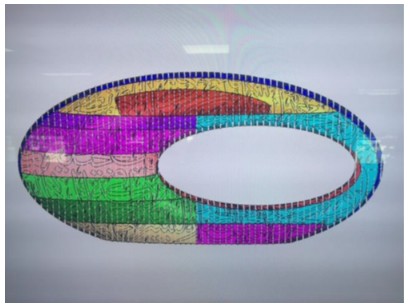
“Q146. And you will appreciate then and I don't think we need to take you to it, that the right hand drawing on which the CATIA Model drawing, but I'll come to that and ask you about that, has been superimposed. What you see there, is that superimposition and that is your CATIA Model?
…
A: The model is not a CATIA Model. I checked. If it was, it must have been a slip of the tongue. And we had not been proposing to make horizontal panels in dark blue on the top, either. We had not been proposing to make one big panel in blue, covering four floors. We had not been proposing to make a red one which stops mid-air at the top. This one here is simply an interrogation of the different surfaces that the Architect used to create his building.
Q147. I don't think there is any suggestion that the choice of colours is significant here.
A: But you have done so, and you can see it's a different colour because you're referring to different colours and different things. But there was never been a panelisation in this building. That is as simple a photo sent to us, part of the Architect photos, and we just coloured it to interrogate the different surfaces making up this building.”
…
“A: I think it's a picture, just to show interpretation of the different surfaces created by the Architect. And we wanted to see what the different surfaces, because at every level was a different surface. Different surface, architecturally. So, I cannot rely on the same panel being repeated twice. That what it serves.”
442. AFFAN also relies on the evidence of Mr Morante that the design proposed and intended in the Tender was a maximum panel sizing of 9 metres x 2.2 metres because “my machines were not made for it anymore and I would lose far too much production time” (Transcript 24 October 2024, page 54).
443. Dr Affan’s evidence was to the same effect (ibid. pages 115-116).
“JUSTICE MICHAEL BLACK:
…
Number one, what's the maximum size of panel, your machinery at the time your Tender could produce?
DR. AMER AFFAN: 9Mtr. x 2.2Mtr.
JUSTICE MICHAEL BLACK: That was the maximum size at that time?
DR. AMER AFFAN: Yes.
30 JUSTICE MICHAEL BLACK: You had to buy additional machinery to produce larger. I’m sure, you'll come to that in due course. So, at the time, you could only produce 9 x 2.2. I want to envisage that, then you might use, as it were, two of those panels, for example, if we look at the lowest, if we look at the lowest blue figure on this Exhibit-1. Can you see that? I think this is probably just above the moun[d] and it says, if one's doing as double curvature, that will need a panel of 17.564. Can you see that?
DR. AMER AFFAN: Yes.
JUSTICE MICHAEL BLACK: So, how would you approach that if you could only produce that time a panel?
DR. AMER AFFAN: That's actually two panels.
JUSTICE MICHAEL BLACK: You used two panels?
DR. AMER AFFAN: Yes, we did, actually and that we... initial proposal by us was two panels. And we went back to the Architect and he insisted and we put additional machine to meet that. And just for your information, we actually supported at the midspan.”
444. It is AFFAN’s case that its original tender intention was not to have the panels follow the internal floor levels but it was instructed to do so in accordance with KD’s wishes (the “Killa preferred scheme”), which involved substantial changes (see paragraph 159 above).
(1) By an email sent on 2 March 2017 with the subject matter “Fwd: MoTF Issued for Construction BIM Models Vol 4 (02)” and a noted Reason “Issued for Action”, BAM sent AFFAN “Rhino Model 0121-P101-KLD-FAC-BIM-00001-0003D Revision C00 Revision Date 11/12/1016 Title Architecture Mound, Lobby, Press Room & Aud. Rhino Models (ZIP)” (paragraph 111 above) – the drawing referred to in evidence and submissions as “Tab 15” with red lines showing the internal floor levels. AFFAN contends that the drawing requires the panels to span floor to floor and was a variation. AFFAN submits that the instruction to follow this model is a variation to the Tender, the LoI and the Subcontract which made clear that panel sizing would be to AFFAN’s preference and design.
(2) AFFAN says that a further revision of this model was issued by KD and dated 6 March 2017 and which shows the same panelisation with panels spanning floor to floor. The drawing is under paragraph 113 above. AFFAN submits that this revised model is a further instruction to AFFAN to design and construct panels that span floor to floor. This is a variation to the Tender, the LoI and the Subcontract which made clear that panel sizing would be to AFFAN’s preference and design.
(3) AFFAN relies on repeated instructions in subsequent Façade Meetings and Presentations to design and construct panels that span floor to floor as a variation to the Tender, the LoI and the Subcontract which made clear that panel sizing would be to AFFAN’s preference and design. In particular:
(a) Façade Structural Steel Coordination Meeting No. 3 on 6 March 2017 (paragraphs 114 to 117 above);
(b) Façade Structural Steel Coordination Meeting 4 held on 13 March 2017 (paragraph 118 to 122 above). It is worth blowing up one of the Architect’s drawings addressing horizontal joints at floor level
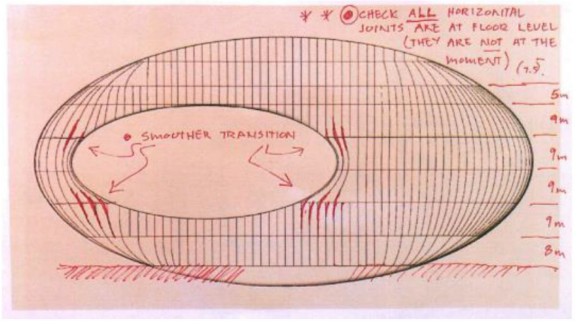
This became the “Killa Preferred Scheme” (paragraphs 118 to 120 above). KD directed that the horizontal joint should be at floor level. It was Dr Affan’s evidence that every single point on the diagrid was capable of supporting the façade. After some prevarication, Ms Kindelan accepted in cross- examination that she was not in a position to say that the midspan between floors was structurally unable to hold or support the panels. It is AFFAN’s case that BHE made clear that unless the instructed panelisation was adopted, the shop drawings were not acceptable (see paragraph 122 above);
(c) the sixth meeting held on 27 March 2017 (paragraph 124 above). AFFAN notes that the final panelisation scheme was still under construction;
(d) the seventh meeting took place on 3 April 2017 and the scheme was finalised. AFFAN produced shop drawings showing the preferred panelisation instructed including the larger panel sizes (e.g. 0121-P101- AFN-FAC-SHD-00136-000EL revision 0 which appears to have been submitted on 9 August 2017).
445. BAM counters AFFAN’s suggestion that the email dated 2 March 2017 enclosing the Tab 15 Rhino model could be a variation by pointing out that on the same day BAM issued letter ref. BHH-LETTER-000111 (0121-BHH-LET-00111) (“Letter 111”) and thereafter, also on 2 March 2017, 17 further transmittals, all of which enclosed IFC documentation (which had previously been sent to AFFAN by email on 22 February 2017). By that letter, BAM sought AFFAN’s confirmation that its tender fully took into account the IFC documents. The “action” mentioned in the transmittals was, BAM contends, AFFAN’s required confirmation within a period of seven days. One of the transmittals was Transmittal BH-TRANSMIT-000653. It is that transmittal which is alleged to have attached the Tab 15 model. BAM submits that Transmittal BH- TRANSMIT-000653 cannot constitute an instruction to vary the Subcontract Works when on its face it can only be construed as seeking confirmation, in accordance with Letter 111, that AFFAN had received the IFC documentation underlying the LoI. The Tab 15 model, BAM says, is incapable, in the absence of further specific explanation giving details of its import, of amounting to a Subcontract variation instruction requiring the horizontal joints to mirror the floor level(s) and the panels to span floor to floor.
446. Further, BAM contends that it was always AFFAN's intention for the panels to span floor to floor, meaning that the Tab 15 model could never have constituted an instruction to vary work, when the work on the basis of the allegedly new plans was already intended to be undertaken in precisely the way allegedly instructed in respect of the alleged variation. BAM says that on 8 March 2017, AFFAN signed and returned the acceptance of the LoI. It is BAM’s case that nothing in or attached to the email of 2 March 2017 in any way amounted to an instruction to AFFAN to vary the Subcontract Works. AFFAN’s acceptance of the LoI on 8 March incorporated all the listed IFC documentation into the agreement constituted by the LoI and is inconsistent with a variation of the Subcontract instructed on 2 March 2017, the effect of which would have been significantly to displace the IFC documentation.
447. Dr Affan was cross-examined on the point:
“Q260: The question I'm inviting you to answer is what is there in that email that happens to be sent to you the same day as the Letter of Intent, that displaces the terms of the Letter of Intent
A: It's instructions.
Q261. But you said doesn't change anything?
A: It changes, it said that I want it to be like this. That's what you want, that's what you get.
Q262. So it was just a suggestion as to how you might like to develop the...
A: It was not suggestion. It was instructions, pure instructions based on a model issued by the Architect.”
448. AFFAN refutes BAM’s suggestions. AFFAN’s position is that the variation was the instruction to follow the KD preferred panelisation shown in its Rhino models, and specifically to size the panels in accordance KD’s preference including to span the panels floor to floor. This is a change to the Tender documents, the approved Tender Proposal, the LoI and the Drawings that form part of the Subcontract which repeatedly and clearly state that the subcontractor will choose the panel sizing and panelisation according to its own preference and design. However, AFFAN was not permitted to choose the panelisation of its own preference and design. A preferred panelisation was instructed, which is a variation. AFFAN says that the fact that the KD Rhino models are included in a list of Tender Documents which was then incorporated in the Subcontract does not change this fact.
449. AFFAN continues – BAM argues that because the instructions pre-date the execution of the Subcontract this means there is no variation. This is wrong. The Subcontract Commencement Date is agreed as 23 February 2017 (paragraph 109 above).
450. More fundamentally, AFFAN says, the Subcontract makes clear that the Subcontractor will panelise and size the panels as per its preference and design. BAM’s new argument that somehow AFFAN inadvertently waived its rights to claim a variation for the instruction of a preferred panelisation and panel sizing simply by signing the Subcontract is wrong.
451. AFFAN points out that BAM’s position is also contrary to its own documented position in CCN 222 where it recorded that the panelisation was an instructed change to meet the Employer’s Design Team’s preference. BAM records that there was an instruction by the Employer’s Design Team to optimise maximum panel size and avoid horizontal joints. This is a reference to KD’s instructed panelisation models. AFFAN says that it was instructed and required to follow this preferred panelisation which it did as it was obliged to follow such instruction. The panelisation that had to be followed was the KD preferred scheme and AFFAN was not allowed to size panels as per its preference and design.
452. Dr Affan’s evidence was to the same effect:
“A: I would like to answer that question correctly. On the 2nd of March, we received instructions to follow a panelisation sequence. On the 7th of March, we issued our first CATIA Model to BAM. On the 13th of March that CATIA Model was the basis of that discussion and it will be very clear to you that it was driven by the Architect how he would like to see the panelisation and it was, you could see that suggestion. He is the one who is driving all these changes in the presence of BAM.”
453. AFFAN points out that BAM has not proffered a witness of fact from BAM who has any technical qualification or who was involved in the Façade Structural Steel Coordination meetings. Mr Doyle accepted in cross examination that he has no technical qualifications and that he did not attend any Façade Structural Steel Coordination meetings or any appraisals of the VMUs. It is said that this is significant. Not only is BAM contradicting the position it took in CCN 222 (based on its technical personnel’s true views) that the panelisation had been varied by instruction of the Employer for aesthetic reasons, it is doing so without any evidence from its own technical personnel.
454. BAM did call Mr Halsam who gave evidence as set out at paragraph 78 above that it was AFFAN’s strategy to tender on the basis of double-curved panelisation, spanning floor to floor. I reject this evidence both because, as noted, Mr Haslam admitted that the lawyers had written that part of his statement for him and because it is not consistent with his contemporaneous correspondence (see his letter of 29 October 2018 - paragraphs 175 to 180 above).
455. These are issues of fact rather than expert opinion. AFFAN observes that Ms Kindelan’s evidence was largely directed to issues of fact. Her evidence cannot gainsay what was set out in BAM’s own claim document.
456. The experts did seem to agree when conferenced by me that the Tab 15 model did appear to show floor levels.
457. AFFAN also notes that BAM states that any variation of the Subcontract would have been required to have been instructed in accordance with the terms of Clause 20 of the Subcontract and there was no such instruction regarding the panels being required to span floor to floor. AFFAN denies that there is any prescribed form of instruction under the Subcontract. It says that the Employer or BAM need not label an instruction as a “variation” - that is a question of substance rather than form. Otherwise, the Employer or BAM could avoid their obligation to make additional payment for an instructed change in the works by not labelling its instruction as a variation. In the same vein, BAM and AFFAN were obliged to follow instructions from the Employer. There was no basis in the Subcontract for BAM or AFFAN to object to such an instruction. AFFAN (as BAM itself records in CCN 222) continued to produce designs and VMUs for the instructed design. Once that VMU was approved in the form of VMU 5, a timeous notice of claim for the time impact was put in. Likewise, once production of the instructed varied panel sizes had progressed to 100 panels such that the costs impact could be projected, a timeous notice of increased cost was submitted.
458. AFFAN says that it could not reasonably notify the time impact of the instructed variation imposing panelisation as per the Employer’s or KD’s preference until the instructed panelisation was an approved VMU and AFFAN had started panel production and had an idea of the increased cost. AFFAN points to the confirmation of that situation in BAM’s CCN 222 Submission (see paragraph 244 above). AFFAN also points to Mr Morante’s evidence which was to the same effect: “The Architectural Design Development, we had no right to interfere in it. That has to be done by Shaun Killa and the Client. So, the aesthetic part of it is not decided by AFFAN” (Transcript 24 October 2024, pages 63-4).
459. VMU 5 was approved (with notes) on 25 March 2018. The day following such approval, AFFAN issued a notice under Clause 28.3 of the Subcontract by letter dated 26 March 2018 (see paragraph 151 above). The letter noted in particular:
“As the facade Subcontractor we acknowledge receipt of your letter ref: BHH- LETTER-002310 dated 28 February 2018. We refer to our correspondence dated 26 March 2018 outlining the Impacted As Planned revised program submission and now duly advise the contributing causes for delay that has a total impact of 169 days.
…
Pursuant to Sub-clause 28.3 [Subcontractor's Notices and Claims] of the Subcontract Agreement and Clause 8.4 (a) [Extension of Time] as per the Main Contract conditions, the Subcontractor notifies of the delays to the works and its intention to claim for an Extension of Time. Any further interim particulars to the events described below will be submitted under separate cover. Whilst notification is necessary, we confirm our ongoing commitment to undertake all necessary steps to provide the best results possible for the project.
…
2. Delay Event - Panelisation & Calligraphy The sequence of the design is critical to its overall development. This is evident through several meetings that took place in the presence of the Employer's Representative [Meraas Development], the Supervision Consultant [Buro Happold Engineering] and the Main Contractor, wherein numerous 3D and physical models had to be presented to establish and ultimately finalize the Panelisation for the project. The Panelisation had to be revised to meet the Employer's requirements (due largely to aesthetics) which resulted in further design development that was time consuming and delayed subsequent activities of the programme of works and critical path.
Upon completion of the Panelisation in July 2017 the tasks of overlaying and fine tuning the calligraphy was the second main critical task. As per the Panelisation a series of detailed workshops had to be implemented to check every letter, embellishment and joint to ensure that not only was the calligraphy correct grammatically but also the affected panels and most important the glazed units could be practically produced.
In view of the above and the complex bespoke design of the project, the finalization of Calligraphy caused further delays to the execution of the works.”
460. AFFAN claims that for the notification of cost, it had to await the start of production and that it issued a notice of increased cost having seen the production of 100 panels by the letter of 29 October 2018.
461. In his evidence set out at paragraph 249 above, Mr Doyle confirmed that in BAM’s Summary Statement at Taking Over the AED 421 million figure claimed against EOT included AED 200 million claimed by AFFAN.
Hexagonalisation
462. AFFAN relies on BAM’s CCN 222 claim document at paragraphs 8.5.1 and 8.5.2 (see paragraph 172 above). AFFAN submits that the documents shows that hexagonalisation was instructed specifically to avoid the sight of hairline joints. It was not instructed, as is now being suggested, for any drapeability reasons. The need for hexagonalisation arose from the instruction to have a full-width stainless steel panel.
463. The experts, Mr Cordon and Mr Smith, agree that there was no technical reason why hairline joints were unacceptable. Thus, says AFFAN, there was no technical reason to cover up the joints with a full-length steel panel that gave rise to the need to improve its malleability by the introduction of hexagonal scoring
464. On 23 May 2018, AFFAN set out what it considered to be additions to and omissions from the Subcontract Works, including as an addition “Hexagon pattern to stainless steel”.
465. On 2 July 2018, AFFAN wrote:
“We write to record that the first approvals of the hexagon patterns for levels 1-4 were received on 2ist June 2018.
As the aesthetic requirement of the hexagon pattern is not a requirement of the specification, the subsequent alignment, and approval has to be considered a variation to the scope with the approximate time and cost implications.
We will advise in due course of the full effects under clause 20.1(C).”
466. BAM apparently agreed. BAM wrote to BHE on 3 July 2018 that additional items not included in any of the original IFC documentation included, “Hexagonal Patterns - Introduced by the Employers design team to enhance the malleability of the specified S/S sheet thickness” intrinsically linked to which was “Hairline Joint Setting Out” that “was never part of the Contract requirements” equating to “enhancement of the original specification”.
467. On 4 July 2018, BAM wrote to BHE:
“We are in receipt of the enclosed AFFAN letter ref. Affan-LETTER-000264 regarding the hexagon patterns to stainless steel and write to advise that we believe the changes detailed in the letter constitute a Variation to the Contract under Sub-Clause 13.1(c). For practical purposes we take your approvals of the hexagon patterns as an instruction to proceed, however we would request the formal Variation Instruction from the Employer as required under Sub- Clause 13.l(d).
In the meantime, as the changes are likely to result in additional costs and may delay the Works, for which the Contractor would consider itself entitled to additional Costs/payment and/or an extension to the Time for Completion we hereby give notice of such entitlement pursuant to Sub-Clause 20.1 (c), pending the finalisation of the revised Employer's requirement …”
468. Mr Smith’s view that the introduction of the hexagonal pattern was an aesthetic one based upon a desire to remove the visibility of the hairline joints between the stainless- steel sheets is noted at paragraph 171 above.
BAM’s Submissions
The Variation of the Subcontract Predates the Subcontract
469. BAM submits that the Subcontract represented the agreement between the Parties entered into on the date it was made, 8 January 2018. Accordingly, if the scope of Subcontract Works and/or the Accepted Subcontract Amount had been varied or was liable to be changed from the draft before the date of the Subcontract, the Subcontract would, when executed, have had to reflect such changes.
470. BAM suggests that it makes no difference that the Subcontract commencement date was defined in Annex 3 at §9 (paragraph 134(29) above) as 23 February 2017. That definition was provided expressly for the application of Clause 16.1 of the Subcontract (paragraph 134(11) above). It defined the date at which AFFAN came under an obligation to "enter upon the Site and commence the execution of the Subcontract Works". It cannot be read as having imported into the Subcontract a variation involving a change in the scope of Subcontract Works instructed before the Subcontract date, nor as changing the Accepted Subcontract Amount retrospectively by reference to any such alleged variation.
471. BAM says its submission is reinforced by Clause 18.1 of the Subcontract (paragraph 134(14) above) which provided: "The Subcontract Price shall…. be subject to adjustment solely in accordance with the express provisions of the Subcontract". The common-sense view that one cannot vary a contract before it is made is correct.
472. Dr Affan accepted that when he signed the Subcontract, he was fully aware that the Accepted Subcontract Amount might turn out to be too low and took the risk of signing the Subcontract in the hope/belief that AFFAN would get a variation. Dr Affan did not say that AFFAN already had a variation.
473. I found his evidence hard to follow on this issue. At one point he said that he knew that it would have been very difficult to do the work for AED 125 million because of the changes instructed by BAM prior to signing the Subcontract and that he said that to BAM. At another point he said that in 2018 he did not know the Accepted Subcontract Amount was too low. He said that AFFAN was “coerced” into signing the Subcontract. I make due allowance for the fact that while Dr Affan is a fluent English speaker, it is not his mother tongue. His explanation indicated to me that he used the word “coerced” in a subtly different way than might have been used by a native English speaker. It seemed to me that he was saying that it was a marquee project for AFFAN and that it would have been difficult for BAM to find another subcontractor, thus the combination of the two led him to believe that, notwithstanding the express terms of the Subcontract, he was bound to receive a variation order covering the changes to the Subcontract Works as tendered before the Subcontract was signed. He would not be the first entrepreneur who, when the bones of a pathological deal are subsequently picked over by the lawyers, would appear to have acted with an optimistic trust in his counterparty that turned out to be misplaced.
The Contractual Mechanism for Variation
474. BAM makes reference to the following terms of the Subcontract:
(1) The definition of “Subcontract Variation" in Clause 1.1(m) (paragraph 134(2) above);
(2) Clause 20(1)(paragraph 134(16) above);
(3) Clause 20(4) (paragraph 134(18) above); and
(4) Clause 20(5) (paragraph 134(19) above).
475. BAM may, pursuant to Clause 20.1(b) of the Subcontract order AFFAN by an instruction in writing to vary the Subcontract Works. The instruction must be clear and must convey to AFFAN that it is contractually obliged to carry it out. BAM submits that there is no evidence of any instruction, in writing or otherwise, by BAM to AFFAN to vary the panelisation. There was a collaborative development of the design put forward by AFFAN, for which AFFAN had responsibility under the Subcontract. KD made comments on the design and BHE and AFFAN agreed to their suggestions well before the date of the Subcontract. It does not matter whether one takes the tender package as the base or the IFC drawings as the base.
476. As to hexagonalisation, BAM submits that AFFAN misinterprets or overinterprets the short run of correspondence in July 2018: from 23 July 2018, BAM and AFFAN both knew that the Employer was not accepting the hexagonal patterning as a variation and there was nothing in the correspondence to suggest an instruction from BAM to AFFAN to proceed with a variation. On the contrary, the Employer refused a variation instruction and maintained that this solution was introduced to help AFFAN with buildability. It is submitted that AFFAN is attempting to construe BAM's expression of opinion to BHE about AFFAN's request for a variation instruction as an instruction in writing from BAM to AFFAN to proceed with a paid variation.
477. BAM says that the case advanced on hexagonalisation by AFFAN carries the inherent absurdity that where BAM passes on to the Employer a request from AFFAN for a variation instruction, and this request is met with a refusal by the Employer which is then relayed to AFFAN, AFFAN may be entitled to claim payment from BAM for a variation, for which all parties know that the Employer was not going to pay BAM. This is inconsistent with Clause 20.5 of the Subcontract which provides that AFFAN shall in no circumstances be entitled to be paid an amount greater than BAM actually receives under the Main Contract.
478. BAM sets out what it submits are the minimum requirements for such a contractor's instruction. It is submitted that such an instruction for a variation must make clear, as a minimum:
(1) that it is a Contractor's instruction;
(2) that it is an instruction for a variation of the Subcontract;
(3) what works are to be added, omitted, modified (and, if modified, the nature and extent of the modification being instructed) or substituted; and
(4) that the amount of payment for the variation was be computed in accordance with Clause 21 of the Subcontract.
479. It is submitted that, without more by way of explanation sufficient to satisfy the requirements set out in the preceding paragraph, the mere provision of a drawing or image would not / could not constitute such an instruction. There was no written instruction for a variation of the panelisation nor for the hexagonalisation.
AFFAN’s Changing Case and Tab 15
480. BAM criticises AFFAN for changing its case. It says there were two alterations: first, it was pleaded that the instructed variation in panelisation was initiated at the 13 March 2017 Structural Steel Coordinating meeting; secondly, it was claimed in oral opening submissions that the change was instructed by an Aconex transmittal of 2 March 2017, included at Tab 14 in the two-volume bundle introduced by AFFAN at the beginning of the trial (the “Opening Bundle”); and thirdly, in evidence on 25 October 2024, Dr Affan identified Tab 15 (paragraph 405(2) above) as the document he had been sent on 2 March 2017. His case was now that the introduction of Tab 15 was the instruction by which BAM changed the panelisation from the IFC documents. 2 March 2017 was the date of the LoI, so that the effect was that AFFAN contended that on the day that BAM sent the LoI to AFFAN stating that the Subcontract would be awarded to AFFAN, BAM also issued an instruction that, says AFFAN, fundamentally varied the Subcontract Works.
481. On 28 October 2024, BAM made an application to investigate the provenance of Tab 15 further and to see and interrogate the CATIA model in view of Dr Affan's evidence that the Tender Proposals were wrong in asserting that AFFAN had prepared a CATIA model and proposed panelisation. Furthermore, by this time Ms Kindelan had discovered that the documents included in Tab 14 did not include Tab 15 and that the document at Tab 15 could not be generated from the apparently corresponding model listed in Tab 14. On the morning of 29 October 2024, the Court and BAM were informed that Tab 15 had not been attached to any document in Tab 14 but had been created on 6 March 2017.
482. BAM submits that this was of considerable importance because, while it stretched credibility that the panelisation could have been completed between 2 March and 7 March, it was plainly impossible to accept that the exercise could have been carried out between 6 March and 7 March 2017. The 7 March 2017 date is said to be highly significant because that was the date of Model 1, the first model presented by AFFAN to BAM containing the proposed panelisation – and the starting point for Ms Kindelan's analysis demonstrating that between Model 1 and the model finally approved on 29 June 2017, less than 10% of the panels had increased in size.
483. Subsequently, in AFFAN’s Supplementary Memorial dated 8 November 2024, BAM says that AFFAN set out a new case, this time alleging that on 2 March 2017 a document that was actually attached to Tab 14 represented the instruction for changed panelisation. The Supplementary Memorial was accompanied by a fifth statement from Dr Affan, in which he asserted that he had "discovered an error in [his] evidence" which was that Tab 15 was not sent with Tab 14, but it was the document numbered 0121-P101-KLD- FAC-BIM-0003D (“the red line model” - paragraph 111 above) that accompanied Tab 14. In the same paragraph, Dr Affan says: "A screenshot of the model sent with the Claimant’s email on 2 March 2017 is attached at [Bundle I, File 23 document “0121- P101-KLD-FAC-BIM-0003D[82].png."
484. BAM says that it is unclear where the ending "[82].png" came from because the computer heading does include that ending. BAM submits that this part of AFFAN’s new case is most odd. Tab 14 was indeed the email sent by Aconex on 2 March 2017. It did indeed attach, at page 5/6, a second document: the Rhino model with Document number 0121-P101-KLD-FAC-BIM-0001-0003D, Revision C00, Revision Date 11/12/2016, having the title “Architecture Mound, Lobby, Press Room & Aud. Rhino Models (ZIP)” and “Issued for Approval”. But this document was also in the IFC documents listed with the LoI of the same date at document number 119 in the Index of Tender Documents. Moreover, in the description in both Tab 14 and the Index of Tender Documents, the revision designation is C00 and the revision date is given as 11 December 2016. In those circumstances, says BAM, it is hard to see how Dr Affan can argue that the red line model represented a new document incorporating new panelisation which he was instructed to implement on 2 March 2017, when his case was that KD only worked on the panelisation in late February 2017, finishing it on 2 March 2017, nearly three months after the red line model’s revision on 11 December 2016. The red line document therefore pre-dated 2 March 2017 by some months and so could not have incorporated the panelisation worked upon by KD in the period (according to Dr Affan) of late February and the beginning of March 2017. This is said to be fatal to AFFAN's new case on alleged variation.
485. BAM points out that the red line model was not the only document listed in Tab 14 that came from the IFC Tender documents. In fact, every one of the 43 documents attached to the email in Tab 14 was already included in the IFC documentation attached to the LoI, at line items 94-136. BAM suggests that AFFAN seeks to argue that the significance of Tab 14 is to be found in the fact that just one of the forty-three attachments to that email, i.e. the red line document at line item 116 of the Tender documents attached to the LoI, amounted to an instruction which signified a dramatic variation of the Subcontract, upon which the whole of AFFAN’s variation case now depends.
486. Dr Affan said at paragraph 1.5 of his Fifth Witness Statement, that "this requirement and instruction" (given by the red line model on 2 March 2017) "was repeated in the Killa Design model created on 6 March 2017" (Tab 15) "which shows the same panelisation with panels spanning floor to floor". AFFAN submitted that Tab 15 represented a "further revision of this model, issued by Killa and dated 6 March 2017", which "shows the same panelisation" (as the red line model) "with panels spanning floor to floor".
487. BAM says that the difficulty with that argument for AFFAN is that the red line model does not portray any panelisation. It shows the surface and the calligraphy, and the torus as a whole is marked with horizontal (red) lines, but there is no image of the panels and, apart from four apparently vertical lines to the left of the middle of the torus, there are no vertical lines – and therefore no panelisation is shown. AFFAN says that this image shows the horizontal joints mirroring the floor level(s) and requiring the panels to span floor to floor, but there is no evidence of that.
488. BAM continues that, notwithstanding the lack of panelisation information in this image, AFFAN maintained that the transmittal of this red line model involved an instruction to follow this model, which was a "variation to the tender, the LoI and the Subcontract which made clear that the panel sizing would be to D1's preference and design" (even though the red line model was included in the LoI, as above).
489. BAM submits that the minutes of the Structural Steel Coordination meetings are irrelevant to the questions for the Court because they largely post-date 7 March 2017. In any event they do not contain instructions from BAM to Affan.
490. On 12 December 2024, Dr Affan was cross-examined on the red line model and, BAM submits, when the lack of panelisation was put to him, he was unable to explain satisfactorily how the red line model could have amounted to an instruction to vary the panelisation.
491. It is said that a further difficulty with AFFAN's case to the effect that the Subcontract was varied by an instruction dated 2 March 2017 is Letter 111 sent the same day from BAM to Affan under the heading "IFC DRAWING ISSUE". The letter was dated 22 February 2017 (paragraph 107 above). It asked AFFAN to confirm that its tender offer was fully compliant in all respects with the IFC drawings and specifications appended thereto. In the event that AFFAN identified any changes from the previously issued tender documents, AFFAN was required to detail those changes in a schedule specifying the exact change in scope by referencing the relevant drawings/specification sections, quantifying the extent of the change, and providing the associated cost impact (if any). BAM says that had it wished to vary the scope of Subcontract Works to introduce a new package of larger panels than previously envisaged, spanning floor to floor rather than some other unspecified configuration, on the day (2 March 2017) that BAM sent the LoI to AFFAN, then BAM would not have written to AFFAN seeking AFFAN's confirmation within seven days that its offer was "fully compliant in all respects with the IFC drawings and specifications appended thereto". The IFC documentation was incorporated into the LoI and was not, therefore, compatible with an instruction that same day from BAM to produce a panelisation that was allegedly completely different from the IFC drawings (and far more expensive).
492. BAM says that a further significant difficulty with AFFAN’s case arises out of the date, structure, and contents of the letter from AFFAN to BAM, LO4 etc-241-AFN-BAM-MOF- 2017, dated 22 March 2017, attaching Affan's signed acceptance of the LoI (paragraph 126 above). 22 March 2017 was 15 days after the provision by AFFAN to BAM of AFFAN's initial model.
493. BAM submits that given the sequence of events and all the evidence, AFFAN’s case that a variation instruction was sent by BAM to AFFAN on 2 March 2017 by Aconex under cover of an email of that date is not credible for the reasons set out below:
(1) The alleged variation instruction was sent via a drawing sent through Aconex following BAM’s Letter 111 dated 2 March 2017;
(2) The alleged variation instruction would have represented, if AFFAN’s account were right, a dramatic recasting of the entire panelisation of the Museum’s cladding and could have had major financial consequences;
(3) The LoI, sent to Dr Affan for signature, included the detailed Scope of Work;
(4) The Scope of Work included a commitment to compliance with the specification and drawings, as well as commitments to design development;
(5) The Scope of Work also included a clear provision that any further works required would be included in the Accepted Subcontract Amount;
(6) The LoI acceptance letter included a list of the contract documents and clear reference to the contract drawings and specifications. These included reference to the Index of Tender Documents;
(7) The acceptance letter returned by AFFAN comprised the LoI itself, stamped and initialled by Dr Affan personally on every page and signed in full;
(8) Moreover, AFFAN, through Ms Katia Pastro, raised numerous detailed queries and points for change over more than two pages of the covering letter. This letter was plainly composed with great care and attention to detail. However, although Ms Pastro mentioned detailed but largely minor amendments to the LoI, there was no suggestion anywhere that the Subcontract Works had changed in the way now contended by AFFAN. Nor was there any reference to the Aconex transmittals from BAM to Affan on 2 March 2017.
494. Had there been such an instruction as AFFAN contends for on 2 March 2017, BAM suggests, it is inconceivable that Dr Affan could have failed to raise the issue with BAM, but instead have gone on to sign the acceptance of the LoI, as he did, and instruct (presumably) Ms Pastro to write raising detailed points on the LoI, without mentioning the alleged variation to the panelisation. Furthermore, on AFFAN's case, Dr Affan had got down to work on 2 March 2017, on receipt of the Aconex transmittal, and produced an entirely fresh panelisation on the basis of the allegedly new drawing, the red line model, in time to produce Model 1 to BAM on 7 March, the day before he even signed the acceptance of the LoI.
495. BAM maintains that it is and always has been its case that the panels were always intended to span floor-to-floor. It was that which enabled the cladding to be designed with fewer panels than had been envisaged by the Employer’s original concept and than AFFAN’s competitors could propose, which was one of the major advantages of AFFAN’s proposal.
496. In this connection BAM relies on the evidence of Mr Haslam. I have already indicated that I do not accept his written evidence (paragraph 454 above) but BAM makes reference to his oral testimony. I have reviewed the passages refenced by BAM as evidence that “any discussion of the panels spanning floor to floor was just a repeat of what Affan had always intended to produce.” I do not find support for that assertion. At most, his evidence (largely prompted in re-examination) was that 9m x 2m could span floor to floor in certain areas.
497. BAM says that Ms Kindelan’s evidence is “of cardinal importance”. It seems to me that there is an inconsistency between her evidence and that of Mr Haslam. Mr Haslam said, that “when we originally designed our tender and our proposal, we knew that the line of least resistance, the line of what the Client wanted to see, as in Shaun Killa, was minimum number of joints and panels that spanned floor-to-floor… [the 9 m double- curved panel] In the general areas … spanned floor-to-floor.”
498. In contrast Ms Kindelan said that was simply not feasible. In Appendix A of the Joint Report of the Architectural Experts she said,
“According to our understanding and based on the screenshot of the CATIA model provided at the tender design stage by AFFAN, the intention was to span the panels floor to floor. AFFAN arrived at the nominal size of 9x2.2 meters for the curved panels. But, given that the average floor-to-floor height is 9 meters. This suggests that unless the panels are straight and flat, it would not be feasible to have 9-meter panels spanning floor to floor. Please refer to Exhibit 1, where the dimensions have been highlighted.
In our view, the tender's estimated dimensions are incorrect as they are not feasible. Therefore, the 9x2.2 metres dimension cannot be considered the basis of the tender, as it is not feasible.”
499. Thus, she uses the lack of feasibility to ignore the actual tender and indeed the IFC drawings: “IFC is not relevant to this issue because the central question is on whether 70% of the panels have increased in size, as claimed in AFFAN's counterclaim. The IFC specifies that panelization is the façade contractor’s responsibility and serves as a design intent providing the optimal dimensions and the maximum sizes expected rather than a prescriptive document. Therefore, it cannot be considered the base design for the overall panelization, especially since no panelization model was included in the IFC package.”
500. This appears to be inconsistent with BAM’s case as set out at paragraph 491 above that the IFC were “prescriptive” so as to preclude production of a panelisation that was completely different from the IFC drawings.
501. Ms Kindelan was obliged to ignore the actual tender and the IFC drawings if she was to justify the use of AFFAN’s model submitted on 7 March 2017 as “the base model to be considered for assessing any changes in panel size” so as to opine that the panel size increase only affected approximately 10% of the panels. This appears to me to be “reverse-engineering”.
The CATIA Model
502. BAM invites the Court to reject Dr Affan’s evidence that AFFAN had not produced a CATIA model prior to March 2017 for the following reasons:
(1) In his evidence on 23 October 2024, Dr Affan maintained that he had personally checked AFFAN’s records and confirmed that there had been no CATIA model initiated by Affan before "the 7th of March 2017 and that was based on instructions by the Main Contractor to follow panelisation issued by the Architect on the 2nd of March". Yet on 12 December 2024, Dr Affan admitted that AFFAN had used a CATIA model in making one of the original mock-ups. That was inconsistent with his evidence that the first CATIA model was initiated on 7 March 2017. In that passage he also said the mock-up "could only be produced using CATIA because of the details in it";
(2) If BAM is right, as submitted in relation to the CATIA inspection on 11 November 2024, that AFFAN deliberately withheld disclosure of the original CATIA model from BAM at the inspection, the inevitable conclusion is that AFFAN wished to withhold from BAM and the Court evidence that a CATIA model had been created before the tender proposals were made, so that the statement in the tender document (paragraphs 61 and 97 above) that AFFAN had made a CATIA model before then was true, rather than false as Dr Affan had testified;
(3) It is in any case, simply not credible that the statement in AFFAN’s tender presentation (paragraph 97 above) that "We have completed a Catia model of the panels see below, with proposed panelisation" was untrue and inserted only to impress the architect (as testified by Dr Affan) or for any other spurious reason. The statement has the ring of truth. The availability and use of the CATIA model were AFFAN’s unique selling point that gave them an important competitive advantage. This was confirmed by Mr Haslam. There is no reason to suppose that this was simply falsehood. It reads as true;
(4) As Mr Doyle confirmed, the smaller number of panels proposed by AFFAN was also an advantage. The figure of 700 panels may have been on the low side, but it was repeated twice. Dr Affan said that was also a mistake. However, this again was not credible. AFFAN could not have made a mistake of such magnitude;
(5) Furthermore, any panel number of anything like as low as 700 was only consistent with 9m nominal panels spanning floor to floor and not floor to mid-point and mid- point to floor;
(6) The CATIA model was necessary for producing double-curved panels, which compounded AFFAN’s competitive advantage. These were specifically envisaged in the tender proposals;
(7) The technical documents in the tender proposals themselves clearly demonstrate that the panels were always intended to span floor to floor. In the context of the tender proposals as a whole, which inevitably required double-curved panels, the proposed use of panels spanning floor to floor was only consistent with the use of a CATIA model. Given that a mock-up had been made using a CATIA model, the tender proposals must have been produced after the first creation of a CATIA model. Reliance is placed on Ms Kindelan’s analysis of the tender proposals and her presentation – in particular:
(a) the nominal panel size of 9 metres x 2.2 metres, which was not consistent with panels spanning mid-point to floor;
(b) the mock-up panel “simply supported at both ends" shows a floor to floor spanning panel (paragraph 98 above);
(c) the image at page 85 of AFFAN’s tender proposals shows a panel spanning floor to floor (paragraph 102 above); and
(d) the images at pages 86 and 87 similarly show panels spanning floor to floor (ibid.);
(8) The evidence of Mr Haslam, supported by the exhibit PH1-1 (said to be a CATIA file dated 14 December 2015 but it was not possible to open it and so it is unknown what if anything it showed) in particular, establishes that AFFAN was working on producing a CATIA model of its proposed cladding for the Museum – and the proposed panelisation of the cladding – as long before the tender proposals as 2015, which is entirely consistent with Dr Affan’s evidence that the CATIA model was used for the initial 9 metre mock-up (paragraph 83 above, but it was larger than 9 metres);
(9) Mr Haslam’s oral evidence on this point on 12 December 2024 was also clear and credible. Significantly, Mr Haslam was not cross-examined on the use of the CATIA model prior to production of the tender or prior to 2 March 2017;
(10) Mr Haslam’s evidence on this point is strongly supported by Exhibit PH1-1, as opened and downloaded by Mr Florian. When BAM says that Mr Florian “opened” the file he was only able to do so to the extent that he was able to access the metadata. It was not possible to access the contents of the file because the underlying master model was missing/not available. He was able to make the following findings:
(a) PH1-1 is a CATIA file created and saved using the CATIA software system, as is shown by the fact that the document was capable of being opened/accessed on CATIA software and has the file extension "Catia" and "CATPart";
(b) PH1-1 appears to have been a file owned or created by an organization using the name “Affan Projects” for computer folders, as per the file path name including the name “Affan Projects”;
(c) PH1-1 appears to have been created in 2015, as per the file path name including the year "2015";
(d) PH1-1 was created in respect of the Project, as shown by the file path name stating "Museum of the Future"; and
(e) PH1-1 appears to have been a model of, or containing, panelisation owing to the file path name stating "Museum of the Future Panelisation".
(11) BAM submits that Affan deliberately withheld disclosure of the original CATIA model from BAM at the inspection undertaken by Mr Florian and Ms Kindelan on 11 November 2024. It is said that the only possible inference from the fact and the timing of the movement of files from the Master CATIA model to the laptop and from the inutility of the files shown to the experts was that there was a deliberate attempt to conceal from them the nature, history, and development of the CATIA model and of the panelisation of the cladding of the Museum. The only reason for that can have been that AFFAN wished to conceal from the experts that there had been a CATIA model in being from 2015 and certainly from before the tender proposals were presented on 25 January 2017. On 29 October 2024, Mr Hussain said that the modelling was available in the main computer at AFFAN, which was a separate offline computer. Despite Mr Hussain’s assurance, the master copy of the CATIA model was not made available to the experts at the inspection. The explanation that it was “unavailable” was unsupported and not credible. It was unexplained prior to the inspection.
(a) Asked about this on 12 December, all that Dr Affan offered was first a denial that the experts had not been shown what they wanted to see;
(b) He then suggested an explanation that wholly lacked credibility, namely when BAM occupied AFFAN offices, they switched off the electricity and the server was damaged, totally. BAM refutes this explanation because –
(i) it was inconsistent with what Mr Hussain said on 29 October;
(ii) the unavailability of the CATIA model had never been asserted before and no such account as Dr Affan gave in evidence had ever been given or heard before and no such account was given at the time of the inspection;
(iii) this explanation was inconsistent with the subsequent completion of the Project;
(iv) it was also inconsistent with the survival of those files which the experts were shown. The experts were shown a laptop which held, so far as relevant, only disparate and jumbled files, which had been copied over to the laptop as recently as 4 November 2024. The copying exercise had eliminated from the documents shown to the experts any record of when the original files were created, any history of their development and modification, which would have been visible had the master file been disclosed and any link to the master model; and
(v) as a further impediment to Dr Affan's credibility, he then attempted to resile from the answer that what was shown to the experts was everything AFFAN "ha[d] in our possession" by stating that he was actually unaware of what data had been shown to the experts.
503. BAM makes much of Dr Affan’s alleged untruthfulness about the first use of the CATIA model which, it says, undermines the veracity of his evidence as a whole. Furthermore, it is said, the early use of the CATIA model for the panelisation of the cladding, as stated in the tender proposals, is of great importance to the credibility of AFFAN’s case on the variation of the panelisation. If it is accepted that AFFAN had been working on the panelisation of the cladding for the Museum with a CATIA model from before the presentation by AFFAN of its tender proposals, that undermines AFFAN’s contention that the basis of its tender was fundamentally altered by BAM in March 2017. That would be true whether AFFAN’s case were based upon its originally pleaded case, an instruction allegedly given at or around the Structural Steel Coordination meeting on 13 March 2017, or upon an instruction allegedly contained in or evidenced by the transmission of BAM’s email sent to AFFAN on 2 March 2017 containing the red-line drawing, or upon an instruction allegedly contained in or evidenced by the transmission of the Tab 15 image, actually created on 6 March 2017.
Hexagonalisation
504. It is BAM’s case that the origin of the need for the hexagon pattern is contested: AFFAN claims that the hexagonalisation was instructed by BAM at the instigation of BHE for aesthetic reasons, while BAM contends that the introduction of the hexagonalisation was to assist AFFAN with addressing issues with the "drapability" and "bondability" of the stainless steel over the GFRP panels. BAM submits that there is no evidence of any instruction by BAM or anyone else to introduce hexagonalisation. It is submitted that the better view is that the hexagons were introduced to increase "drapability" and "bondability" rather than for aesthetic reasons.
505. BAM does not accept the proposition that just because a discussion between BHE and AFFAN may lead to a decision on design taken for aesthetic reasons, that this is outside AFFAN’s design responsibility, a fortiori where a decision is taken partly for aesthetic and partly for structural, practical, or buildability reasons. In the context of hexagonalisation, this last point may be important because some decisions (for example, the decision to avoid exterior rivets because of their visibility, arising from indentations in the surface of the stainless steel) may be considered as hybrid decisions. However, such a hybrid decision, it is submitted, still falls within the area of “design” and AFFAN’s design responsibility.
506. BAM maintains that the analysis by Mr Cordon in his first report was not in any sense undermined in cross-examination. BAM noted that Mr Cordon set out the history of the introduction of the hexagonalisation at section 4.3.4 of AESG's first report and cites his oral presentation on 25 October 2024 which set out his views of the history of the introduction of the hexagonalisation and relied upon BHE’s response of 7 April 2019 to the CCN 222:
“So, the introduction of the hexagon stainless, hexagon scoring of the stainless steel. "When was the hexagon scoring of the stainless steel panels introduced? On my review of the documents, the proposal to introduce hexagon scoring was put forward between Rev 0 and Rev 1 of the VMU-5, between the 4th of February, 2018 and 18th of March, 2018 and subsequently incorporated into the VMU-5 Rev 1, in particular, it was included on AFFAN's shop drawing submission on the 22nd of February under the transmittal that's noted there. 000465 with the attached drawing 0121-P101-AFN-FAC-SHD-10000-000DP Rev 3.
There's no documents during that period to identify that the scoring was instructed by the Engineer of record. However, further into the project timeline and in response to the Contractor CCN 222, Interim Claim Notice submitted on the 29th of January, 2019, the ERC response, dated 7th of April, 2019, has identified the source of the hexagon introduction as being AFFAN. I refer to AFFAN there because it says Contractor there actually, in the response. I refer to the extract below. And referring to 8.2.2.2. "The Contractor explained that the drapeability of the stainless steel sheet needed to be increased to reduce the propensity for the sheets to peel away from the curved surface of the panels, as they inherently tried to return elastically, sorry, to their original flat form. The Contractor showed the client a previous concept of putting large relief slots in the large-scale hexagon shapes, which they had explored during pre-tender as a proposed solution. The Contractor developed a prototype panel of stainless steel using smaller hexagons, cut and laid over a foam mould to assess the drapeability. This immediately resolved the Contractor's issues relating to the panel debonding and the drapeability, ultimately providing a viable solution for the façade panels to the project. The Contractor requested the Engineer to assist with enabling this solution to be acceptable to the client. Engineer assisted the Contractor in the process of presenting the solution to the Clients, assisting in describing that it solved the issues that the Contractor had experienced to date.”
507. BAM says that it is significant that even in CCN 222 (the notice of claim itself, dated 29 January 2019), upon which heavy reliance is placed by AFFAN, the purpose of the hexagonalisation was clearly stated as being "to overcome the resistance of the sheet thickness as the specified 0.8mm Grade 316 6WL to being double curved to the upgraded geometries of the project's panels".
508. This is a partial quotation from CCN 222, the full section of relevant text is set out above at paragraph 172. That document suggested that the adoption of the hexagons was consequent on the rejection of vertical hairline joints in all locations and the instruction that full-width panel lengths of stainless steel, more extensively curved, were to be used instead to reduce the number of vertical hairline joints. It was said that the only way AFFAN could otherwise accommodate the curvature of the façade panels using the specified stainless was to introduce vertical and horizontal joints indiscriminately.
509. BAM claimed that this was a variation because the use of hairline joints, or restrictions in using them, was not covered in the Contract Specification, and the approved shop drawing for VMU05 Rev. 0 had clearly shown the locations of the intended hairline joints which had been approved by the Employer's Representative.
510. Thus, it was said that the drapability/malleability issue only arose by reason of a deviation from the approved specification designed to avoid hairline joints. Mr Cordon’s evidence on this point was simply, “I don't think that was the reason. You probably still need to have hexagonal scoring to make it to drapeability, in whatever form.”
511. BAM points out that Mr Smith agreed that the hexagons were employed to improve the ability of the sheet to match the curvature of the composite panels.
512. It is quite clear that the case as originally pleaded by AFFAN was to use BAM’s phrase “all gobbledegook”. How it came to be pleaded that the metal was cut into small individual hexagons attached not just to the panel itself but each to its neighbouring hexagon in order to 'drape' over the panels as opposed to scored into the metal, was unexplained. I am inclined to believe that this was a misunderstanding on the part of the original pleader and that AFFAN either did not check the pleading at all or was careless in so doing.
513. Mr Cordon was of the view that the 90-degree rotation of the panels to change their orientation (paragraph 148 above) would have significantly assisted the production and quality control process, and the rotation (noted as either Sawtooth or Hex Wave Joint), would not have had a different production duration.
Discussion
Preliminary
514. BAM’s position is not attractive. It involves rejecting (1) the IFC drawings with which BAM insisted strict compliance and AFFAN’s tender which BAM accepted; (2) BAM’s correspondence during the execution of the Subcontract and BAM’s subsequent claim CCN 222; and (3) BAM’s settlement with the Employer.
515. Addressing point (3) first as it would involve a pro tanto defence, Clause 20.5 of the Subcontract provides:
“In the event a Subcontract Variation is ordered by the Engineer and/or the Employer under the Main Contract and confirmed in writing to the Subcontractor by the Contractor's instruction, the Subcontractor shall in no circumstances be entitled:
a) to be paid an amount greater than the Contractor actually receives under the Main Contract, less an amount in respect of Contractor's profit, overhead on costs, and attendances and other services and Contractor's costs, or to be paid earlier than the Contractor is paid under the Main Contract;”
516. In its Reply, BAM refers to the “back-to-back nature of the Subcontract with the Main Contract”. BAM refers to the point in the context of hexagonalisation, but it would apply equally to the panelisation. If, contrary to what is said at paragraph 438 above, Clause 20.5 of the Subcontract does apply, the issue is whether BAM received anything under the Main Contract and, if so, how much.
517. BAM has failed to provide any information relating to the calculation of its settlement with the Employer on Taking Over but it is known that it made a claim of approximately AED 421.4 million, which included AED 200 million claimed by AFFAN (paragraph 249 above).
518. It is also known that BAM entered into the Settlement Agreement which valued BAM’s final account at AED 795 million, just over AED 7 million more than the Employer’s Representatives’ assessment in the Statement at Taking Over (paragraph 320 above).
519. Given the substantial delay to the Project, it is overwhelmingly likely that the Employer was seeking delay damages from BAM that would easily have reached the 10% of the Contract Price cap in the Main Contract as, in the event a delay exceeds 60 days, the Employer reserved the right to recover the maximum amount of the delay damages provided for under the Main Contract with immediate effect. The Contract Price under the Main Contract was AED 861,616,858. The cap was therefore AED 86.16 million.
520. Under the Settlement Agreement, the Employer waived the delay damages. The settlement was therefore worth just over AED 93 million to BAM (7 + 86). In the absence of any information showing how the settlement was calculated, it is possible that the sum attributable to the façade subconstruct and AFFAN’s work could be AED 218 million (125 + 93), it could be less.
521. What it does do is two things: first, BAM cannot rely on Clause 20.5 of the Subcontract because it is to be inferred that BAM did receive an undisclosed amount under the Main Contract in respect of the Subcontract Works; and secondly, it exacerbates the unattractive nature of BAM’s case in that in addition to the matters listed at paragraph 514 above, BAM is refusing to hand over monies it has received from the Employer in respect of the works in respect of which AFFAN is making claim against BAM.
522. As to point (2), BAM denies that CCN 222 has any bearing upon the question as to whether or not BAM ordered a variation of the Subcontract Works:
(1) CNN 222 was irrelevant to the issues in this case;
(2) CNN 222 was a document written by BAM to the Employer as an application by BAM to the Employer for an EOT for completion of the Project in the hope that the Employer would grant such an extension, which would have been of assistance to AFFAN. It was not written or presented as a claim for payment of increased sums payable for the Subcontract Works as varied by a variation instruction and it did not purport to be such a claim;
(3) Moreover, CNN 222 was compiled on a false basis and included, in paragraph 7.3.2, an assertion that “such a smooth surface can therefor (sic) be achieved by replacing the single-curve panels in the IFC/Contract Drawings with double-curved panels.” However, AFFAN’s tender proposals were on the basis that double- curved rather than single-curved panels would be used for the façade. Single- curved panels were no longer under consideration after the signing of the LoI;
(4) AFFAN’s description in paragraphs 7.3.3 of the CNN 222 set out in paragraph 5.3 of the Defendants’ Supplementary Memorial was entirely consistent with and supportive of the account and interpretation of the discussions and consideration of the development of the panelisation. In the premises, the interpretation advanced by AFFAN of the said discussions and consideration of the development of the panelisation does not accurately reflect the tenor, purpose, or outcome of the said discussions and consideration, and is denied.
523. I find BAM’s submissions to be wholly unrealistic. Even if the document were inaccurate in one isolated respect (which it is not – see paragraph 88 above), it does not rob it of its significance as a near contemporaneous account of events, confirmed by Mr Doyle in its accuracy as having been compiled by BAM’s technical personnel. Its significance is only reinforced by the fact (as observed by AFFAN) that BAM declined to call as witnesses any of the personnel who were involved in the technical discussions during the execution of the Subcontract.
524. Point (1) forms part of the consideration of panelisation.
Panelisation
525. As noted at paragraph 501 above, I consider that Ms Kindelan’s rejection of the IFC drawings and AFFAN’s tender was in order to enable her to assert that AFFAN’s “Model No.1” was the base model and therefore fewer than 10% of the panels would have been affected by the variation. While Ms Kindelan accepts that AFFAN would be responsible for the development of the design and a nominal panel size of 9 metres x 2.2 metres with a double curvature was assumed, she expresses the view that the process of development of the panelisation model commenced on 7 March 2017.
526. Mr Smith notes that the drawings included in the request for tender provided that the typical module size was “2.5m x 4.5m or 9m x 3m vertical span 4.5 or 9m typ (to preferred contractor module) panel depth 300mm”; that a suggested process for sub-division of the façade was, “1.Preliminary subdivision of façade surface along horizontal diagrid members. 2. Secondary transversal subdivision to achieve panels size within the maximum allowable limits by main UAE suppliers of GFRP and close to single curvature configuration”; and that the panel width was noted as “2500mm or 3000mm typical depending on contractor design.” I note that the drawings did not specify that there was a relationship between the cladding and floor levels or that panels had to span floor to floor.
527. AFFAN’s tender made no reference to panels spanning floor to floor, nor did the IFC drawings.
528. The differences between Ms Kindelan and Mr Smith are summarised in Appendix A to their Joint Meeting Report of 2 September 2024. Ms Kindelan stated,
“According to our understanding and based on the screenshot of the CATIA model provided at the tender design stage by AFFAN, the intention was to span the panels floor to floor. AFFAN arrived at the nominal size of 9x2.2 meters for the curved panels. But, given that the average floor-to-floor height is 9 meters. This suggests that unless the panels are straight and flat, it would not be feasible to have 9-meter panels spanning floor to floor. Please refer to Exhibit 1, where the dimensions have been highlighted.
In our view, the tender's estimated dimensions are incorrect as they are not feasible. Therefore, the 9x2.2 metres dimension cannot be considered the basis of the tender, as it is not feasible. Therefore the base model would be the initial model.” [emphasis added]
529. Mr Smith agrees that if the panels were to span floor to floor (i.e., 9 metres vertically) then the dimensions stated in AFFAN’s tender return may not be feasible.
530. What is “the screenshot of the CATIA model provided at the tender design stage by AFFAN”? It is a reference to the images appearing at paragraphs 97 and 441 above. Dr Affan denied that it was a CATIA model. I will come back to that shortly. He also denied that it was showing proposed panelisation and said that it was an interrogation of the different surfaces that KD used to create his building. That much may be true, but it was said to be “a Catia model of the panels … with proposed panelisation. At present, we envisage approx. 700 panels, 9m x 2.2m …” In my view he was wrong to deny that the image was intended to give an indication of panelisation. It was a preliminary indication that required further development, as demonstrated by the inaccurate figure for the number of panels and indeed as indicated by the words “at present”. It appears very rough, undeveloped, and bears little relation to the panelisation models subsequently developed.
531. One cannot derive from that image an intention that the panels were to span floor to floor. As Dr Affan said, they had not been proposing to make horizontal panels in on the top nor one big panel covering four floors, nor one which stopped mid-air at the top. I also note that one view showed a large circular panel at the narrower end of the torus which had never been intended. If one cannot derive an intention that the panels were to span floor to floor, Ms Kindelan’s thesis crumbles. One cannot read anywhere in the contract documents that there was any constraint on AFFAN’s freedom to align the panels as it saw fit particularly in view of the fact that panels could be affixed to the diagrid at points other than floor-slab level.
532. Notwithstanding the above, BAM seeks to support the idea that it was always AFFAN’s intention to span floor to floor by speculating that there existed a CATIA created before March 2017 showing panels spanning floor to floor that was deliberately withheld by AFFAN. The best evidence in favour of the existence of a CATIA model before March 2017 and indeed as early as 2015 was that of Mr Haslam. I am inclined to accept what Mr Haslam said, but it is important to understand what precisely he did say.
533. His evidence was that “D1 began preparing surface models using CATIA in 2015”, “I recall that the initial CATIA surface model created by D1 was sufficiently far advanced so as to construct the life size, 9 metre mock-up panel in 2016” and
“I believe that the models shown to me at pages 916 and 917 [i.e. those referred to in the preceding paragraphs] in the of the combined bundle, were iterations of the surface model worked on by D1 in CATIA. Whilst by no means a finished product and fully cognisant of the fact that its design would need to be developed and refined, D1 was able to estimate the number of panels to be included in its tender based on the typical size of 9 x 2.2 metres. That is to say that through the initial CATIA modelling, D1 estimated at the time that the most commonly occurring size panel would be approximately 9 x 2.2 metres in the most typical part of the building.” [emphasis added]
534. As I understand it, it is possible to import a surface model created with software like Rhino into CATIA (see paragraphs 2.2.1.10-16 of the Expert Report of Marina Kindelan Calvo and Michele Florian CATIA model Analysis dated 20 November 2024). The resultant model will not, without more, have the full functionality of a CATIA model. It seems likely to me that that was done when AFFAN was first approached BAM, hence the word “enquiry” in the file path set out under paragraph 502(10)(e) above. It would also seem likely that the model was developed to produce the images in the tender return (see Mr Florian’s evidence on 12 December 2024, Transcript page 14, lines 29 to 36). Given, as I have found, that those images were still rough and undeveloped, it may explain why Dr Affan claimed that it was a mistake to call them CATIA models. They may not have been fully functional CATIA models, but I think it was likely that CATIA was used in their production. CATIA may have been used simply to generate an image of a Rhino model.
535. I am reinforced in this view by the terms of the Tender set out at paragraph 99 above – “Upon award we will request issue of the full construction status model either in Revit or Rhino. In the first 2 months we will work on completing the 3D model in Catia for issue/approval by the consultants.” It appears that until the date of the tender, AFFAN had not been supplied with full construction status models in either Revit or Rhino and consequently, even if CATIA were used to create surface models, they were rough preliminary surface models, not developed panelisation models.
536. Having found that it is not possible to infer from those images an intention to span floor to floor, I am not willing to go further still and infer there was something behind them that would have shown such an intention and that it was deliberately supressed. While I agree that both Dr Affan’s evidence and the circumstantial evidence concerning the use of CATIA are unsatisfactory, I do not accept that is enough to make a finding that the Defendants are effectively guilty of perjury. On reading the 24 November 2024 report, the position is not as stark or as simplistic as BAM seeks to paint it. It was possible to retrieve some information albeit there were missing links and files. The disarray was as consistent with chaotic management over the preceding 9 years as an intention deliberately to mislead. I have reservations about accepting Dr Affan’s evidence that it was BAM who caused the data loss, but on the other hand BAM’s analysis (and indeed whole case) seems to be infected by Mr Doyle’s desire to accuse the Defendants of dishonesty at every possible turn. There is simply not enough to conclude that the Defendants deliberately suppressed evidence.
537. I accept Mr Smith’s technical analysis in preference to that of Ms Kindelan’s - that AFFAN’s tender return, based as it was on panels not spanning floor to floor, was feasible:
“The panel size stated in Affan's tender return is of similar dimensions to the module sizes noted on IFC drawing 00901 which states the typical module size is to be 2.5m x 4.5m or 9m x 3m, vertical span 4.5m or 9m typical to preferred contractor module. Drawing 00906 does suggest a maximum panel height of 22m, however 9m is noted as "optimal". The detail is also noted as "potential module sizes/options (dependent on contractor design). Drawings 00918, 00934, 00942 and 00946 all show vertical details and state "panel height typical 4500mm". I consider this to mean the IFC contemplated panels being fixed to the diagrid horizontal member mid span between the floors, i.e. at 4.5m centres vertically.
To state the 9m panels are not feasible would suggest that the IFC design, stating 9m panels are optimal, was defective. In my opinion, by referring to 9m panels as optimal in the IFC, BHE considered them to be feasible. As Affan's proposal mirrored that of the IFC in terms of the optimal panel height, therefore I consider it wrong to state Affan's tender was not feasible.”
538. I agree with the analysis of the terms of the Subcontract set out at paragraphs 439 and 440 above.
539. BAM constructs what are essentially a series of narrow pleading points in an attempt to tie AFFAN to an elaborate narrative of its choosing that demonstrated, it said, that there was always (from the IFC documents) an intention to span panels floor to floor and to support Ms Kindelan’s thesis that what she called “Model No. 1” was the base model from which there was only minor deviation.
540. The case as has been pleaded is not so limited as BAM would suggest. It is right that the narrative section of the Defence and Counterclaim in the part of the pleading dealing with the Defence has a section entitled “The Variation”. It is also right that within that section AFFAN specifically referred to the emergence of the “Killa Preferred Scheme” at the Fourth Structural Steel Coordination Meeting on 13 March 2017.
541. The pleading of the Counterclaim was more general. It referred to “an instructed variation arising from the evolving aesthetic preferences expressed by, inter alia, the design architect for the project, and specifically referred to as the “Killa preferred scheme”. This resulted in: (a) The increase in the panel sizes above that quoted in the tender (panelisation); and (b) The introduction of the hexagons.”
542. I do not consider that the way in which AFFAN closed the case digressed from the way in which it was put in the Counterclaim. AFFAN was permitted by the Subcontract to size the panels as it saw fit within the guidelines set out at paragraphs 87 to 90 above and I have found that there is no evidence that the tender return was based on panels spanning floor to floor. Notwithstanding Ms Kindelan’s theories, this is not only borne out by the point made by AFFAN in closing, namely why would it adopt a more expensive solution when there was no obligation to do so and it was on a fixed-price lump-sum subcontract (paragraph 440(2) above), but also by the fact that as late as the meeting on 13 March 2017 KD was complaining that AFFAN was not following the floor levels (paragraph 120 above).
543. It was BAM’s own evidence in its CCN 222 claim document that KD started the Killa Preferred Design even before the issue of the LoI (paragraph 106 above) and that it was largely completed (80%) by 27 February 2017 (paragraph 108 above).
544. AFFAN’s analysis at paragraph 444 above is consistent with the pleading that following the Tender there developed the Killa Preferred Design based on aesthetic considerations. There was no technical reason why the joints between the cladding panels should follow the floor levels. As noted at paragraph 92 above, the Tender documents also included a “Basis of Design”. Section 8 addressed “Facades Design Criteria”. It outlined the façade engineering design criteria. It made no reference to aesthetic criteria.
545. At paragraph 3.6.18 of CCN 222, BAM summarised the design obligations:
(1) Drawings, and information in the Specification, were intended to show the general form and arrangement of the façade;
(2) BAM was to complete the engineering of the design through the incorporation of AFFAN’s technical details whilst maintaining the visual aesthetics of the design provided by the Employer;
(3) BAM was therefore not responsible for the aesthetic design, nor any enhancements or changes to the aesthetic design which must be maintained as supplied by the Employer;
(4) BAM’s Shop Drawings were to comply with the performance requirements;
(5) The Contract Drawings showed the design intent;
(6) The façade Contract Drawings showed the detailed design, and;
(7) Mock-Ups were required for acceptance of the visual parameters for the purpose of having a ‘benchmark’ for maintaining the quality of the installation of the permanent Works.
546. On page 1 of CCN 222 BAM confirmed the position – “The Contractor has no authority or obligation for the aesthetic design, nor any enhancements or changes to the aesthetic design, which is provided by the Employer in the Contract/IFC documents and which must be maintained” (paragraph 77 above). BAM continued on page 2 of CCN 222 (paragraph 136 above), “… samples, models, mini mock-ups and the like were being reviewed and rejected on arbitrary aesthetic grounds notwithstanding there being no aesthetic criteria within the Contract Documents and therefore rejected without any reference to being non-compliant with the Contract Documents.” On page 3 of CCN 222 (paragraph 138 above) BAM recorded “the Design Team’s actual intention for the Mock- Ups contradicted that to which was recorded in the Contract Documentation in that they were incorrectly used to aestetically enhance the design. Upon inspecting the façade Visual Mock-Up, arbitrary, subjective and unspecified aesthetic criteria were used to unjustifiably reject the Mock-Up. In essence, the Employer/Design Team were dissatisfied with how their design actually ‘looked’ in reality and the aesthetically-based comments received with the “Revise and Resubmit” rejection of the Visual Mock-Up included an instruction to re-build incorporating such comments.”
547. BAM characterised the whole process (at page 2 of CCN 222, paragraph 130 above) as
“The Design Team, constantly and repeatedly chang[ing], develop[ing] and enhance[ing] their own design following protracted periods of indecision and instructing a multitude of mock-ups demonstrating various alternative configurations… This period of completion of the design was led throughout by the Employer and Design Team with the Contractor and specialist façade subcontractor following instructions as and when issued.”
548. I am satisfied that the Design Team, through BAM, instructed AFFAN to make changes to its design that were not based on engineering necessity but for aesthetic reasons. AFFAN was obliged to price for changes of a “minor” nature by reason of Clause 3 of the Scope of Works document (paragraph 135 above). I accept Mr Smith’s expert evidence that the changes were more than minor, increasing the size of the panels beyond 9 metres x 2 metres (see paragraphs 7.3.1 to 7.3.3 of his First Report). He stated in Appendix A to the Technical Experts Joint Report:
“Approximately 70% of the panels increased in length and/or width from the size stated in the tender return and the optimal size stated in the IFC drawings, it is unclear from the document review why the panel sizes increased from those proposed by Affan and those stated as optimal in the IFC to the initial post contract award model.
Approximately 10% of the panels increased in size between the initial model and the final approved model. However, even on the 'initial model' comments from Shaun Killa (D-004) suggest changes were made based upon aesthetics, with him suggesting "smoother transitions" between panels, the summary overview listed "Aesthetic preference of the architect and client" as one of the criteria against which the panelisation options were considered.”
549. The design changes deprived AFFAN of the ability to size the panels according to its preference in accordance with the Subcontract (see paragraph 86 above). This would clearly affect the economic balance of the Subcontract as AFFAN was not free to adopt the panelisation model on which it agreed the lump sum price. How then was this to be addressed under the Subcontract?
550. BAM set out what it contends to be the mechanism for ordering a Subcontract variation at paragraphs 474 to 475 and 478 to 479 above: an instruction for a variation must make clear, as a minimum:
(1) that it is BAM’s instruction;
(2) that it is an instruction for a variation of the Subcontract;
(3) what works are to be added, omitted, modified (and, if modified, the nature and extent of the modification being instructed) or substituted; and
(4) that the amount of payment for the variation is to be computed in accordance with Clause 21 of the Subcontract.
551. I find AFFAN’s arguments at paragraph 457 above more persuasive and indeed consistent with BAM’s own approach in CCN 222 where it asserted that it and AFFAN were “following instructions as and when issued” by the Employer and the Design Team.
552. Under Clause 1.1(m) of the Subcontract “Subcontract Variation” meant any change to the Subcontract Works which was instructed and approved by BAM in accordance with Clause 20.0. By Clause 3.2 this included direct instruction from the Employer or BHE. AFFAN was obliged immediately to inform BAM and supply a copy of the direct instruction, or, if the instruction was verbal, communicate its details. AFFAN was not to comply with such direct instruction unless and until it had been confirmed in writing as BAM’s instruction. If any instruction or determination of the Employer, BHE or BHE representative, notified by BAM in writing, constituted a “Subcontract Variation”, Clause 20.0 would apply.
553. By Clause 20.1 of the Subcontract, AFFAN was obliged to make such variations of the Subcontract Works, whether by way of addition, modification or omission, as may be ordered by BHE and/or the Employer under the Main Contract and confirmed in writing to AFFAN by BAM’s instruction; or ordered in writing by BAM’s instruction.
554. It is clear that the parties did not operate this system rigidly. The Employer and Design Team issued instructions and decisions informally at meetings and, equally informally, AFFAN was expected to comply with them without formal confirmation from BAM.
555. I am satisfied that AFFAN was instructed to effect what amounted to a “Subcontract Variation” by being required to align the panelisation to the floor levels.
Hexagonalisation
556. The issues in respect of hexagonalisation are more straightforward.
557. BAM is attempting to resile from the position that hexagonalisation amounts to a “Subcontract Variation” that it took both immediately and in CCN 222. In its letter to BHE dated 4 July 2018 (in late disclosure) set out at paragraph 467 above, it stated that it considered the hexagon patterns to stainless steel and to constitute a variation.
558. At paragraphs 8.5.1 onwards of CCN 222 (paragraph 172 above), BAM indicated that the underlying reason why hexagonalisation was introduced was because of the aesthetic decision to avoid the use of hairline joints by utilising full-width panel lengths of stainless steel more extensively curved.
559. This was confirmed by Mr Smith in his First Report dated 17 May 2024 at paragraph 7.4.3.
560. Mr Cordon tried to hold to BAM’s new line by suggesting that, “I don't think that was the reason. You probably still need to have hexagonal scoring to make it to drapeability, in whatever form” (paragraph 510 above). BAM seems to place some significance in its closing submissions on the fact that I described that evidence as “short and sweet” when given. Insofar as I was expressing any view, it was that Mr Cordon’s statement was made ex cathedra without any reasoning or evidential backing.
561. In the circumstances, I accept that hexagonalisation was also a “Subcontract Variation”.
Quantum
The Pleaded Case
562. The pleaded case on quantum is that the Accepted Subcontract Amount was AED 125,000,000. The final value of the Subcontract Works was AED 322,217,745.29. Taking into account the payments received from BAM (less the amounts confiscated by BAM by way of the improper calls on the guarantees) and the descoping of the reveals, AFFAN claimed further payment of AED 297,583,642.15 as follows:
| Sl | Description | Amount (AED) |
|---|---|---|
| 1 | Accepted Subcontract Amount | 125,000,000.00 |
| 2 | Instructed variations | 197,217,745.29 |
| 3 | Return of encashed Advance Payment Guarantee | 9,375,000.00 |
| 4 | Return of encashed Performance Guarantee Encashment | 12,500,000.00 |
| 5 | SUB TOTAL: | 344,092,745.29 |
| 6 | Less amounts received from BAM | (46,509,103.14) |
| 7 | TOTAL: | 297,583,642.15 |
563. The sum of AED 197,217,745.29 takes into account:
(1) additional costs for design and production management, site management and installation;
(2) 16.9% overhead and profit (“OHP”), being the rate included in the Accepted Subcontract Amount; and
(3) a deduction of AED 11,687,310 to account for the descope of the GFRP reveals.
For all variation-related costs resulting from the increased panel size and hexagonalisation, the costs only refer to 70% of the total costs incurred, being the percentage of panels that were over and above the size specified in the tender.
564. The instructed variations comprised:
(1) Variations arising from the “Killa preferred scheme”, more specifically:
(a) Increase in panels sizes larger than those quoted in the tender resulting in additional costs of AED 102,624,163.14;
(b) Hexagonalisation resulting in additional costs of AED 29,677,128.11;
(c) LED lighting resulting in additional costs of AED 3,917,980;
(2) Incidental costs:
(a) Brackets and Supports - AED 1,554,815.42;
(b) Foam and Foam Milling - AED 10,522,274.12;
(c) Fibre Reinforced Materials – AED 23,891,453.10;
(d) Stainless Steel - AED 5,747,938.72;
(e) Panel Joints – AED 6,033,766.71;
(f) Consumables to Composite - AED 5,576,241.57;
(g) Ovens - AED 3,115,320.60;
(h) Facilities - AED 13,491,801.01;
(i) Labour for Fabrication - variation for the panel size increase, AED 36,766,809.61, and the variation for the stainless-steel hexagons, AED 19,442,165.39;
(j) Additional LEDs - extra over costs AED 3,917,980;
(k) Additional Costs for Design and Production Management, Site Management and Installation - AED 36,118,859.69.
Quantum Experts’ Fourth Joint Minute
565. The Quantum Experts’ Fourth Joint Minute dated 6 December 2024 reduces the differences in quantum.
566. There is agreement as to:
(1) the total amount paid to AFFAN and Affan Building Systems LLC in the sum of AED 54,357,103.14 (cf line 6 of the table under paragraph 562 above); and
(2) the sums recovered by BAM against the Advance Payment and Performance Guarantees amounting to AED 21,875,000.00 (lines 3 and 4 of the table under paragraph 562 above).
567. By Clause 20.5 of the Subcontract, variations were to be valued as provided in Clause 21.0 which stated at Clause 21.2 that Subcontract Variations were to be valued by reference to the rates and prices (if any) specified in the Subcontract for the like or analogous work, but if there was none, then on the basis of what was fair and reasonable in all the circumstances.
568. The parties’ experts put forward three possible bases for valuing the variations:
(1) Mr Kenyon (BAM’s expert) provides a valuation by applying progress to the Subcontract BQ (Bill of Quantities) rates. Mr Kenyon noted that BAM’s IPCs issued to AFFAN were not based on the stage payment schedule at Annex 3 of the Subcontract but were based on applying progress percentages to the Subcontract BQ rates. As AFFAN observes, the valuation has no basis in the Subcontract. Instead, Mr Kenyon has taken at face value an interim valuation by BAM which neither Mr Kenyon nor Mr Atherton (AFFAN’s expert) can validate. This does not value the variations but, as Mr Kenyon said, is the valuation of progress by applying progress percentages against items in the Subcontract BQ, consistent with the methodology set out in BAM’s Interim Payment Certificate (“IPC”);
(2) A valuation based on the stage payment schedule at Annex 3 of the Subcontract. The experts note that buildups to the experts’ valuations are at paragraph 5.3.1 of their First Joint Minute. Mr Kenyon applies a slightly higher progress than Mr Atherton for delivery. Mr Kenyon’s valuation is based on 433 panels, whereas Mr Atherton’s valuation is based on 404 panels. This is because, whilst the panel delivery and installation schedule shows delivery of 433 panels, Mr Atherton says that he has only been provided with delivery notes for 404 panels. BAM submits that the use of the stage payment schedule to establish the value of work undertaken is inappropriate because the stage payment schedule is merely a contractual mechanism for the determination of when particular amounts are to be paid. Such schedules are negotiated and reflect factors that have nothing to do with valuation, principally when the parties want and ultimately agree for payments to be made, generally for cashflow reasons;
(3) A valuation based on the as‐built element of AFFAN’s variation claims. BAM argues that this approach to valuation puts to one side the BQ rates and prices and the Accepted Subcontract Amount. Given the criticism of the other two proposed methods, this is the only option proposed and valued by the experts that in my judgment is capable of constituting a “fair and reasonable in all the circumstances” valuation.
569. Under their third method, the experts have considered the following (all sums in AED):
(1) Brackets and supports – this is agreed in the sum of 2,460,055.89;
(2) Foam and foam milling – this is not agreed. Mr Atherton’s figure is 12,647,763.70 and Mr Kenyon’s figure is 11,352,989.90;
(3) Fibre reinforced materials - this is agreed in the sum of 15,905,818.84;
(4) Panel joints - this is agreed in the sum of 2,387,436.22;
(5) Consumables - this is agreed in the sum of 2,073,027.36;
(6) Ovens - this is agreed in the sum of 390,872.96;
(7) Facilities - this is agreed in the sum of 4,743,189.16;
(8) Stainless steel - this is not agreed. Mr Atherton’s figure is 3,911,536.65 and Mr Kenyon’s figure is 2,849,536.51;
(9) Additional LEDs - this is agreed in the sum of 4,518,500.34;
(10) Labour for fabrication - this is not agreed. Mr Atherton’s figure is 11,727,924.88 and Mr Kenyon’s figure is 8,714,919.49 (primary) or 10,791,711.94 (alternative);
(11) Additional costs for design and production management, site management and installation – the experts agreed they were unable to value this item.
570. Item (2):
(1) AFFAN notes that there are two points of difference explaining the different totals arrived at by the experts;
(2) First, for the provision of foam (although quantities are agreed the rates are disputed):
(a) Mr Atherton has used the invoiced rates from the supplier, Polychem.
(b) Mr Kenyon has used rates in quotations. AFFAN submits that the rates in invoices are plainly the reliable rates as they show the actual rate secured rather than a quoted rate;
(3) Mr Atherton values a rate of AED 1,170.00 per m3 whereas Mr Kenyon values a rate of AED 1,098.11 per m3. Mr Kenyon says he reviewed the supporting information that AFFAN had provided in its voluntary disclosure for the provision of foam, in addition to the supporting information provided by BAM for the foam that it purchased and noted that the documents (including invoices) identified rates of between AED 955.00 and AED 1,444.44 per m3. On the basis that the blended rate falls within the range of rates that he had identified from the invoices provided by BAM and quotes provided by AFFAN, Mr Kenyon has based his valuation on the rate claimed by AFFAN;
(4) Arithmetically, the rate utilised by Mr Atherton also falls within the range of rates and is nearer to the average (leaving aside any weighting). I will therefore adopt Mr Atherton’s rate;
(5) Second, for the foam milling costs, the point of difference is an item claimed for “Base Set up Including Steel Structure”. AFFAN submits that a cost was obviously incurred, but there is no back up beyond a quotation received for part of the work. Mr Atherton has noted that he is unable to verify the sums claimed but, having made this clear, and with this caveat, he has allowed the sum stated by AFFAN;
(6) Mr Kenyon states that the difference between the experts relates to the item ‘base setup including steel structure’. The amount claimed by AFFAN, and the amount included in Mr Atherton’s rate build‐up, is AED 1,267,500.00. Mr Kenyon notes that the only supporting information for this item is a quotation totalling AED 165,752.50 for concrete foundations at the ‘Jabal Ali Ind. 2 Factory’. He has not seen any details to support that the quotation was accepted by AFFAN, nor any subsequent invoice etc;
(7) It seems to me that an expert is failing in their duty when seeking to value something on a fair and reasonable basis if they value the item at nil when a cost has obviously been incurred. It is well within the expertise of a specialist construction costs expert to generate a fair and reasonable rate, even in the absence of historic costs, drawing on their experience and published pricing information. It is also right to say that an expert should not uncritically accept a claim but should subject it to professionally sceptical scrutiny. Neither expert here has assisted the Court in the way they should have done, but in the absence of any other figure, the Court will have to accept the amount claimed by AFFAN, otherwise a cost that has been incurred will be unremunerated;
(8) The Court therefore reluctantly accepts the sums as valued by Mr Atherton as AED 12,647,763.70. Had Mr Kenyon suggested a reasoned lower sum as opposed to nil, I would have accepted it.
571. Item (8):
(1) AFFAN accepts there is a difficulty here. It says that the additional steelwork required additional machining work and cost. Mr Atherton accepts that there is no build up or verification of the rate claimed by AFFAN, but the cost is not nil. He has tentatively allowed the rate claimed by AFFAN whilst fairly making clear he is unable to verify the machining rate;
(2) Mr Kenyon’s position is that Mr Atherton’s valuation is based on the rate of AED 610.12 claimed by AFFAN. Mr Kenyon noted that there was no build‐up to this rate. It is noted that Mr Atherton also has not been able to verify this hourly rate. Mr Kenyon notes that the same hourly rate is being applied to the cutting, loading, and bending activities and that this assumes that the same resources are required for each activity. In the absence of any build‐up to the rate and/or supporting information in respect of the resources required for these activities, Mr Kenyon declined to provide a valuation;
(3) Mr Atherton confirms that he has not been able to verify the hourly rate of AED 610.12 claimed by AFFAN. However, on the basis that the machining, cutting, bending, and loading activities were carried out, the value cannot be zero and Mr Atherton has maintained his valuation of the stainless-steel machining based on a rate of AED 610.12 claimed by AFFAN, subject to further verification;
(4) I repeat my observations at sub-paragraph 570(7) above. Again, I have been left with no alternative but to accept the item as calculated by Mr Atherton in the sum of AED 3,911,536.65.
572. Item (10):
(1) AFFAN says that the differences in figures are caused by two points of disagreement:
(a) First, for a period of time in March to May 2019 where there is no record of labour hours costs, Mr Atherton has taken forecast hours for this period and applied a historical split in the total between BAM and AFFAN’s labour;
(b) Secondly, Mr Kenyon has made a deduction from the labour rates on an assumption that 15% should be excluded for supplier overheads. As Mr Atherton points out, there is no basis from the factual records to make this adjustment;
(2) The experts say, in relation to the former, that it relates to the 105,122 manhours in the period between March 2019 and May 2019. The experts agree that the hours in this period are based on a forecast of total labour hours which are not split between BAM and AFFAN’s labour. Mr Atherton applies a percentage to the total forecast labour hours to reflect AFFAN’s labour. Mr Kenyon does not include these hours in his primary valuation. However, he provides an alternative valuation that does include these hours;
(3) As to the latter, the experts say that the difference is in relation to the hourly rate applied to AFFAN’s labour. The experts agree that there is no supporting information for the cost of AFFAN’s own labour. The experts have calculated an average hourly rate from the contra charge notices issued by BAM to AFFAN for BAM’s labour. Mr Kenyon has made an adjustment to the hourly rate to exclude supplier’s overheads and profit, based on an allowance of 15%. This is on the basis that AFFAN has not provided any details to support whether its own labour was directly employed or employed through external manpower suppliers. The experts both value an uplift of 16.9% for D1’s overheads and profit;
(4) I am pleased to see that, in relation to the first limb of this item, Mr Kenyon has made a principled alternative analysis to a nil valuation and agrees Mr Atherton’s figure. As to the second limb, it seems to me that whether AFFAN has used its own directly employed labour or labour employed through external manpower suppliers is wholly speculative. I cannot see the justification for the allowance of 15%;
(5) In the circumstances I accept Mr Atherton’s valuation of AED 11,727,924.88.
573. In summary I accept Mr Atherton’s overall valuation in the sum of AED 60,766,126. AFFAN notes that BAM seems to refer to “costs incurred by Claimant” with respect to the 433 panels installed prior to AFFAN’s management being excluded from site. AFFAN says that it is not clear what the significance of these costs is said to be as the sums valued by the experts for the work done by AFFAN are costs incurred by AFFAN itself. There is therefore, submits AFFAN, no basis to deduct from the sums due to AFFAN the costs claimed to have been incurred by BAM for which AFFAN has not been paid. I agree, if there were something in the point, I would have expected to see an analysis demonstrating that AFFAN’s claim includes those costs. I also agree for the additional reason that reimbursement of any costs incurred by BAM in respect of materials incorporated in the Subcontract Works will have been recovered by BAM in payments made by the Employer.
574. BAM finally submits that AFFAN’s claim is a global claim unsupported by calculations or evidence on quantum. I find this argument hard to follow given the agreement of the experts to the valuations of the Counterclaim by reference to the as‐built design element of AFFAN’s variation claims. BAM says this point is effectively made by the table at §2.2.1 of the Technical Experts' First Joint Minute which sets out a list of potentially extra works and costs as claimed in the Counterclaim, as identified in that table. It is said that there is no evidence adduced by AFFAN to quantify or substantiate any of the extra labour and/or materials and/or costs listed in that table. This is an incomprehensible suggestion given that the list is that considered by the quantum experts.
Clause 20.5
575. At this point it is necessary to consider the effect of Clause 20.5 of the Subcontract (134(19) above) – if it applies. If a variation is granted, AFFAN will not be paid an amount greater than BAM actually receives under the Main Contract, less an amount in respect BAM’s profit, overhead costs, and attendances and other services and BAM’s costs, nor paid earlier than BAM is paid under the Main Contract.
576. As to the first qualification, the amount BAM appears to have received in respect of the varied works may have been as much as AED 93 million (paragraph 520 above). Given the absence of any evidence from BAM as to how that was calculated, I consider that I am justified in drawing the inference that the increment of the settlement sum attributable to the Subcontract variations exceeded AED 60,766,126 plus BAM’s profit, overhead costs, and attendances and other services. It is also to be noted that BAM was due to receive the balance due under the settlement within 25 days of 14 July 2022, i.e. by 18 August 2022.
Design Costs
577. The sum of AED 60,766,126 does not include design costs, which were certified and paid in the sum of AED 31,250,000. It seems to me that if that sum is for design costs, it must either be added into the valuation at item (11) or deducted from the payments made in order that like is compared to like. I do note that both experts declined to comment on item (11).
578. Mr Kenyon did express some reservations about the sum in his oral presentation of his evidence on 28 October 2024:
If we look at the amount for design, this is 31,250,000. If this is going to be used as a figure to add to other items to provide a valuation, then care needs to be taken to ensure that the 31,250,000 does not include/overlap in any way with the amounts in the balance of the valuation. Now, if we look at the Pricing Document that was produced as a basis for valuing the difference in D1's original claim, the one that I referred to at the beginning, where we substituted the 6.5 million to 25 and 30 million, the design allowance presented in that document is 3.3, sorry, 13.3 million. If we then look at the document that was exhibited at D032 which is referred to the paragraph 6.9, of the reply to the Defence to Counterclaim, the design allowance is 3.7 million. In my opinion, that variance between those two figures and the 13.25... 31.250 million, requires some degree of investigation. Contractors will often seek to undertake work and be paid for work on as positive a cash flow basis as possible and because of that, payments are... and Payment Schedules often, can often be very favourable. Now, if I found the design allowance was 13.3 million, and we have a payment to be paid at 31 million, then, it seems to me that D1 would also be recovering compensation for other Works. And D1's other Works, in addition to design, will be fabrication, purchase materials and setting up the facilities to deliver the fabrication of materials for this Project. If that's 31,250,000 includes for those Works or a contribution to those Works, then it would be incorrect to add that sum to the As-Built cost of fabrication materials all over and the setting of facilities.
579. On the same day Mr Atherton said, “I am aware that an amount of 31,250,000 has been certified and paid to D1 under the Subcontract and I do believe that this amount should be considered in the valuation of the work completed by D1 in the final valuation.” I noted that it was Mr. Kenyon's evidence that it is possible that it included an advanced payment on actual production. Mr Atherton responded that it was possible and he would have to look at it.
580. The Fourth Joint Minute post-dates that evidence from both experts but they did not take the matter further. In the experts’ First Joint Minute (which predated their oral evidence) they agreed on the valuation based on the stage payment schedule at Annex 3 of the Subcontract. The valuation found its way into the Fourth Joint Minute. The experts agreed that the payment of AED 31.25 million broke down as follows: Submission and approval of shop drawings – AED 12,699,675.32; Submission and approval of shop drawing – AED 12,400,000.00; and Submission and approval of shop drawings – AED 6,150,324.68.
581. I do not consider that there is any material before me to indicate that I should not take what both parties have agreed at face value or to enable me to do so were I so minded. They appear to be calculated sums attributable to design. If that is so the figure should be added in at item (11). I note that the pleaded claim was AED 36,118,859.69. However, it would be illogical to add the totality of that sum and indeed the claim is for “Additional costs for design and production management, site management and installation”. It seems to me that the additional production management, site management and installation will be included in the as-built rates and this item is property confined to additional design costs. Constrained as I am to regard the figure of AED 31.25 million as solely relating to design costs, in the light of Mr Smith’s evidence that approximately 70% of the panels increased in length and/or width from the size stated in the tender return and the optimal size stated in the IFC drawings, AFFAN should, recover 70% of the agreed design costs as the additional redesign costs. Put another way AFFAN should not recover design costs attributable to non-varied work.
Conclusion
582. It therefore follows that I calculate the sums due to AFFAN in respect of the varied work as AED 60,766,126 plus (AED 31,250,000 x 70%) minus AED 54,357,103.14 (paragraph 566(1) above), which is AED 28,284,022.86.
583. Given that I have found that BAM should have awarded a Subcontract variation to AFFAN and that accordingly it should not have called the guarantees (see paragraph 566(2) above) which must now be repaid, this makes a grand total of AED 50,159,022.86 payable to AFFAN.
Interest
584. It appears to be common ground that the award of interest should follow UAE practice being the substantive law of the Subcontract following Sky News Arabia FZ-LLC v Kassab Media FZ (LLC) [2018] DIFC CFI 067 [27]-[28] per Justice Sir Richard Field.
585. AFFAN points to Article 72 of the Federal Decree-Law 50/2022 Issuing the Commercial Transactions Law which provides:
“Article 72 The creditor shall have the right to charge interest on the commercial loan as per the rate stated in the contract. If the interest rate is not determined in the contract, it shall be calculated as per the interest rate prevailing in the market at the time of transaction. However, in this case, the rate shall not exceed (9%) per annum until full payment.”
586. As no interest rate is included in either the Subcontract or the Addendum, AFFAN submits that the rate applicable under UAE law shall be adopted, and this shall run from the point at which BAM should have properly made payment to AFFAN for the amounts claimed in these proceedings.
587. AFFAN notes that Dubai Court of Cassation (Challenge 586/2021/1 Decision 1-2021) dated 9 June 2021 reduced the rate of interest from 9% to 5% per annum. However, as Law 50/2022 was enacted on 3 October 2022, which falls after the decision in Challenge 586/2021/1, AFFAN submits that the rate of 9% will continue to apply.
588. BAM suggest that 5% is the appropriate rate.
589. My understanding is that the Dubai Courts follow the decision of the Court of Cassation in awarding simple interest at the rate of 5%, and I will apply that rate in the present case.
DISPOSITION
590. BAM’s claims against AFFAN and Dr Affan are dismissed.
591. There shall be judgment for AFFAN on its Counterclaim against BAM in the sum AED 50,159,022.86.
592. All matters of costs and interest (including interest on costs) are reserved to be determined on paper after receipt of written submissions.
593. This is a long and complex judgment. It will be submitted to the parties in draft for the correction of any typographical or computational errors. The parties shall file and exchange their written submissions on costs and interest within 10 working days of the date of the perfected judgment and written submissions in reply within 5 working days thereafter.
POSTSCRIPT
594. BAM and the Defendants duly submitted lists of typographical and computational errors. The Defendants comment on BAM’s list:
“4. At section 2 of the Claimant’s Submissions, the Claimant has made what it refers to as comments on “factual/computational errors.” What follows is not, in fact, a list of computational or factual errors, but rather an attempt by the Claimant to alter the outcomes of the Draft Judgment by inviting the Court to recalculate the quantum due to D1.
5. The Claimant is engaging in the most transparent of tactics to reduce its liability to D1 by reopening the quantum evidence and inviting the Court to reconsider its analysis. Whilst the correction of factual or computational errors relates to mere slips, such as transposing a number incorrectly, or saying that an amount was paid but on the incorrect date, it does not properly relate to asking the Court to change its method of calculation and the amounts it considers relevant to that calculation. The Claimant’s submissions are therefore not only inappropriate, but are also directly contrary to the exercise that the Court asked the Parties to undertake and the limitations the Court put in place.”
595. BAM did in fact identify computational errors both in relation to the record of the sums paid against the Security Cheques at paragraphs 19 and 189 above and (more importantly) the calculation of the sum due to AFFAN at paragraph 583 above.
596. The Defendants’ criticisms are however justified in two respects:
(1) The suggestion that the judgment does not take into consideration the costs paid by BAM on AFFAN's behalf before Take Over; and
(2) The amount of the sum that should be taken into account in respect of design costs.
597. When inviting comments from the parties on the draft judgment, the Court made clear that “This draft judgment is being sent for the sole purpose of inviting the legal representatives to provide the court with a list of factual errors and typographical mistakes. Legal representatives are not being invited to make any other comment on the draft and none should be provided.”
598. I consider that the Defendants’ criticisms are justified in the two instances identified and that BAM has breached the Court’s admonition against attempting to reargue the Court’s findings.
599. As to the first criticism, the issue is addressed at paragraphs 309 to 348 above. BAM’s claim was found to suffer from a number of conceptual difficulties. In particular BAM has produced no evidence that it has suffered any loss in the amounts of the costs paid by BAM on AFFAN's behalf before Take Over by reason of any breach of contract on the part of AFFAN. BAM has produced no evidence to show that it did not receive payment from the Employer attributable those costs.
600. As to the second criticism, the issue is addressed at paragraphs 577 and 581 above. The arguments purporting to be the correction of factual or computational error are neither, but submissions on the merits. Further, the arguments did not figure in BAM’s oral or closing submissions. It is not the function of a court’s invitation to correct factual or computational errors to permit a party to raise further issues that it omitted, for whatever reason, to raise when it had the opportunity to do so during the course of the trial.
601. The Court will consider these matters further in the context of costs.